
A homeowner in Phoenix fills out your quote form at 9:47pm. A borrower in Charlotte requests a rate callback during her lunch break. A seller in Tampa asks for a home valuation on a Sunday. In every one of those moments, a clock starts. Five minutes later, if nobody has responded, the math has already turned against you, and the lead is quietly comparing you to whoever answered first.
Speed to lead automation exists to win that window. This page covers what the American research actually says about response time, what LeadsNow AI sets up to guarantee a sub-5-minute response around the clock, and how our pay-per-result model works for US businesses.
At a glance
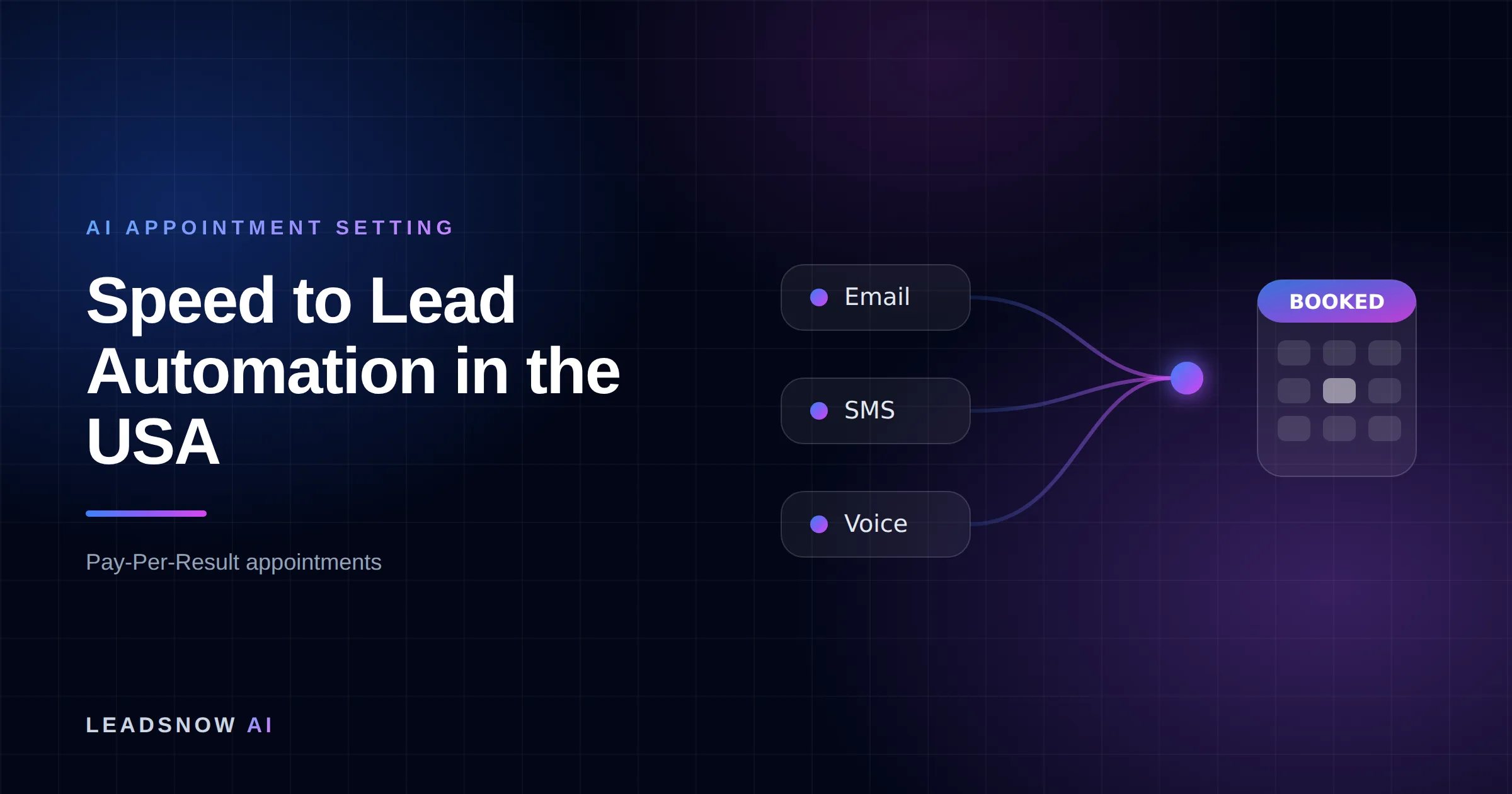
Speed to lead automation uses AI agents to engage, qualify, and book every inbound lead within 5 minutes, 24/7, including nights, weekends, and holidays. LeadsNow AI builds and runs the entire system for US businesses on a pay-per-result basis: you pay for booked, qualified appointments, not software seats. Track record: 50,769+ AI-booked sales appointments since 2017 and 1M+ leads generated.
- The guarantee: every inbound lead engaged inside the 5-minute window, day or night.
- The evidence: US-native research from MIT/InsideSales.com and Harvard Business Review (figures below).
- The model: pay-per-result, measured in booked appointments, priced in USD.
- The proof: 25 filmed client case studies and 4.7 / 60 Google and Facebook reviews.
- The team: headquartered in Melbourne, Australia, operating an always-on system for US clients across every time zone.
- Next step: Book a call.
How it works
How an AI sales agent books your appointments
Six channels feed in
Outbound email, SMS, voice and social – plus inbound search and AI referrals from our own AI SEO and chat agents.
Your list or CRM
Outbound starts from data you already own – past enquiries, dormant customers, or a targeted prospect list.
Qualified against your rules
Budget, timing and fit are checked before anything reaches your team, using criteria you set.
Booked into your calendar
Only qualified prospects reach the booking step, so your closers spend their time selling.
MAKE MORE SALES.
Pay-Per-Result pricing – We scale sales HARD aligned to your interests, better than anyone else.
The 5-minute rule is American research, and the numbers are stark
The speed-to-lead evidence base wasn’t produced by marketing agencies. It came out of two well-known American studies, and both are worth knowing cold.
The first is the 2007 Lead Response Management study (archived) by Dr. James Oldroyd of MIT’s Sloan School of Management, run in partnership with InsideSales.com. Analyzing thousands of leads and over one hundred thousand call attempts, it found that the odds of making contact with a web lead drop more than 10x within the first hour. The steepest cliff is right at the start: responding in 5 minutes versus 30 minutes made reps 100x more likely to reach the lead and 21x more likely to qualify them.
The second is the 2011 Harvard Business Review study “The Short Life of Online Sales Leads” (Oldroyd, McElheran, and Elkington). The researchers submitted test web leads to 2,241 US companies and timed the responses. Companies that reached out within an hour were nearly 7x more likely to qualify the lead than those that waited even sixty minutes longer. Yet the average response time among companies that replied at all was 42 hours, and 23% of companies never responded to their own inbound leads.
Read those two findings together and the conclusion is uncomfortable. The winning window is minutes. The typical American company operates in days. That gap is not a marketing problem; it’s an operations problem, and it’s exactly the kind of problem automation is good at.
Want this done for you? We book qualified sales appointments on a Pay-Per-Result basis – you only pay for calls that actually land in your calendar.
Response time vs. your odds: the benchmarks
| First response time | What the research shows | Source |
|---|---|---|
| Under 5 minutes | 100x more likely to reach the lead and 21x more likely to qualify them than at 30 minutes | MIT/InsideSales.com Lead Response Management study (Oldroyd, 2007) |
| Within 1 hour | Nearly 7x more likely to qualify the lead than firms responding an hour later | Harvard Business Review, “The Short Life of Online Sales Leads” (2011) |
| After 1 hour | Contact odds have already fallen more than 10x from the moment of inquiry | MIT/InsideSales.com Lead Response Management study (Oldroyd, 2007) |
| 42 hours | The average first response among US companies that responded at all | Harvard Business Review audit of 2,241 US companies (2011) |
| Never | 23% of audited US companies never responded to their inbound lead | Harvard Business Review audit of 2,241 US companies (2011) |
One caveat we’d rather state than bury: these multipliers describe contact and qualification odds in the original studies, not guaranteed revenue outcomes for your business. But the direction is unambiguous, replicated, and has held up for nearly two decades. Faster response wins more conversations, and more conversations win more deals.
Where the minutes actually go in a US business
Nobody decides to ignore leads. The delay is structural, and it looks a little different in every vertical we work with:
- Real estate: a realtor is mid-showing when a Zillow or website inquiry lands. By the time the showing ends, that buyer has messaged three other agents. Whoever texts back first usually gets the client. (If this is your world, see our page on lead generation for realtors in the USA.)
- Home services: an HVAC or roofing crew is on ladders all day. Form fills from three different ZIP codes stack up in an inbox until 6pm, when half of them have already booked the competitor who picked up.
- Mortgage and lending: a borrower rate-shopping at 9pm submits to four lenders at once. The loan officer who calls at 10am the next day is competing against one who responded at 9:03pm.
- Legal: someone searching for an attorney after an accident or a dispute is stressed and acting now. Intake that runs 9-to-5 misses the exact hours when people finally sit down to deal with it.
The pattern is the same everywhere: leads arrive on the customer’s schedule, and humans respond on the business’s schedule. Hiring more staff shrinks the gap but never closes it, because no team covers 2am, Sundays, and Thanksgiving at a cost that makes sense.
If we can’t make you money, we don’t deserve yours.
Pay-Per-Result pricing – performance-based alignment.
What LeadsNow AI sets up to win the window
We deploy an AI sales agent in front of your inbound lead flow. Not a canned autoresponder that fires “Thanks, we’ll be in touch!” and calls it a day, a conversational agent that does the first-touch job a great inside sales rep would do, in seconds instead of hours. (For the full anatomy, read what an AI sales agent is in 2026.)
Engage in seconds, around the clock
The moment a form, ad lead, or chat inquiry arrives, the agent opens a two-way conversation, typically by text and email. Midnight Eastern, 5am Pacific, Fourth of July: the response time doesn’t change, because the agent doesn’t have office hours.
Qualify with real questions
Fast and indiscriminate is just a faster way to waste your closers’ time. The agent works through the qualification criteria you’d give a new hire: budget range, timeline, location, decision authority, whatever defines a real prospect in your business. Unqualified inquiries get a polite, useful reply and stay out of your calendar.
Book directly into your calendar
Qualified leads get offered live appointment slots inside the same conversation, while their interest is at its peak. No handoffs, no “someone will call you,” no scheduling ping-pong across three days.
Chase the leads who don’t answer first touch
Most leads don’t respond to the first message even when it arrives instantly. The agent runs structured follow-up over the following days and weeks, persistent enough to recover leads a human pipeline would write off, measured enough not to burn your brand.
A note on TCPA and consent
US businesses are right to ask about the Telephone Consumer Protection Act before automating any outreach by text or phone. The short version: speed-to-lead automation as we run it is built around inbound, consent-based contact, responding to people who just submitted their own details through your form and asked to hear from you, with clear consent language and opt-outs in place. That is a very different posture from cold robocalling, which is what TCPA enforcement chiefly targets. We’re not attorneys and this isn’t legal advice; your own counsel should sign off on your forms and consent flow, and we work within whatever framework they set.
Pay-per-result, in plain terms
Most of the speed to lead software sold in the USA is exactly that: software. You license the platform, you build the flows, you write the scripts, and the subscription bills regardless of whether a single extra appointment lands. Agencies on retainers carry the same asymmetry, they get paid on effort, you get paid on outcomes, and only one of those is guaranteed.
LeadsNow AI runs the opposite structure. We build, run, and tune the entire system, and our fees are tied to results: booked, qualified appointments on your calendar. When the system produces nothing, it costs you accordingly. That’s not a marketing flourish; it’s the only pricing structure that forces us to care about the same number you care about.
It also explains why we won’t race to the bottom on volume. Loose qualification makes any vendor’s numbers look great and fills your calendar with no-shows. We’d rather book you fewer, better conversations, because our economics only work when your closed-deal ROI works. In most US verticals we serve, one additional closed deal per month, a listing, a funded loan, a signed service contract, covers the cost of the whole system many times over. That’s the anchor we ask you to measure against.
Proof, not promises
LeadsNow AI has been running AI-driven lead engagement since 2017. In that time our systems have booked 50,769+ sales appointments and generated over 1 million leads for clients. We’ve published 25 filmed client case studies, real operators on camera, not stock-photo testimonials, and hold a 4.7 rating across 60 Google and Facebook reviews.
Clients we’ve run lead generation and appointment setting for include Sam Tajvidi at 121 Brokers, Colliers, Marcus Wilkinson at Iron Body, Foundr, SheSells.online, and Lambda Academy. The playbook that booked those appointments, instant engagement, hard qualification, direct calendar booking, relentless follow-up, is the same one we deploy for US clients.
An Australian HQ, an American clock
Full transparency: LeadsNow AI is headquartered in Melbourne, Australia. We’re not going to pretend otherwise with a rented Delaware address. Here’s why it doesn’t matter for this service, and in one respect actually helps: the product is an always-on automated system, not a local office you visit. Your AI agents respond in American English, quote times in your lead’s time zone, and book into your calendar exactly the same whether the inquiry comes from Boston or Boise. And because our human team’s working day overlaps US evenings and nights, the hours when your leads are most active and your staff are least available are the hours we’re wide awake. Onboarding and strategy calls are scheduled in your US time zone.
If you’re evaluating the broader offering beyond response speed, our AI sales agents for US businesses page covers the full funnel.
Frequently asked questions
What is speed to lead automation?
Speed to lead automation is a system that responds to every new inbound lead within minutes, automatically. In LeadsNow AI’s version, an AI sales agent opens a real two-way conversation within the 5-minute window, qualifies the lead against your criteria, and books qualified prospects directly into your calendar, 24 hours a day.
Why is 5 minutes the benchmark?
Because that’s where the American research draws the line. The MIT/InsideSales.com Lead Response Management study found reps were 100x more likely to reach a lead and 21x more likely to qualify one when responding in 5 minutes versus 30. Harvard Business Review’s audit of 2,241 US companies found within-the-hour responders were nearly 7x more likely to qualify a lead, while the average company took 42 hours.
You’re based in Australia. Can you really serve US businesses?
Yes. The system is fully automated and runs 24/7 regardless of geography, in American English, on US time zones and US calendars. Our Melbourne team’s working hours overlap US evenings and overnights, precisely when unattended leads pile up. Strategy and onboarding calls are booked in your time zone, and pricing is in USD.
Is automated follow-up compliant with TCPA?
Our system responds to inbound leads who submitted their own contact details and asked to be contacted, which is a consent-based interaction, with opt-out honored on every message. That’s structurally different from unsolicited cold outreach. We’re not a law firm and don’t give legal advice; we recommend your counsel review your forms and consent language, and we operate within your compliance requirements.
Which US industries does this work best for?
Any business where inbound leads are perishable and one closed deal carries real value: real estate, mortgage and lending, home services (HVAC, roofing, solar, remodeling), legal intake, insurance, education, health and fitness, and B2B services. If your leads arrive around the clock and your team doesn’t, the fit is usually strong.
What does it cost?
We charge on results, booked, qualified appointments, rather than a flat software license or retainer. Exact economics depend on your industry, deal value, and lead volume, so we scope it on a call. The honest way to evaluate it is closed-deal ROI: what one extra closed deal per month is worth against what the appointments cost you.
How quickly can this be live?
Typically a matter of days, not months. We need your lead sources connected, your qualification criteria defined, and your calendar linked. Because we build and run everything, there’s no software for your team to learn. Book a call and we’ll map your current lead flow against the 5-minute window.
Your leads are already on the clock
Somewhere between the 42-hour average and the 23% of companies that never respond at all, there is an enormous amount of American revenue going to whoever answers first. Speed to lead automation makes “first” your default position, on every lead, at every hour, without adding headcount. And with pay-per-result pricing, the risk of proving it sits with us.
Book a call. We’ll look at your lead sources, your current response times, and show you exactly what a guaranteed 5-minute response would do to your calendar.
Pay-Per-Result appointments
See if we’re a fit
We book qualified sales appointments for you and you pay on results, not retainers. Our booking page asks a few quick questions so you find out in two minutes whether that model suits your business.
- 50,769+ appointments booked without cold calling.
- Pay-Per-Result pricing – you pay for booked, qualified calls.
- Pick your own time on our live calendar, no phone tag.