
Last updated: July 23, 2026
An AI sales agent is software that holds real sales conversations with your leads — responding the moment an enquiry arrives, asking qualifying questions, following up across channels like SMS and email, and booking sales-ready prospects straight into a calendar. Unlike a basic chatbot, it works a lead through the whole top of the funnel rather than answering one question and disappearing. It doesn’t close deals; it makes sure a human closer only ever talks to people worth their time.
The plain-English definition
Strip away the hype and an AI sales agent does one job: the repetitive, time-sensitive work between “a lead exists” and “a qualified prospect is sitting in a meeting with your closer.”
That job has four parts, and a genuine AI sales agent does all four:
- Instant lead response. When someone fills in a form, replies to an ad or messages your business, the agent answers in seconds — at 2am, on weekends, on public holidays. Speed matters because interest decays fast: research popularised by Harvard Business Review found that firms responding to a lead within an hour were far more likely to qualify it than those that waited longer.
- Qualification. It asks real questions — budget, timing, fit, authority — and filters out tyre-kickers before they ever reach your calendar.
- Multi-channel follow-up. Most leads don’t reply to the first message. The agent keeps following up politely over days or weeks, across SMS, email and chat, resurfacing prospects a busy human team would have written off.
- Appointment booking. Once a lead qualifies, the agent books them into a live calendar on the spot. No email tag, no “what time suits you?” threads that die after two replies.
If a tool only does one of those things — say, answering website questions — it’s not an AI sales agent. It’s a chatbot wearing the label.
How it works
How an AI sales agent books your appointments
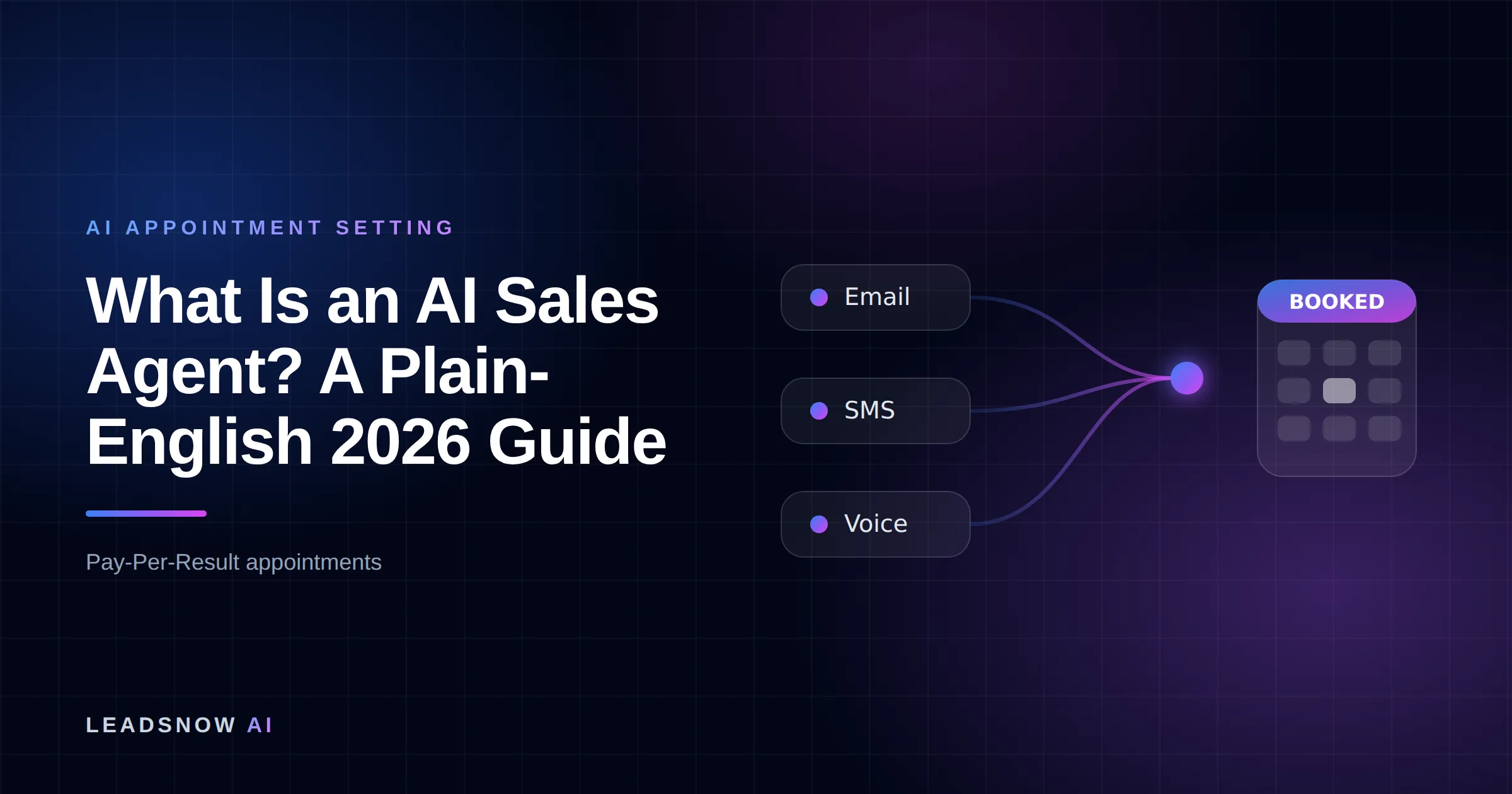
Six channels feed in
Outbound email, SMS, voice and social — plus inbound search and AI referrals from our own AI SEO and chat agents.
Your list or CRM
Outbound starts from data you already own — past enquiries, dormant customers, or a targeted prospect list.
Qualified against your rules
Budget, timing and fit are checked before anything reaches your team, using criteria you set.
Booked into your calendar
Only qualified prospects reach the booking step, so your closers spend their time selling.
MAKE MORE SALES.
Pay-Per-Result pricing — We scale sales HARD aligned to your interests, better than anyone else.
AI sales agent vs chatbot vs human SDR
These three get lumped together constantly, and they’re not the same thing. Here’s the honest side-by-side.
| AI sales agent | Website chatbot | Human SDR | |
|---|---|---|---|
| What it does | Engages, qualifies, follows up and books appointments — the full top of funnel | Answers common questions, deflects support tickets, maybe captures an email | Prospects, calls, qualifies and books — with human judgement |
| Channels | SMS, email, web chat, social messaging — wherever the lead is | Usually one widget on one website | Phone, email, LinkedIn — one conversation at a time |
| Availability | 24/7, every lead at once | 24/7, but shallow | Business hours, dozens of quality conversations a day |
| Best for | Speed-to-lead, qualification, follow-up discipline at volume | FAQ deflection and basic lead capture | Complex discovery, relationship selling, the close |
The chatbot distinction is the one most people miss. A chatbot is reactive — it waits on your website and answers what it’s asked. An AI sales agent is proactive: it initiates contact, chases non-responders, moves the conversation towards a booked meeting, and works across channels rather than living in a single widget.
The human SDR distinction runs the other way. A good SDR brings judgement, rapport and improvised discovery that no AI matches. What they can’t bring is being awake at 2am, replying to fifty leads simultaneously, or following up with machine-like consistency on lead ten thousand. If you want the full dimension-by-dimension breakdown, we’ve written it up honestly in AI sales agents vs human SDRs. The short version: AI wins the top of the funnel, humans win the close, and the best setups use both. For what that coverage does to revenue, see how to increase sales with AI agents.
Want this done for you? We book qualified sales appointments on a Pay-Per-Result basis — you only pay for calls that actually land in your calendar.
Is an AI sales agent the same as an “AI SDR tool”?
Not quite, and the difference matters when you’re shopping.
“AI SDR” software is usually built for outbound: it researches prospect lists, writes personalised cold emails and sends outreach at volume. You (or your team) still build the sequences, manage deliverability and handle the replies.
An AI sales agent, in the sense most businesses actually need, is conversation-first: it works the leads you already generate — ad enquiries, form fills, old database contacts — and its job is a two-way dialogue that ends in a booked appointment. Some platforms do both. But if your problem is “leads come in and go cold before anyone responds,” you’re looking for an AI sales agent, not a cold-email machine.
The three ways to pay for one
Whatever a vendor’s pricing page says, there are really only three commercial models. Deliberately, no dollar figures here — prices shift constantly and depend heavily on volume and industry. What matters is who does the work and who carries the risk.
| Model | How it works | Who carries the risk |
|---|---|---|
| DIY software | You subscribe to a platform and build, train and manage the agent yourself. Cheapest on paper; the real cost is your time and skill. | You — the subscription bills whether or not appointments land |
| Managed service (retainer) | An agency builds and runs the agent for a setup fee plus a recurring monthly fee, regardless of output. | You — the retainer is paid on activity, not results |
| Pay-per-result | A provider builds and runs everything and charges per outcome — typically per booked, qualified appointment. | The provider — no appointments, no fee |
None of these is universally “best.” DIY suits teams with technical skill and time to iterate. A retainer suits businesses that want a hands-off build and are comfortable paying for effort. Pay-per-result suits businesses that want the outcome without the build — and want the provider’s incentives tied to their calendar. LeadsNow AI operates on the third model; our AI sales agents in Australia page explains how that works in practice.
If we can’t make you money, we don’t deserve yours.
Pay-Per-Result pricing — performance-based alignment.
What an AI sales agent can’t do
Any definition that skips the limits is a sales pitch, so here are the honest ones:
- It won’t close complex deals. Negotiation, multi-stakeholder discovery and high-emotion decisions still belong to humans. The agent’s job ends when the meeting is booked.
- It can’t fix a broken offer. If your service doesn’t sell when a human pitches it, an AI agent will just get you to “no” faster. It amplifies a working sales motion; it doesn’t create one.
- It needs lead flow to work with. An agent with nothing to respond to books nothing. It’s a conversion multiplier on enquiries and databases, not a source of demand by itself (though some providers pair it with lead generation).
- It’s not “set and forget.” Qualification logic, messaging and follow-up cadence need ongoing tuning — someone has to notice when the agent is booking the wrong people and adjust. That someone is either you (DIY) or your provider.
- It will occasionally get a conversation wrong. Good implementations hand ambiguous or sensitive conversations to a human rather than bluffing. If a vendor claims theirs never misses, be sceptical.
Should your business use one?
A strong fit if: you generate enquiries you can’t respond to within minutes; leads regularly go cold in your inbox or CRM; your salespeople spend hours chasing non-responders; you have an old database of past enquiries nobody has touched; or your sales team’s calendar has gaps a steadier flow of qualified meetings would fill.
Probably not yet if: you get a handful of enquiries a month and already answer each one personally within minutes; your entire sales cycle is referral and relationship-driven with no top-of-funnel volume; or you haven’t yet proven that a human can sell your offer — fix that first.
Who’s actually using them
This isn’t theoretical. AI sales agents are running today across mortgage broking (Sam Tajvidi’s 121 Brokers), commercial real estate (Colliers), fitness (Marcus Wilkinson’s Iron Body), education and coaching (Foundr, SheSells.online, Lambda Academy) and plenty of industries in between. At LeadsNow we’ve booked 50,769+ AI-booked sales appointments since 2017 and generated 1M+ leads, documented across 25 filmed client case studies and a 4.7/5 rating from 60 Google and Facebook reviews. The pattern is the same in every industry: engage fast, qualify hard, book the meeting, hand it to a human.
If you want to see what that would look like on your own lead flow, the fastest way is a conversation. Book a call and we’ll walk through your numbers — no obligation, and we’ll tell you honestly if you’re not a fit yet.
Frequently asked questions
Is an AI sales agent the same as a chatbot?
No. A chatbot is reactive: it sits on a website and answers questions it’s asked. An AI sales agent is proactive: it initiates contact with leads, asks qualifying questions, follows up across SMS, email and chat over days or weeks, and books qualified prospects into a calendar. A chatbot handles FAQs; an AI sales agent works the whole top of the sales funnel.
Can an AI sales agent book appointments?
Yes — that’s the core output. Once a lead answers the qualifying questions and clears the bar, the agent offers live calendar slots and confirms the booking in the same conversation, then sends reminders to protect the show-rate. If it can’t book appointments, it isn’t an AI sales agent.
Do AI sales agents replace salespeople?
No. They replace the grind — instant responses at odd hours, repetitive qualification, endless follow-up — not the selling. That grind is worth automating: the Lead Response Management study (led by MIT’s Dr James Oldroyd) found the odds of qualifying a lead fall roughly 21-fold when response time stretches from five minutes to half an hour. Discovery, negotiation and closing still need humans. The practical effect is that your salespeople spend their time on qualified conversations instead of chasing cold leads.
What channels does an AI sales agent use?
Typically SMS, email and web chat, and often social messaging channels too. SMS tends to do the heavy lifting for speed-to-lead because people read texts quickly, with email supporting the longer follow-up tail. The best setups meet the lead on whichever channel they enquired through.
How much does an AI sales agent cost?
It depends on the model rather than a single price tag. DIY software charges a subscription and you do the work. Managed services charge setup plus a monthly retainer regardless of results. Pay-per-result providers charge per outcome, usually per booked qualified appointment, so the provider carries the risk. Compare models on who does the work and who pays when results don’t land, not on the sticker price.
How is an AI sales agent different from an AI SDR tool?
AI SDR tools are mostly built for outbound — researching prospects and sending cold outreach at volume, with your team managing sequences and replies. An AI sales agent is conversation-first: it works the leads you already have, holds two-way dialogues, and drives each one towards a booked appointment.
Does an AI sales agent work for small businesses in Australia?
Yes, provided there’s lead flow to work with. If enquiries regularly wait hours for a reply, or an old database of past leads is sitting untouched, an AI sales agent usually pays its way. If you receive only a handful of enquiries a month and already respond within minutes, you may not need one yet.
Comparing agencies? See Best AI Sales Agent Companies in Australia (2026) and Best AI Sales Agent Companies in the US (2026).
Pay-Per-Result appointments
See if we’re a fit
We book qualified sales appointments for you and you pay on results, not retainers. Our booking page asks a few quick questions so you find out in two minutes whether that model suits your business.
- 50,769+ appointments booked without cold calling.
- Pay-Per-Result pricing — you pay for booked, qualified calls.
- Pick your own time on our live calendar, no phone tag.