
Home services is the most honest market in America: when a homeowner’s AC dies in a Phoenix July or a pipe bursts in a Chicago January, they don’t shortlist vendors for a quarter – they call three or four contractors and hire whoever answers first and shows up. That means home services lead generation in the USA is really two problems wearing one coat: getting the lead at a sane cost, and getting to it before the other three companies the homeowner just contacted. Most HVAC, plumbing, roofing, electrical, solar, and pest control businesses solve neither – they buy shared leads from marketplaces and then respond hours later. This page covers how to fix both.
At a glance
Home services companies get more leads by combining their own demand capture – Google ads, LSAs, website forms, past-customer reactivation – with instant AI-powered response that answers, qualifies, and books every inquiry within seconds, 24/7. Exclusive, pay-per-appointment lead generation beats shared marketplace leads because you stop paying to compete against three rivals for the same homeowner.
- Who this is for: US HVAC, plumbing, roofing, electrical, solar, and pest control companies with real service capacity.
- The two levers: lead cost (what you pay to make the phone ring) and speed-to-lead (whether the ringing phone turns into a booked job).
- The trap: shared-lead marketplaces charge you per lead while sending the same homeowner to multiple competitors.
- Track record: 50,769+ AI-booked sales appointments since 2017 and 1M+ leads generated.
- Who runs it: LeadsNow AI – headquartered in Melbourne, Australia, serving US home services companies fully remotely, on your customers’ clocks.
- Next step: Book a call – you pick the slot, no phone tag.
How it works
How an AI sales agent books your appointments
Six channels feed in
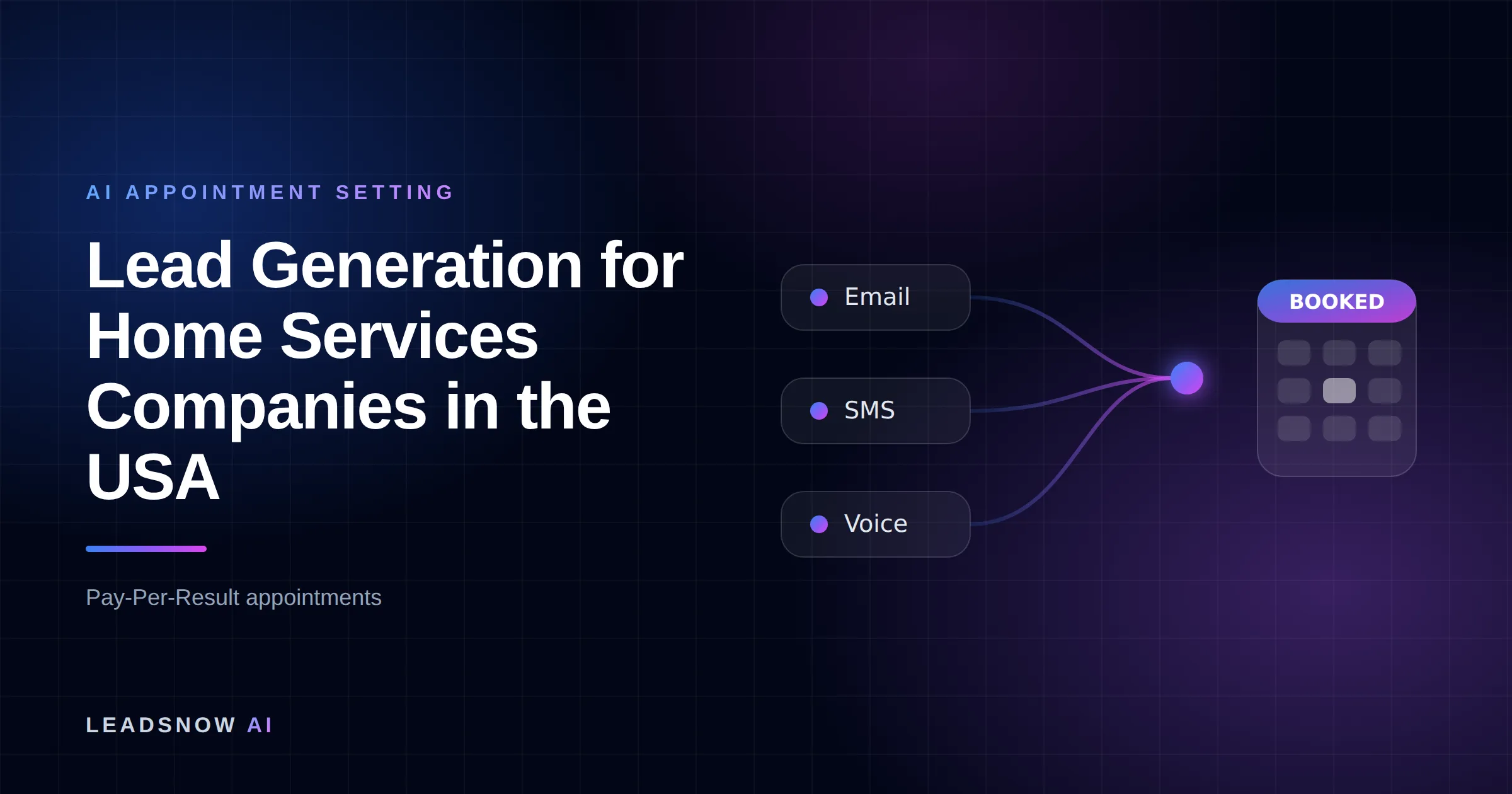
Outbound email, SMS, voice and social – plus inbound search and AI referrals from our own AI SEO and chat agents.
Your list or CRM
Outbound starts from data you already own – past enquiries, dormant customers, or a targeted prospect list.
Qualified against your rules
Budget, timing and fit are checked before anything reaches your team, using criteria you set.
Booked into your calendar
Only qualified prospects reach the booking step, so your closers spend their time selling.
MAKE MORE SALES.
Pay-Per-Result pricing – We scale sales HARD aligned to your interests, better than anyone else.
What a home services lead actually costs in 2026
Start with the market rate, because every decision downstream depends on it. WordStream’s 2026 Google Ads benchmarks put the average cost per lead in the Home & Home Improvement category at $90.92 – well above the $66.69 average across all industries – on an average cost per click of $8.33 and a conversion rate of 8.05%. In plain terms: home services is one of the more expensive corners of Google, because everyone from the two-truck plumber to the private-equity-backed HVAC roll-up is bidding on the same emergency keywords.
Two things follow from a $90 lead. First, waste is unaffordable. If your CSR misses the call or your follow-up starts tomorrow morning, you didn’t lose a lead – you lost ninety-plus dollars and handed the job to a competitor. Second, the number that matters is never the CPL sticker; it’s what a booked, completed job returns against what the pipeline cost. A $150 exclusive lead that becomes a $12,000 roof replacement beats a $40 shared lead that becomes a voicemail. We keep a running breakdown of what leads cost across US industries in our 2026 cost-per-lead benchmarks guide if you want to see how your category compares.
Want this done for you? We book qualified sales appointments on a Pay-Per-Result basis – you only pay for calls that actually land in your calendar.
Speed-to-lead: the variable that decides who gets the job
Homeowners with a broken furnace do not wait politely for a callback. They submit your form, then Google the next company, then the next. Whoever engages first sets the appointment; everyone else is calling a homeowner who already has a technician scheduled.
The research here is old and still routinely ignored. A Harvard Business Review audit of 2,241 US companies found that firms contacting a web lead within an hour were nearly 7 times more likely to qualify it than those that waited even an hour more – and over 60 times more likely than companies that took 24 hours or longer. The same audit found the average response time among companies that responded at all was 42 hours, and 23% never responded. Forty-two hours, in a market where the homeowner has a bucket under the sink.
This is where most home services lead generation quietly dies. The marketing worked. The lead arrived. And then it sat – behind a busy dispatch line, an after-hours voicemail, a Monday-morning backlog. An AI response layer closes that gap mechanically: the moment an inquiry lands from your website, a Google Local Services Ad, or a Facebook lead form, the system answers by text, email, or a natural-sounding voice call within seconds, asks the qualifying questions your best CSR would ask, and books the estimate or service window straight into your calendar – at 2pm and at 2am. We’ve written up exactly how that layer works in our guide to speed-to-lead automation for US businesses.
One compliance note, because it matters in the US: AI voice and SMS outreach falls under the TCPA, so this only works cleanly on consented, inbound-driven lead flow – people who filled out your form or asked for a quote – with opt-outs honored and Do-Not-Call hygiene built in. Fast and compliant beats fast and reckless, every time.
The shared-lead problem: what you’re really buying from marketplaces
Ask ten US contractors about lead generation and eight will mention Angi Leads (which absorbed HomeAdvisor), Thumbtack, or a similar marketplace. These platforms are a legitimate demand source and plenty of contractors make them work. But you should understand the model before you build a business on it – from the platforms’ own descriptions, not competitor spin.
Here’s how Angi Leads describes its own system in its pro-facing FAQ: the platform “connect[s] customers with multiple Angi Leads service professionals that can best complete their project,” and pros “pay a nominal fee for each lead you match to.” Read that carefully. The same homeowner is connected to multiple pros, and every one of those pros pays for the lead – whether or not they win the job, and whether or not the homeowner ever picks up. That’s not a scandal; it’s the business model. The marketplace monetizes one homeowner several times, and the contractors compete on – you guessed it – response speed.
The model has also drawn regulatory attention. In January 2023, the FTC ordered HomeAdvisor to pay up to $7.2 million over allegations it misrepresented lead quality – including claims that leads matched pros’ service types and geographic preferences when many didn’t, and unsubstantiated claims about how often leads turned into jobs. To be fair: that order addressed past marketing conduct, not the shared-lead structure itself, which remains legal and disclosed. But it’s a useful reminder to judge any lead vendor – marketplaces and agencies alike, us included – on verifiable delivery, not brochure math.
If we can’t make you money, we don’t deserve yours.
Pay-Per-Result pricing – performance-based alignment.
Shared marketplace leads vs. exclusive pay-per-appointment
The structural difference between the two models is worth seeing side by side, because it explains almost everything about how each one feels to run a business on.
| Shared-lead marketplace | Exclusive pay-per-appointment | |
|---|---|---|
| What you pay for | Contact info, charged per lead matched – win or lose | A booked, qualified appointment on your calendar |
| Competition on the lead | Same homeowner connected to multiple pros at once | Exclusive – the appointment is yours alone |
| Who carries the conversion risk | You: the fee is due whether the homeowner answers or not | The provider: no appointment, no fee |
| Speed pressure | Extreme – you’re racing every other pro who got the lead | Handled – instant AI response is part of the service |
| Qualification | Whatever the homeowner typed into the form | Enforced before booking: scope, location, timeline, fit |
| Brand ownership | Homeowner remembers the platform, not your company | Every touch is under your brand |
| Where it fits | Filling short-term capacity gaps | Building a predictable, owned pipeline |
Note what this table doesn’t say: it doesn’t say marketplaces never work. If you have empty trucks this week, a shared lead you chase hard is better than silence. The point is that shared leads are a spot market, and you can’t build a company on a spot market where you fund your competitors’ pipeline every time you buy.
What a complete home services lead system looks like
The businesses that win their metro run three plays at once, and none of them is optional.
1. Capture your own demand. Google Ads and Local Services Ads, a website that converts, Facebook lead forms for solar and roofing, review velocity on your Google Business Profile. This is where the WordStream numbers live – roughly $90 a lead at market rates – and it’s worth paying, because these leads are exclusively yours from the first click.
2. Answer everything instantly. Every form fill, missed call, and after-hours inquiry gets an AI response in seconds: qualification questions (service type, ZIP code, urgency, ownership of the property), then a booked slot on your dispatch calendar in the homeowner’s own time zone. The long tail matters as much as the first touch – most home services revenue hides in the leads that didn’t answer the first attempt, and the AI politely persists for weeks where a busy CSR quits after one voicemail.
3. Mine the database you already paid for. Your CRM holds years of past customers – people whose water heater you replaced in 2021, whose AC you serviced twice, who requested a quote and went quiet. Every one of them was acquired at full price, and most home services companies never contact them again. Reactivating that list for maintenance plans, seasonal tune-ups, and repeat work is routinely the cheapest pipeline a contractor owns; our database reactivation service exists for exactly this job.
LeadsNow AI runs plays two and three as a done-for-you system – the AI agents, the qualification scripts, the calendar integration, the follow-up sequences – and gets paid on booked, qualified appointments. Not clicks, not contact info, not a retainer that invoices whether your schedule filled or not.
Trade by trade: where the leverage is
The system is the same; the pressure points differ by trade.
- HVAC: demand spikes with the weather, and emergency calls arrive at night. After-hours response is the whole game – the 11pm no-heat call books with whoever answers at 11pm.
- Plumbing: the classic first-responder-wins trade. Burst pipes don’t comparison shop; they book the first live conversation.
- Roofing: long sales cycles, storm-driven surges, and high ticket sizes. Qualification matters most here – an unqualified “leads” pile wastes your estimators’ week, while weeks-long AI follow-up wins the homeowner who was “still getting quotes.”
- Electrical: a mix of urgent repairs and planned projects (panels, EV chargers). Instant response wins the urgent work; persistent nurture wins the planned work.
- Solar: the longest consideration cycle in home services and notoriously expensive leads. Speed still matters at the top, but disciplined qualification – homeownership, roof suitability, credit-relevant questions asked politely – is what keeps closers off dead-end appointments.
- Pest control: recurring-revenue economics mean one converted lead is worth years of service. That justifies aggressive response and makes database reactivation of lapsed customers unusually profitable.
Pay for appointments, not for promises
A word on how we price, without a rate card – because the structure matters more than any number. LeadsNow AI is paid on booked, qualified appointments delivered to your calendar. That single design choice aligns the incentives: a calendar full of no-shows and tire-kickers costs us, not just you, so the qualification bar stays high because our margin depends on it.
It also means we won’t win a race to the cheapest cost-per-appointment, and we’re not trying to. Rock-bottom pricing per booking almost always means the qualification filter got loosened to hit volume – and you pay the difference in your estimators’ wasted afternoons. We qualify tighter, which can make each booked appointment cost more, deliberately. Judge the model the way you’d judge a technician: on completed jobs and what they returned, not on the cheapest quote for the visit.
Proof, on the record
Numbers first: 50,769+ AI-booked sales appointments since 2017 and 1M+ leads generated. Behind the totals: 25 filmed client case studies – real operators on camera, not logo walls – and a 4.7 rating across 60 Google and Facebook reviews. Client work spans brokerages, fitness, education, and enterprise real estate, including Sam Tajvidi’s 121 Brokers, Marcus Wilkinson’s Iron Body, and teams at Colliers, Foundr, SheSells.online, and Lambda Academy – the same response-and-booking system, pointed at different industries’ lead flow.
And full disclosure on geography, because we’d rather you hear it from us: LeadsNow AI is headquartered in Melbourne, Australia, and serves US home services companies entirely remotely. In practice, that’s an advantage you’d otherwise have to staff for – the AI agents answer on your customers’ clocks in every US time zone, campaigns get managed while your office is dark, and appointments land directly in your US dispatch calendar. Homeowners don’t care where the software lives; they care that someone answered.
Frequently asked questions
How do home services companies get more leads?
Three ways, in order of leverage: capture your own demand (Google Ads, Local Services Ads, a converting website, reviews), respond to every inquiry within seconds so leads become booked jobs instead of a competitor’s customer, and reactivate your past-customer database for repeat and maintenance work. Buying shared marketplace leads can fill short-term gaps, but you’re paying to race other contractors for the same homeowner.
How much does a home services lead cost in the USA?
WordStream’s 2026 Google Ads benchmarks put the average cost per lead for Home & Home Improvement at $90.92, against a $66.69 average across all industries. Marketplace leads and exclusive appointments price differently – but the sticker matters less than the return: what a booked, completed job earns against what the pipeline cost.
Are Angi Leads or HomeAdvisor leads worth it?
They can fill capacity gaps, and many contractors use them. Just understand the model: Angi’s own pro FAQ says leads connect a customer with multiple pros, and each pro pays a fee per matched lead – win or lose. You’re buying a foot race, so if you use marketplace leads, instant response is non-negotiable. Exclusive pay-per-appointment models remove the race entirely.
Why does speed-to-lead matter so much in home services?
Because home services problems are urgent and homeowners contact several companies at once. Harvard Business Review’s audit of 2,241 companies found firms responding within an hour were nearly 7 times more likely to qualify a lead than slower responders – and the average company took 42 hours. In a hire-the-first-responder market, seconds are the moat.
Can an Australian company generate leads for a US contractor?
Yes. LeadsNow AI is Melbourne-headquartered and serves US clients fully remotely: the AI agents respond on US time zones around the clock, messaging is written in American English for American homeowners, outreach is TCPA-aware and consent-based, and appointments book straight into your US calendar. What matters is response time and US-market fluency, not the office’s ZIP code.
What counts as a “qualified appointment” for a home services company?
One that clears the bar you set before it ever hits your calendar: right service type, inside your service area, real timeline, property ownership or authority confirmed, and a slot your dispatch can actually serve. Leads that don’t clear the bar get nurtured, not booked – your estimators’ time is the most expensive asset in the funnel.
The next call your competitor answers was yours
Somewhere in your service area tonight, a homeowner will submit a form or leave a voicemail – and at roughly $90 a lead at market rates, silence is the most expensive response you can give. If you’d rather every inquiry got answered in seconds, qualified honestly, and booked into your calendar – and pay only when the appointment lands – book a call. We’ll look at your lead flow and your close rates together, and tell you plainly whether the model fits. If it doesn’t, we’ll say so on the first call.
Related: see Best lead generation companies for home service businesses in the USA (2026), Cost per booked appointment for US home service businesses.
Pay-Per-Result appointments
See if we’re a fit
We book qualified sales appointments for you and you pay on results, not retainers. Our booking page asks a few quick questions so you find out in two minutes whether that model suits your business.
- 50,769+ appointments booked without cold calling.
- Pay-Per-Result pricing – you pay for booked, qualified calls.
- Pick your own time on our live calendar, no phone tag.