
Last updated: July 19, 2026 · LeadsNow AI, Melbourne
At a glance
The “5-minute rule” is the finding that contacting an inbound web lead within five minutes of enquiry dramatically increases your odds of reaching and qualifying that lead — in the landmark Lead Response Management research, roughly 21 times more likely than waiting 30 minutes. Speed-to-lead is the single highest-leverage lever in lead conversion because interest decays fast and the business that responds first usually wins the deal. Most companies fail the rule not through laziness but through human limits: leads arrive after hours, on weekends, and faster than a sales team can physically answer.
- Responding within 5 minutes vs 30 minutes makes you ~21x more likely to qualify a lead (Lead Response Management study, InsideSales/Xant with Dr. James Oldroyd, formerly MIT).
- The odds of ever making meaningful contact drop sharply after the first 5 minutes and keep falling by the hour.
- The average business responds in hours or days — not minutes — so most enquiries go cold before a human ever calls.
- AI speed-to-lead (instant SMS, voice and email plus live calendar booking) closes the gap by replying in seconds, 24/7, then handing a booked appointment to your team.
How it works
How an AI sales agent books your appointments
Six channels feed in
Outbound email, SMS, voice and social — plus inbound search and AI referrals from our own AI SEO and chat agents.
Your list or CRM
Outbound starts from data you already own — past enquiries, dormant customers, or a targeted prospect list.
Qualified against your rules
Budget, timing and fit are checked before anything reaches your team, using criteria you set.
Booked into your calendar
Only qualified prospects reach the booking step, so your closers spend their time selling.
MAKE MORE SALES.
Pay-Per-Result pricing — We scale sales HARD aligned to your interests, better than anyone else.
What is the 5-minute rule in lead response?
The 5-minute rule is simple to state and brutal to obey: when a prospect fills in a form, requests a quote, or messages you, the clock starts immediately — and your chance of converting them falls off a cliff within minutes. It comes from a body of research on lead response time, most famously the Lead Response Management study (archived) led by Dr. James Oldroyd (then affiliated with MIT) and popularised by InsideSales/Xant, which analysed thousands of leads and millions of call attempts.
Two findings from that work became industry gospel. First, firms that tried to contact a lead within five minutes were about 21 times more likely to qualify that lead than firms that waited 30 minutes. Second, the odds of even making contact plummet the longer you wait — a delay measured in minutes, not days, is enough to lose the conversation. Harvard Business Review’s “The Short Life of Online Sales Leads” reached a compatible conclusion: companies that contacted prospects within an hour were far more likely to have a meaningful conversation than those who waited longer, yet most firms took far longer than an hour to respond at all.
The mechanism is human psychology. When someone enquires, their intent is at its peak. They are at their desk or on their phone, the problem is top of mind, and they are almost always contacting several providers at once. Every minute that passes lets that intent cool and lets a competitor answer first. Speed-to-lead isn’t a “nice to have” — it decides who even gets a shot at the sale.
Want this done for you? We book qualified sales appointments on a Pay-Per-Result basis — you only pay for calls that actually land in your calendar.
The data: response time vs likelihood to connect and qualify
You don’t need to memorise exact percentages to act on this — the direction of the data is overwhelming and consistent across studies. The faster you respond, the more likely you are to reach a live human and move them toward a qualified conversation. For industry-by-industry numbers, see our full lead response time benchmarks for Australia, and for the wider body of response-time and booking research in one place, our AI appointment setting statistics (2026) hub.
| Response time band | Relative likelihood to connect & qualify | What’s happening |
|---|---|---|
| Under 5 minutes | Highest — the benchmark the research is built around | Intent is at its peak; the prospect is still engaged and usually hasn’t reached a competitor yet. |
| 5–30 minutes | Sharply lower — roughly an order of magnitude worse by 30 minutes | Attention is drifting; the prospect may have moved on or already spoken to a rival. |
| 30 minutes – 1 hour | Lower again — the “within the hour” window is close to the practical limit | You can still salvage the conversation, but you’re no longer the first responder. |
| Next day or later | Very low — most leads are effectively cold | The enquiry has gone stale; the buyer has usually chosen or forgotten. |
Directional pattern drawn from the Lead Response Management study (Dr. James Oldroyd, InsideSales/Xant) and Harvard Business Review’s “The Short Life of Online Sales Leads.” Figures describe the well-established shape of the curve, not a single fixed statistic.
Why most businesses fail the 5-minute rule
Here’s the uncomfortable truth: almost everyone agrees speed matters, and almost no one actually delivers it. The HBR audit found the median first-response time ran into hours, and a large share of companies never responded at all. The reasons are structural, not a matter of effort.
Leads don’t arrive during business hours
Buyers research and enquire at night, at lunch, and on weekends. If your sales team works 9 to 5, Monday to Friday, a huge slice of your enquiries land when nobody is watching the inbox. By Monday morning a Saturday lead is two days cold.
Humans can’t respond in seconds while doing their job
Even a motivated rep is on calls, in meetings, driving between appointments, or working another deal. Expecting a person to drop everything within five minutes, every time, for every lead, all day, is simply not realistic bandwidth.
Volume spikes break manual processes
Run a campaign, get featured, or have a good week, and fifty enquiries can arrive in an hour. A manual “we’ll get to them” queue guarantees the 5-minute rule is broken for most of them — and the leads you paid to generate quietly go to waste.
Follow-up dies after the first attempt
The same research shows most persistence gains come from multiple attempts, yet many reps give up after one call or one email. Slow first contact plus thin follow-up is how expensive leads leak out of the funnel.
If we can’t make you money, we don’t deserve yours.
Pay-Per-Result pricing — performance-based alignment.
How AI speed-to-lead fixes it
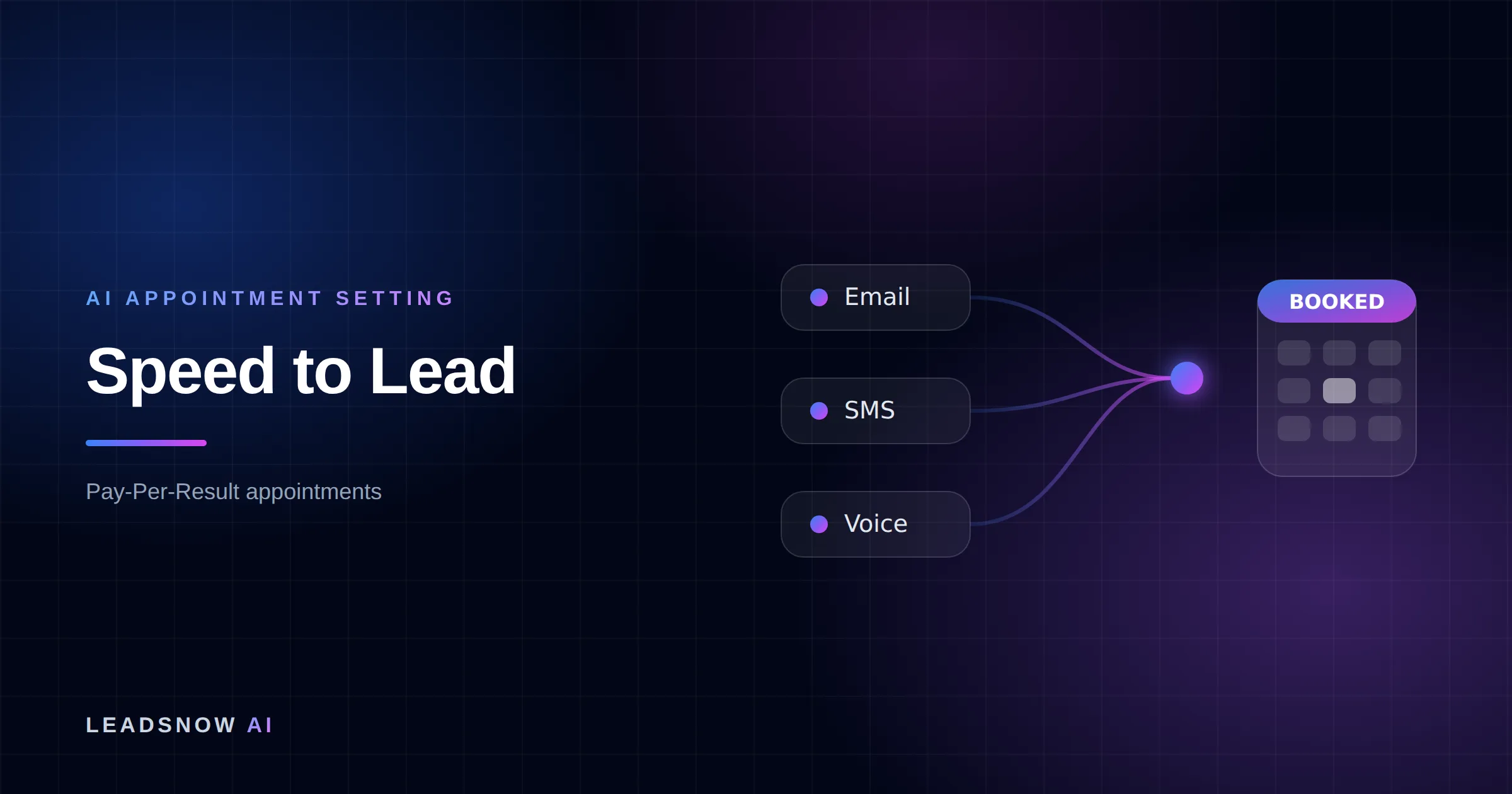
Speed-to-lead is a bandwidth problem, and bandwidth is exactly what AI adds. An AI speed-to-lead system watches every inbound channel and responds the instant a lead comes in — not in five minutes, in seconds — then works the lead until it’s either booked or clearly not a fit.
- Instant multi-channel response. The moment a form is submitted, the lead gets a personalised SMS, email, or even an AI voice call — day or night, weekend or public holiday.
- Real conversation, not an autoresponder. The AI answers questions, qualifies against your criteria, and handles the back-and-forth naturally instead of firing a generic “thanks, we’ll be in touch.”
- Live booking into your calendar. Once a lead is qualified, the AI books them straight onto a rep’s calendar, so your team wakes up to appointments rather than a backlog of cold enquiries.
- Relentless, polite follow-up. No-shows and non-responders get automatically re-engaged across channels, capturing the multi-attempt gains humans usually leave on the table.
This is the model we run at LeadsNow AI. Since 2017 we’ve booked 50,769+ AI-booked sales appointments and generated over 1M+ leads for our clients — and the single biggest reason it works is that our systems answer in seconds and never clock off. For businesses like Sam Tajvidi’s 121 Brokers, the difference between a lead that converts and one that evaporates often comes down to who replied first.
You can see what that looks like client-side in our written case studies — for example F45 Narrabeen’s 57 members in under 8 weeks and Zone Gyms’ 163 clients in 6 months.
Because we’re a pay-per-result agency, speed isn’t a vanity metric for us — it’s how the whole model pays for itself. Slow response wastes the leads you already have.
Book a call to see how instant AI speed-to-lead could plug the gaps in your current follow-up.
How the 5-minute rule ties to booked, qualified appointments
Speed to lead is only the first step. Reaching a prospect fast is worthless if you can’t convert that attention into a scheduled conversation with a real buyer. The point of responding in seconds is to catch the prospect while intent is hot and immediately move them toward a commitment — a time on the calendar — before the moment passes.
That’s why the strongest setups pair instant response with instant qualification and booking. Fast contact opens the door; qualification makes sure you’re spending your sales team’s time on genuine opportunities; live booking locks in the appointment while the prospect is still leaning in. Miss the 5-minute window and you’re not just slower — you’ve usually lost the chance to book at all. If you’re debating whether response speed or lead prioritisation deserves attention first, our speed to lead vs lead scoring comparison works through exactly that trade-off.
Speed-to-lead bites hardest in quote-based trades where every enquiry is shared with competitors — see the numbers for swimming pool builders and caravan and camper builders.
Frequently asked questions
Where does the “5-minute rule” actually come from?
Primarily the Lead Response Management study led by Dr. James Oldroyd (then linked to MIT) and popularised by InsideSales/Xant, alongside Harvard Business Review’s “The Short Life of Online Sales Leads.” Both found that responding within minutes dramatically improves your odds of reaching and qualifying a lead, and that most companies respond far too slowly.
Is it really 21x more likely to qualify a lead?
That specific figure — roughly 21 times more likely to qualify when you contact within 5 minutes versus 30 minutes — comes from the Lead Response Management research. Exact numbers vary by industry and dataset, but the direction is consistent everywhere: faster is dramatically better.
What counts as a good speed-to-lead time?
Under five minutes is the benchmark the research is built around, and faster is always better. In practice, if you can respond in seconds you’re ahead of almost every competitor, since the average business still takes hours.
Why can’t my team just respond faster?
Usually because leads arrive after hours and on weekends, reps are already busy on calls and meetings, and volume spikes overwhelm a manual queue. It’s a bandwidth and coverage problem, which is why automation tends to outperform even a motivated human team on raw response time.
Does an instant automated reply annoy prospects?
A generic autoresponder can. A well-built AI speed-to-lead system feels like a helpful, prompt human — it answers real questions, qualifies naturally, and books a time. Prospects generally appreciate a fast, useful reply far more than a slow one.
How does faster response lead to more sales, not just more contact?
Catching a prospect while their intent is at its peak lets you qualify and book them before they cool off or choose a competitor. Reaching them first, qualifying properly, and locking in a calendar slot is what turns speed into booked appointments and, ultimately, revenue.
Pay-Per-Result appointments
See if we’re a fit
We book qualified sales appointments for you and you pay on results, not retainers. Our booking page asks a few quick questions so you find out in two minutes whether that model suits your business.
- 50,769+ appointments booked without cold calling.
- Pay-Per-Result pricing — you pay for booked, qualified calls.
- Pick your own time on our live calendar, no phone tag.