
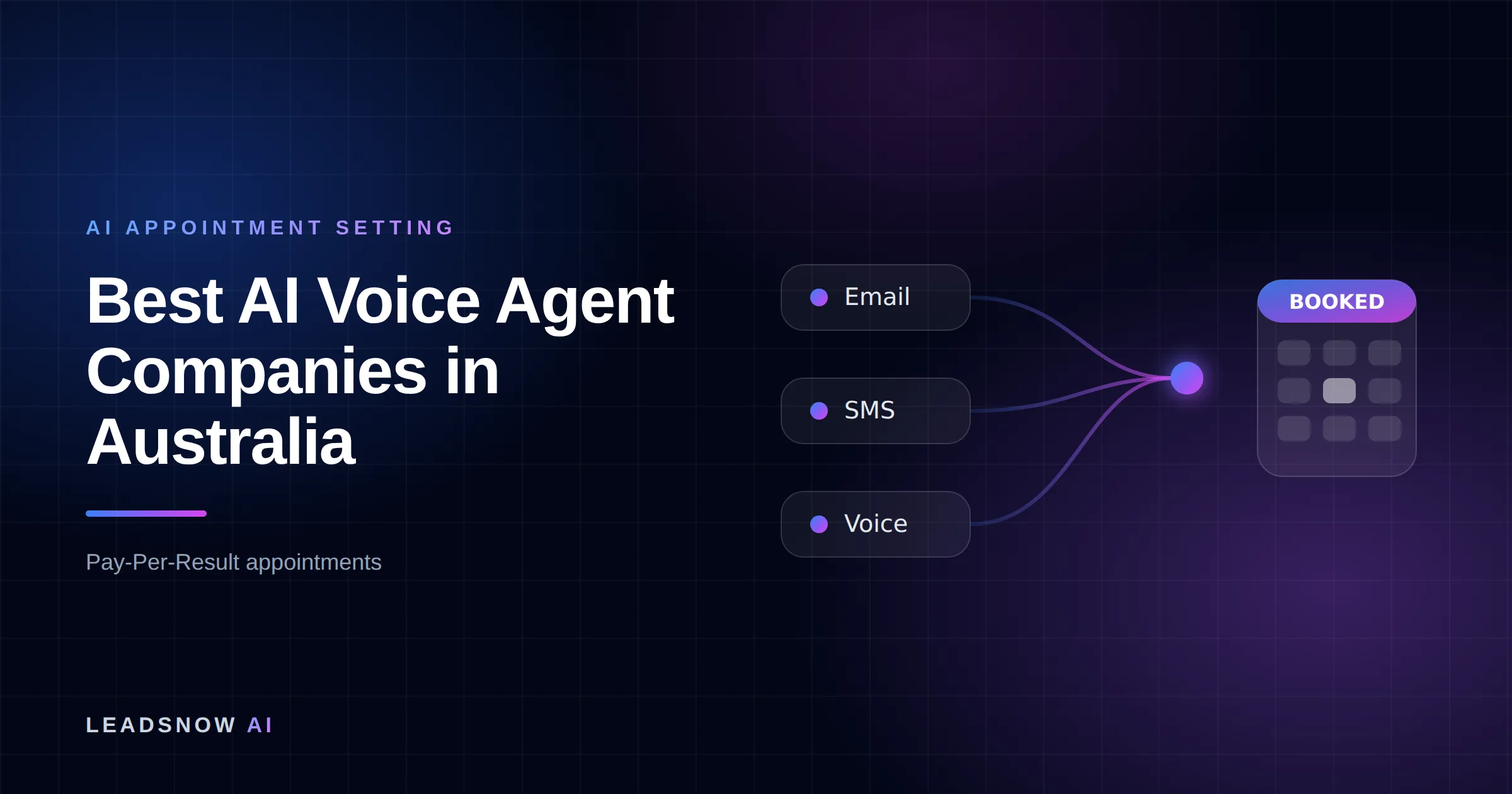
“AI voice agent” now covers two very different purchases. On one side are platforms – you (or your developer) build, script and run phone agents yourself, usually on per-minute pricing. On the other are agencies that operate the whole thing for you and are paid on what the calls produce. Both categories have matured fast, and Australia now has genuinely local options alongside the big global platforms – which matters for data residency, local accents and compliance with Australian calling rules.
This round-up covers both, because the right answer depends less on “whose AI sounds most human” and more on a blunter question: do you want to run a voice agent, or do you just want the results one produces? We’ve been upfront about where we sit in the list and who each option genuinely fits – including when that isn’t us.
At a glance
Q: What are the best AI voice agent companies in Australia in 2026?
The best AI voice agent companies in Australia in 2026 are LeadsNow AI, Curious Thing, Voxworks, Heya, Retell AI, Vapi, Synthflow and Bland. LeadsNow is the pick for outcome-based appointment setting; Curious Thing, Voxworks and Heya are strong Australian-built platforms; Retell, Vapi, Synthflow and Bland suit teams building and running their own voice agents.
How it works
How an AI sales agent books your appointments
Six channels feed in
Outbound email, SMS, voice and social – plus inbound search and AI referrals from our own AI SEO and chat agents.
Your list or CRM
Outbound starts from data you already own – past enquiries, dormant customers, or a targeted prospect list.
Qualified against your rules
Budget, timing and fit are checked before anything reaches your team, using criteria you set.
Booked into your calendar
Only qualified prospects reach the booking step, so your closers spend their time selling.
MAKE MORE SALES.
Pay-Per-Result pricing – We scale sales HARD aligned to your interests, better than anyone else.
Summary comparison
| Company | Model | Best for | AU presence |
|---|---|---|---|
| LeadsNow AI | Agency – pay-per-result appointment setting | Businesses that want booked, qualified appointments, not software to run | Australian (Melbourne HQ) |
| Curious Thing | Voice AI company – inbound & outbound phone agents | SMBs to enterprise wanting an established local voice AI provider | Australian (Sydney) |
| Voxworks | Platform – self-serve AI voice agents | Local service businesses wanting Australian voices and data residency | Australian owned & built |
| Heya | Managed AI workers (voice + coordination) | AU firms that want calls answered and the follow-up work done | Australian (Melbourne) |
| Retell AI | Platform – build your own voice agents | Teams that want a fast, well-documented agent builder | Global; works with AU numbers via SIP/Twilio |
| Vapi | Platform – developer / API-first | Engineering teams building custom voice infrastructure | Global platform |
| Synthflow | Platform – no-code, enterprise-leaning | Non-technical teams and larger operations wanting visual builds | Global platform |
| Bland | Platform – enterprise voice AI | Regulated, high-volume call operations | Global platform |
Want this done for you? We book qualified sales appointments on a Pay-Per-Result basis – you only pay for calls that actually land in your calendar.
How we chose (methodology)
Full disclosure: this list is published by LeadsNow, and we’ve ranked ourselves first. We think the reasoning below supports that, but weigh the bias and verify details with any provider directly – offerings and pricing change quickly in this category.
Every company here passed three checks before inclusion:
- Verified live offering – we confirmed each has a live website and a real, currently marketed AI voice agent or AI calling product (for sales or customer service), not vapourware or a waitlist page.
- Australian availability – either Australian-based, or a global platform that Australian businesses can genuinely use today.
- Distinct use-case fit – each entry earns its place by being the sensible pick for a specific type of buyer, so the list helps you choose, including away from us.
We have not invented ratings, review counts, client lists or pricing for anyone. Where we cite a competitor’s numbers, they come from that company’s own site or a linked public source.
1. LeadsNow AI – best for outcome-based appointment setting
LeadsNow is a Melbourne-headquartered agency, not a platform – and that’s the point of putting it first for a specific kind of buyer. Instead of selling you software to configure, script and monitor, LeadsNow runs AI voice agents for sales as a done-for-you service on a pay-per-result model: the AI (with humans holding the line on qualification) works your leads and cold outbound, and you pay when a qualified, exclusive appointment lands in your diary.
The track record is the argument: 50,769+ AI-booked sales appointments since 2017 and 1M+ leads generated, backed by 25 filmed client case studies and a 4.7-star rating across 60 Google and Facebook reviews, with clients including Sam Tajvidi’s 121 Brokers, Colliers, Marcus Wilkinson’s Iron Body, Foundr, SheSells.online and Lambda Academy.
Best for: Australian businesses that want the output of a voice agent – booked, qualified sales meetings – without building, prompting or babysitting one. The delivery risk sits with the agency, not you.
Consider if: you have engineering capacity and want full control over scripts, voices and call logic – in that case a platform below is the better buy. And if you’re weighing agents against hiring, our AI sales agents vs human SDRs comparison lays out the honest trade-offs.
Book a call – self-book a time and we’ll tell you straight whether pay-per-result fits your market.
If we can’t make you money, we don’t deserve yours.
Pay-Per-Result pricing – performance-based alignment.
2. Curious Thing – best established Australian voice AI company
Curious Thing is a Sydney-based voice AI company, founded in 2018, whose AI phone agents handle both inbound and outbound calls – missed-call answering, customer engagement, reminders and outreach. It’s one of Australia’s longest-running dedicated voice AI businesses, covered by TechCrunch back in 2022 and built on its own conversational AI technology, with work spanning SMBs through to enterprise and government-adjacent use cases in healthcare and financial services.
Best for: businesses that want a local, established voice AI provider with real deployment history rather than a newer self-serve tool.
Consider if: you want a purely self-serve, build-it-this-afternoon experience – the developer platforms further down are quicker to experiment with.
3. Voxworks – best for Australian voices and data residency
Voxworks is a 100% Australian-owned and built AI voice agent platform covering both sides of the phone: inbound reception, enquiries and appointment handling, plus outbound campaigns and automated workflows. Its pitch is deliberately local – Australian-accented voices, speech recognition tuned for Australian vernacular, Australian data residency, and industry focuses (real estate, trades, medical, dental, legal, financial services) that map to how local service businesses actually use the phone. Pricing is published openly on its site.
Best for: Australian SMBs and service businesses that want a voice agent that sounds local and keeps data onshore, without enterprise procurement.
Consider if: you need heavy custom integrations or developer-level control – an API-first platform like Vapi or Retell offers more headroom.
4. Heya – best when calls are only half the job
Heya is a Melbourne-built AI automation company whose “digital workers” answer calls and messages, then handle what comes next – bookings, confirmations, follow-ups, document chasing and system updates. Voice is one capability among several rather than the whole product, and the platform runs on Australian infrastructure with sovereign deployment options for regulated industries. Its site lists an AI Innovation win at the Australian Business Awards 2025.
Best for: property management, legal, insurance, trades and healthcare firms where the call is just the trigger for a chain of admin work you’d also like automated.
Consider if: you only need a phone agent – a dedicated voice platform will be simpler and likely cheaper to run.
5. Retell AI – best platform for getting an agent live fast
Retell AI is one of the most widely used platforms for building AI voice agents that handle phone calls end to end – inbound and outbound, appointment booking, lead qualification and support, with warm hand-off to humans. It pairs a drag-and-drop conversation flow builder with proper developer tooling, connects to Australian numbers via Twilio, Vonage or SIP trunking, and states HIPAA, SOC 2 Type II and GDPR compliance.
Best for: teams – technical or semi-technical – that want to stand up a working, production-grade voice agent quickly and iterate on it themselves.
Consider if: nobody on your team wants to own prompts, test calls and edge cases week to week; a platform agent is never “done”, and unowned agents drift.
6. Vapi – best for developers building custom voice infrastructure
Vapi is the developer’s pick: an API-first platform where you configure everything – voice, model, conversation flow, telephony, integrations – in code. Its own site reports 750K+ developers on the platform and a recent US$50M Series B, and the flexibility is real: if you can specify it, you can generally build it, from lead qualification to full support lines.
Best for: engineering teams and agencies building bespoke voice agents or products on top of voice AI.
Consider if: you don’t have developers. Vapi’s power assumes someone technical is driving; non-technical teams will be happier on Synthflow or Voxworks.
7. Synthflow – best no-code platform for larger teams
Synthflow targets the middle ground: enterprise-grade voice agents built through a visual Flow Designer rather than code, with pre-built industry templates, multilingual support and stated GDPR, HIPAA and SOC 2 compliance. It leans towards larger deployments – BPOs, healthcare, financial services, real estate – where non-technical operations teams need to own and adjust call flows without an engineering queue.
Best for: operations-led organisations that want visual control over sophisticated call flows, integrated with existing CRM and contact-centre systems.
Consider if: you’re a small business wanting one receptionist-style agent – the enterprise feature depth may be more than you need.
8. Bland – best for regulated, high-volume call operations
Bland builds enterprise voice AI on its own end-to-end infrastructure rather than stitched-together third-party services, which is its core pitch for reliability at scale. Its site cites hundreds of millions of calls processed, support for thousands of concurrent calls, and SOC 2 Type II, HIPAA, PCI DSS and GDPR compliance – aimed squarely at insurance, healthcare, financial services and logistics.
Best for: enterprises replacing IVRs or automating large inbound/outbound call volumes under compliance constraints.
Consider if: you’re mid-market or smaller – Bland’s proposition is built for enterprise scale, and lighter platforms will get you moving faster.
How to actually choose
Strip the category back and there are three buys. If you want meetings in the diary and nothing to operate, use an outcome-based agency – that’s LeadsNow’s lane, and the broader case for it is covered in our guide to AI sales agents in Australia. If you want a capable phone agent you control, pick a platform matched to your team: Voxworks or Synthflow for no-code, Retell or Vapi for developers, Bland for enterprise scale. And if the calls are just the start of a workflow, Heya’s coordination angle or Curious Thing’s managed deployments fit better. The most expensive mistake is buying a platform when nobody in the business will own it – that’s how voice agents end up switched off by month three.
Frequently asked questions
What’s the difference between an AI voice agent platform and an agency?
A platform sells you the tooling: you build the agent, write and test the scripts, connect the phone numbers and monitor the calls, usually paying per minute of usage. An agency operates the whole system for you and is accountable for an outcome – in LeadsNow’s case, qualified appointments on a pay-per-result basis. Platforms suit teams with someone to own the agent; agencies suit businesses that just want the result.
Do AI voice agents handle Australian accents?
Increasingly well, but it varies by provider. Australian-built options like Voxworks explicitly tune voices and speech recognition for Australian accents and vernacular, and global platforms typically offer Australian English voices among many. Whatever you evaluate, test with real local callers – regional accents, industry jargon and mobile-line audio quality are where weaker systems still slip.
Are AI voice agents legal for outbound calling in Australia?
Yes, but the same rules that govern human telemarketing apply. Outbound calling must respect the Do Not Call Register, and how you collect and handle personal information falls under the Privacy Act. Whoever runs your calls – you on a platform, or an agency on your behalf – should be able to explain exactly how they stay compliant. Treat vague answers as a red flag.
Can an AI voice agent replace a human SDR?
For volume tasks – first-touch outreach, lead qualification, follow-up, reactivating old databases – AI agents now do the work of several SDRs at a fraction of the cost, around the clock. For complex, high-stakes conversations, humans still win. The strongest results come from pairing the two: AI handles volume, humans handle judgement. We’ve written a detailed comparison in AI sales agents vs human SDRs.
How much do AI voice agents cost in Australia?
Platforms generally charge per minute of talk time plus a subscription tier, with costs scaling on call volume – several publish pricing openly, so check their sites for current numbers. Agencies price differently: retainers, per-call, or per-outcome. With a pay-per-result model like LeadsNow’s, the cost conversation starts from what a qualified appointment is worth in your market rather than a software line item.
Want the appointments without the platform?
If you’d rather skip the build entirely and pay for booked, qualified meetings, that’s the model we run – and if a platform is genuinely the better fit for you, we’ll say so. Book a call with the LeadsNow team – pick a time that suits and we’ll map it against your numbers.
Pay-Per-Result appointments
See if we’re a fit
We book qualified sales appointments for you and you pay on results, not retainers. Our booking page asks a few quick questions so you find out in two minutes whether that model suits your business.
- 50,769+ appointments booked without cold calling.
- Pay-Per-Result pricing – you pay for booked, qualified calls.
- Pick your own time on our live calendar, no phone tag.