
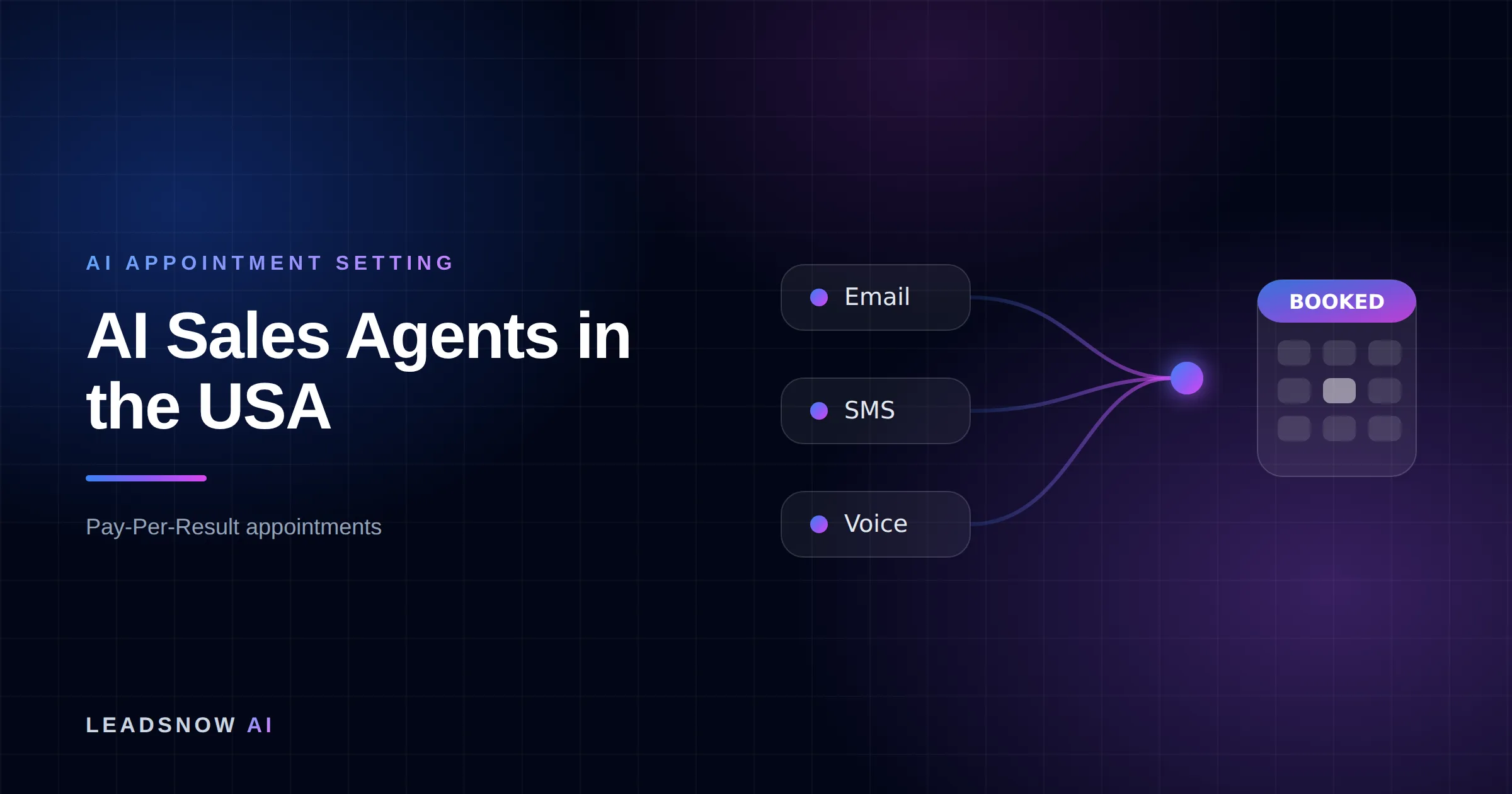
Every US sales team knows the math is broken somewhere. Marketing spends real money generating leads, and then those leads wait — behind a voicemail greeting, behind a rep’s lunch break, behind a Monday-morning backlog. Meanwhile the prospect who filled out your form at 9pm Eastern is filling out a competitor’s form at 9:04. An AI sales agent exists to close exactly that gap: it answers the moment a lead raises their hand, works the conversation across call, SMS, and email, and puts qualified prospects on your calendar while your competitors are still checking their CRM.
At a glance
AI sales agents are software reps that answer, qualify, and book your US leads by phone, SMS, and email within seconds — 24/7, across every time zone from New York to Los Angeles. LeadsNow AI builds and runs them on a pay-per-result model: you pay for booked, qualified appointments, not software seats or monthly retainers.
- Channels: AI voice calls, two-way SMS, and email, orchestrated as one conversation.
- Jobs it does: instant speed-to-lead response, qualification, appointment setting, and weeks of long-tail follow-up.
- Compliance posture: TCPA-aware by design — consent-based contact, honest AI disclosure, opt-outs honored.
- Track record: 50,769+ AI-booked sales appointments since 2017 and 1M+ leads generated.
- Who runs it: LeadsNow AI — headquartered in Melbourne, Australia, serving US clients fully remotely on US business hours.
- Next step: Book a call — you pick the slot, no phone tag.
How it works
How an AI sales agent books your appointments
Six channels feed in
Outbound email, SMS, voice and social — plus inbound search and AI referrals from our own AI SEO and chat agents.
Your list or CRM
Outbound starts from data you already own — past enquiries, dormant customers, or a targeted prospect list.
Qualified against your rules
Budget, timing and fit are checked before anything reaches your team, using criteria you set.
Booked into your calendar
Only qualified prospects reach the booking step, so your closers spend their time selling.
MAKE MORE SALES.
Pay-Per-Result pricing — We scale sales HARD aligned to your interests, better than anyone else.
Why speed-to-lead decides who wins US pipeline
The research on this is old, famous, and still ignored by most sales teams. The MIT/InsideSales.com Lead Response Management study (archived), led by Dr. James Oldroyd, found that reps who contact a new lead within 5 minutes are 21 times more likely to qualify it than reps who wait just 30 minutes — and 100 times more likely to actually reach the person at all. A separate Harvard Business Review audit of 2,241 US companies found that firms responding within an hour were nearly 7 times more likely to qualify the lead than those that waited longer.
Five minutes is the bar, and almost nobody clears it with humans. Your reps are in meetings, on other calls, or asleep when the West Coast lead comes in at 11pm your time. An AI sales agent clears the bar every single time, because it has no other calls, no lunch, and no ZIP code. The lead submits, the agent responds in seconds — by text, by email, or with a natural-sounding voice call — and the conversation starts while intent is at its peak. If you want the deeper mechanics, our explainer on what an AI sales agent is in 2026 breaks the whole system down.
Want this done for you? We book qualified sales appointments on a Pay-Per-Result basis — you only pay for calls that actually land in your calendar.
What the agent actually does, channel by channel
An AI sales agent is not one tool — it’s one conversation running across three channels, each with its own job and its own US compliance baseline.
| Channel | What the agent does | US consent baseline |
|---|---|---|
| AI voice calls | Calls new leads back in seconds, holds a real qualifying conversation, books the meeting live on the call | AI voices count as “artificial voice” under the TCPA per the FCC’s February 2024 ruling — calls to US cell phones require prior express consent, which is why we work consented inbound leads, not cold lists |
| Two-way SMS | Instant text response, back-and-forth qualification, calendar links, reminders that cut no-shows | Marketing texts require prior express written consent; every message carries a working opt-out |
| Long-tail nurture, follow-up sequences, re-engagement of leads that went quiet weeks ago | CAN-SPAM: truthful sender and subject lines, a physical address, and a functioning unsubscribe |
Across all three channels, the agent runs the same four plays:
Instant response. The second a lead comes in — from your website, a Facebook ad, a Google LSA, a landing page — the agent engages. Not “within business hours.” Seconds.
Qualification. Speed only pays off if the right people end up on your calendar. The agent asks the questions your best rep would ask: budget range, timeline, decision authority, fit for your offer. Leads that don’t clear the bar get nurtured; leads that do get booked.
Appointment setting. Qualified prospects go straight into your team’s live calendar, in the prospect’s own time zone. A realtor in Phoenix and an attorney in Boston see slots that make sense for their day, not ours.
Long-tail follow-up. Most revenue hides in the leads that didn’t answer the first touch. Humans quit after an attempt or two; the agent politely persists for weeks, and re-engages the “not right now” pile when the timing turns. Nobody falls through the cracks because nobody is doing the remembering by hand.
AI sales agents vs human SDRs: where each one wins
The honest answer is that this isn’t a cage match. AI agents and human SDRs are good at different layers of the funnel, and the teams getting the best results in the US run them together. Here’s the split as we see it after nine years of running these systems — and there’s a fuller breakdown in our AI sales agents vs human SDRs comparison.
| AI sales agent | Human SDR | |
|---|---|---|
| Response time | Seconds, every time | Minutes to days, depending on workload |
| Coverage | 24/7, all US time zones at once | One shift, one time zone |
| Follow-up persistence | Every lead, every sequence, for weeks | Fades after 1–2 attempts on most leads |
| Complex discovery and judgment | Handles structured qualification well | Wins on nuance, objections, multi-stakeholder deals |
| Cost structure | Scales with results, not headcount | Salary, benefits, tools, ramp time, turnover — before the first meeting is booked |
| Consistency | Same qualifying script at 2pm and 2am | Varies with mood, fatigue, and tenure |
The pattern that works: let the AI agent own speed, coverage, and persistence — the layer where being tired or busy loses deals — and let your humans own the conversations that need judgment. That’s exactly how we run it: the AI does the reach and the follow-up, and qualification standards are enforced before anything lands on your calendar, so your closers only ever talk to people worth their time.
If we can’t make you money, we don’t deserve yours.
Pay-Per-Result pricing — performance-based alignment.
The TCPA question, answered before you ask it
If you’re evaluating any AI calling or texting for the US market, this is the section to read twice. In February 2024 the FCC ruled that AI-generated voices — including cloned voices — are “artificial voices” under the Telephone Consumer Protection Act. In plain English: outbound AI voice calls to US cell phones require the called party’s prior express consent, and marketing robocalls and robotexts require prior express written consent. Statutory penalties run per violation, and plaintiff attorneys actively build cases on sloppy campaigns.
This is why our model is built on consented, inbound-driven lead flow: prospects who filled out your form, clicked your ad, or asked to be contacted — with consent language captured at the point of capture. Add Do-Not-Call scrubbing, honored opt-outs on every channel, and calling windows that respect the clock in the prospect’s state, and TCPA stops being a landmine and becomes a moat. Most of your competitors are either ignoring it (a lawsuit waiting to happen) or so scared of it they respond slowly (a pipeline leak). Doing it fast and compliant is the actual edge. Any vendor who waves this question away is telling you something important.
Pay for appointments, not for seats
Here’s how the US market typically buys this capability. Option one: license an AI SDR platform, pay per seat or per contact every month, and become your own systems integrator — prompts, calendars, CRM, compliance, all on you. Option two: hire an agency on a retainer that invoices on the first of the month whether your calendar filled up or not. Both models share one feature: the vendor gets paid either way, and you carry the performance risk.
LeadsNow AI inverts that. We build the agent, run the campaigns, enforce the qualification bar, and get paid on booked, qualified appointments. No appointments, no fee. That single design choice does more for quality than any feature list, because we lose money on bad meetings too — a calendar full of no-shows costs us, not just you.
One thing we won’t do is race to the cheapest cost-per-appointment. A rock-bottom price per meeting almost always means the qualification filter was loosened to hit volume, and you pay for it later in your closers’ wasted hours. We qualify tighter, which can make each booked appointment cost more — deliberately. The number that matters is what a closed deal returns against what the pipeline cost, and tight qualification is how that number stays healthy. If you’re comparison-shopping models and vendors, our guide to the best AI lead generation agencies in the USA for 2026 lays the whole landscape out, competitors included.
Who this works for in the US
AI sales agents earn their keep anywhere lead flow outruns human response capacity and an appointment is the natural next step. In the US that’s:
- Realtors and real estate teams — buyer and seller leads go stale in minutes; we built a dedicated program for lead generation for realtors in the USA.
- Mortgage brokers and loan officers — rate-shoppers book with whoever answers first.
- Attorneys and law firms — consult requests arrive around the clock and expect a same-hour reply.
- Home services and contractors — after-hours inquiries are half the opportunity.
- Coaches, consultants, agencies, and SaaS teams — anywhere a booked discovery call is the unit of pipeline.
If your leads don’t need a conversation — pure e-commerce, self-serve checkout — this isn’t your tool. We’ll tell you that on the first call rather than take the engagement.
Proof, on the record
Numbers first: 50,769+ AI-booked sales appointments since 2017 and 1M+ leads generated. Behind those totals sit 25 filmed client case studies — real operators on camera, not logo walls — and a 4.7 rating across 60 Google and Facebook reviews. Client work includes Sam Tajvidi’s 121 Brokers, Marcus Wilkinson’s Iron Body, and teams at Colliers, Foundr, SheSells.online, and Lambda Academy.
Full disclosure on geography, because it matters and we’d rather you hear it from us: LeadsNow AI is headquartered in Melbourne, Australia, and serves US clients entirely remotely. In practice that’s an advantage you’d have to engineer otherwise — the AI agents run on your buyers’ clocks across all US time zones, campaigns are managed while your team is offline, and appointments land directly in your US calendars. The system doesn’t care about street addresses; it cares about response time, and on that measure it doesn’t sleep.
Frequently asked questions
What is an AI sales agent?
An AI sales agent is software that engages new leads the moment they come in, qualifies them with real questions across call, SMS, and email, and books the sales-ready ones directly into your calendar. It owns the top-of-funnel grind — instant response, qualification, and weeks of follow-up — so your human closers spend their time closing.
Can an Australian company run AI sales agents for a US business?
Yes. The agents operate on US business hours and US time zones regardless of where the agency sits, and appointments book straight into your US calendars. LeadsNow AI is Melbourne-headquartered and serves US clients fully remotely — what matters is US-market fluency in messaging and compliance, not the office’s ZIP code.
Are AI sales calls legal in the US?
Yes, with consent. The FCC ruled in February 2024 that AI-generated voices are “artificial voices” under the TCPA, so outbound AI calls to US cell phones require prior express consent, and marketing robocalls and robotexts require prior express written consent. We work consented inbound leads, scrub against Do-Not-Call lists, and honor opt-outs on every channel.
Will an AI sales agent replace my SDRs or my sales team?
No — it replaces the parts of the job that burn SDRs out: answering in seconds, working nights and weekends, and following up for the fifth time. Humans stay where they win: nuanced discovery, objection handling, and closing. Most teams end up with fewer wasted hours, not fewer people worth keeping.
Why not just buy an AI SDR platform ourselves?
You can — but then you’re the one building prompts, wiring calendars and CRMs, managing TCPA compliance, and paying the subscription whether it books anything or not. Our model outsources both the work and the risk: we build and run everything, and we’re paid on booked, qualified appointments.
Isn’t a cheaper cost-per-appointment better?
Usually not. The cheapest appointments come from the loosest qualification, and you pay the difference in no-shows and dead-end meetings. We qualify tighter, which can raise the cost per booked appointment — and raises the share of meetings that turn into revenue. Judge the model on closed-deal ROI, not the sticker on a single meeting.
How do we start?
Book a call. We’ll review your lead flow, your consent capture, and your qualification criteria, then tell you plainly whether a pay-per-result AI sales agent fits your business — and if it doesn’t, we’ll say so.
The next lead that comes in decides this for you
Sometime in the next 24 hours, a lead will hit your pipeline and wait. The MIT/InsideSales research says the first five minutes decide whether that lead becomes a meeting. An AI sales agent makes the five-minute window automatic — compliant, qualified, and booked — and with LeadsNow you only pay when the appointment actually lands. Book a call and we’ll walk through your numbers together.
Pay-Per-Result appointments
See if we’re a fit
We book qualified sales appointments for you and you pay on results, not retainers. Our booking page asks a few quick questions so you find out in two minutes whether that model suits your business.
- 50,769+ appointments booked without cold calling.
- Pay-Per-Result pricing — you pay for booked, qualified calls.
- Pick your own time on our live calendar, no phone tag.