
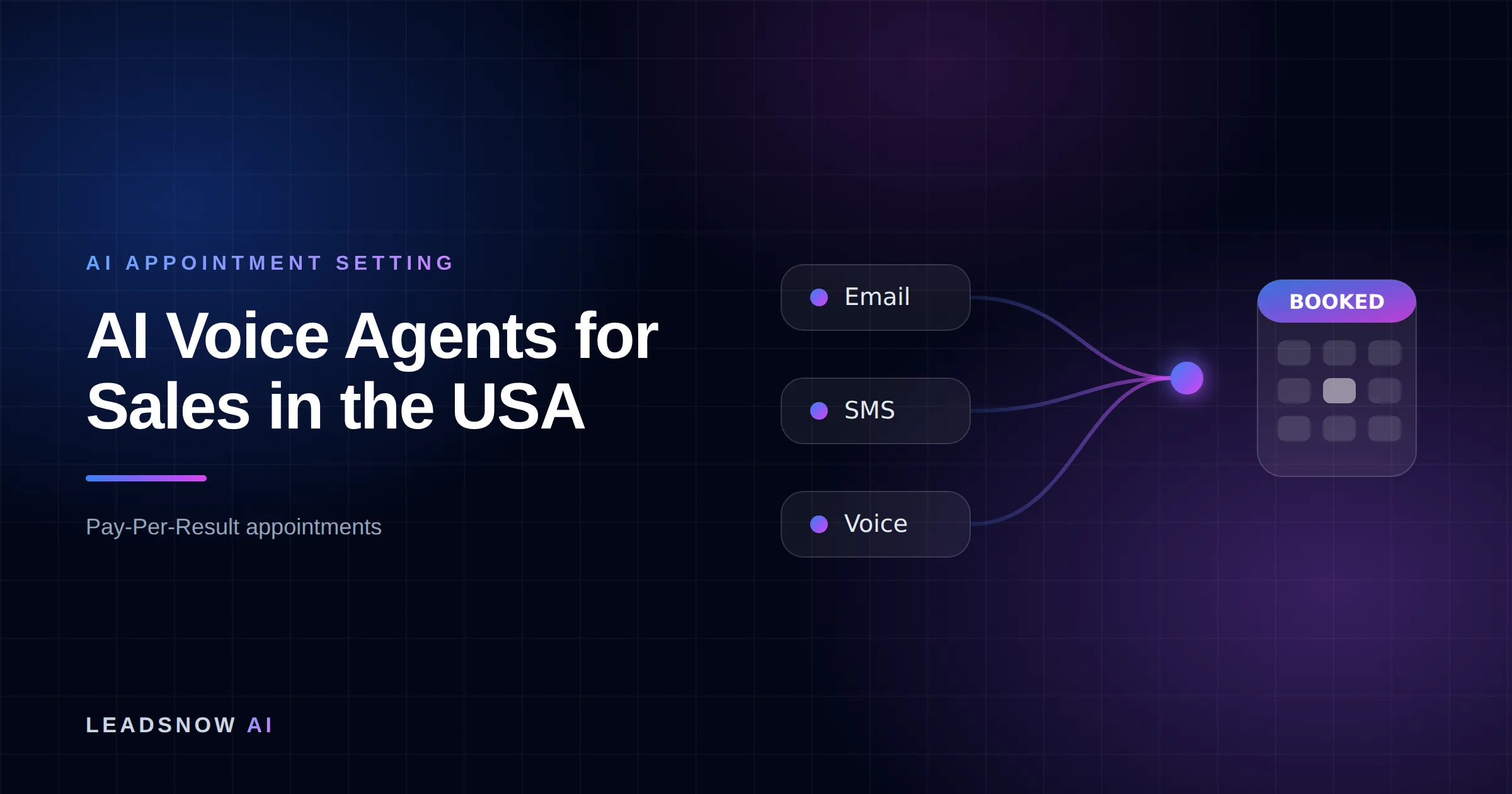
In the US, the phone is where two things happen at once: deals get started, and lawsuits get filed. An AI voice agent that calls a fresh lead back in seconds can transform your pipeline. The same agent, pointed at a purchased list with no consent trail, can generate statutory liability at $500 to $1,500 per call under the TCPA — per call, with no cap.
So this page does two jobs. First, it explains what an AI voice agent for sales actually does on American inbound and outbound calls — qualifying, booking, routing objections — and what should stay with your human closers. Second, it puts compliance where it belongs: front and center, before the sales pitch, because in the US market a calling program that ignores TCPA is not a growth strategy. It’s a countdown.
At a glance: LeadsNow AI builds and runs done-for-you AI voice agents for US sales teams — instant lead callback, inbound answering, qualification, objection routing, and appointment booking — on a strictly consent-based, TCPA-aware footing. You pay for results, not software: 50,769+ AI-booked sales appointments since 2017 and 1M+ leads generated.
Last updated: 29 July 2026
TCPA, consent, and Do Not Call: read this before you deploy any AI caller
Here is the current legal landscape for AI voice calling in the United States, in plain English. (One caveat up front: we’re a lead generation agency, not a law firm. This is general information, not legal advice — run your specific program past your own counsel.)
AI voices are “artificial” under the TCPA — the FCC settled that in 2024
In a declaratory ruling released February 8, 2024, the FCC confirmed that AI-generated voices — including cloned and fully synthetic voices — count as “artificial or prerecorded voice” under the Telephone Consumer Protection Act. The practical effect: an AI voice agent calling a cell phone needs the called party’s prior express consent, and if the call is marketing, it needs prior express written consent. There is no “but it sounds human” exception and no AI loophole. If your vendor tells you otherwise, get a new vendor.
The one-to-one consent rule was vacated — but consent did not go away
You may have heard that a big TCPA rule “got struck down” in 2025. True, but widely misunderstood. On January 24, 2025, the Eleventh Circuit in Insurance Marketing Coalition v. FCC vacated the FCC’s “one-to-one consent” rule — the rule that would have required lead-gen forms to name each individual seller a consumer was consenting to hear from. The court held the FCC had exceeded its authority under the statute, and in July 2025 the FCC issued an order formally removing the vacated requirement from its regulations and reinstating the prior consent rule text (FCC Order DA 25-621).
What that means: the consent standard reverted to what it was before — it did not disappear. Prior express written consent is still required for AI and prerecorded marketing calls to cell phones. Consent still has to be clear and voluntary. The lead-gen paperwork got simpler; the obligation to have real consent did not budge an inch.
The National DNC Registry and state “mini-TCPAs” still apply on top
Federal TCPA is the floor, not the ceiling. The National Do Not Call Registry still governs telemarketing to registered numbers. And a growing stack of state laws — Florida’s Telephone Solicitation Act, Oklahoma’s near-identical statute, Washington’s rules, Texas’s updated telemarketing law, among others — layer on their own consent, disclosure, calling-hour, and record-keeping requirements, several with private rights of action of their own. A national calling program has to clear all of it, not just the federal baseline.
How LeadsNow runs voice AI in the US: consent-based calling only
Our position is simple and non-negotiable: we only call people who have asked to hear from your business. In practice, most of our US voice work is instant callback of leads who just submitted a form on your site or ad — warm, expected, consent-documented calls. For any outbound program we require a documented consent trail, we scrub against the National DNC Registry and internal do-not-call lists, we honor opt-outs immediately, and we configure disclosures and calling windows to the states you operate in. No purchased cold lists. No “gray area” dialing. Ever.
We’ve written up the full framework — consent capture, records, disclosures, escalation — in our guide to TCPA compliance for AI voice and SMS agents.
How it works
How an AI sales agent books your appointments
Six channels feed in
Outbound email, SMS, voice and social — plus inbound search and AI referrals from our own AI SEO and chat agents.
Your list or CRM
Outbound starts from data you already own — past enquiries, dormant customers, or a targeted prospect list.
Qualified against your rules
Budget, timing and fit are checked before anything reaches your team, using criteria you set.
Booked into your calendar
Only qualified prospects reach the booking step, so your closers spend their time selling.
MAKE MORE SALES.
Pay-Per-Result pricing — We scale sales HARD aligned to your interests, better than anyone else.
Compliant vs. non-compliant AI calling: what the difference looks like
| Compliant program (how LeadsNow operates) | Non-compliant program (what to walk away from) | |
|---|---|---|
| Who gets called | Your own inbound leads and contacts with documented prior express (written) consent | Purchased or scraped lists; “opted in somewhere, probably” |
| Consent records | Timestamped, retrievable proof of consent for every number dialed | No consent trail; vendor “handles it” |
| DNC handling | Scrubbed against the National DNC Registry and internal suppression lists; opt-outs honored immediately | No scrubbing; opt-outs ignored or delayed |
| State law | Calling hours, disclosures, and consent configured per state (FL, OK, WA, TX, and more) | Federal-only thinking; state mini-TCPAs never considered |
| AI disclosure | Agent is honest about being AI; never built to impersonate a human | Voice clone pretending to be a person |
| Financial exposure | Managed and documented | $500–$1,500 per call in TCPA statutory damages, uncapped, plus state penalties |
The right column isn’t hypothetical — it’s the standard operating mode of the cheap-dialer end of this industry. Cost per appointment looks great right up until the demand letter arrives.
Want this done for you? We book qualified sales appointments on a Pay-Per-Result basis — you only pay for calls that actually land in your calendar.
What an AI voice agent does on US sales calls
With the guardrails established, here’s the upside — and it’s substantial. A Harvard Business Review study of 1.25 million sales leads found that companies attempting contact within an hour were nearly seven times as likely to qualify the lead as those that waited even sixty minutes — and most companies don’t come close. That gap is exactly where a voice agent earns its keep.
Inbound: every call answered, around the clock and across time zones
If you sell nationally, your phone rings from Miami to Seattle — a four-hour spread your front desk was never going to cover. The voice agent answers every inbound call in a couple of rings, 24/7, including the 8pm Pacific caller who rings while your East Coast office is asleep. It answers questions from your approved knowledge base, captures details, and moves qualified callers straight to a booking.
Outbound: speed-to-lead on your own consented leads
A prospect fills out your form. Within seconds — while they’re still on your site, before they’ve opened a competitor’s tab — the agent calls, references the exact thing they inquired about, and starts a real conversation. This is the compliant sweet spot of outbound AI calling in the US: responding to people who just asked you to contact them.
Qualification and objection routing
The agent runs your qualification criteria — budget, authority, timeline, fit — identically on every call, at call one hundred exactly as at call one. Routine objections (“just email me something,” “what’s this going to cost?”) get your approved responses. Signals that a call needs judgment — pricing negotiation, technical depth, frustration, or a plain “can I talk to a person?” — trigger a warm transfer or a flagged handoff to your team, context attached.
Booking, confirmed and reminded
Qualified prospects get offered live openings from your calendar in their own time zone, booked on the spot, confirmed instantly, and enrolled in reminder sequences so the meeting actually happens. No callback tag, no scheduling-link limbo.
What stays human
The AI does not close. It doesn’t negotiate contracts, untangle a complicated objection, or build the trust that gets a five-figure deal signed. Anyone promising an AI that “replaces your sales team” is selling you a demo, not a pipeline.
The honest division of labor: the voice agent owns speed, coverage, consistency, and scheduling — the mechanical work that burns out SDRs and slips through cracks. Your humans own persuasion and judgment, and they start each morning with a calendar of qualified, confirmed appointments instead of a call sheet. For a deeper look at where the line sits, see our explainer on what an AI sales agent actually is.
If we can’t make you money, we don’t deserve yours.
Pay-Per-Result pricing — performance-based alignment.
Done for you, paid on results — in USD, measured in closed deals
LeadsNow is a service, not a software subscription. We design the agent around your offer, write and test every script (you approve each word before the first call), integrate your calendar and CRM, build the compliance layer described above, and then run and tune the whole system. There’s no dashboard you’re left to figure out at 11pm.
Pricing is pay-per-result: you pay in US dollars for booked, qualified sales appointments — not per seat, per minute, or per month of “activity.” We’ll also tell you the uncomfortable part up front: because we qualify hard and call only consented leads, our cost per appointment is higher than a volume dialer’s. It should be. The metric that decides whether this works is revenue from closed deals against what you paid for the meetings that produced them — and tightly qualified, legally clean appointments win that math.
Proof: the numbers behind the claims
Since 2017, LeadsNow has delivered 50,769+ AI-booked sales appointments and 1M+ leads generated — a running count across our client base, not a projection.
- 25 filmed client case studies — clients on camera, walking through their own numbers.
- 4.7 / 60 Google and Facebook reviews.
- Clients include Sam Tajvidi of 121 Brokers, Colliers, Marcus Wilkinson of Iron Body, Foundr, SheSells.online, and Lambda Academy.
Ask on the call and we’ll point you to the case studies closest to your industry.
Who we are, and where we are
Full transparency: LeadsNow AI is headquartered in Melbourne, Australia, and we’ve been running AI-booked appointment programs since 2017 — first at home (our Australian AI voice agent service is where this started), now for US clients as well. The service is fully remote: agents are built for your market, your scripts, your time zones, and US-specific compliance, with everything delivered and managed online. Voice is also one channel of a wider system — our AI sales agents for US businesses work the same leads across SMS, email, and chat, typically with voice booking the meeting and messaging running confirmations and follow-up.
Frequently asked questions
Is it legal to use AI voice agents for sales calls in the US?
Yes — with consent. The FCC’s February 2024 declaratory ruling classifies AI-generated voices as “artificial” under the TCPA, so AI calls to cell phones require prior express consent, and AI marketing calls require prior express written consent. Calling your own inbound leads back, with consent captured at the form, is the clean use case — and it’s how we run nearly all US voice work. This is general information, not legal advice.
Didn’t a court throw out the TCPA consent rules in 2025?
No. On January 24, 2025, the Eleventh Circuit vacated one specific FCC rule — the “one-to-one consent” requirement for lead generators — in Insurance Marketing Coalition v. FCC, and the FCC formally rescinded it in July 2025. That reverted the consent standard to its prior form. Prior express written consent for AI marketing calls, the National DNC Registry, and state mini-TCPA laws all remain fully in force.
Will callers know they’re talking to AI?
Yes, whenever they ask — the agent always tells the truth — and we generally recommend disclosing upfront. We never build agents designed to pass as human; beyond being bad practice, impersonation is precisely what regulators are targeting.
How fast does the agent call a new lead?
Typically within seconds of the form submission. Given that responding within the first hour makes you roughly seven times more likely to qualify a lead (per the Harvard Business Review study above), those seconds are most of the ROI.
What happens when a call needs a real person?
The agent transfers or escalates — warm, with the full context of the conversation. Complex questions, negotiation, complaints, or a simple request for a human all route to your team; nothing important gets trapped inside the AI.
Do you work with businesses across all US states?
Yes. The service is remote and national, with the agent configured for your operating states — calling hours, disclosures, and the stricter requirements of mini-TCPA states like Florida, Oklahoma, Washington, and Texas. We’re upfront that our HQ is in Melbourne, Australia; delivery, integrations, and reporting are all online.
How does pay-per-result pricing work?
You pay in USD for booked, qualified sales appointments — not licenses, minutes, or retainers. Exact terms depend on your offer, market, and volume, which is what the first call establishes. Judge the program on closed-deal ROI, not cost per meeting.
Fast on the phone. Clean on the law.
You don’t have to choose between speed-to-lead and staying on the right side of the TCPA — but you do have to build for both on purpose. We’ve been doing exactly that since 2017, and we only get paid when appointments land on your calendar.
Pay-Per-Result appointments
See if we’re a fit
We book qualified sales appointments for you and you pay on results, not retainers. Our booking page asks a few quick questions so you find out in two minutes whether that model suits your business.
- 50,769+ appointments booked without cold calling.
- Pay-Per-Result pricing — you pay for booked, qualified calls.
- Pick your own time on our live calendar, no phone tag.