
Most lead generation advice is written for businesses selling something worth a few hundred dollars: get more leads, keep cost per lead down, let volume work. Good advice — and it stops working around a $5,000 average deal.
Above that line the arithmetic inverts. Leads stop being scarce and sales capacity becomes the scarce resource — every hour a closer spends on someone who was never going to buy is an hour that cannot be recovered. This is the umbrella version of the argument on our coaching, consulting, agency and trades pages. The vertical changes; the shape does not.
The short answer: Above roughly $5,000 in average deal value, lead generation for high-ticket services stops being a volume problem. Sales capacity becomes the constraint, so the levers that actually move revenue are qualification, speed-to-lead, follow-up depth and show-rate — roughly in that order. Cheap leads get more expensive as deal value rises, because what you are really spending is closer attention, not ad budget.
Why the $5k line is where the economics flip
The number is not magic and the currency barely matters — A$5,000 or US$5,000 puts you in the same place. Below the line, the sale is usually one short conversation or no conversation at all, so the marginal cost of a bad lead is close to zero. You can afford to be wrong most of the time. Above the line, the sale needs a real discovery call, often a second call, frequently a proposal, and almost always more than one person on the buyer’s side. The marginal cost of a bad lead is now a 45-minute call plus the preparation and the follow-up around it.
An illustrative example. A closer holds 25 sales conversations a week and closes 20% of qualified ones at a $12,000 average deal. Now dilute the calendar so only half the bookings are genuinely qualified. You have not halved the leads — you have halved the revenue, while paying the same salary, running the same ad spend and generating more meetings than before. Cost per lead falls, booking volume rises, closed revenue flatlines, and the metric that changed is not on the report.
How it works
How an AI sales agent books your appointments
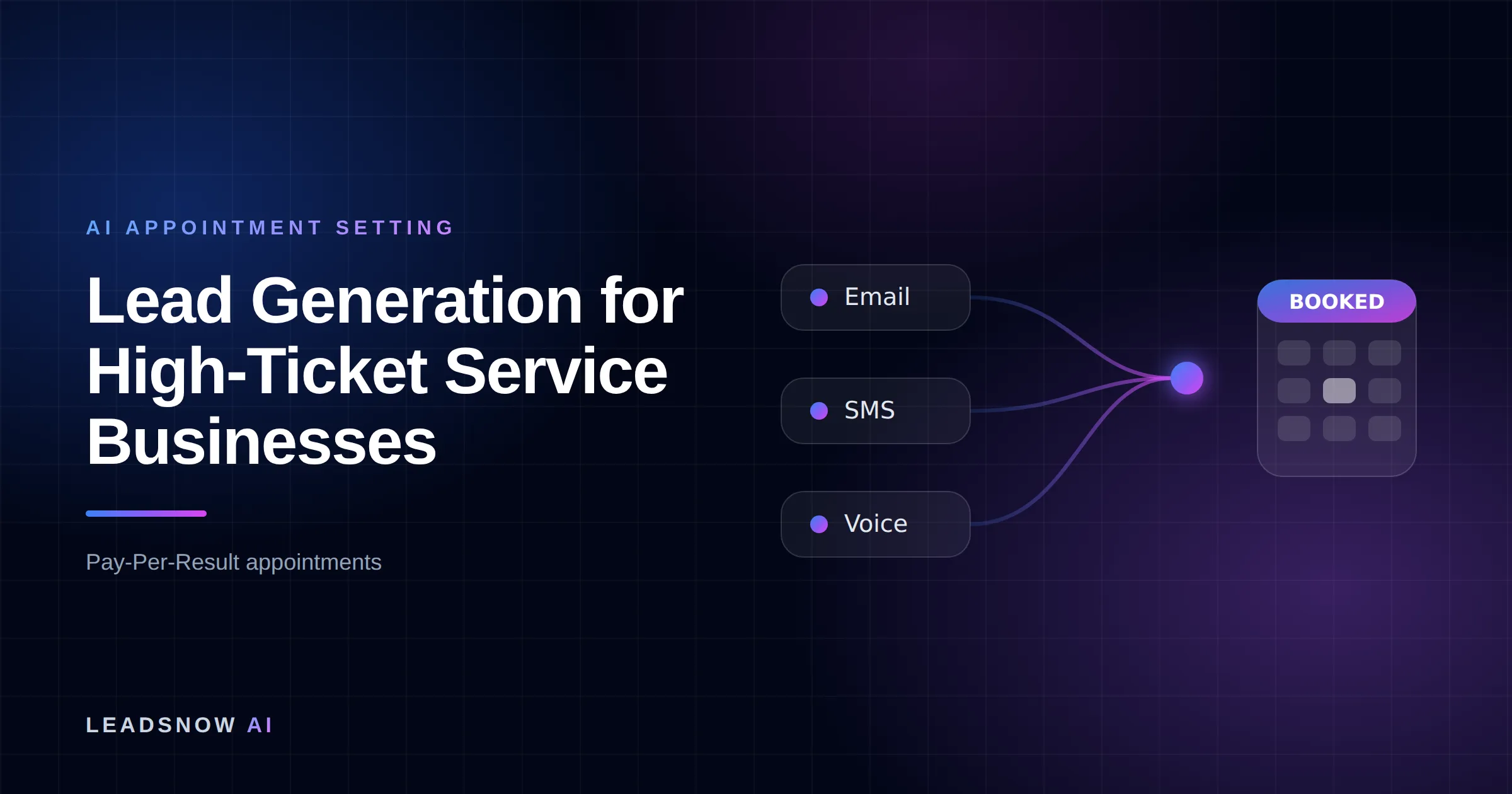
Six channels feed in
Outbound email, SMS, voice and social — plus inbound search and AI referrals from our own AI SEO and chat agents.
Your list or CRM
Outbound starts from data you already own — past enquiries, dormant customers, or a targeted prospect list.
Qualified against your rules
Budget, timing and fit are checked before anything reaches your team, using criteria you set.
Booked into your calendar
Only qualified prospects reach the booking step, so your closers spend their time selling.
MAKE MORE SALES.
Pay-Per-Result pricing — We scale sales HARD aligned to your interests, better than anyone else.
Cheap-lead channels actively damage a high-ticket business
Shared or resold leads, aggressive lead magnets and broad interest-based targeting all reliably produce contacts. They also produce a specific kind of contact: someone with a mild problem, no budget conversation behind them, and often three other vendors in their inbox. Three costs follow, none of which show up as media spend.
- Capacity dilution. Closers spend their best hours on people who cannot buy, and the good leads get the tired version of your pitch on a Friday afternoon.
- Standards drift. A sales team on a thin calendar starts working unqualified deals to look busy, which lengthens the pipeline, wrecks forecasting and quietly teaches everyone to discount.
- Brand contact quality. At high ticket, the first conversation is part of the product. Rushed, low-context calls with badly matched prospects do damage that a lower cost per lead never pays back.
When cheap leads are the right call: if you have genuine spare closing capacity, a low-friction entry offer, or you are deliberately buying market data, volume channels earn their place. The test is simple — is anyone’s calendar actually empty? If not, more leads is not the intervention.
Want this done for you? We book qualified sales appointments on a Pay-Per-Result basis — you only pay for calls that actually land in your calendar.
The qualification line, and what to disqualify on
Qualification at high ticket is not a scoring model. It is a short list of things that must be true before a call is worth an hour, and a shorter list of things that end the conversation politely. Four things worth confirming before booking:
- Deal-size fit. Can this buyer plausibly transact at your average? Interest is free; capacity is not.
- Access to the decision group. Larger purchases are not decided alone. Forrester’s Buyers’ Journey Survey of nearly 18,000 global business buyers found that on average 13 internal stakeholders and nine external participants influence buying decisions. If your one contact cannot bring anyone else, that is a pipeline problem you should know about on day one, not in week six.
- A live trigger. A hire, a growth target, a failed vendor, a deadline. No trigger usually means no timeline.
- Scope match. They want the thing you sell, not an adjacent thing you would have to invent.
Disqualify, cheerfully, on: no budget authority and no path to it; a timeline of “sometime next year” with nothing driving it; a problem your offer does not solve; a shopper collecting quotes with no intention of choosing. Disqualifying is not lost revenue — it is capacity returned to deals that can close.
Two cautions. Over-tight gating starves a small sales team, and a script that interrogates people kills more good deals than bad ones. The gate should be short, human and mostly invisible.
We run this on ourselves. The block at the bottom of this page is our own gate: a short set of questions covering current lead volume, current marketing spend, what an average customer is worth over their lifetime, and whether a performance-fee model is something you would accept at all. If the answers say the model will not pay for you, it hands over free resources instead of a calendar. We would rather lose the booking than sell an engagement the maths does not support.
Speed-to-lead and follow-up depth
Once qualification is right, the next two leaks are timing and persistence. Speed matters because attention is perishable. A buyer enquiring about a $30,000 engagement is, in that moment, at their most motivated and most contactable, and very often enquiring with two or three other providers in the same session. First substantive contact wins a disproportionate share of those. The practical target is minutes, not hours, and it has to hold at 7pm and on Saturday, which is where human-only teams break.
Persistence matters because high-ticket buyers are busy people who genuinely meant to reply. Most booked meetings we see come from the second, third or fourth touch, and the accounts that give up after two attempts are usually the ones convinced their leads are poor quality. The cadence should mix channels, be easy to stop, and have an explicit end — the line between persistence and harassment is whether you honour the first clear no.
If your database already contains people who enquired, got a proposal and went quiet, that is usually the cheapest pipeline in the business. In our Colliers-era database reactivation work, campaigns against dormant records booked appointments at a 4.4% average with an 8.9% peak — that is a reactivation figure specifically, on data the business had already written off, not a cold-outbound benchmark.
If we can’t make you money, we don’t deserve yours.
Pay-Per-Result pricing — performance-based alignment.
Show-rate is the leak nobody reports
Booked meetings are not the product; attended meetings are. A campaign that doubles bookings and halves show-ups has gone backwards, and will still look like a win in every report you receive.
What moves show-rate, in rough order: booking within days rather than weeks; a confirmation that requires a reply rather than one that just arrives; a reminder in the channel the person actually uses; and treating a no-show as a reschedule task rather than a lost lead. Most of the recoverable loss sits in the gap between booking and meeting, and most teams have nothing running in that gap at all.
Set the target honestly, too. A show-rate near 100% usually means you gated so hard you are only booking people who were already going to buy, which is a different problem wearing a good number.
Four ways to buy leads above $5k, compared
| Per-lead vendor | Retainer agency | In-house setter | Pay-on-booked-outcome | |
|---|---|---|---|---|
| What you buy | Contact records | Time and media management | A salary and a script | Attended, qualified meetings |
| Who carries the risk | You | You | You | Shared |
| Incentive points at | Lead volume | Retention and reporting | Activity targets | Bookings that hold |
| Handles speed and follow-up | No — yours to do | Sometimes | In business hours | Yes, continuously |
| Best when | Spare closing capacity, low deal value | You need brand and channel strategy, not just meetings | Complex technical sale needing product depth up front | Closers are the bottleneck, deal value is high |
| Main failure mode | Resold, stale contacts | Paid for effort regardless of outcome | Ramp time, churn, single point of failure | Tighter gating means fewer, costlier meetings |
The last column is our model, so read it sceptically. Paying on booked outcomes aligns well above $5k for one structural reason: the thing you are short of is qualified attended conversations, so paying for exactly that is cleaner than paying for hours. It fits badly when deal values are low, when a handful of meetings decides the month, or when what you need is brand and creative work. We have written the honest version of that trade-off in pay-per-result vs retainer, and the separate build-or-buy question — licence a setter tool or hire the outcome — in our AI appointment setter software vs done-for-you comparison.
The same shape, across very different industries
We have produced more than 50,769 AI-booked sales appointments since 2017 and generated over a million leads, across 25 filmed client case studies and a 4.7 rating from 60 Google and Facebook reviews. The industries look unrelated until you line up the deal values. Sam Tajvidi’s 121 Brokers sells finance broking, where a single client relationship is worth years of trail. Marcus Wilkinson’s Iron Body sells high-ticket coaching. Foundr, Lambda Academy and SheSells.online sell education and training programmes at prices that need a real conversation. Colliers sells commercial property services. Different buyers, different cycles, same constraint: a limited number of people who can hold the closing conversation, and a queue in front of them that is mostly noise unless something filters it. The newest variant we see is a franchisor selling a licence rather than a service: franchisee recruitment runs on exactly the same constraint, at a deal value well into six figures and with a disclosure period bolted on the end.
It is also why our vertical pages read like variations on one argument. The mechanics of high-ticket coaching client acquisition, of lead generation for consulting firms, of reviving dead quotes in a trade business and of lead generation for custom home builders differ in language and compliance detail. The economics are identical.
Frequently asked questions
What counts as a high-ticket service?
Any service where the average deal clears about $5,000 and the sale requires at least one scheduled conversation: coaching and consulting engagements, finance broking, agency retainers, education and training programmes, and most residential trades doing renovations, builds, pools or custom joinery. The test is whether a human has to spend an hour to make the sale.
Why is cost per lead the wrong metric above $5k?
Because it prices the wrong resource. At high ticket the constraint is qualified closer hours, so the metric that matters is cost per attended qualified meeting, and after that, cost per closed deal. A campaign can halve your cost per lead and increase your cost per closed deal at the same time, which is the most common way high-ticket businesses talk themselves into a channel that is quietly losing them money.
How many leads should we actually be disqualifying?
More than feels comfortable, and the number is not small even for well-run inbound. Chili Piper’s 2025 benchmark report — a vendor-reported analysis of nearly four million form submissions across its own mostly-B2B customer base during 2024 — found 14.1% of submissions were disqualified, and that 66.7% of the qualified ones went on to book a meeting. Those are inbound demo requests from people who deliberately filled in a form. Treat one in seven as a floor, not a ceiling, and expect a higher rate on outbound.
Does speed-to-lead really matter if the deal takes three months to close?
Yes, because speed decides whether you get into the process at all, not how fast it finishes. The buyer is comparing providers in a narrow window at the start; the long cycle happens after someone has been let in. Being first to a substantive conversation and slow-and-thorough afterwards is the correct combination.
Should we fix show-rate or book more meetings first?
Show-rate, almost always. Improving attendance is nearly free — confirmations, reminders, shorter booking windows, reschedule handling — while extra bookings cost media spend and setter time. Below about 70%, more bookings mostly produce more no-shows.
Is an in-house setter better than an outsourced one at this deal size?
Sometimes, and it is a fair choice. In-house wins when the sale is technically complex enough that the first conversation needs genuine product depth, or when your brand voice is a real asset in the opening call. It loses on coverage — one person cannot answer in five minutes on a Sunday — and on single-point-of-failure risk when they resign or go on leave.
How do we know if we are above the line?
Multiply your average deal value by your close rate on qualified calls. If the expected value of one qualified conversation is greater than the fully loaded cost of an hour of your closer’s time by a wide margin, you are above the line and should be optimising for qualification, not volume. If it is close, you are not, and cheaper leads are still the right answer. If you want a second opinion on the numbers, book a call and we will tell you which side you are on.
Pay-Per-Result appointments
See if we’re a fit
We book qualified sales appointments for you and you pay on results, not retainers. Our booking page asks a few quick questions so you find out in two minutes whether that model suits your business.
- 50,769+ appointments booked without cold calling.
- Pay-Per-Result pricing — you pay for booked, qualified calls.
- Pick your own time on our live calendar, no phone tag.