
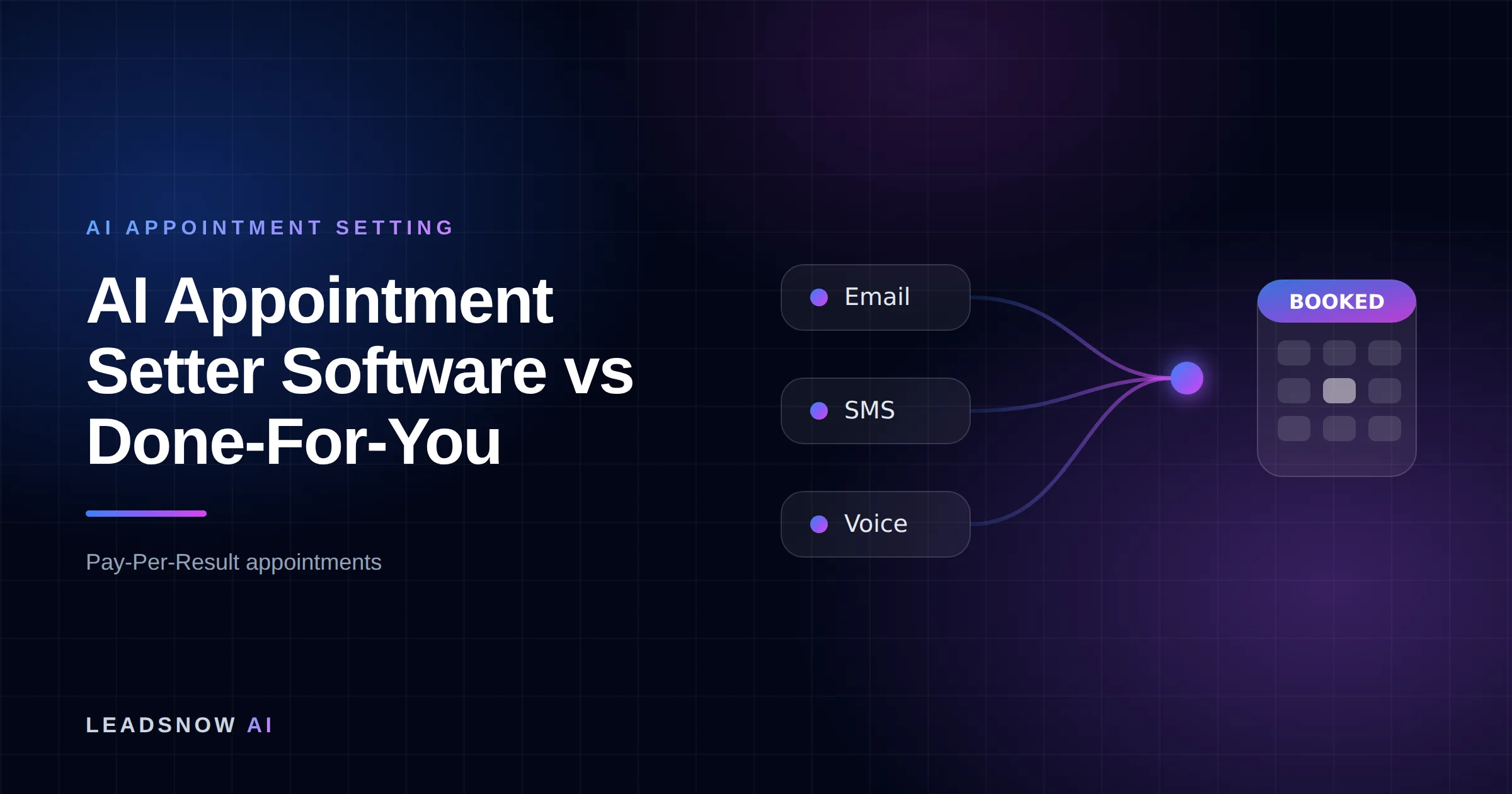
Every AI appointment setter demo looks the same. The agent dials, it talks, it handles an objection, it drops a meeting into a calendar. Twelve different products will show you that exact sequence this week, at wildly different prices, and you will walk away unable to explain why one costs a few hundred dollars a month and another is a managed engagement. This is the comparison we wish more buyers saw first — including buyers evaluating us.
The short answer: Self-serve AI setter software and a done-for-you setter service are not the same product at different price points. Nearly every tool on the market is a well-built interface on top of a foundation model that somebody else trains — which means it does not get better because you used it. What actually moves conversion is a learning layer that sees enough campaigns to spot patterns, and a skilled operator acting on what it finds. We run our own learning engine across more than 10,000 leads a day and 420,000 tracked data points, which is why we routinely take accounts from around 2% conversion to about 8%, and in some cases five times what their previous system produced.
Every tool passes the same feature checklist
Put a Toyota and a Ferrari side by side in a dark car park and run a checklist. Four wheels? Both. Steering wheel? Both. Engine, windscreen, seats, indicators? Both. On paper they are the same vehicle, and both will get you to the shops perfectly well. One of them also does 0–100km/h in about three seconds while the other takes ten. The checklist could not tell you that, because the checklist was never measuring the thing that separates them.
AI setter software is at exactly this stage. Ask any vendor whether their product does outbound calls, inbound qualification, SMS follow-up, calendar booking, CRM sync and objection handling, and every serious one says yes. The feature grid is table stakes across the whole category now. So buyers compare the only remaining visible variable — monthly cost — and reasonably conclude the cheap one is the same thing for less.
Two things the checklist never shows you: what is actually learning underneath, and who is driving.
How it works
How an AI sales agent books your appointments
Six channels feed in
Outbound email, SMS, voice and social — plus inbound search and AI referrals from our own AI SEO and chat agents.
Your list or CRM
Outbound starts from data you already own — past enquiries, dormant customers, or a targeted prospect list.
Qualified against your rules
Budget, timing and fit are checked before anything reaches your team, using criteria you set.
Booked into your calendar
Only qualified prospects reach the booking step, so your closers spend their time selling.
MAKE MORE SALES.
Pay-Per-Result pricing — We scale sales HARD aligned to your interests, better than anyone else.
The engine: almost nobody owns the thing they call “their AI”
This is the single biggest misunderstanding in the category, and it is worth being precise about.
Nearly every AI setter product is built on a foundation model from OpenAI, Anthropic or Google. Those companies spend enormous sums and employ enormous engineering teams to train those models, on their own schedule. A vendor calling their API cannot change the model’s weights, and neither can your call volume. The model handling your ten-thousandth conversation is byte-identical to the one that handled your first.
So when a tool says “our AI gets smarter with every call,” it is almost never describing model training. It usually means someone read a few transcripts and edited a prompt. That is a real activity and it has some value. It is not a learning system, and it will not compound.
We built the other thing. Underneath our campaigns sits our own machine-learning layer, run by actual data scientists and ML engineers rather than a prompt document, and it does something no single-account tool can do: it learns across accounts.
That capability has a specific origin. Years before any of this was called AI, we were running acquisition for a large number of gyms across many locations simultaneously. A single gym running its own campaign learns only from itself, and has to wait for enough volume before its data means anything at all. We were sitting across roughly a hundred of them. A pattern that would take one operator two quarters to see with confidence was visible to us in days, because the sample was a hundred times larger. Then we applied the correlation back across every account. That is how we beat agencies with better-known names and bigger teams — not by working harder on any one account, but by learning from all of them at once.
That engine now tracks around 420,000 data points, roughly double the largest published figure we have seen from anyone else in this space, across more than 10,000 leads a day flowing through the system. It reverse-engineers targeting and individual buyer bias, then matches each person against everything the model already knows about people like them — at that daily volume.
Every competing tool is siloed by design. Your data helps you and nobody else, and nobody else’s data helps you. That sounds like a privacy feature. In practice it means their system will never learn faster than your own account can teach it.
Want this done for you? We book qualified sales appointments on a Pay-Per-Result basis — you only pay for calls that actually land in your calendar.
What that difference is actually worth
All of this only matters if it shows up in the number that pays you. Smoke, mirrors and impressive-sounding AI are irrelevant next to one question: what is the conversion rate?
Typical result of moving an account onto our engine is going from roughly 2% to about 8%. Where a client had an existing system running, we have in some cases beaten it by five times. On a business turning over $100,000 a month, that difference is the gap between $100,000 and $500,000 — from the same list, the same offer, and largely the same conversations.
For context on scale: we have booked more than 50,769 AI-assisted sales appointments since 2017 and generated over a million leads. In our Colliers-era database reactivation work, campaigns against dormant records ran at a 4.4% average conversion with an 8.9% peak — on data most businesses had already written off entirely.
The three ways to actually buy this
| DIY tool | Tool + your own operator | Done-for-you | |
|---|---|---|---|
| What you buy | Software licence | Licence plus a salary | A booked-meeting outcome |
| What learns | Nothing — a fixed model plus your prompt edits | Your operator, from one account | A model across every account it runs |
| Who builds the list | You | Your operator | The provider |
| Who rewrites the script when it stalls | You, if you notice | Your operator | The provider, continuously |
| Who carries the risk if nothing books | You | You | Depends entirely on the contract |
| Best when | You have in-house capability and time | Volume justifies a dedicated hire | You want the outcome, not the project |
The middle column is where most buyers end up without planning for it. They buy the cheap tool, discover it needs an owner, and hand it to whoever has capacity — usually someone already doing another job.
If we can’t make you money, we don’t deserve yours.
Pay-Per-Result pricing — performance-based alignment.
The tools worth knowing about
This category is genuinely good and getting better, and if you are going self-serve these are the products that keep coming up. Grouped by what they actually are.
Builder platforms — you assemble the agent
Vapi and Bland AI are developer-first: low-latency voice infrastructure, deep control, an engineering task. Retell AI sits slightly higher up the stack. Synthflow is the no-code option for non-technical teams. ElevenLabs leads on voice quality and now offers agent infrastructure. Excellent if you have engineering capacity — they hand you a blank builder, not a campaign.
Packaged setters — the agent comes pre-assembled
Thoughtly handles qualification, booking and confirmation in one flow. Setter AI focuses on speed-to-lead over SMS and WhatsApp. 11x, AiSDR and Artisan package the whole AI SDR motion. Faster to launch, less control.
Full platforms — production infrastructure
Zian AI sits in this tier, handling the parts that don’t demo well: real-time voice latency, follow-up state, deliverability, handoff and CRM sync. Disclosure: Zian is a sister brand of ours. Its technical breakdown of whether AI sales agents actually learn is the clearest statement of the model-ownership problem we have seen anywhere.
Any of these can book meetings. None of them will build your list, decide your offer, notice that your booking rate fell 30% on Thursdays, or bring another hundred campaigns’ worth of pattern to your account.
Who is driving it
Put a two-year-old in a Ferrari and they will crash it into a wall. Put a Formula 1 driver in the same car and they set a lap record. Identical machine, completely different output, and no feature comparison would have predicted the gap.
This is the part buyers systematically underweight. The tool is the car. The result comes from the driver: who chooses the list, who writes the first script, who reads the failed calls, who spots that the offer is wrong rather than the agent, who tightens qualification when the calendar fills with people who should never have been booked.
And it is worth being blunt about who is usually in that seat. Most cheap AI setter deployments are steered by whoever was available — an offshore VA on a few hours a week, or a founder doing it at 11pm between other jobs. Not because those people lack ability, but because at that price point nobody has funded the role properly. We put data scientists and machine-learning engineers behind the wheel, which is a completely different lap time in the same car.
The uncomfortable economics of attention
Here is the part vendors don’t say out loud. The operating work does not shrink when the account is small. Building a clean list, writing and rewriting a script, listening to calls, adjusting follow-up cadence and reporting honestly takes a similar number of hours whether it produces ten meetings a month or two hundred.
There is also always more you could do. More testing, more segments, more script variants, more follow-up refinement — the work never runs out, and every additional hour has to be paid for out of the account’s margin.
Which gives a real threshold. Below roughly $30,000 a month in revenue, an account cannot fund serious dedicated attention — after cost of goods there simply isn’t enough left to pay for the hours, from us or anyone else. If that is where a business is, running a lean self-serve tool themselves is the genuinely correct answer, and we will say so on a call rather than take the money. Done-for-you starts making sense once volume is high enough that a percentage point of conversion is worth more than the labour it takes to find it.
Anyone who tells you their managed service is right for every business regardless of size is selling, not advising.
For SaaS platforms and agencies: the missing turbo
A note for the readers who are themselves selling AI setting. If you have built the interface, the telephony and the workflow but have no learning layer underneath — because building one requires data scientists and, more importantly, cross-account volume you do not have — that is the piece we can supply on the back end.
You keep the product and the customer relationship; the engine underneath is the turbo you are currently missing. If that is interesting, our agency and partner page is the place to start.
How to actually run an AI cold-calling campaign
If you are going DIY, this is the work. It is not hidden and it is not magic — it is just consistently more than people expect.
- Fix the offer first. No agent rescues an offer nobody wants. If your human callers can’t book with this pitch, an AI won’t either — it will just fail faster and at greater volume.
- Build a list you can defend. Source, consent basis and recency all matter, legally and practically. A dormant customer database almost always outperforms cold purchased data — our database reactivation walkthrough covers that motion specifically.
- Write the opener for a suspicious human. The first eight seconds decide the call. State who you are, why you are calling this specific person, and give them a fast exit. Agents that bury the reason for the call get hung up on.
- Decide what a qualified meeting is before you launch. Write the disqualifying criteria down. An AI setter is extremely good at filling a calendar with people who should never have been booked.
- Set the follow-up rules explicitly. Most booked meetings come from the second, third or fourth touch. Decide the cadence, the channel switch and the stop condition up front.
- Get the compliance basics right. In Australia that means the Do Not Call Register, the Telemarketing Standard’s calling hours and identification rules, and consent under the Spam Act for SMS. In the US it means TCPA consent and state rules, several of which now address AI-generated voice directly. Disclose that the caller is an AI.
- Listen to failed calls every week. Not the good ones. The failures tell you whether the problem is the list, the opener, the offer or the agent.
- Measure to the outcome that pays you. Connect rate and booking rate are diagnostics. Show-up rate and closed revenue are the score. A campaign that doubles bookings and halves show-ups has gone backwards.
So which should you choose?
Buy the tool and run it yourself if you have someone whose actual job includes owning this, you are comfortable writing and testing scripts, your compliance position is clear, and you would rather spend attention than money.
Buy done-for-you if the meetings matter more than the machinery, nobody internally owns campaign iteration, and your volume is high enough that small conversion gains are worth real money. That is the usual shape for high-ticket service businesses, where one closed job is worth thousands and every unworked enquiry is an expensive miss.
Be honest about the middle path. Buying a tool and hoping someone absorbs it is the most common failure mode in this category, and it produces the conclusion “we tried AI setting and it didn’t work.” Usually the software worked fine and nobody was driving.
Frequently asked questions
Are AI appointment setters actually worth it?
Yes, when the offer converts and someone owns the campaign. The technology reliably handles volume, speed-to-lead and follow-up persistence better than a human team. It does not fix a weak offer, a bad list or an absent operator, and it is very good at scaling those problems.
Is cheap AI setter software the same product as a managed service?
The interface is comparable. What differs is what sits underneath and who operates it. A licence gives you a fixed model plus your own prompt edits; it does not improve because you used it. If you supply the list, offer, script testing and weekly attention yourself, the cheap tool is genuinely good value.
Do AI sales agents really learn from my calls?
With almost every self-serve tool, no — the foundation model underneath is trained by OpenAI, Anthropic or Google and your conversations do not change it. Real learning requires a model layer the provider actually owns, and enough cross-account volume to make patterns visible. Ask any vendor to name the specific mechanism.
What conversion improvement is realistic?
Moving an account from roughly 2% to about 8% is a typical outcome for us, and we have beaten an existing system by five times where one was already running. Results depend on offer, list quality and deal size — but the lever is the learning layer and the operator, not the dialler.
Do I have to tell people they are talking to an AI?
Disclose. Regulation is tightening in both Australia and the US, several US states now address AI voice directly, and undisclosed AI calling is a reputational risk well before it is a legal one. Our TCPA guide covers the US position.
How quickly should I expect results?
Expect two to four weeks before the numbers mean anything, because the first weeks are spent finding out which parts of the assumption set were wrong. Anyone promising a full pipeline in week one is describing a demo, not a campaign.
Want a straight answer on which one fits you? Nine years, 50,769+ booked appointments and over a million leads means we can usually tell within one conversation whether you need our engine or a $200-a-month tool. If it’s the tool, we’ll say so. Book a call.
If you sell in Australia, our list of the best AI appointment setter agencies in Australia splits the market the same way: done-for-you agencies on one side, DIY tools on the other.
Pay-Per-Result appointments
See if we’re a fit
We book qualified sales appointments for you and you pay on results, not retainers. Our booking page asks a few quick questions so you find out in two minutes whether that model suits your business.
- 50,769+ appointments booked without cold calling.
- Pay-Per-Result pricing — you pay for booked, qualified calls.
- Pick your own time on our live calendar, no phone tag.