
Most Australian kitchen renovation companies feed their pipeline the same way: pay a directory subscription, buy lead credits, quote fast, and watch most of those quotes disappear into a drawer while the homeowner “thinks about it”. In 2026 that habit has a real price tag — hipages-style platforms run $200–$600 a month in subscription before you’ve bought a single lead, and the leads themselves cost $25–$80 each, with renovation categories at the premium end. This guide breaks down what kitchen renovation lead generation actually costs in Australia right now, why cost-per-lead is the wrong number for a $40,000 average job, and why the biggest asset most renovators own is the pile of kitchens they quoted but never closed. It’s written by LeadsNow AI, the Melbourne team behind 50,769+ AI-booked sales appointments since 2017 and 1M+ leads generated.
Kitchen renovation lead generation in Australia, at a glance (2026): Tradies on hipages typically pay a $200–$600 monthly subscription plus $25–$80 per lead, with a metro tradie in a competitive category often spending around $900 a month all-in, per 20 Minute Marketing’s 2026 hipages analysis. The same analysis puts the platform-average conversion at roughly 1 in 5 quotes becoming booked jobs. Meanwhile the job itself is a big-ticket sale: a mid-range kitchen renovation runs $25,000–$45,000 per What’s The Damage’s 2026 city-by-city guide. The alternative to buying enquiries is pay-per-result appointment setting: you pay only when a qualified homeowner is booked into your calendar — plus reactivating the quotes you’ve already paid to generate.
What kitchen renovation leads cost in Australia in 2026
There’s no liquid market publishing kitchen-specific lead prices the way there is for solar, so the honest starting point is what the dominant platform actually charges tradies. Per 20 Minute Marketing’s 2026 breakdown of hipages:
- Subscription: $200–$600 per month before any leads are purchased.
- Per-lead credits: $25–$80 per lead for most categories, with premium categories (the guide names large bathroom renos, full house rewires and major commercial work) running higher — kitchen renovations sit in the same big-ticket renovation territory, at the top of that band rather than the bottom.
- All-in spend: a metro tradie in a competitive category often spends around $900 a month combined.
- Conversion: the platform average is roughly 1 in 5 quotes turning into booked jobs; strong operators hit 1 in 3, weaker ones 1 in 8 or worse.
Run the arithmetic and the guide’s own worked example lands where you’d expect: at a 20% quote-to-job rate the real cost per booked job comes out around $300, dropping to roughly $182 at 33%. That’s before you price your estimator’s time measuring up and preparing detailed kitchen quotes that never convert.
Cost per lead is the wrong number for a $40,000 sale
Kitchens are one of the most expensive rooms in the house to renovate. What’s The Damage’s 2026 pricing guide — cross-referenced against 90+ Australian trade pricing sources — puts a budget kitchen renovation at $12,000–$25,000, mid-range at $25,000–$45,000, premium at $45,000–$80,000 and luxury builds at $80,000–$150,000, with most households spending $35,000–$45,000 on a full mid-range remodel. HIA research cited by Kitchen Shack’s 2026 cost guide puts the average 2026 kitchen renovation, including installation, at $42,630.
Against a job worth $25,000–$45,000, a $60 lead is a rounding error and a $300 cost per booked job is cheap. The number that actually hurts is different: every quoted kitchen that doesn’t close is $25,000–$45,000 of revenue you did the site visit, the measure-up and the quote for — and then let walk away without a structured follow-up. That’s the number this page is really about.
Honesty box — what we could not verify at source: it’s commonly said in the trade that hipages leads are shared with up to three tradies, and that kitchen renovators specifically close somewhere between 1-in-3 and 1-in-5 of quotes. We could not verify either figure at a primary source this session, so treat both as unverified industry folklore. The verified platform-wide figures above (1-in-5 average quote-to-job, 1-in-3 for strong operators) are the numbers we’re comfortable standing behind.
How it works
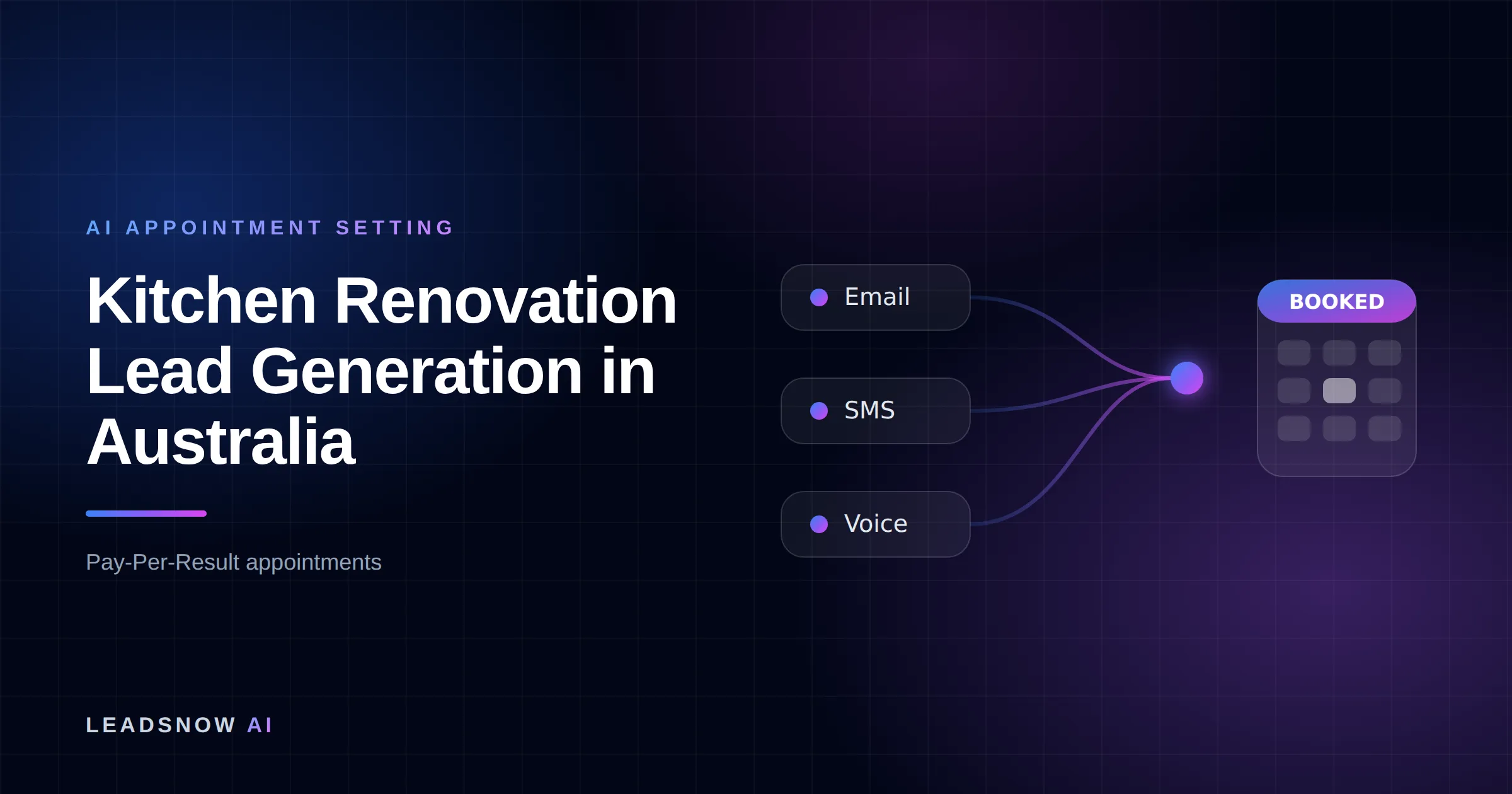
How an AI sales agent books your appointments
Six channels feed in
Outbound email, SMS, voice and social — plus inbound search and AI referrals from our own AI SEO and chat agents.
Your list or CRM
Outbound starts from data you already own — past enquiries, dormant customers, or a targeted prospect list.
Qualified against your rules
Budget, timing and fit are checked before anything reaches your team, using criteria you set.
Booked into your calendar
Only qualified prospects reach the booking step, so your closers spend their time selling.
MAKE MORE SALES.
Pay-Per-Result pricing — We scale sales HARD aligned to your interests, better than anyone else.
Comparison: four ways kitchen renovators buy growth in 2026
| Shared platform leads | Exclusive leads | Your own marketing | Pay-per-result appointments | |
|---|---|---|---|---|
| What you pay for | A contact record — $25–$80 per lead plus $200–$600/mo subscription (20 Minute Marketing, 2026) | A contact record only you receive, priced at a premium over shared leads | Ad spend, creative and agency fees, paid win or lose | A qualified homeowner booked into your calendar |
| Who else gets the lead | Competing renovators quoting the same kitchen | Only you (in theory) | Only you | Only you |
| Who does the chasing | You — and the fastest quote usually wins | You | You | Included — AI contact within minutes, multi-touch follow-up until booked or disqualified |
| No-show / dud risk | You carry it — pay per lead regardless | You carry it — exclusive doesn’t mean qualified | You carry it entirely | Provider carries it — you pay for the booked result |
| Cost per signed job logic | Lead price ÷ close rate: ~$300 per booked job at the 1-in-5 platform average (20 Minute Marketing, 2026) | Higher lead price, better close rate — maths only works if exclusivity is real | Whatever your blended CPL and close rate say it is — you find out after spending | Priced per appointment, so cost per signed job = appointments ÷ your close rate, known in advance |
Want this done for you? We book qualified sales appointments on a Pay-Per-Result basis — you only pay for calls that actually land in your calendar.
The dead-quote goldmine: kitchens you already quoted and never closed
Here’s the maths nobody on a lead platform wants you to do. If you quote ten kitchens a month and close at the 1-in-5 platform average, eight households a month walk away with your detailed, measured-up quote in hand — roughly a hundred a year. At a $25,000–$45,000 mid-range job size, two years of trading leaves most established kitchen companies sitting on several million dollars of quoted-but-never-closed work. And kitchens aren’t impulse purchases that expire: the homeowner who got your quote in 2024 and baulked at the price often still has the same dated kitchen, a bigger budget, and a renovation that’s moved up the priority list.
Database reactivation is the discipline of working that list properly: AI-driven SMS and voice outreach over your historical quotes and enquiries, re-opening the conversation and booking the live ones straight into your calendar. No ad spend, no lead credits — these are people who already invited you into their home and asked you for a number. Across LeadsNow’s own database reactivation campaigns — the track record built through our Colliers-era work, not a kitchen-specific claim — we’ve averaged a 4.4% booking rate, peaking at 8.9% on the best-performing lists. On a database of 1,000 old kitchen quotes and enquiries, that’s dozens of booked appointments from contacts you’ve already paid to acquire once. We’ve written up the mechanics on our database reactivation services for Australian businesses page, and there’s a step-by-step walkthrough in our guide to how to run a database reactivation campaign.
This is also where kitchen renovation genuinely differs from the bathroom and whole-home versions of this problem. Kitchen quotes are typically single-room, tightly scoped and price-anchored — which means the objection that killed the deal was usually budget or timing, not scope confusion. Both of those objections expire on their own. A quote list like that is close to the ideal reactivation asset: high job value, clear original intent, and a reason to say yes now that didn’t exist then.
How pay-per-result appointment setting works for kitchen renovators
Pay-per-result means LeadsNow runs the campaigns, the AI qualification and the multi-touch follow-up at our own risk — and you pay only when a qualified homeowner is booked into your calendar as a sales appointment. Not per click, not per enquiry, not per contact record. For a kitchen renovation business that changes three things:
- You stop paying for duds. Renters, out-of-area enquiries, and homeowners with a $5,000 budget for a $30,000 job get filtered out before they cost you anything. Qualification criteria — homeowner status, suburb, budget band, timeframe — are agreed with you up front.
- Speed-to-lead is automated. Our AI calls and messages every new enquiry within minutes, at any hour, then follows up across multiple touches until the prospect books or disqualifies. With platform-average conversion sitting at 1-in-5 and the fastest responder usually winning the quote slot, this is the discipline that moves the number. We’ve written up how it works in our guide to speed-to-lead automation in Australia.
- Your closers close. Your salesperson or owner-operator walks into booked consultations with qualified homeowners instead of ringing a call sheet between site visits.
Be clear-eyed about the trade-off: a booked, qualified appointment costs more than a raw lead, because it should — it has survived qualification and been scheduled. On a job worth $25,000–$45,000, the comparison that matters is cost per signed kitchen, and on that basis tighter qualification usually wins. If you’re weighing the two models in detail, we’ve published a straight comparison of pay-per-lead vs pay-per-appointment pricing in Australia.
If we can’t make you money, we don’t deserve yours.
Pay-Per-Result pricing — performance-based alignment.
Who this is a fit for — and who it isn’t
Good fit: established kitchen renovation companies and cabinet makers doing steady quote volume who can service more consultations than they’re getting; businesses with two or more years of quote history sitting dormant in a spreadsheet, job-management system or email inbox; teams with someone ready to take booked design consultations.
Not a fit: brand-new operators with no trading history and no quote database — reactivation needs a list to reactivate; businesses at full capacity with a six-month wait list; anyone who wants the cheapest possible per-contact number and is happy doing their own dialling. A $30 shared lead genuinely is the cheaper line item if your chase time is free to you. We’d rather say that plainly than win a client who churns in eight weeks. If you are still deciding who to hand the work to, our ranking of the best lead generation agencies for kitchen renovators in Australia compares the main suppliers on cost per booked job rather than cost per lead.
The proof
Since 2017, LeadsNow’s AI systems have booked 50,769+ sales appointments and generated over 1 million leads for clients. We hold a 4.6-star average across 43 Google reviews and have published 25 filmed client case studies — clients on camera, not testimonial graphics. Those case studies span finance, property, fitness and education rather than kitchen renovation specifically; the mechanics — AI speed-to-lead, qualification, multi-touch follow-up, database reactivation, calendar booking — are industry-agnostic, and we’ll happily walk you through how they map to a kitchen sales cycle on a call.
FAQ: kitchen renovation lead generation in Australia
How much do kitchen renovation leads cost in Australia?
There’s no published kitchen-specific per-lead market rate, so the best verified benchmark is platform pricing: hipages tradies pay a $200–$600 monthly subscription plus $25–$80 per lead, with premium renovation categories running higher and metro tradies in competitive categories often spending around $900 a month all-in, per 20 Minute Marketing’s 2026 analysis. At the platform-average 1-in-5 quote-to-job rate, that works out to roughly $300 in lead costs per booked job.
How much does a kitchen renovation cost in Australia in 2026?
What’s The Damage’s 2026 guide puts a budget kitchen renovation at $12,000–$25,000, mid-range at $25,000–$45,000 and premium at $45,000–$80,000, with most households spending $35,000–$45,000 on a full mid-range remodel. HIA research cited by Kitchen Shack puts the 2026 average, including installation, at $42,630. That job value is why lead quality and quote follow-up matter more in kitchens than raw lead price.
What’s a good quote-to-close rate for a kitchen renovation company?
Verified platform-wide figures from 20 Minute Marketing’s 2026 hipages analysis: the average tradie converts roughly 1 in 5 quotes into booked jobs, strong operators hit 1 in 3, and weaker performers land at 1 in 8 or worse. Kitchen-specific close rates aren’t published anywhere we could verify, but the practical implication is the same at any point in that range: the majority of kitchens you quote don’t close — which is exactly why your historical quote list is worth reactivating.
Is the Australian renovation market big enough to sustain lead generation in 2026?
Yes. The Australian Bureau of Statistics’ Building Approvals release for June 2026 (published 30 July 2026) records $1,321 million of residential alterations and additions approved in that single month, seasonally adjusted — and that only counts work requiring approval, so cosmetic kitchen renovations sit on top of it. Renovation demand is a monthly billion-dollar market; the constraint for most kitchen companies is converting their share of it, not finding it.
What’s the difference between paying per lead and paying per appointment?
A lead is a contact record — a name and number you still have to call, qualify, site-visit and quote, and you pay whether or not any of that succeeds. A pay-per-result appointment is a qualified homeowner already booked into your calendar; the provider carries the cost of the contacts that don’t qualify or don’t book. The per-unit price is higher, but you’re buying a later, more certain stage of the funnel — which matters most on big-ticket jobs like kitchens.
What is database reactivation for kitchen renovators?
It’s AI-driven SMS and voice outreach over your existing list of past quotes and enquiries — the homeowners who asked you for a kitchen quote and went quiet — with revived conversations booked straight into your calendar. Across LeadsNow’s own reactivation campaigns we’ve averaged a 4.4% booking rate, peaking at 8.9% on the best-performing lists; that’s our cross-industry track record, not a kitchen-specific guarantee. It’s typically the fastest-payback campaign a renovator can run, because the list is already bought and paid for.
Ready to see it on your own pipeline? Book a call — you’ll speak with us about your market, your lead flow, and whether the model fits before anything is signed.
Pay-Per-Result appointments
See if we’re a fit
We book qualified sales appointments for you and you pay on results, not retainers. Our booking page asks a few quick questions so you find out in two minutes whether that model suits your business.
- 50,769+ appointments booked without cold calling.
- Pay-Per-Result pricing — you pay for booked, qualified calls.
- Pick your own time on our live calendar, no phone tag.