
Ask most high-ticket coaches how their revenue looks month to month and you’ll get a wince. It’s launch-to-launch, spike-then-drought — a big cart-open week followed by a quiet stretch where you’re refilling the funnel from scratch. The sales calls that do get booked are half tyre-kickers who love your content but can’t come near a $15k program, and the show rate on your calendar is a running joke: a third simply ghost. When paid ads get expensive or an algorithm shifts, the whole thing wobbles. That’s not a discipline problem. It’s what happens when high-ticket coaching client acquisition is built on rented attention and a “book a call” button that lets anyone through.
Comparing providers? Our reviewed list of the best appointment setting agencies for coaches (2026) covers seven real options, including where each fits best.
This page is the hub for how Australian high-ticket coaches and course creators build a predictable acquisition engine — booked, qualified strategy sessions with people who can actually afford and commit to the program, not a diary full of no-shows. For the mechanics behind it, we’ve linked our AI appointment setting breakdown and our comparison of pay-per-lead vs pay-per-appointment in Australia throughout, and you can see the wider model on the LeadsNow home page.
At a glance
Q: How do high-ticket coaches get qualified client acquisition calls in Australia, and what does pay-per-result involve?
Most Australian coaches chase volume — ad-driven “book a call” funnels and VSLs that fill the calendar with curious browsers and low-show prospects who can’t afford the program. The shift is toward pre-qualified, pre-committed strategy sessions booked directly into your diary. Pay-per-result means no ad spend gamble and no monthly retainer: you pay only when a genuinely qualified, exclusive coaching call is booked — someone with the budget, the fit and the intent to enrol. The agency carries the delivery risk, so a higher cost per call reflects tighter qualification and a far better show rate, not waste.
How it works
How an AI sales agent books your appointments
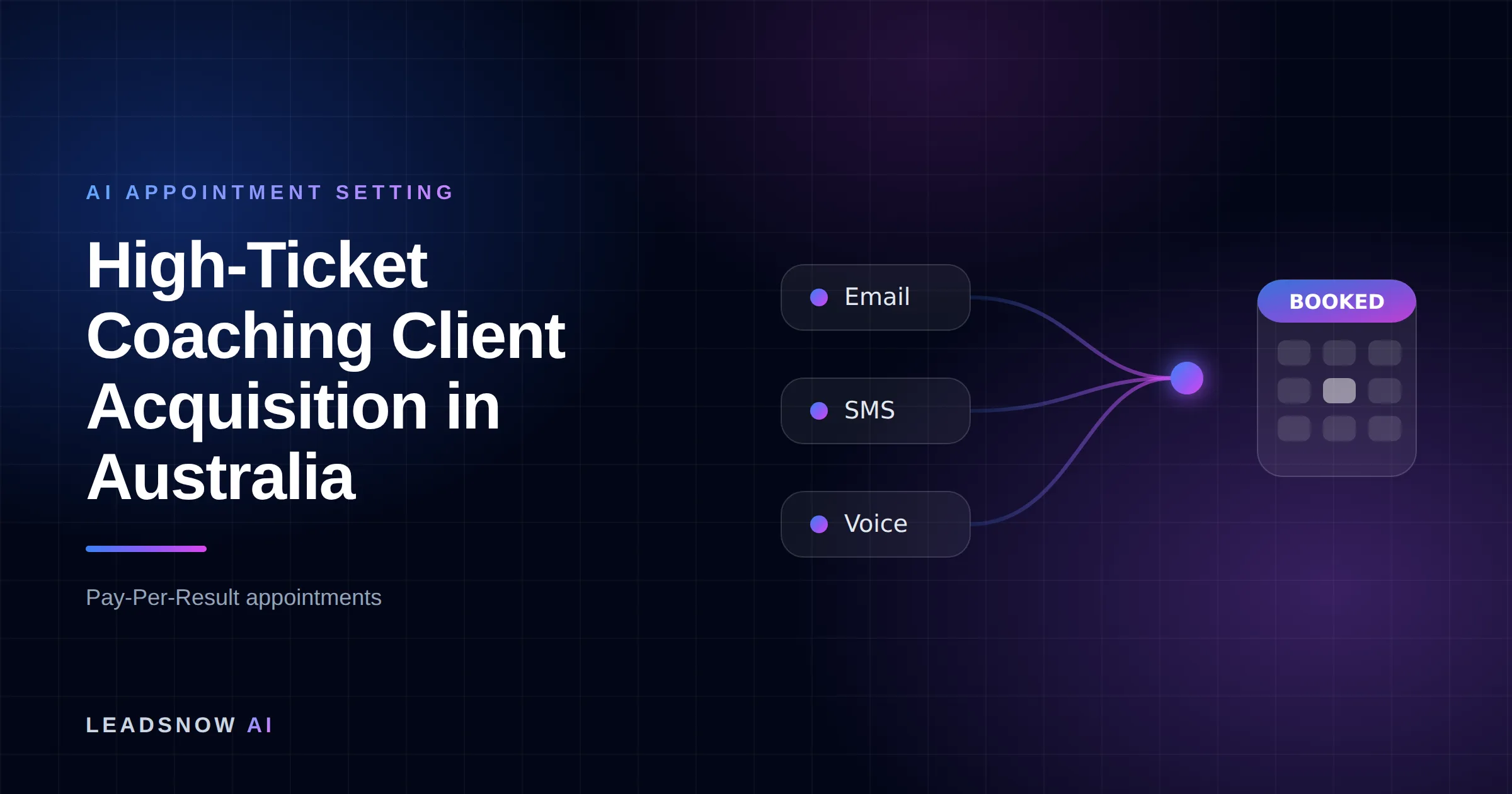
Six channels feed in
Outbound email, SMS, voice and social — plus inbound search and AI referrals from our own AI SEO and chat agents.
Your list or CRM
Outbound starts from data you already own — past enquiries, dormant customers, or a targeted prospect list.
Qualified against your rules
Budget, timing and fit are checked before anything reaches your team, using criteria you set.
Booked into your calendar
Only qualified prospects reach the booking step, so your closers spend their time selling.
MAKE MORE SALES.
Pay-Per-Result pricing — We scale sales HARD aligned to your interests, better than anyone else.
Why the standard funnel caps high-ticket coaching client acquisition
The typical high-ticket funnel is a paid-ads engine feeding a VSL feeding a calendar link. It works right up until it doesn’t. Every booked call is downstream of ad spend you don’t control, on platforms that reprice and re-target you constantly. The moment costs climb or a launch under-performs, your pipeline dries up with it.
The deeper issue is who the funnel lets through. An open “book a call” link optimises for volume, not fit — so your calendar fills with people who binge-watched the VSL but have no budget, no urgency and no real intent to enrol. Show rates crater because there’s no commitment behind the booking, and you spend your highest-value hours on discovery calls that were never going to close. That’s the ceiling: you can’t scale a program by pouring more traffic into a funnel that can’t tell a buyer from a browser.
Want this done for you? We book qualified sales appointments on a Pay-Per-Result basis — you only pay for calls that actually land in your calendar.
How pay-per-result booked calls work for coaches
Pay-per-result inverts the risk. Instead of gambling on ad spend or paying a monthly retainer that bills whether or not a single call shows, you pay for a defined outcome: a qualified, exclusive strategy session booked into your diary with someone who’s already been screened and warmed up.
For a high-ticket coach specifically, that matters because your selling time is your scarcest asset. An hour on a call with someone who can’t afford the program is an hour you can’t get back. So the incentive that works is one where we only win when you get a call worth taking: we build and run the outbound, do the qualification and follow-up, and hand you a booking that’s expected and committed. A higher cost per qualified call isn’t a downside here; it’s the direct result of tighter screening and a much stronger show rate.
And because these are high-ticket programs, the honest frame is never dollar-per-call — it’s ROI per enrolment. When a single closed client is worth thousands, one additional enrolment typically dwarfs the cost of every appointment it took to win it. The same maths drives how we run lead generation for business coaches in Australia, where the offer is a B2B engagement rather than a personal-transformation program.
What makes a qualified high-ticket coaching call
“Qualified” is where most lead-gen relationships quietly fall apart, so we define it plainly. A qualified high-ticket coaching call meets four tests:
- Budget — the person can genuinely afford a $5k–$50k program, not someone hoping for a payment plan they can’t sustain.
- Fit — they match your ideal client: the right stage, the right problem, the outcome your program actually delivers.
- Commitment — they’ve confirmed the time and shown real intent, so the call is expected rather than a passive calendar click.
- Decision-maker — they can say yes themselves and enrol, not “run it past” a partner or a board.
If a booking fails those tests, it isn’t a result — and you shouldn’t be paying as though it were. Setting the bar this high deliberately lowers volume. That’s the point. Ten committed strategy sessions with people who can buy beats fifty VSL browsers who ghost.
If we can’t make you money, we don’t deserve yours.
Pay-Per-Result pricing — performance-based alignment.
The show-rate and pre-qualification advantage
Show rate is the number that quietly decides whether your acquisition maths works. A calendar of twenty bookings at a 40% show rate is really eight conversations — and half of those aren’t a fit. The fix isn’t more bookings; it’s better ones. When a prospect has been screened for budget and fit, then personally confirmed the time, they turn up in a different frame of mind: expecting the call, clear on why they’re on it, and closer to a decision before you say a word.
That’s the whole design of pre-qualification. We filter for the four tests above before the booking is ever counted, so the person who lands in your diary is pre-committed rather than curious. It costs more per call than spraying a funnel and hoping — and that’s the feature, not the bug. You’re buying the right conversation with the right person, exclusively yours.
Proof the model works
Every name we cite has filmed their story — browse all 25 on our client case studies page, including written case studies with the interview transcripts quoted verbatim.
High-ticket coaching is a high-trust, high-value, considered sale. The evidence that targeted outbound and disciplined qualification work in exactly that context starts with our own numbers.
We dogfood our own model. The machine we point at your market is the same one behind our own results: 50,769+ AI-booked sales appointments since 2017 and more than 1M leads generated. That includes our Colliers-era database reactivation work on dormant, long-cold leads — the coaching equivalent of turning a stale list of past webinar registrants and lapsed enquiries back into booked strategy sessions.
We’ve also done this across the coaching and creator-education world specifically. We’ve worked with Foundr in entrepreneur education, SheSells.online in sales coaching, Lambda Academy, and Marcus Wilkinson’s Iron Body in the coaching and fitness space — the same high-ticket, program-led sale a course creator runs. It’s part of a body of work backed by 25 filmed client case studies and a 4.6-star rating across 43 Google reviews.
Paid-ads funnel vs in-house setter vs pay-per-result
| Paid-ads funnel / VSL | In-house setter / DIY | Pay-Per-Result (LeadsNow) | |
|---|---|---|---|
| Who carries the risk | You — ad spend paid upfront, bookings not guaranteed | You — salary and hours, win or lose | Us — you pay on a booked qualified call |
| Lead quality / fit | Whoever the ad and VSL attract — mostly browsers | Variable, depends on the setter and script | Screened for budget, fit, commitment, decision-maker |
| Show rate | Low — passive calendar clicks, no commitment | Mixed — improves with follow-up you must run | High — pre-qualified and personally confirmed |
| Exclusivity | You compete with every advertiser for attention | Exclusive but capped by one person’s capacity | Exclusive to you |
| What you pay for | Ad impressions and clicks | A salary, win or lose | A qualified strategy session in your diary |
| Predictability | Launch-to-launch, spikes and droughts | Depends on retention and ramp-up | A steady, dial-able flow of committed calls |
Frequently asked questions
How is this different from a paid-ads funnel for high-ticket coaching client acquisition?
A funnel optimises for volume — it lets anyone who watched the VSL book a call, which is why show rates and fit are so poor. We optimise for the opposite: fewer calls, each screened for budget, fit and commitment before it’s booked, and paid for only when it lands. You carry no ad-spend risk, and the person who shows up is pre-committed rather than curious.
What makes a coaching call “qualified”?
Four things: the prospect can genuinely afford a $5k–$50k program, fits your ideal client profile, has confirmed the time with real intent, and can enrol themselves without a third party’s sign-off. If a booking misses those, we don’t count it as a result.
Won’t tighter qualification mean fewer calls?
Yes, deliberately. Ten committed strategy sessions with people who can actually buy beat fifty VSL browsers who ghost. A higher cost per qualified call is the direct result of that filtering and a far better show rate — you’re buying the right conversation, not volume.
How much does high-ticket client acquisition cost, and is it worth it?
We don’t anchor on a per-call price, because a raw lead and a qualified, committed strategy session are different products. The number that matters is ROI per enrolment: when one closed client is worth thousands, a single additional enrolment usually dwarfs the cost of every appointment it took to win it. Our pay-per-lead vs pay-per-appointment guide walks through why.
Does this work if I currently rely on launches and paid ads?
That’s the ideal starting point. Launches and ads can spike revenue, but you can’t dial them up on demand and they dry up between opens. Pay-per-result adds a controllable channel on top, so a quiet month between launches doesn’t turn into a scramble — without replacing what already works when it’s working.
Can you reactivate my old list of leads and past enquiries?
Yes. Dormant webinar registrants, lapsed application-funnel enquiries and past free-training sign-ups are often your warmest untapped source. Our reactivation approach — honed in our Colliers-era work and part of the system behind our 50,769+ AI-booked sales appointments since 2017 — turns a stale coaching list back into booked strategy sessions.
Book a qualification call
If your revenue lives and dies on the next launch, the fix isn’t more ad spend or another VSL — it’s a controllable channel that books committed, qualified strategy sessions for you. Let’s map what a qualified high-ticket coaching call looks like in your market and whether pay-per-result fits your program.
Book a qualification call with the LeadsNow team. We’re based at Level 2, 696 Bourke St, Melbourne VIC 3000, and you can reach us on +61 485 037 755. No retainer pitch, no ad-spend games — just a straight conversation about your acquisition engine.
Pay-Per-Result appointments
See if we’re a fit
We book qualified sales appointments for you and you pay on results, not retainers. Our booking page asks a few quick questions so you find out in two minutes whether that model suits your business.
- 50,769+ appointments booked without cold calling.
- Pay-Per-Result pricing — you pay for booked, qualified calls.
- Pick your own time on our live calendar, no phone tag.