
Most Australian custom home builders fill the pipeline the same three ways: a display home if the budget stretches that far, a directory or shared-lead subscription if it doesn’t, and a referral network they hope keeps producing. In 2026 the maths on that mix is getting harder. Master Builders Australia’s chief economist says a new house is now 47 per cent more expensive than it was just before the pandemic, which means every enquiry is a bigger, slower, more nervous decision — while the directory leads most builders buy still cost $25–$80 each, arrive shared, and go cold in days. This guide breaks down what custom home builder lead generation actually costs in Australia right now, why per-lead pricing is the wrong number for a business that signs six-figure contracts, and how pay-per-result appointment setting flips the risk. It’s written by LeadsNow AI, the Melbourne team behind 50,769+ AI-booked sales appointments since 2017 and 1M+ leads generated.
Custom home builder lead generation in Australia, at a glance (2026): On the big directory platforms, builders typically pay a subscription of $200–$600 per month plus $25–$80 per lead, with premium categories running higher — a metro tradie in a competitive category often lands around $900 a month all-in, per 20 Minute Marketing’s 2026 hipages breakdown. Those leads are shared, unqualified, and expensive to chase for a product where, per Master Builders Australia, “A new house is now 47 per cent more expensive than it was just before the pandemic.” The alternative is pay-per-result appointment setting: you pay only when a qualified prospect — right block, right budget band, real build intent — is booked into your calendar, not for raw enquiries you still have to chase.
What builder leads cost in Australia in 2026
There’s no neat published price list for “custom home builder leads” the way there is for solar or plumbing, but the channels builders actually use are well documented:
- Directory platforms (hipages and similar): 20 Minute Marketing’s 2026 review puts the hipages subscription at $200–$600 per month, with a typical range of $25–$80 per lead for most categories — and it notes that premium categories — its examples are large renovations, full house rewires and major commercial work — run higher than that band. Their worked estimate: a metro tradie in a competitive category often spends around $900 a month all-in before winning anything.
- Your own ads: Google and Meta campaigns for new builds put the ad spend, landing pages, creative testing and follow-up workload on you. You pay whether or not anyone signs, and the long decision cycle means you’re funding months of nurture before a contract appears.
- Display homes: the traditional channel. A display home generates walk-in enquiry, but you carry the build cost, the land, and weekend staffing — and most visitors are years away from building, browsing for ideas, or comparing you against the volume builders on either side of you in the display village.
Honesty box — what we couldn’t verify: it’s widely repeated in the trade that hipages sends each lead to up to three tradies, and that big-build categories carry the highest credit prices on the platform. We couldn’t confirm either figure at the source while writing this page, so treat both as industry folklore rather than published fact. What is confirmed is the shared-lead model itself: you are not the only builder who receives the enquiry.
Per-lead price is the wrong number for a builder
For a plumber, a $60 dud lead is an annoyance. For a custom home builder, the per-lead price is almost irrelevant — the real costs are the estimating hours behind every serious enquiry and the months of sales cycle before anyone signs. A custom build enquiry that goes nowhere doesn’t cost you $60; it costs you site visits, a preliminary design conversation, and often a full tender your estimator spent days pricing. That’s why the only number worth optimising is cost per signed contract, and why lead quality — land secured, budget realistic, timeframe genuine — matters more in this trade than in any other.
The demand side, for what it’s worth, is holding up. The ABS Building Approvals release for June 2026 counted 10,631 private sector houses approved in the month, up 15.8 per cent over the year. People are building. The question is whether the ones with land and finance end up in your calendar or your competitor’s.
How it works
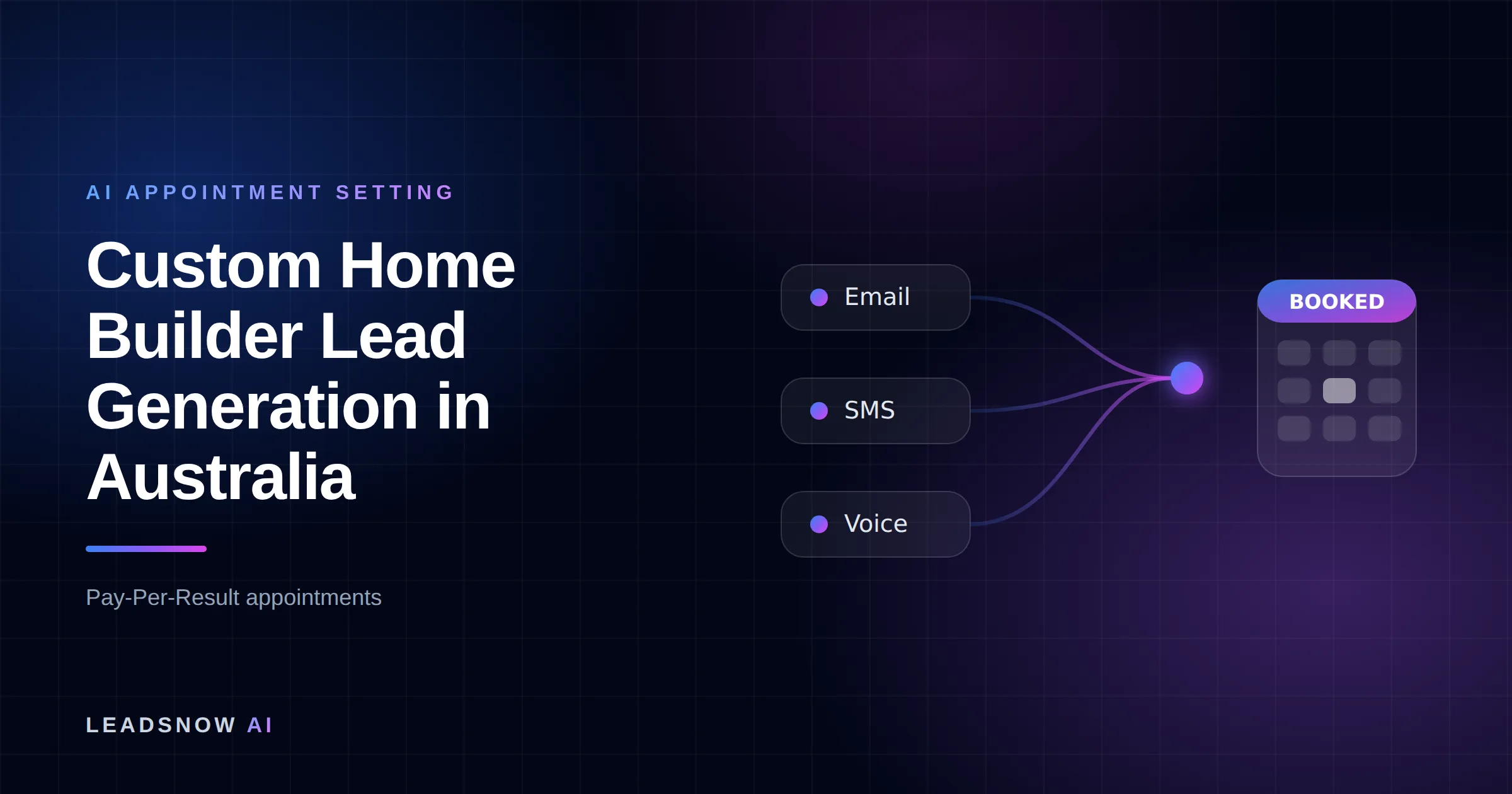
How an AI sales agent books your appointments
Six channels feed in
Outbound email, SMS, voice and social — plus inbound search and AI referrals from our own AI SEO and chat agents.
Your list or CRM
Outbound starts from data you already own — past enquiries, dormant customers, or a targeted prospect list.
Qualified against your rules
Budget, timing and fit are checked before anything reaches your team, using criteria you set.
Booked into your calendar
Only qualified prospects reach the booking step, so your closers spend their time selling.
MAKE MORE SALES.
Pay-Per-Result pricing — We scale sales HARD aligned to your interests, better than anyone else.
Why buying leads keeps disappointing builders
- The shared-lead race, with a longer fuse. When several builders receive the same enquiry, the relationship usually goes to whoever calls first and follows up hardest. In a trade where the decision takes months, “we’ll ring them back Thursday” means another builder has already done the first site chat.
- You pay for enquiries, not intent. A directory “lead” can be someone without land, someone whose budget was set three price rises ago, or someone collecting a third quote to keep their preferred builder honest. You’ve paid — and possibly tendered — either way.
- Follow-up dies in the sales cycle. A kitchen-table meeting that goes quiet for six weeks isn’t dead, it’s normal — but almost no builder has someone whose actual job is staying in structured contact across a months-long decision. Enquiries don’t get lost; they get neglected.
Want this done for you? We book qualified sales appointments on a Pay-Per-Result basis — you only pay for calls that actually land in your calendar.
Comparison: four ways builders buy growth in 2026
| Shared directory leads | Exclusive leads / your own ads | Display home | Pay-per-result appointments | |
|---|---|---|---|---|
| What you pay for | A contact record ($25–$80 typical, premium categories higher, plus $200–$600/mo subscription — 20 Minute Marketing, 2026) | Clicks, impressions and management fees, paid win or lose | Build cost, land and weekend staffing for walk-in traffic | A qualified prospect booked into your calendar |
| Who else gets the lead | Multiple competing builders — that’s the model | Only you | Every builder in the display village gets the same visitor | Only you |
| Who does the chasing | You, across a months-long cycle | You | You, from a visitor book of mostly someday-browsers | Included — AI contact within minutes, then multi-touch follow-up until booked or disqualified |
| No-show / dud risk | You carry it, per lead, regardless | You carry it entirely | You carry it entirely | Provider carries it — you pay for the booked result |
| Cost per signed contract logic | Lead price + estimating hours + chase time, divided by a thin signing rate | Total spend divided by however many sign, months later | A large fixed cost amortised over however many contracts it produces | Appointments are dearer per unit but pre-qualified — fewer wasted tenders per signed contract |
The dead-quote goldmine: your tender file
Here’s the asset almost every established builder is sitting on and almost none is working: the pile of people who got a tender, a preliminary quote or a full design-and-price — and never signed. In this trade that file is unusually valuable, because nobody requests a construction tender casually. Those people had land, or were close to it. They had finance conversations. Many didn’t build with anyone; they paused when the numbers scared them, and some of those numbers have since been reframed by the market. Others built stage one of the plan and are a knockdown-rebuild or second dwelling away from calling someone.
Database reactivation runs AI-driven SMS and voice outreach over that list and books the revived conversations straight into your calendar. Across LeadsNow’s own historical reactivation campaigns — our Colliers-era database reactivation work — we’ve averaged a 4.4% booking rate, peaking at 8.9% on the best-performing lists. That’s our reactivation track record across our client base, not a promise about builder lists specifically, but the mechanics transfer: a warm list of people who already asked you to price their home beats any lead you can buy. On a few hundred dead tenders and quote requests, even a modest revival rate is multiple kitchen-table meetings from people you’ve already paid to acquire once. More detail on our database reactivation services for Australian businesses page.
If we can’t make you money, we don’t deserve yours.
Pay-Per-Result pricing — performance-based alignment.
Pay-per-result appointment setting: how it works for builders
Pay-per-result means LeadsNow runs the campaigns, the AI qualification and the multi-touch follow-up at our own risk — and you pay only when a qualified prospect is booked into your calendar as a sales appointment. Not per click, not per enquiry, not per contact record. For a custom home builder that changes three things:
- You stop tendering for tyre-kickers. Qualification criteria are agreed with you up front — land status, budget band, build region, timeframe — so idea-collectors and no-land dreamers are filtered out before they cost you estimating hours.
- Speed-to-lead is automated. Our AI calls and messages new enquiries within minutes of them coming in, at any hour, then keeps following up across the long decision cycle — the exact discipline that decides who wins shared enquiries. We’ve written up how this works in our guide to speed-to-lead automation in Australia.
- Your best people do the part only they can do. Directors and sales leads walk into booked meetings with qualified prospective clients instead of triaging a shared inbox between site visits.
Be clear-eyed about the trade-off: a booked, qualified appointment costs more than a raw lead, because it should — it has survived qualification and been scheduled. In a business where one signed contract is worth more than most trades bill in a year of small jobs, the comparison that matters is cost per signed contract, and on that basis tighter qualification usually wins. If you’re weighing the two models in detail, we’ve published a straight comparison of pay-per-lead vs pay-per-appointment pricing in Australia.
Who this is a fit for — and who it isn’t
Good fit: established custom builders with capacity for more contracts than the pipeline is producing; builders sitting on years of dead tenders and quote requests; builders whose enquiry follow-up currently depends on whoever isn’t on site that day.
Not a fit: brand-new builders with no trading history or quote database; builders at capacity with a signed-contract waitlist; teams that want the cheapest possible per-contact number and are happy to do their own chasing — a shared directory lead genuinely is the cheaper line item if your team’s chase and estimating time is free to you. We’d rather say that plainly than win a client who churns in eight weeks.
The proof
Since 2017, LeadsNow’s AI systems have booked 50,769+ sales appointments and generated over 1 million leads for clients. We hold a 4.6-star average across 43 Google reviews and have published 25 filmed client case studies — clients on camera, not testimonial graphics. Those case studies span finance, property, fitness and education rather than residential construction specifically; the mechanics — AI speed-to-lead, qualification, multi-touch follow-up, calendar booking — are industry-agnostic, and we’ll happily walk you through how they map to a builder’s sales cycle on a call.
FAQ: custom home builder lead generation in Australia
How much do custom home builder leads cost in Australia?
There’s no published national price for builder-specific leads, but on the directory platforms most builders use, 20 Minute Marketing’s 2026 hipages review puts the subscription at $200–$600 per month plus a typical $25–$80 per lead, with premium categories such as large renovations and major commercial work running higher — around $900 a month all-in for a metro tradie in a competitive category. The bigger cost in this trade is invisible: estimating hours and site visits spent on enquiries that were never going to sign.
Is demand for new custom homes actually there in 2026?
Yes. The ABS Building Approvals data for June 2026 recorded 10,631 private sector houses approved in the month, up 15.8 per cent over the year, within 18,328 total dwellings approved. Costs are the headwind, not demand: Master Builders Australia puts a new house at 47 per cent more expensive than just before the pandemic, which makes buyers slower and more cautious — and makes qualification and follow-up discipline decide who wins them.
Why do so many builder quotes and tenders never sign?
Usually not because the prospect chose a competitor. Common reasons: the tendered price landed above the budget they’d set a year earlier, finance took longer than expected, or life simply intervened — and no one from the builder’s side stayed in structured contact while they wobbled. That’s why a builder’s dead-tender file is such a strong reactivation list: much of it is paused intent, not lost deals.
What’s the difference between paying per lead and paying per appointment?
A lead is a contact record — a name and number you still have to call, qualify and book, and you pay whether or not any of that succeeds. A pay-per-result appointment is a qualified prospect already booked into your calendar; the provider carries the cost of the contacts that don’t qualify or don’t book. The per-unit price is higher, but you’re buying a later, more certain stage of the funnel — which matters most in trades like custom building where every wasted “maybe” burns estimating hours.
Does LeadsNow have builder-specific case studies?
Our 25 filmed client case studies come from finance, property, fitness and education — we won’t pretend otherwise or invent a builder logo wall. What we bring to custom building is the appointment-setting system behind 50,769+ booked sales appointments since 2017, applied to your offer, your build regions and your qualification criteria. Book a call and we’ll map it to your sales cycle honestly, including whether we think you’re a fit.
Ready to see it on your own pipeline? Book a call — you’ll speak with us about your market, your lead flow, and whether the model fits before anything is signed.
Pay-Per-Result appointments
See if we’re a fit
We book qualified sales appointments for you and you pay on results, not retainers. Our booking page asks a few quick questions so you find out in two minutes whether that model suits your business.
- 50,769+ appointments booked without cold calling.
- Pay-Per-Result pricing — you pay for booked, qualified calls.
- Pick your own time on our live calendar, no phone tag.