
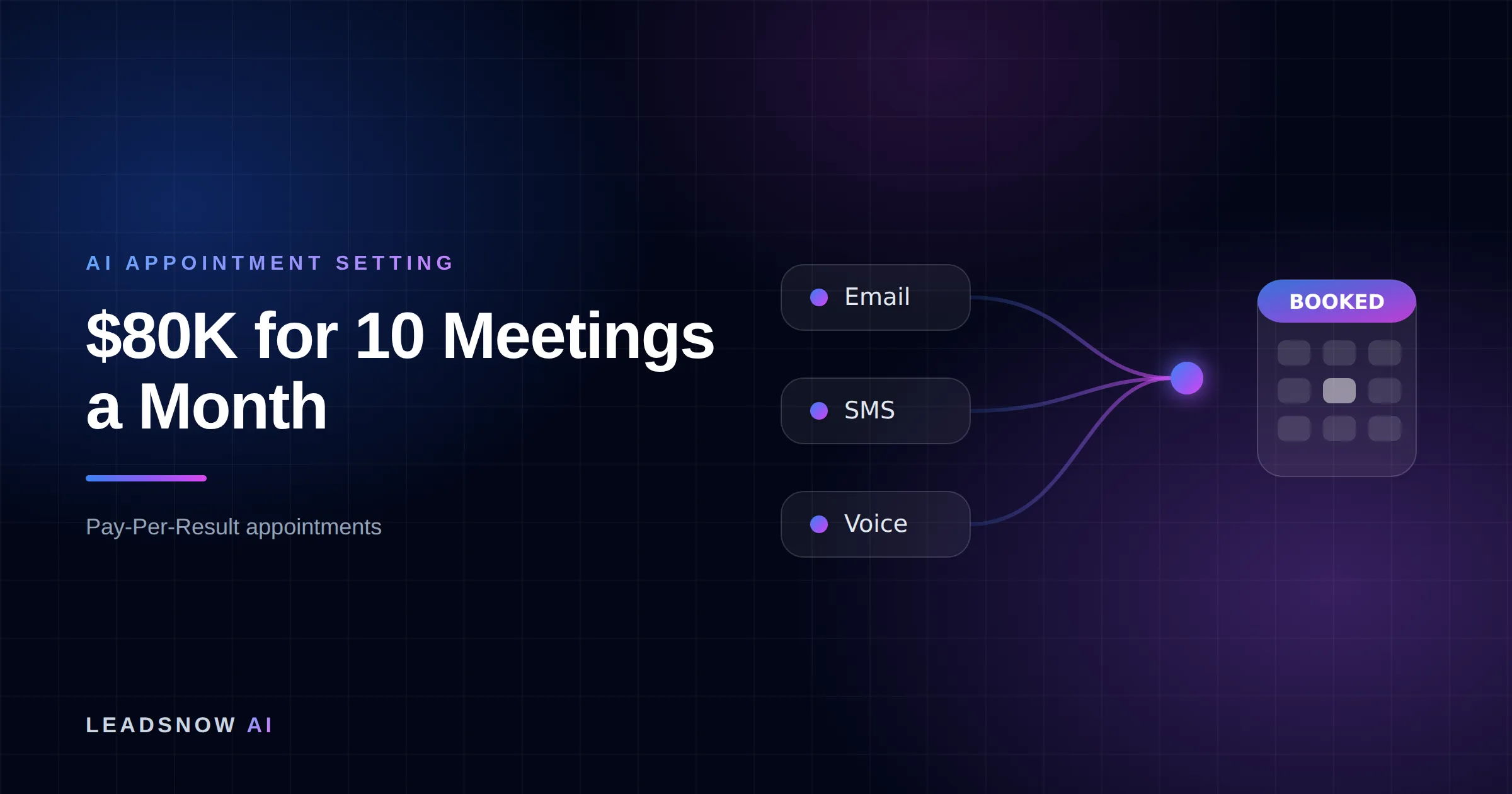
Appointment setting services book qualified sales meetings into your calendar, sold in five models: in-house SDR, freelance setter, retainer agency, pay-per-appointment agency and AI. Compare every quote as cost per held meeting. At a 70% show rate, a fee charged per booked appointment costs 1.43 times the same fee charged per held one.
Appointment setting services at a glance
- Five models: in-house SDR, freelance or commission setter, monthly retainer agency, pay-per-appointment agency, and AI (as software you run, or done for you).
- The in-house benchmark: median SDR on-target earnings of $80,000, a median quota of 10 held meetings a month, 60% of SDRs at quota, 3.0 months to ramp and 1.9 years average tenure (Bridge Group, 2025, 351 B2B companies).
- The 1.43x rule: at a 70% show rate, paying per booked appointment costs 1 ÷ 0.70 = 1.43 times paying the same fee per held appointment.
- The unit to buy: a held meeting with a buyer who meets your written criteria, not a calendar entry.
- The legal line (US): since 8 February 2024 the FCC treats AI-generated voices as “artificial” under the TCPA.
What appointment setting services are
An appointment setting service contacts your leads or target accounts, qualifies them against criteria you set, and books the ones who fit into a salesperson’s calendar. The service ends when a meeting is booked or held; closing stays with you.
- Inbound setting: working leads who already raised a hand (form fills, ad leads, DM enquiries, missed calls).
- Outbound setting: reaching accounts that have not enquired, by phone, email, LinkedIn or SMS.
- Reactivation: re-contacting old leads and lapsed customers already in your CRM.
What appointment setting services are not: lead generation (creating the contacts), or closing (running the sales call). Many vendors bundle all three, which is why quotes are hard to compare. B2B-specific process detail is in our B2B appointment setting guide, and the decision to outsource at all is covered in appointment setting outsourcing. This page compares the models side by side.
How it works
How to compare appointment setting service quotes on one unit
Write qualification criteria
Put budget, authority, need, timing and outright disqualifiers on one page before talking to providers.
Measure your show rate
Divide held meetings by booked meetings for the last 90 days of past appointments.
Normalise every quote
Divide each quote’s total monthly fees by the qualified held meetings it would produce. Repeat for a bad month.
Choose and track weekly
Pick the lowest stable cost per held meeting and track contact, set, show and qualified-held rates every week.
MAKE MORE SALES.
Pay-Per-Result pricing — We scale sales HARD aligned to your interests, better than anyone else.
The five appointment setting service models compared
Every appointment setting service model answers the same three questions differently: what you pay for, who absorbs a no-show, and what you pay in a month when no meetings happen. AI appears twice because it is sold two ways.
| Model | What you pay for | Who absorbs no-shows | Cost in a zero-meeting month | Ramp before meetings |
|---|---|---|---|---|
| In-house SDR | Salary, commission, benefits, tools, management time | You | Full salary and tools | 3.0 months average (Bridge Group) |
| Freelance or commission setter | Hourly rate, per-booking commission, or both | You, unless commission is paid only on held calls | Hours billed, if hourly | Depends on the setter; you train them |
| Retainer agency | A fixed monthly fee for activity (dials, emails, sequences) | You | The full retainer | Set in contract; ask for it in writing |
| Pay-per-appointment agency | A fee per booked or per held appointment | Depends on the contract: per-booked means you; per-held means the agency | Nothing, unless there is a set-up fee or minimum | Set in contract |
| AI software you run | Software subscription plus usage, plus your team’s time | You | Subscription and staff time | Your build and test time |
| Done-for-you AI, paid on results | A share of revenue, a fee per appointment, or a mix | The provider, if no-shows are excluded in the contract | Nothing, unless there is a minimum | Set in contract |
The quotable reading: the further down this table you go, the more of the risk of a bad month moves from you to the provider, and the more the provider will care about who it books. The trade-off between running AI software yourself and buying it as a service is set out in AI appointment setter software vs done-for-you.
Want this done for you? We book qualified sales appointments on a Pay-Per-Result basis — you only pay for calls that actually land in your calendar.
The in-house SDR baseline: $80,000 for a 10-meeting quota
Every outsourced appointment setting service should be compared with doing it in-house. The Bridge Group’s 2025 SDR research report (351 B2B companies, 83% B2B SaaS, 78% North America-based) gives the cleanest public baseline:
- Median on-target earnings: $80,000 ($55,000 base, $25,000 variable), unchanged since 2022.
- Median monthly quota: 10 held first meetings (“Stage 0 held”), down 40% since 2018.
- Attainment: 60% of SDRs at quota, the lowest in the study’s history.
- Ramp and tenure: 3.0 months to ramp; 1.9 years average tenure.
Simple arithmetic on those medians: $80,000 ÷ (10 meetings × 12 months) = about $667 of on-target earnings per held meeting, for an SDR who hits quota every month, before benefits, software, management, recruiting and the three ramp months. With 40% of SDRs below quota, the real figure is higher. The fully loaded US calculation, with benefits and software seats, is in how much an SDR costs in the US.
Note what the Bridge Group counts: held meetings. That is the right unit, and it is the unit to hold any appointment setting service to.
Why show rate decides what you really pay for appointments
Show rate is held meetings divided by booked meetings, for meetings whose scheduled time has passed. It decides the true price of any appointment setting service that charges per booking or per month.
- Formula: show rate = held ÷ (held + no-shows + same-day cancellations not rebooked). Count reschedules once, at the date they finally land.
- What moves it: time between booking and meeting, confirmation and reminder cadence, whether the buyer chose the slot, and how qualified they were when they booked.
- Published reference points: our sales call show rate benchmarks collect the published figures with their samples, and the fixes are in how to increase sales call show rate.
The multiplier below is pure arithmetic: what one held meeting costs when you are charged per booked meeting, as a multiple of the per-booking fee. The show rates are assumption bands, not benchmarks; use your own.
| Show rate (assumption) | Booked meetings per held meeting | Cost per held meeting, as a multiple of the per-booking fee |
|---|---|---|
| 50% | 2.00 | 2.00x |
| 65% | 1.54 | 1.54x |
| 70% | 1.43 | 1.43x |
| 80% | 1.25 | 1.25x |
| 90% | 1.11 | 1.11x |
The 1.43x rule: at a 70% show rate, an appointment setting service that charges per booked appointment costs 43% more per real conversation than one charging the same fee per held appointment. A cheaper per-booking quote only wins if its fee is lower by more than the no-show gap.
If we can’t make you money, we don’t deserve yours.
Pay-Per-Result pricing — performance-based alignment.
The held-meeting test: a worked example of comparing quotes
The held-meeting test converts every appointment setting quote into one number: total fees for the month divided by held meetings that meet your written criteria. Below, three hypothetical quotes are expressed in units of F, one per-booking fee, so the comparison holds at any price level. All inputs are assumptions for illustration, not market rates.
| Quote | Terms (assumed) | Good month | Bad month |
|---|---|---|---|
| A: per booked appointment | Fee of 1.0F per booking; no-shows charged; 70% show rate | 1.0F ÷ 0.70 = 1.43F per held meeting | Show rate falls to 50%: 2.00F per held meeting |
| B: per held appointment | Fee of 1.3F per held meeting; no-shows not charged | 1.30F per held meeting | 1.30F per held meeting |
| C: monthly retainer | Retainer of 20F a month; 25 bookings at 64% show = 16 held | 20F ÷ 16 = 1.25F per held meeting | 15 bookings at 64% = 9.6 held: 20F ÷ 9.6 = 2.08F |
What the worked example shows:
- The cheapest quote on paper (A, at 1.0F) is the most expensive per held meeting in a good month (1.43F, against 1.30F and 1.25F).
- The retainer (C) is cheapest in a good month and most expensive in a bad one (1.25F rising to 2.08F), because the fee does not move when output does.
- The per-held quote (B) is the only one whose unit cost does not move. The volatility is the provider’s problem.
- Revenue share is a fourth case: its cost per held meeting is the share × your average deal value × your held-meeting-to-close rate, so it falls automatically when meetings do not close.
Run the test on your own quotes with your own show rate and a realistic bad month. If a provider will not tell you its show rate, assume the bad month. Published US agency rate cards are converted to the same held-meeting unit in our guide to what an appointment setting agency costs in the US.
Metrics to demand from an appointment setting service
An appointment setting service that will not report these six numbers by week cannot be managed:
| Metric | Formula | What it tells you |
|---|---|---|
| Speed to first contact | Median minutes from lead arrival to first attempt | Whether inbound leads are worked while they are warm |
| Contact rate | Leads reached ÷ leads attempted | List quality and channel mix |
| Set rate | Meetings booked ÷ leads reached | Script, offer and setter skill |
| Show rate | Held ÷ booked (past meetings only) | Qualification and reminder discipline |
| Qualified-held rate | Held meetings meeting your criteria ÷ held meetings | Whether the provider is booking the right people |
| Cost per qualified held meeting | Total fees ÷ qualified held meetings | The held-meeting test, every month |
Set rate and show rate move in opposite directions under pressure: a setter pushed for volume books weaker buyers, who no-show. Watch both together. The scripts that keep set rate up without hurting show rate are in our appointment setting scripts.
Which appointment setting model fits your situation
A threshold table for choosing an appointment setting service model. The 10-meeting line comes from the Bridge Group median quota; the other conditions are decision rules, not measurements.
| If your situation is… | Lean towards | Why |
|---|---|---|
| You need fewer than 10 held meetings a month | Freelance setter, pay-per-appointment or done-for-you | A full-time SDR is sized for about 10 held meetings a month at the median quota |
| You need 10+ a month, sell a complex product and can wait 3 months to ramp | In-house SDR team | Product knowledge compounds; 3.0-month ramp and 1.9-year tenure are the cost |
| You have ad leads arriving daily and slow follow-up | AI-led inbound setting (software or done-for-you) | The problem is response speed and persistence, which software handles at any hour |
| Your show rate is unknown or below your own target | Per-held or results-based pricing | Moves no-show risk to the provider until you can measure it |
| You have a large CRM of old leads | Reactivation campaign before new outbound | Those contacts have already been paid for |
| You need a fixed budget line and have strong internal management | Retainer agency | Predictable spend, but you carry the volume risk |
Ten questions to ask an appointment setting service before you sign
- Do you charge per booked or per held meeting, and how is a no-show defined?
- What was your show rate across clients last quarter, and how is it calculated?
- What happens to fees if meetings drop to zero for a month?
- Is there a set-up fee, a minimum term or a minimum spend?
- What is the notice period to cancel?
- Who owns the call recordings, transcripts and contact data at the end?
- Which channels do you use: calls, SMS, email, DMs, AI voice?
- How do you handle consent, Do Not Call registers and opt-outs in my country?
- Can I see the qualification script and change it?
- Which of your clients can I speak to, and are any in my industry?
A provider that answers questions 1 to 3 precisely and in writing is usually worth a trial. Vague answers on those three are a warning sign.
Calling and texting rules appointment setters must follow
Appointment setting services make marketing calls and send messages, so the provider’s compliance becomes your exposure. General information only, not legal advice:
- United States: on 8 February 2024 the FCC ruled that calls made with AI-generated voices are “artificial” under the Telephone Consumer Protection Act, so the TCPA’s rules for artificial or prerecorded voice calls, including prior express written consent for telemarketing robocalls, apply to AI voice.
- United Kingdom: the ICO says you must not make marketing calls to numbers on the TPS or Corporate TPS unless that person has specifically consented to your calls.
- Australia: the ACMA’s Do Not Call Register lets people register home phone, personal mobile and fax numbers to reduce telemarketing calls.
Ask every provider how it screens numbers and records consent. The US rules in more depth are in our Do Not Call compliance guide.
Where appointment setting services go wrong
- Paying for calendar entries. A per-booking contract with no show-rate reporting rewards volume over quality.
- No written qualification criteria. If “qualified” is not defined before launch, every dispute afterwards is opinion.
- Booking too far out. The longer the gap between booking and meeting, the more buyers forget or cool.
- No reminder sequence. A booked meeting with no confirmation and no reminder is the easiest no-show to prevent.
- Closers who do not turn up prepared. The setter’s notes never reach the salesperson, and the buyer repeats themselves.
- Judging the service in month one. In-house SDRs take 3.0 months to ramp on the Bridge Group figures; outsourced teams also need a calibration period.
What I’d fix first before buying an appointment setting service
If you asked me where to start, before signing any appointment setting service, I would do four things:
- Measure your own show rate for the last 90 days. Without it, you cannot run the held-meeting test on any quote.
- Write the qualification criteria on one page. Budget, authority, need, timing, and the two or three things that disqualify a lead outright.
- Check what happens to a lead in its first hour. If nobody contacts it, the cheapest fix is response speed, and some providers specialise in exactly that.
- Get every quote into cost per held meeting, good month and bad month. Then choose.
The principle behind that order: the provider you buy matters less than the unit you buy, and the unit should be a held meeting with someone who fits.
How LeadsNow applies appointment setting
LeadsNow is a done-for-you appointment setting service that books calls using AI calling, SMS and DM follow-up, then hands the held conversation to your salespeople. Its headline record: 50,769+ AI-booked sales appointments since 2017 and 1M+ leads generated.
- Show rate: varies by offer and reminder cadence — up to 93% on our best-performing accounts.
- Proof you can check: 24 filmed client case studies and a 4.6 rating from 43 Google reviews.
The service is described in full on our AI appointment setting page.
LeadsNow: a pay-per-result way to put this into practice
LeadsNow sits in the last row of the models table. You pay on results: a revenue share, a fee per appointment, or a mix of both. Pricing is 5–25% of the revenue we generate for you (revenue share), or an equivalent pay-per-appointment fee, depending on your lead volume, what you sell and its price, the type of product and business, and which part (or all) of the sales funnel we run.
- No-shows aren’t charged.
- Bad lists, bad ad creative and the cost of contacting the thousands of people who never book are our cost.
- No retainer. Cancel any time with 14 days notice.
Who should not use it: a business that needs only a handful of meetings a month from a known list, or one with a strong in-house team already hitting its numbers. The model is summarised on the pricing page.
Sources
- The Bridge Group, SDR Models, Motions & Metrics: 2025 Research Report — $80,000 median OTE, 10 held meetings median quota, 60% at quota, 3.0-month ramp, 1.9-year tenure, 351 companies.
- US Federal Communications Commission, “FCC Makes AI-Generated Voices in Robocalls Illegal”, 8 February 2024.
- UK Information Commissioner’s Office, Telephone marketing (PECR guidance).
- Australian Communications and Media Authority, Do Not Call Register.
Appointment setting services FAQ
How much do appointment setting services cost?
It depends on the model. An in-house SDR has a median on-target earnings of $80,000 for a median quota of 10 held meetings a month, per the Bridge Group’s 2025 report. Outsourced services charge hourly, monthly, per appointment or as a revenue share. A typical cost per booked call across the market is $30–$400+ depending on industry, offer, price and many other variables.
Is it better to pay per booked appointment or per held appointment?
Per held, if the fees are similar. At a 70% show rate, a per-booked fee costs 1.43 times as much per real conversation as the same per-held fee. A per-booked quote only wins if it is cheaper by more than the no-show gap.
What is a good show rate for an appointment setting service?
Show rate varies with offer, lead source, booking lead time and reminder cadence, so compare a provider against your own baseline. At LeadsNow, show rate varies by offer and reminder cadence, up to 93% on our best-performing accounts.
Can appointment setting services use AI voice calls?
In the US, yes, within the TCPA. The FCC ruled on 8 February 2024 that AI-generated voices are “artificial” under the TCPA, so the same consent rules as prerecorded calls apply, including prior express written consent for telemarketing robocalls. Other countries have their own rules.
How long before an appointment setting service books meetings?
An in-house SDR takes 3.0 months to ramp on average, according to the Bridge Group. Outsourced and AI services usually start sooner because the setters and systems already exist, but they still need a calibration period on your offer and criteria.
Should I hire an SDR or use an appointment setting service?
Hire when you need 10 or more held meetings a month, sell something complex enough that product knowledge compounds, and can carry a 3-month ramp. Below that volume, or if your show rate is unknown, an outsourced or results-based service carries less fixed cost.
Pay-Per-Result appointments
See if we’re a fit
We book qualified sales appointments for you and you pay on results, not retainers. Our booking page asks a few quick questions so you find out in two minutes whether that model suits your business.
- 50,769+ appointments booked without cold calling.
- Pay-Per-Result pricing — you pay for booked, qualified calls.
- Pick your own time on our live calendar, no phone tag.