
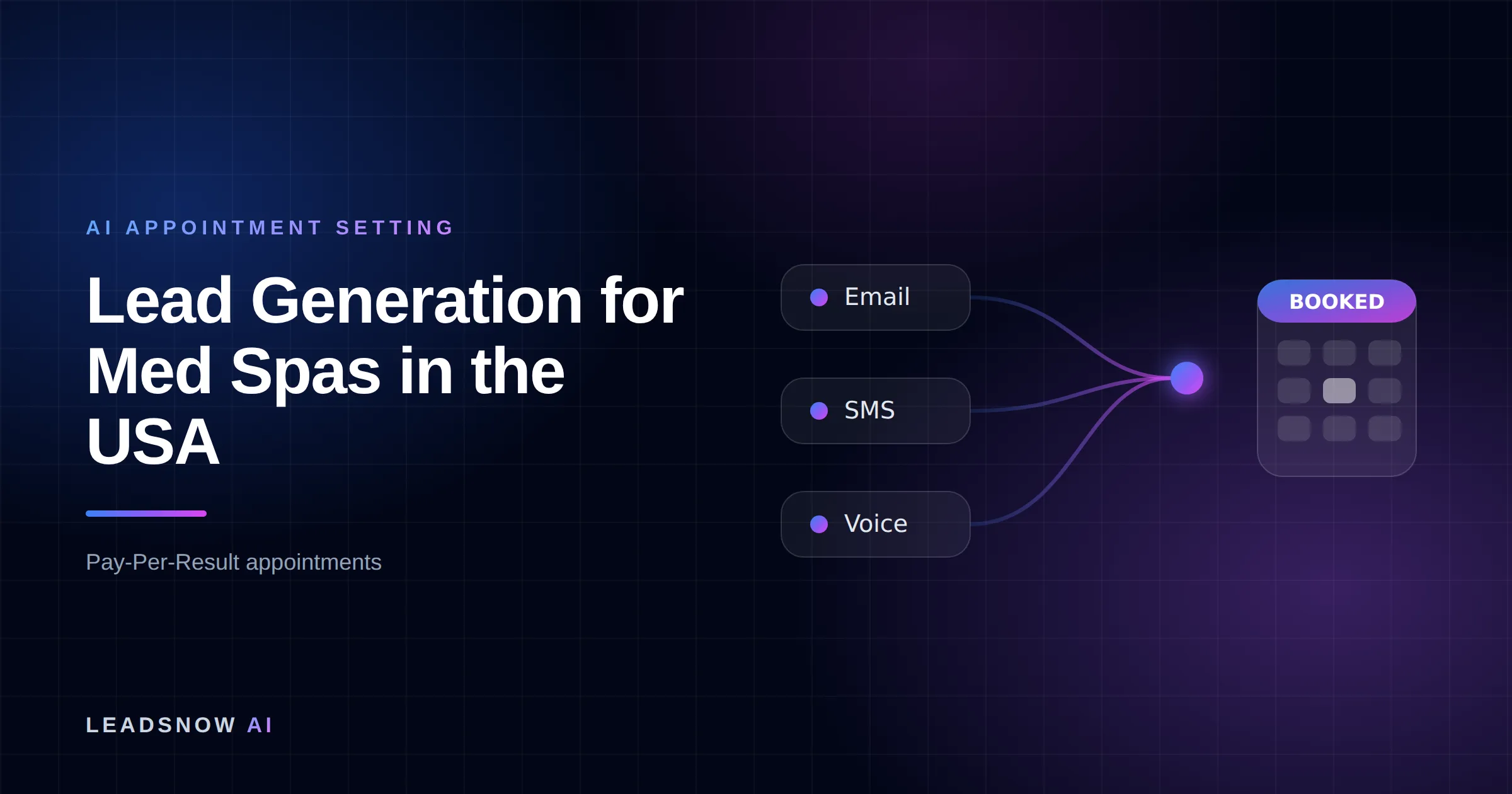
Lead Generation for Med Spas in the USA: Booked Consults, Not Just Clicks
A woman in Dallas searches “lip filler near me” at 9:40 on a Tuesday night, finds your med spa, and fills out the consult form. What happens in the next five minutes decides whether she becomes a Botox-every-twelve-weeks patient worth thousands a year — or books with the injector two miles away who texted her back first. Most med spas lose that race not because their work is worse, but because nobody was answering. This page is about fixing that: how the US med spa market actually generates clients in 2026, which lead channels are worth your money, and how a med spa marketing agency built on pay-per-result appointment setting changes the math.
At a glance
Med spas get more clients by answering every consult inquiry within minutes, qualifying each lead for treatment fit and budget before booking, and following up persistently on quotes, memberships, and lapsed patients. LeadsNow AI runs that entire system — instant AI response, qualification, and booking — on a pay-per-result model: you pay for booked, qualified consultations.
- Who this is for: US med spa owners — injectables, laser, body contouring, memberships — anywhere a booked consult is the unit of growth.
- The two pain points we attack: slow speed-to-lead and consult no-shows.
- Compliance posture: HIPAA-aware and TCPA-aware by design — consent-based contact, no patient health data in ad targeting, opt-outs honored.
- Track record: 50,769+ AI-booked sales appointments since 2017 and 1M+ leads generated, across industries.
- Who runs it: LeadsNow AI — headquartered in Melbourne, Australia, serving US clients fully remotely on US business hours.
- Next step: Book a call — you pick the slot, no phone tag.
How it works
How an AI sales agent books your appointments
Six channels feed in
Outbound email, SMS, voice and social — plus inbound search and AI referrals from our own AI SEO and chat agents.
Your list or CRM
Outbound starts from data you already own — past enquiries, dormant customers, or a targeted prospect list.
Qualified against your rules
Budget, timing and fit are checked before anything reaches your team, using criteria you set.
Booked into your calendar
Only qualified prospects reach the booking step, so your closers spend their time selling.
MAKE MORE SALES.
Pay-Per-Result pricing — We scale sales HARD aligned to your interests, better than anyone else.
The US med spa market: big, growing, and crowded
The American Med Spa Association (AmSpa) puts the US medical spa industry at more than $17 billion in revenue, growing by more than $1 billion a year. Its 2024 State of the Industry report counts more than 11,000 med spas employing over 100,000 people, with more than $4 billion in revenue and 30,000 jobs added in just three years.
Read those numbers the way a competitor would. Demand is real and compounding — but so is supply. Eleven-thousand-plus med spas means the patient searching for tox, filler, laser hair removal, or CoolSculpting in any US metro has more credible options than ever, and they all run Instagram ads. In a market like that, the winner is rarely the clinic with the best before-and-afters. It’s the clinic that answers first, books cleanly, and actually gets the patient through the door. That’s a systems problem, not a creative problem — and it’s the problem lead generation for med spas has to solve.
Want this done for you? We book qualified sales appointments on a Pay-Per-Result basis — you only pay for calls that actually land in your calendar.
Speed-to-lead: the short window on a high-intent consult
The lead-response research is old, famous, and still ignored by most front desks. A Harvard Business Review audit of 2,241 US companies found that firms trying to contact a web-generated lead within an hour were nearly 7 times more likely to qualify it than those that waited even an hour longer — and most companies, HBR concluded, aren’t responding anywhere near fast enough. The odds of reaching a prospect decay by the minute, not by the day.
Now map that onto a med spa’s reality. Your consult inquiries arrive at night, on weekends, and mid-afternoon while your coordinator is rooming patients and your injector is mid-syringe. Aesthetic purchases are also emotional and elective — the prospect who was excited about a body-contouring package at 9pm can talk herself out of it by morning, or be talked into it by whoever replied first. An AI agent that responds in seconds, by text and voice, holds the conversation while intent is at its peak and books the consult on the spot. That’s the core of our speed-to-lead automation for US businesses, tuned here for aesthetic inquiries: treatment interest, timing, budget comfort, and a confirmed calendar slot.
Med spa lead channels compared
Most med spas buy leads from some mix of four places. Each can work; they fail differently, and they leave different amounts of work on your front desk.
| Channel | What you pay for | Typical intent | Exclusivity | Who does the follow-up | Where it breaks |
|---|---|---|---|---|---|
| Paid social (Meta/Instagram, TikTok) | Impressions and clicks | Low to medium — interruption-based, often offer-driven | Yes, leads are yours | You — and these leads go cold in minutes | Volume of tire-kickers; wasted spend when nobody works the leads fast |
| Google Ads / local search | Clicks on high-intent searches | High — “botox near me” is a buyer | Yes, leads are yours | You — after-hours calls still ring out | Expensive clicks in competitive metros; intent wasted on slow response |
| Directories and shared-lead sites | Listings or per-lead fees | Medium — browsing and comparing | Often shared with competing clinics | You — racing other clinics to the same lead | Same inquiry sold to your rivals; price-shoppers by design |
| Pay-per-appointment (LeadsNow model) | Booked, qualified consultations | High — qualified before it reaches your calendar | Yes, exclusive to you | The AI agent — seconds-fast response, weeks of follow-up, reminders | Not the cheapest per contact — by design; wrong fit if you just want raw traffic |
The honest takeaway: the top three channels sell you inputs and leave the hardest part — response, qualification, follow-up, confirmation — on a front desk that already has a full-time job. The fourth sells you the output. If you’re pricing the difference, our US cost-per-lead benchmarks for 2026 break down what leads actually cost by channel and why cost-per-lead is the wrong number to optimize anyway.
If we can’t make you money, we don’t deserve yours.
Pay-Per-Result pricing — performance-based alignment.
No-shows: the silent tax on aesthetic calendars
Booking the consult is half the job. Elective aesthetic appointments are among the easiest in healthcare to skip — no symptoms force the visit, and cold feet are real. Even in adjacent specialties the leakage is measurable: a peer-reviewed study of an outpatient plastic surgery clinic found a 13.84% no-show rate — roughly 3 missed appointments per clinic day. For a med spa, every empty consult slot is an injector standing idle and a marketing dollar written off.
The fix is unglamorous and systematic: confirm immediately at booking, remind by text and voice at sensible intervals, make rescheduling one tap instead of a phone call, and re-engage the no-show the same day instead of letting the lead die. Humans do this inconsistently; an AI agent does it every time, for every booking. Our AI voice agents for US sales teams handle the confirmation and reminder calls in a natural voice, catch the “actually, can we move it to Thursday?” replies, and keep your calendar honest — so the consults you paid to generate actually happen.
HIPAA-aware marketing, without the overclaim
Here’s the careful version, because vendors routinely get this wrong in both directions. Whether HIPAA formally applies to your med spa depends on whether you transmit health information electronically in connection with HIPAA-covered transactions — typically electronic insurance billing. Per the HIPAA Journal’s guidance for medical spas, a med spa that bills electronically is a covered entity; a purely cash-pay operation that never touches a covered transaction may technically fall outside HIPAA. Many med spas are covered, many aren’t sure, and the penalties for guessing wrong are steep — so ask your healthcare attorney where you stand, not your marketing agency.
What a marketing partner can control is how it behaves either way. Even where HIPAA doesn’t technically apply, patient trust does, and state consumer-health-privacy laws increasingly treat health-adjacent data as sensitive. So we operate HIPAA-aware by default for med spa clients:
- No patient health data in ad platforms. Lead follow-up runs on contact details and the prospect’s own stated interest — not treatment histories, photos, or anything resembling a medical record.
- Photos and testimonials only with valid written authorization. For covered entities, using an identifiable patient photo in marketing requires a compliant HIPAA authorization — per the same HIPAA Journal guidance. It’s good practice even if you’re not covered.
- Careful public replies. Even confirming someone is a patient in an Instagram comment can be a disclosure. The AI agent moves conversations to private channels fast.
- TCPA discipline on top. The FCC’s February 2024 ruling classified AI-generated voices as “artificial voices” under the TCPA, so we work consented, inbound-driven leads only — your form fills and ad responders, never cold lists — with opt-outs honored on every channel.
Any agency that promises to “handle HIPAA for you,” or that waves the question away entirely, is telling you something important about how carefully they’ll handle your patients.
Qualification beats volume when a consult is worth this much
A med spa consult isn’t a cheap lead — it’s a seat in front of a licensed provider whose time bills by the syringe and the session. Behind a good consult sits a patient who may return every quarter for tox, add filler, graduate to laser packages or a membership. The lifetime value is why qualification matters more than lead count: twenty raw inquiries that produce three flaky consults lose to eight qualified prospects who show up ready to talk treatment plans.
This is also why we won’t race anyone to the cheapest cost-per-appointment. A rock-bottom price per booked consult almost always means the qualification filter got loosened to hit volume — and you pay the difference in no-shows, price-shoppers, and Groupon-hunters occupying your injector’s afternoon. We qualify tighter — treatment interest, timing, budget comfort, distance from your clinic — which can make each booked consultation cost more, deliberately. The number that matters is what a converted patient returns against what the pipeline cost. Judge the model on that, not on the sticker price of a single meeting.
Proof, on the record
Numbers first: 50,769+ AI-booked sales appointments since 2017 and 1M+ leads generated. Behind those totals sit 25 filmed client case studies — real operators on camera, not logo walls — and a 4.7 rating across 60 Google and Facebook reviews. Client work spans industries: Sam Tajvidi’s 121 Brokers, Marcus Wilkinson’s Iron Body, and teams at Colliers, Foundr, SheSells.online, and Lambda Academy.
We’ll be straight with you: those are cross-industry results, not med spa case studies. What transfers isn’t the industry — it’s the machine. Answering a high-intent inquiry in seconds, qualifying before booking, and following up for weeks works the same whether the appointment is a brokerage consult or a filler consult. The aesthetic-specific layer — treatment vocabulary, HIPAA-aware handling, no-show economics — is what this page describes, and it’s what we build into the agent before your first lead is touched.
Full disclosure on geography, because we’d rather you hear it from us: LeadsNow AI is headquartered in Melbourne, Australia, and serves US med spas entirely remotely. In practice that’s an advantage you’d otherwise have to staff for — the AI agents run on your patients’ clocks across all US time zones, campaigns get managed while your clinic is dark, and consults land directly in your US booking calendar. Response time doesn’t care about ZIP codes, and on that measure this system doesn’t sleep.
Frequently asked questions
How do med spas get more clients?
By treating response speed and follow-up as the growth lever, not just ad spend. Answer every consult inquiry within minutes, qualify for treatment fit and budget before booking, confirm and remind to protect against no-shows, and re-engage quotes and lapsed patients systematically. Ads generate inquiries; the booking system turns them into patients.
Does HIPAA apply to med spa marketing?
It depends on your operation. A med spa becomes a HIPAA covered entity when it transmits health information electronically in connection with covered transactions — typically electronic insurance billing — while a purely cash-pay spa may technically fall outside HIPAA. Confirm your status with a healthcare attorney. Either way, we market HIPAA-aware: no health data in ad targeting, written authorization before any patient photo is used, and private-channel conversations by default.
Do you have med spa clients or case studies?
Our named case studies are cross-industry — 25 filmed client case studies including 121 Brokers, Iron Body, Colliers, Foundr, SheSells.online, and Lambda Academy — not med spas, and we won’t pretend otherwise. The appointment-setting machine transfers directly; the med spa layer (aesthetic treatment vocabulary, HIPAA-aware handling, no-show reduction) is built in before launch.
How do you reduce consult no-shows?
Instant confirmation at booking, then text and natural-voice reminder calls at sensible intervals, one-tap rescheduling instead of phone tag, and same-day re-engagement of anyone who misses. Elective aesthetic appointments are easy to skip — even an outpatient plastic surgery clinic in a peer-reviewed study saw a 13.84% no-show rate — so confirmation has to be systematic, not occasional.
Can an Australian agency run lead generation for a US med spa?
Yes. The AI agents operate on US business hours and your patients’ time zones regardless of where the agency sits, and consults book straight into your US calendar. LeadsNow AI is Melbourne-headquartered and serves US clients fully remotely — what matters is US-market fluency in messaging, TCPA and HIPAA-aware compliance, not the office’s ZIP code.
Why does pay-per-appointment cost more per contact than buying leads?
Because you’re buying a different product. A lead is a contact record you still have to chase, qualify, book, and confirm; an appointment is the finished output with the qualification already enforced. Tighter qualification can raise the cost per booked consult — and raises the share of consults that become patients. Judge it on what a converted patient returns, not the price of a single meeting.
Your next consult inquiry is already on its way
Somewhere in the next day or two, someone in your metro will search for the exact treatments you offer and submit a form — yours or a competitor’s. The research says lead value decays within the first hour — and in practice, the clinic that answers first gets the consult. We make that window automatic: HIPAA-aware, TCPA-compliant, qualified, confirmed, and booked — and you pay when the appointment actually lands. Book a call and we’ll walk through your lead flow, your show-rate, and whether pay-per-result fits your clinic.
Comparing agencies? See the best lead generation agencies for US cosmetic and med spa clinics.
Membership and longevity practices face a different fee-structure question; our guide to the best lead generation agencies for US longevity and concierge clinics explains it.
Pay-Per-Result appointments
See if we’re a fit
We book qualified sales appointments for you and you pay on results, not retainers. Our booking page asks a few quick questions so you find out in two minutes whether that model suits your business.
- 50,769+ appointments booked without cold calling.
- Pay-Per-Result pricing — you pay for booked, qualified calls.
- Pick your own time on our live calendar, no phone tag.