
Sooner or later a client asks the question every agency owner recognises: “the traffic is fine — can you just get us the meetings?” You either say yes and find someone to run it behind your brand, say no and watch the account drift toward whoever will, or build an outbound team you did not plan on owning.
This is not a pitch for a partner programme. It is how white-label lead generation is actually structured, what breaks in it, and when reselling beats simply referring. We fulfil behind agency brands, so we have watched all three outcomes from that side.
The short answer: White-label lead generation means a specialist runs the campaigns and books the meetings while the agency keeps the client relationship and puts its own brand on the work. It is one of three viable models — refer, white-label, or build in-house — and it only pays when the agency has the deal values, an account owner who can hold the room, and an escalation path that works in hours. Our own partner terms are agreed case by case rather than published.
The three models, and what each one really costs you
Refer and take a fee. You introduce the client, the specialist contracts with them directly, and you are paid for the introduction. No fulfilment risk, no support load, no brand exposure. You also give up the margin, the recurring revenue line, and a piece of the relationship — the specialist is in your client’s inbox every week now, and you are not.
White-label and resell under your own brand. You contract with the client, the specialist fulfils invisibly behind you, and the client sees your logo on the reporting. You keep the relationship and the revenue line, and you own every problem: the slow week, the lead the client calls unqualified, the calendar that stayed empty in month one. The sub-contractor’s bad Tuesday is your bad Tuesday — as far as your client is concerned, you are the vendor. How you price it onward is a separate decision, worth reading alongside pay-per-result versus retainer.
Build in-house. You hire the operator, buy the stack, own the data and keep the margin. This is the right answer more often than the outsourcing industry admits — but only above a volume threshold. Below it you are paying a salary to run three campaigns, and an operator learning from three accounts learns slowly. Our own advantage came from the opposite situation: running roughly a hundred gym accounts at once meant a pattern that would take one operator two quarters to confirm showed up in days, then applied across every account. That is a volume effect, and it does not arrive with the software.
Affiliate and revenue-share deals on self-serve tools get lumped in here. Nobody is accountable for an outcome in that model, so it is a different business.
How it works
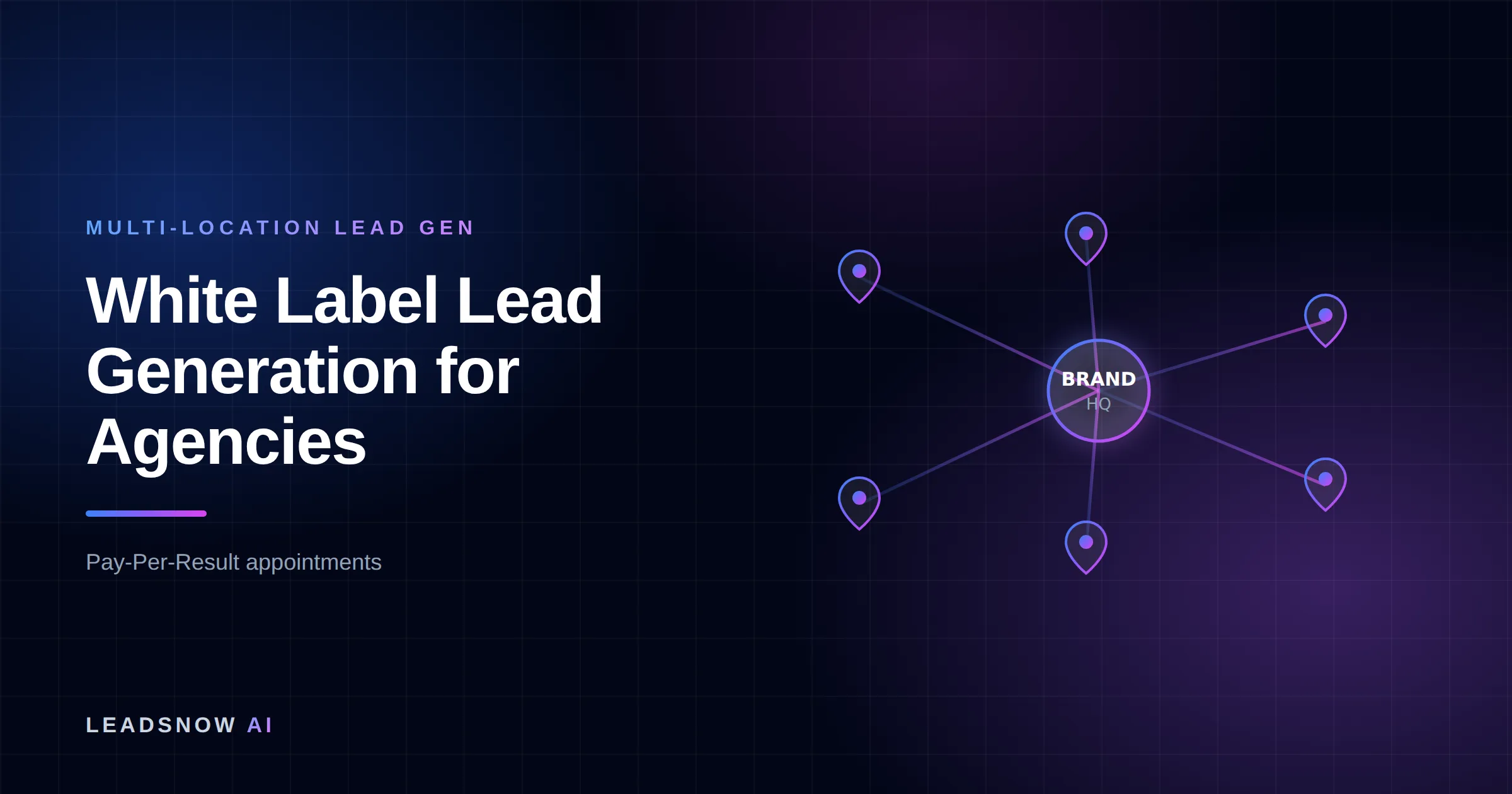
How lead generation works across a multi-location network
Head office sets the rules
Brand standards, qualification criteria and messaging are defined once, centrally.
Campaigns run per territory
Each location gets its own outreach, without every operator building their own marketing.
Leads routed by location
A prospect reaches the location that can actually serve them — the part that usually breaks at scale.
Per-location reporting
Head office sees which territories convert and which need support, instead of one blended number.
MAKE MORE SALES.
Pay-Per-Result pricing — We scale sales HARD aligned to your interests, better than anyone else.
Refer, white-label or build: the honest comparison
| Refer | White-label | Build in-house | |
|---|---|---|---|
| Who the client contracts with | The specialist | You | You |
| Whose brand is on it | Theirs | Yours | Yours |
| Who fulfils | The specialist | The specialist, invisibly | Your team |
| Who the client blames in a bad month | The specialist | You — entirely | You |
| Revenue shape | One-off or trailing fee | Recurring line you own and price | Recurring, minus payroll |
| Time to first campaign | Days | Weeks | Months, then a learning curve |
| Support load on you | None | Full front line, with a delay behind you | Full, but no delay |
| Who owns the performance data | The specialist | Negotiated — settle this in writing | You |
| Best when | One-off client need, or outside your core service | Several clients want it and you can hold the account | It is becoming your main business |
| Worst failure mode | You get disintermediated | You carry blame for work you cannot see | You fund a team below its learning threshold |
Want this done for you? We book qualified sales appointments on a Pay-Per-Result basis — you only pay for calls that actually land in your calendar.
What actually goes wrong in white-label arrangements
The accountability gap. When results dip — and every outbound programme has a flat fortnight — the agency is on a call explaining numbers it did not produce, while the specialist diagnoses the dip against data the agency cannot see. Two people work the same problem in different rooms and the client watches only one. The fix is a named counterpart on the fulfilment side who joins your client call when asked, and a shared view of the raw numbers rather than a monthly summary.
The client finds out. Usually, eventually — a number range they recognise, a confirmation with the wrong sender domain, a caller who names the underlying provider. Survivable if you never claimed to build it yourself; not survivable if you did. Reselling specialist fulfilment is normal. Pretending you have an in-house AI team is the part that ends relationships, and the part regulators care about.
Support latency. Your client emails at 9am, you email the sub-contractor, they reply at 2pm, you reply at 3pm. A twenty-minute answer took six hours, and the client experiences that as your agency being slow. Ask about response commitments and time-zone coverage before signing.
Uneven quality across the sub-contractor’s book. Most fulfilment partners are excellent in the verticals they know and mediocre in the ones they are learning on your client. Ask which industries they have real volume in and be suspicious of a yes to every category — the questions worth asking are in how to evaluate AI setter vendors. We are strong in high-ticket services and high-consideration consumer purchases, and we decline some categories.
Definition drift on “qualified”. The most common cause of these relationships going bad is that nobody wrote down what counts as a qualified booked call. Three months in, the client is counting shows and the partner is counting bookings, and both are right. Agree the criteria in writing before launch — ours are published in our methodology for that reason.
What you need in place before reselling makes sense
Client deal values that carry the cost. Qualified booked conversations are not cheap, because tight qualification is expensive to do. Fine when a closed deal is worth thousands; poor when it is worth a few hundred. If your client base is mostly low-ticket, refer or decline.
Someone who can hold the account. Not a project manager forwarding emails — someone who can read a conversion report, tell a list problem from a script problem, and push back on both the client and the fulfilment partner. Without them the arrangement degrades into message-passing and the client feels it within a quarter. It is the same operator question covered in who should run your AI appointment setter.
A written escalation path. Who you call, how fast they answer, and at what point the fulfilment partner joins a call with your client under your brand. Decide it while everyone is happy.
Enough clients to make it a line, not a favour. One client wanting appointment setting is a referral. Four or five justifies building process around it. That is a judgement about your own business, not a threshold anyone imposes on you.
Clarity on data and compliance. Whose consent record it is, where the data is processed, who answers a complaint. If your fulfilment partner is offshore that is a legal question, not just an operational one — see the FAQ.
If we can’t make you money, we don’t deserve yours.
Pay-Per-Result pricing — performance-based alignment.
When referring is simply the better call
Refer when the client’s deal value will not support done-for-you outbound. Refer when it is a one-off you will never build process around. Refer when the client will want a direct relationship with whoever runs their pipeline anyway — you look better having suggested it. Refer when you cannot staff an account owner within the month.
Build in-house when this is becoming your business rather than an add-on. Some of the best agency outcomes start as a white-label line and end with the agency hiring the operator and licensing the stack. If that is the direction, say so early. Software versus done-for-you lays out that trade-off.
Where the fit usually is
Because we fulfil rather than advise, we can be specific about where agency-resold appointment setting works. High-ticket coaching and education — Foundr, SheSells.online, Lambda Academy, Marcus Wilkinson’s Iron Body. Mortgage and finance broking, where Sam Tajvidi’s 121 Brokers is a long-running account. Property and real estate, including the dormant-database reactivation work that came out of our Colliers-era campaigns — often the fastest first win an agency can hand a client. Plus trades, gyms, and professional services where one job is worth thousands. US agencies weighing whether to resell at all, or to fix their own new-business pipeline first, will find the demand-side view in lead generation for marketing agencies in the USA.
Paid-media agencies are an obvious fit, because they are the ones asked to explain why the leads did not convert — a problem that lives after the click. Their own client acquisition is a separate problem, and we wrote that one up in lead generation for PPC agencies.
Since 2017 the engine behind this has booked more than 50,769 AI-booked sales appointments and generated over a million leads. A typical result of moving an underperforming account onto it is roughly 2% to about 8% conversion on the same traffic, and where a client already had a setter system we have in some cases beaten it by five times. We have 25 filmed case studies and a 4.7 rating across 60 Google and Facebook reviews. Those are our operating numbers, not a guarantee for any account.
Our partner terms
We do not publish them, and we are not going to invent a tier table for a web page. Commercial terms — pricing, who carries what, how reporting looks under your brand — are agreed per partner, because they depend on your client base, categories and how much of the account you hold. The one thing we say publicly, on our agency page, is that we sit behind your brand and do not contract directly with your underlying client. Everything else is settled with you in writing before anything launches. For specifics, book a call — including if the honest answer is that referring suits you better.
The SaaS/OEM version of this — supplying the tuning layer behind a platform’s own interface rather than reselling a service — is covered in the AI setter learning engine for SaaS platforms and agencies.
Frequently asked questions
What is white-label lead generation?
A specialist provider runs the lead generation or appointment setting and the agency sells it under its own brand. The agency contracts with the client, sets its own pricing and owns the relationship; the provider fulfils invisibly. It differs from a referral, where the client contracts with the provider directly, and from a reseller arrangement, where the provider’s brand stays visible.
Will the client work out that we are not doing the work ourselves?
Often, yes — through caller ID, sender domains or an offhand remark. Plan for it rather than against it. Reselling specialist fulfilment is ordinary and defensible; claiming an in-house capability you do not have is not. In Australia the ACCC states that any claim a business makes about its services must be accurate, truthful and based on reasonable grounds, and that it makes no difference whether a business intended to mislead.
Who is responsible when the campaign underperforms?
Contractually, whoever your agreement says. Practically, you are — your client bought from you. That is the real cost of white-labelling, and why the escalation path matters more than the pricing. Ask a prospective partner what happens in week six of a campaign that is behind.
What happens to our client’s data if the fulfilment partner is offshore?
If your agency is covered by the Privacy Act, it becomes your responsibility as well as theirs. The OAIC’s guidance on Australian Privacy Principle 8 is explicit: an entity that discloses personal information to an overseas recipient is accountable, in certain circumstances, for an act or practice of the overseas recipient that would breach the APPs — accountable meaning the act is taken to have been done by the entity itself. It adds that where a subcontractor may be engaged, the entity should take reasonable steps to ensure the subcontractor does not breach the APPs. Exceptions apply, and it does not cover recipients with an Australian link, but the default is that handing over the data does not hand over the obligation.
Should we white-label or just build the capability in-house?
Build in-house if outbound is becoming your primary service and you have enough accounts for an operator to learn from. White-label if you want the revenue line without the hiring risk, or want to prove demand before committing payroll. The mistake is building for three accounts — not enough volume for anyone, human or model, to learn from.
What are your white-label rates and margins?
We do not publish them. Terms are agreed per partner because they depend on your client mix, categories and how much of the account you hold. We would rather quote you accurately than have you plan against a number from a web page. Book a call.
Can we white-label part of it and keep the rest?
Usually, and it is often the smarter start. Common splits: the specialist runs the conversations and booking while the agency keeps paid media and creative, or the specialist handles only database reactivation on the client’s dormant records. Reactivation is a good first piece because it works on data the client already owns, so nothing waits on new ad spend.
Adding this as a service line? We will tell you honestly whether your client base supports it or whether referring is the better call. Terms are worked out per partner — see our agency page, then book a call.
Pay-Per-Result appointments
See if we’re a fit
We book qualified sales appointments for you and you pay on results, not retainers. Our booking page asks a few quick questions so you find out in two minutes whether that model suits your business.
- 50,769+ appointments booked without cold calling.
- Pay-Per-Result pricing — you pay for booked, qualified calls.
- Pick your own time on our live calendar, no phone tag.