
Put six AI appointment setter vendors on a spreadsheet and score them on features. Outbound voice? All six. Two-way SMS? All six. Calendar integration, CRM sync, objection handling, call recordings, custom scripting? All six, every time. The grid comes back a wall of ticks and you are exactly where you started — except now you feel like you did the work.
That is the evaluation trap. The feature list is where buyers go because it is the only thing easy to compare, and precisely the thing that has become identical across the category — a Toyota and a Ferrari both tick four wheels, an engine and a steering wheel. Our software-versus-done-for-you comparison makes that case at category level. This is the practical version: the questions that discriminate, what a real answer sounds like, and how to design a pilot that can tell you no.
The short answer: A feature grid cannot separate AI appointment setter vendors, because every serious vendor ticks every box. Evaluate on the six things the grid never shows: evidence of outcomes on accounts like yours, a named person accountable for the number, what happens in month three when performance dips, what the system actually learns from, how failure is defined and paid for, and what you keep if you leave. Then run a pilot designed to produce a clear no.
Why does comparing features never separate two AI setter vendors?
Because the features are not the product. Almost every vendor assembles the same components: a foundation model from one of three providers, a telephony layer, a messaging layer, a calendar API and a CRM connector. Those parts are commodity, and any competent team can ship the demo you will be shown.
What differs sits underneath: the quality of the data the system reasons from, and the judgement of whoever reads the results each week and changes something. Neither is visible in a demo, and neither is volunteered unprompted.
Feature parity also pushes the comparison onto the one remaining visible axis — monthly cost. Cheap tools genuinely do the demo; they just tend to stall at a conversion rate you did not choose, which our sibling page on why cheap AI setter tools plateau covers in full.
How it works
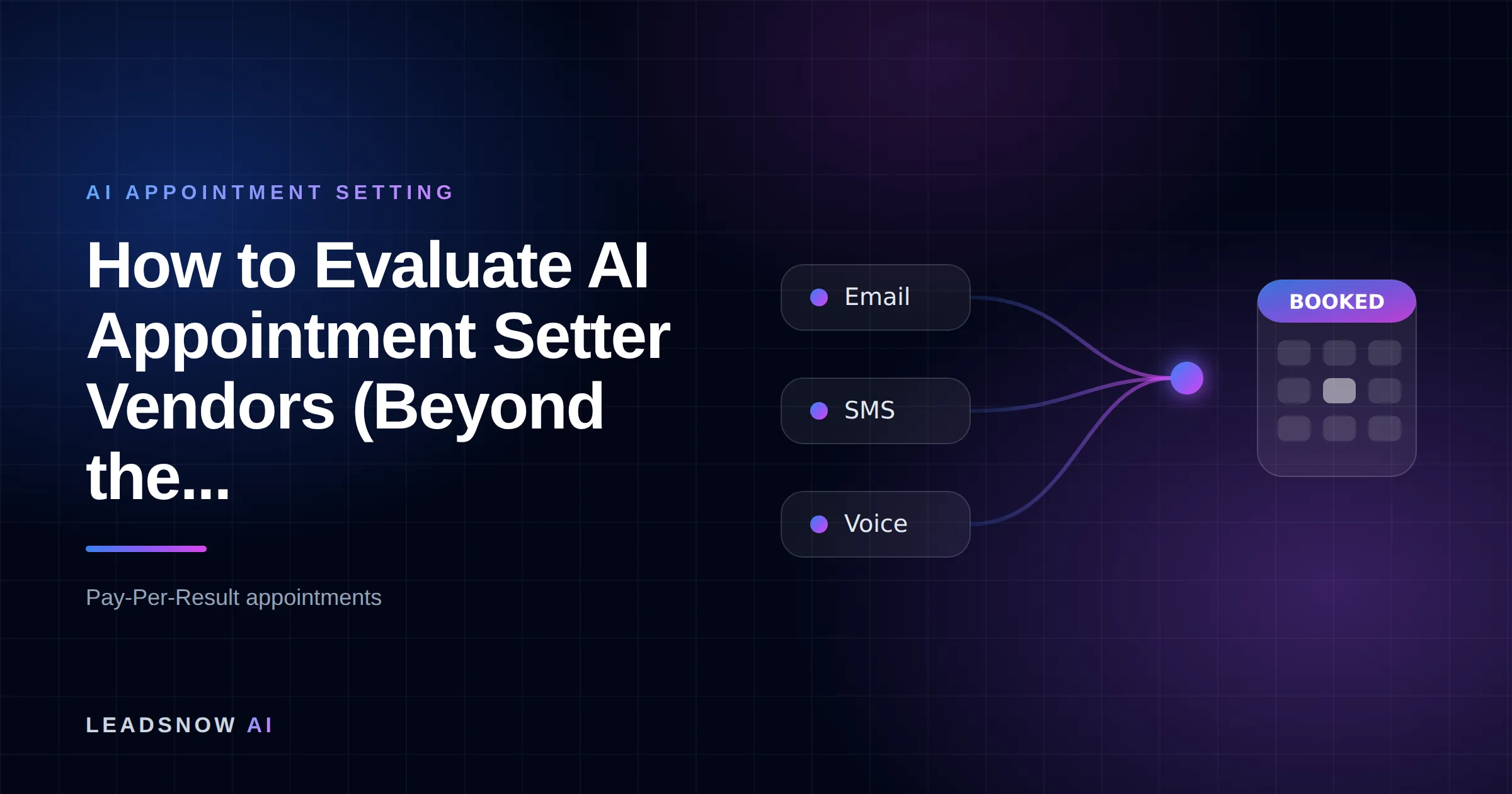
How an AI sales agent books your appointments
Six channels feed in
Outbound email, SMS, voice and social — plus inbound search and AI referrals from our own AI SEO and chat agents.
Your list or CRM
Outbound starts from data you already own — past enquiries, dormant customers, or a targeted prospect list.
Qualified against your rules
Budget, timing and fit are checked before anything reaches your team, using criteria you set.
Booked into your calendar
Only qualified prospects reach the booking step, so your closers spend their time selling.
MAKE MORE SALES.
Pay-Per-Result pricing — We scale sales HARD aligned to your interests, better than anyone else.
What questions actually separate AI appointment setter vendors?
Six, in order.
1. Can you show me outcomes on accounts that look like mine?
Not logos, not a testimonial slide. Accounts with a similar deal size, sales cycle and list condition, with the before number and the after number, and ideally a client who will take your call.
When you get a reference, skip “are you happy?” and ask what broke, how long the vendor took to notice, and who told whom. Every account has a bad stretch; how it was handled is the only reference answer with information in it. Ask for a client who left, too.
The trap here is generic proof. Impressive results in high-volume, low-consideration B2C tell you almost nothing about a business selling a six-figure engagement over eleven weeks. Ask them to name the closest analogue in their book and then explain where your situation differs from it. A good vendor volunteers the differences before you find them.
2. Who is personally accountable for the number, and what is their name?
Ask who reviews your campaign each week, how many other accounts that person carries, and what they can change without a support ticket. “Our team” is not an answer. If nobody is named, nobody is accountable, and you have bought software with a service-shaped invoice. Who that person should be — internal hire, VA or specialist — is covered in who should run your AI appointment setter; for evaluation you only need to establish that they exist and have a name.
3. What happens in month three, when performance dips?
This is the question most buyers never ask, and the most predictive one on the list. Every campaign dips: lists fatigue, an opener stops working, a competitor changes their offer.
You are asking for a described process, not reassurance. What is the trigger threshold? Who gets told, and how fast? What is the first diagnostic — list, offer, script or agent? Vendors who have actually operated campaigns describe this fluently. Vendors who have only sold software talk about optimisation in the abstract.
4. What does the system actually learn from?
Ask for the specific mechanism. If the answer is that the AI improves with every conversation, ask what changes: model weights, a retrieval store, a prompt document, or a human editing a script. All four are legitimate; only one is what most buyers think they are being sold. Then ask whether it learns from your account alone or across many — the subject of our page on cross-account learning in lead generation. For evaluation, just get a straight answer and write it down.
5. How do you define failure, and what does it cost you?
Get the definition of a billable outcome in writing, then the definition of a failed one. Does a no-show still get invoiced? Does an unqualified booking? What is the remedy — replacement, credit, or nothing?
The sharper version: what does a bad quarter cost the vendor? On a pure retainer, nothing. On pay-per-result, a great deal. Neither is automatically correct — retainers can buy deeper work on a long sales cycle, and our pay-per-lead versus pay-per-appointment comparison sets out the trade-offs — but know which way the incentive points before you sign. For the show-rate half of this question, see judging a vendor on show rate.
6. What do I own if I leave?
Exit terms tell you more than an onboarding deck. Who owns the call recordings and transcripts? Do you get the enriched list back, or only the records you supplied? Are the numbers and sender IDs yours or theirs? What is the notice period, and does anything auto-renew?
Reluctance here usually means switching costs are the retention strategy.
Want this done for you? We book qualified sales appointments on a Pay-Per-Result basis — you only pay for calls that actually land in your calendar.
What does a good answer sound like, versus a deflection?
Deflections are rarely lies. They are true statements at the wrong altitude: accurate, agreeable and impossible to act on.
| The question | A good answer sounds like | A deflection sounds like |
|---|---|---|
| Outcomes on accounts like mine | A named comparable account at a similar deal size and sales cycle, its before-and-after numbers, a case study you can actually watch, and an unprompted account of where your situation is harder than theirs. | “We work with hundreds of clients across every industry and we see great results.” |
| Who is accountable | A named person, their account load, and what they can change without escalating. | “You will have a dedicated success team and a shared Slack channel.” |
| Month three dip | A trigger threshold, a diagnostic order, a testing cadence and a named owner. | “We continuously optimise and iterate based on the data.” |
| What it learns from | A specific mechanism, named, with an honest statement of what is human and what is automated. | “Our AI gets smarter with every single conversation.” |
| Definition of failure | A written billable-outcome definition, a no-show policy, and what a bad quarter costs them. | “We only succeed when you succeed.” |
| What you own on exit | Recordings, transcripts, enriched data, numbers and notice period, itemised. | “Nobody ever leaves, so it has not really come up.” |
One caution: a polished answer is not proof. Vendors who sell a lot get good at these questions. Use the answers to decide who is worth a pilot, not who wins.
What should I ask for in a pilot?
Most of the value in an evaluation sits in the pilot design, and most pilots are built so they cannot fail. That is the failure. MIT Project NANDA’s July 2025 report on enterprise generative AI found that 60 percent of organisations evaluated enterprise-grade GenAI systems, 20 percent reached pilot stage and just 5 percent reached production. That is enterprise software broadly, not appointment setting — methodology and limits are in the FAQ below — but the shape is familiar: much evaluating, little surviving contact with production.
A pilot worth running has five properties.
- One success metric, agreed in writing, before it starts. Qualified meetings that held, or closed revenue. Not conversations, not connects, not “engagement”.
- A pre-agreed kill threshold. If the number is below X at day 30, you stop. Write it down while you are still unattached to the outcome.
- Enough volume to mean anything. A pilot on 200 records tells you about variance, not performance.
- Your worst segment, not your best. Everyone books meetings out of a hot list. Run the pilot on a cohort you have already given up on.
- Access to raw call recordings, not a dashboard. Ten failed calls will teach you more about a vendor than a hundred wins.
If we can’t make you money, we don’t deserve yours.
Pay-Per-Result pricing — performance-based alignment.
What would we want you to ask us?
Fair is fair. If you are evaluating LeadsNow, these are the questions we would want on the table.
Show me accounts like mine. We have 25 filmed client case studies, and the clients we can name span finance broking (Sam Tajvidi at 121 Brokers), commercial property (Colliers), fitness (Marcus Wilkinson at Iron Body), and online education and coaching (Foundr, SheSells.online, Lambda Academy). Ask for the closest match to your deal size and sales cycle, and push back if the match is loose. Our 4.7 rating across 60 Google and Facebook reviews is public and easy to check.
What is your typical result, honestly? Moving an account from roughly 2% to roughly 8% conversion on the same traffic is our typical outcome, and we have beaten a client’s existing setter system by five times. Those are our operating numbers, not a guarantee, and they depend heavily on offer strength and list quality. Since 2017 we have generated over 1M leads and booked more than 50,769 AI-booked sales appointments.
What does failure cost you? We are paid on booked and qualified outcomes rather than a pure retainer, so an underperforming month is expensive for us. That is real alignment, and also why our cost per booked call is usually higher than a volume vendor’s — we qualify harder before anyone reaches a calendar.
When are we the wrong call? If your offer has not yet converted for a human salesperson, we will scale a problem rather than fix one. If your volume is low enough that a one to two point conversion gain is not worth real money, a self-serve tool plus someone competent internally is better value, and we will say so on the call. And if you want a pure retainer with no outcome exposure, we are not structured for it.
Two of the questions above deserve their own treatment: how to design a pilot that can actually fail, and what you own when you leave a vendor.
Frequently asked questions
What is the one question most buyers forget to ask an AI appointment setter vendor?
What happens in month three when performance dips. Everyone asks about onboarding and nobody asks about the trough. Ask for the trigger threshold, the diagnostic order, the testing cadence and the named person who owns it. Operators answer this in specifics because they have lived it.
Do AI pilots usually make it into production?
Often not. MIT Project NANDA’s July 2025 report, The GenAI Divide: State of AI in Business 2025, reports that 60 percent of organisations evaluated enterprise-grade generative AI systems, 20 percent reached pilot stage and 5 percent reached production. It describes itself as preliminary findings based on 153 survey responses, 52 structured interviews and 300-plus publicly disclosed initiatives, and it covers enterprise AI broadly rather than appointment setting. Treat it as a directional warning about pilot design, not a benchmark for this category.
Who is legally responsible if my AI setter vendor breaches telemarketing rules?
In Australia, you are. The ACMA states plainly on its telemarketing and e-marketing guidance that businesses cannot outsource their obligations under the spam and telemarketing laws through these arrangements, and that ultimately, the business is responsible. So ask any vendor how they handle consent records, Do Not Call Register washing and AI disclosure, and get the answer in the contract, because the exposure is yours either way.
How long should an AI appointment setter pilot run?
Long enough for a statistically meaningful sample on your list, which for most high-ticket businesses means four to six weeks and several thousand records, not a fortnight and a few hundred. The first two weeks are mostly spent discovering which of your assumptions were wrong. Judging on week one data is judging the setup, not the system.
Is a cheaper AI setter tool ever the right answer?
Yes, and often. If you have someone internally whose actual job includes owning the campaign, you are comfortable writing and testing scripts, and your volume is modest, self-serve software is good value and you should buy it. The failure mode is buying the tool and hoping somebody absorbs it. That produces the conclusion that AI setting does not work, when what actually happened is that nobody was driving.
Want to run these six questions at us? Bring the list. We will answer all six, including the parts where the honest answer is that you should buy a tool instead. Book a call.
Pay-Per-Result appointments
See if we’re a fit
We book qualified sales appointments for you and you pay on results, not retainers. Our booking page asks a few quick questions so you find out in two minutes whether that model suits your business.
- 50,769+ appointments booked without cold calling.
- Pay-Per-Result pricing — you pay for booked, qualified calls.
- Pick your own time on our live calendar, no phone tag.