
You can open a client account this morning, find the campaign that is bleeding and have the cost per acquisition down by Friday. Then you look at your own pipeline: a referral from March, a proposal that went quiet in June. Paid-media agencies have the sharpest version of the cobbler’s-children problem, because yours is the one trade that cannot claim it does not know how.
The short answer: A PPC agency’s own client acquisition is structurally harder than its clients’, because the buyer is marketing-literate, the switch is a technical migration rather than a decision, and the retainer is underwritten by account performance you only partly control. What actually fills a paid-media calendar is outbound to businesses already visibly spending, systematic reactivation of dead proposals, and referrals asked for on a schedule rather than hoped for.
Why your own acquisition is a different problem to your clients’
Not a discipline problem, and not a skills gap. Four things about selling paid media are genuinely different. A fifth, that running ads for yourself is more expensive than the ads you run for clients, is in the comparison below.
1. Your retainer is underwritten by a result you only partly own
You control the account. You do not control the client’s offer, landing page, follow-up speed, sales team, seasonality or the auction. When cost per lead drifts up for reasons outside the account, the client does not experience that as market conditions. They experience it as you. Churn therefore arrives faster and less predictably than on a creative book, so the pipeline has to refill continuously rather than after a bad quarter.
2. Switching agencies is a technical migration, not a decision
Prospects stall for a real reason. Google’s own documentation is explicit that unlinking a client account from a manager account leaves its campaign history intact, but shared remarketing lists relying on the manager’s tag stop populating and cross-account conversion tracking stops recording new conversions. The full list is in the FAQ below. A competent handover manages it, but it explains why a prospect who agrees with you still takes four months. Build for a consideration window measured in quarters: the follow-up layer matters more than the pitch.
3. You cannot sell a media buyer with media-buyer tactics
Your buyer built the funnel you are about to run at them. They know what a fake scarcity timer is and what your frequency cap is set to. Anything that smells like a tactic reads as a tell: if the growth engine were working you would not need the theatrics. What survives is a specific, checkable claim about a vertical you have actually worked in.
4. Referrals dry up exactly when you need them
Your best referrers are clients whose results you produced. When performance softens across a category — a platform change, a rate rise, a seasonal collapse in a vertical you are heavy in — those clients go quiet at exactly the moment your book thins. Referral flow correlates with the thing that causes churn, so it is the one channel that cannot be counter-cyclical. Our page on lead generation for marketing consultants covers the solo version.
How it works
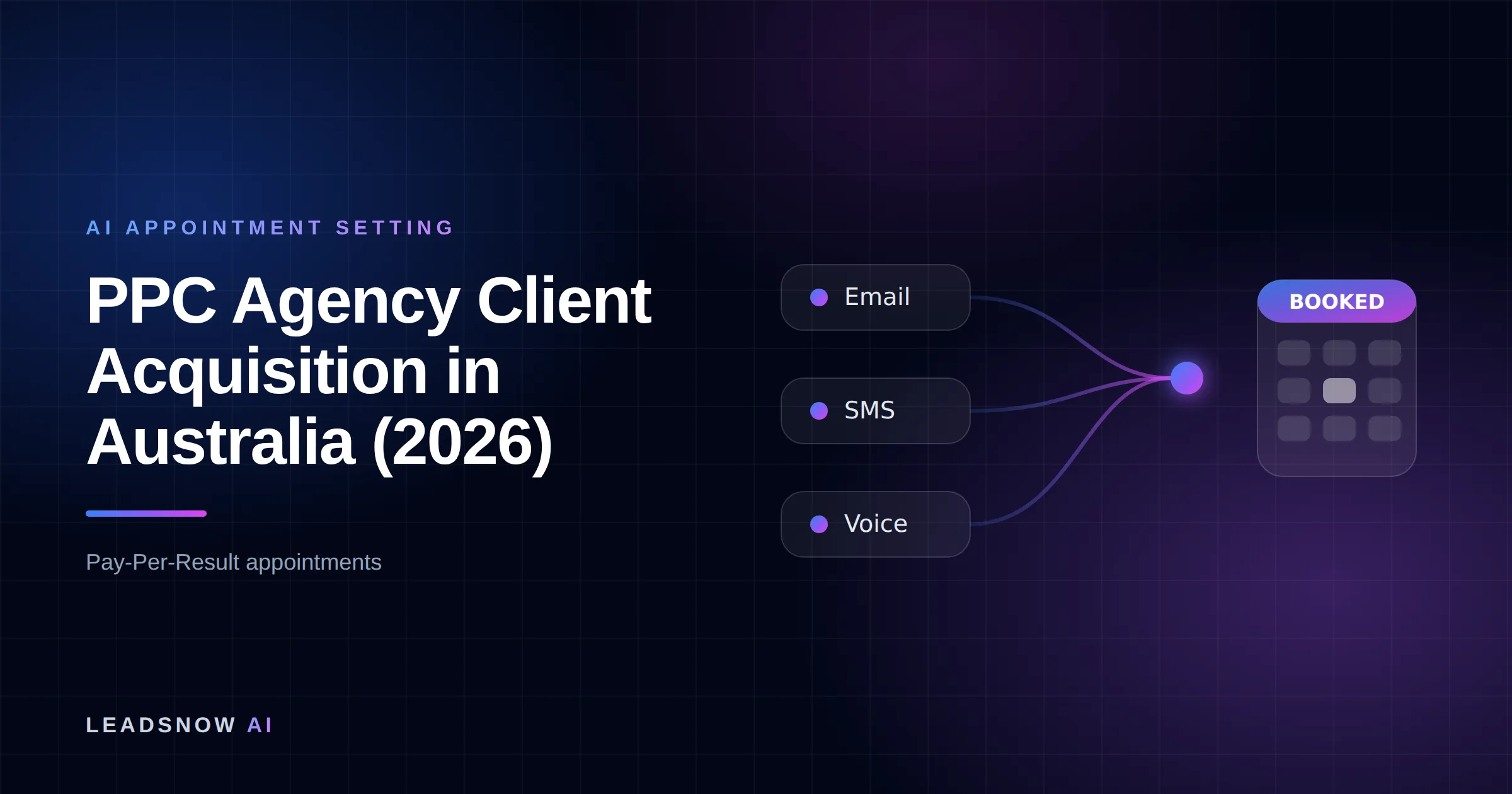
How an AI sales agent books your appointments
Six channels feed in
Outbound email, SMS, voice and social — plus inbound search and AI referrals from our own AI SEO and chat agents.
Your list or CRM
Outbound starts from data you already own — past enquiries, dormant customers, or a targeted prospect list.
Qualified against your rules
Budget, timing and fit are checked before anything reaches your team, using criteria you set.
Booked into your calendar
Only qualified prospects reach the booking step, so your closers spend their time selling.
MAKE MORE SALES.
Pay-Per-Result pricing — We scale sales HARD aligned to your interests, better than anyone else.
The Australian market context that matters to you
The pool of businesses already spending is large and broadening. IAB Australia’s Internet Advertising Revenue Report, prepared by PwC Australia, put the March quarter 2026 at $4.9 billion, up 15.3% year-on-year from $4.22 billion in Q1 2025. Search and Directories remained the largest segment at $2.16 billion, up 13.9% year-on-year and approximately 44% of total internet advertising expenditure. IAB Australia CEO Gai Le Roy said in the release: “Investment in Australian digital advertising remains solid, but the growth is coming from a broader base of advertisers than it used to.” She named SMEs, commerce-led businesses and new international entrants.
That is the prospecting thesis. Your addressable market is not businesses that might advertise; it is businesses demonstrably spending now. And you can see them: Google’s Ads Transparency Center lets you search by advertiser or website name and filter by date and targeted location, and Meta’s Ad Library does the equivalent. A list of advertisers running creative in your vertical is research, not a data purchase.
One caveat. The ACCC reported Google held nearly 94 per cent of general search in Australia as at August 2024, with Bing at 4.7 per cent. That is why your clients are there, and why one policy change can reprice your whole book in a quarter.
Want this done for you? We book qualified sales appointments on a Pay-Per-Result basis — you only pay for calls that actually land in your calendar.
How paid-media agencies actually win clients: an honest comparison
| Channel | Genuinely good at | Where it breaks for a paid-media agency | Time to result |
|---|---|---|---|
| Referrals and partner networks | Highest close rate; the technical trust question is pre-answered | Unschedulable, and correlated with the conditions that cause churn; partners eventually hire in-house | Lumpy; weeks to months between arrivals |
| Running your own paid ads | Fastest to switch on; doubles as a live proof asset | Expensive auctions, long consideration window; first thing paused when delivery gets busy | Weeks to leads; months to payback |
| Cold outbound to advertisers already spending | Targetable from public ad-library data; you can open with a specific observation about their live account | Volume-hungry; this audience spots a template instantly; needs consent handling under the Spam Act | 4–8 weeks to first meetings |
| Reactivating dead proposals and lapsed clients | Cheapest qualified conversation you own; they know your name, scope and pricing | Needs an honest CRM export and someone willing to work it; a bad reopen sounds desperate | Days to weeks — the fastest here |
| Marketplaces, white-label and subcontracting | Fills capacity quickly; larger accounts than you would reach directly | Margin haircut, no relationship of your own; you inherit someone else’s expectations | Weeks, then dependent on partner flow |
| Pay-per-result appointment setting | Runs outbound, qualification and long-cycle follow-up without your team’s hours | Unit price is higher than a click or a list; you still run the audit and close | Booked appointments typically within weeks |
None of these is wrong. The failure mode specific to this industry is treating referrals as the strategy and your own ads as the backup, then finding both correlate with churn.
The pile you are sitting on: dead proposals and lapsed clients
Every established paid-media agency has a graveyard: audits delivered and never converted, proposals that reached a second meeting and then silence, clients who paused “for a quarter” in 2024. It is usually a spreadsheet nobody opens, and it is the highest-yield asset in the building — every record is a business that already had budget, already had the problem, and already sat through your pitch.
The reasons they said no are perishable. The in-house hire has left; the cheap agency has delivered two bad quarters. Nobody monitors for those changes, which is why a reopen sent at random converts poorly and one sent with a reason converts well.
This is the mechanic we have the most measured history with. In our Colliers-era database reactivation work — commercial property, records most people had written off — campaigns against dormant data ran at a 4.4% average conversion with an 8.9% peak. A stale proposal list is a closer analogue to that than a cold list: known name, known context, prior conversation. The method is in how we hit 4.4% average and 8.9% peak on dormant CRM leads. That is our result in that context, not a guarantee for yours.
The agency version: export the last 36 months, tag by why each one died, and write a different opener per reason. “Your ads went quiet in March” beats “just circling back”, and a public ad library will tell you which is true.
If we can’t make you money, we don’t deserve yours.
Pay-Per-Result pricing — performance-based alignment.
Named proof, and where the method came from
We are a pay-per-result AI lead generation and appointment-setting agency: 50,769+ AI-booked sales appointments since 2017 and more than a million leads generated, 25 filmed client case studies, a 4.7 rating across 60 Google and Facebook reviews. The examples that transfer to an agency book are Colliers, where the dormant-database work above was run, and Sam Tajvidi at 121 Brokers — finance broking, a long-consideration sale much like an ad-management retainer.
The capability came from the gym era: running roughly a hundred gym accounts at once meant a pattern that would take one operator two quarters to confirm surfaced in days, then got applied across every account. If you run a portfolio of ad accounts, that is your own cross-account benchmarking argument applied to conversation data instead of auction data — more in cross-account learning in lead generation. Typical result of moving an account onto our engine is roughly 2% to about 8% conversion on the same traffic. Our operating experience, not a study.
Where AI-assisted outbound fits — and where it doesn’t
AI does not make outbound clever. It makes coverage and persistence economical: speed to lead on an inbound audit request, three follow-ups on a proposal instead of one, a reactivation pass across 1,800 dead records no human would work. Those are volume problems, and they are what quietly kills agency pipelines.
What it does not do is invent a position. If your pitch is “we manage Google and Meta ads”, more conversations produce more polite declines. Fix the vertical claim first. The same applies to anyone selling this to you: feature lists are identical across vendors, and the differences that matter are the learning layer and the operator — see evaluating AI setter vendors beyond the feature list.
Two structural options. Run it for yourself, on your dead proposals and outbound. Or resell it, so the appointment layer sits under the traffic you already buy and your reporting moves from leads delivered to meetings attended — the reposition Australian SEO agencies are making for different reasons, and under your own brand the white-label route. Define what qualified means before launch, and agree in writing who owns the relationship.
When it is the wrong call: at capacity with no delivery headroom, do not fill a calendar you cannot service. If your offer is undifferentiated in a crowded metro market, positioning is the cheaper fix. If referrals already produce more work than you can take, buy nothing — just ask them on a schedule.
Otherwise the fastest way to find out is a conversation about your dead-proposal list and your target vertical. Book a call and we will tell you plainly whether there is enough in it.
Frequently asked questions
Is cold outbound to Australian businesses legal if they are already running ads?
Running ads is not consent. The Spam Act 2003 governs commercial electronic messages, and the ACMA is direct: you must have consent before sending marketing messages; it can only be inferred in limited circumstances where the recipient knowingly and directly gave you their address and would reasonably expect marketing from your business; and it is up to you to prove you have it. Every marketing message you send must accurately identify your business — your correct legal name, or your name and ABN — and carry an unsubscribe option honoured within 5 working days. The ACMA also states that even if someone else sends your marketing messages for you, you must still have consent from each person who will receive them, so outsourcing does not outsource the obligation. See the guidance at acma.gov.au, and take legal advice on your specific program.
Why do PPC prospects take so long to switch, even when they agree with us?
Because it is a migration with real consequences and they know it. Per Google Ads Help on unlinking accounts from a manager account, the client account keeps its own campaign history, but shared remarketing lists relying on the manager’s tag stop populating, the account loses access to the manager’s shared lists, ad groups targeting those lists and campaigns excluding them stop running, and cross-account conversion tracking stops recording new conversions. Put the handover plan in the pitch instead of leaving the prospect to imagine it.
Should we just run our own Google and Meta ads to win clients?
Run some, but do not make it the pipeline. The commercial terms in this category are expensive, the consideration window runs into months, and your acquisition cost comes out of the margin you sell. The pattern that tends to work is a small always-on brand and retargeting layer supporting a direct outbound and reactivation motion that produces the meetings.
Where do we find Australian businesses already spending?
Public ad libraries. Google’s advertising policies documentation states you can search for an advertiser via the Ads Transparency Center using the advertiser or website name and filter your search results by details like date and targeted location; Meta’s Ad Library does the equivalent across its platforms. That gives you live creative and rough tenure, enough to write an opener that is specific rather than templated. It will not give you spend levels for ordinary commercial ads, so treat it as a targeting tool, not an intent score.
Does pay-per-result mean cheaper than a retainer?
Not per unit, and we would not claim it is. You are buying a qualified booked meeting rather than a list or a click, so the price per item is higher than any input you could buy. The comparison that matters is the ROI of a closed retainer against total acquisition cost. Tighter qualification raises cost per booked call and lowers cost per signed client, which is the trade most agency owners want once they have sat through a diary of tyre-kickers.
Pay-Per-Result appointments
See if we’re a fit
We book qualified sales appointments for you and you pay on results, not retainers. Our booking page asks a few quick questions so you find out in two minutes whether that model suits your business.
- 50,769+ appointments booked without cold calling.
- Pay-Per-Result pricing — you pay for booked, qualified calls.
- Pick your own time on our live calendar, no phone tag.