
If you sell an AI setter, voice agent or SMS product, you have almost certainly built the builder. A flow editor. A prompt box. Telephony that survives real call volume. Calendar and CRM sync that does not drop records at 2am. Hard engineering, and plenty of the category still gets it wrong.
Then the tickets start. One customer’s agent books well for three weeks, then settles at a rate nobody chose. Another rewrites the prompt weekly and cannot tell whether last week was better or luckier. Your team replies with best practices, because best practices are all anyone has. The product works, the outcome plateaus, and churn follows the outcome, not the uptime.
What is missing is not a feature. It is a learning layer: the part deciding what the agent says, when it calls, and where the qualification bar sits — on evidence, not opinion.
The short answer: Platforms that sell AI setter products have built the builder — flow editor, prompt box, telephony, CRM sync — but not the learning layer that decides what the agent should actually say, when, and to whom. That layer needs two things a platform selling a builder usually lacks: data-science capability, and cross-account volume large enough for a pattern to be visible. We supply it as a back-end service behind your product, and only aggregate, de-identified technique ever crosses account lines.
What a learning layer actually does
“The AI learns” is the vaguest sentence in the category. The concrete version is the work between a working agent and a booked call.
- Objection-handling variants. A prospect says they already work with someone. There are a dozen defensible responses; which one books more calls is an empirical question, and the answer shifts by channel and by how cold the record is.
- Call windows and cadence. Not “call in the morning” — which attempt, at what gap, on which channel, before the sequence stops earning its cost. Second follow-up at 24 hours versus 48 is a real fork with an answer.
- Qualification thresholds. Where the bar sits decides whether the sales team gets a full calendar of weak conversations or a thin one of good ones. It is the highest-leverage change in most accounts, and almost nobody tunes it on purpose.
- Openings and script structure. Order of disclosure, when the agent identifies itself, how the ask is framed, how long the opener runs.
- Ranking the knobs. We track more than forty things that can be changed in a setter campaign. Most do nothing to booked-call rate. Knowing which handful move the number, and in which vertical, is the asset.
None of it is model work. It is measurement, then judgement — which is why a better foundation model does not fix it.
How it works
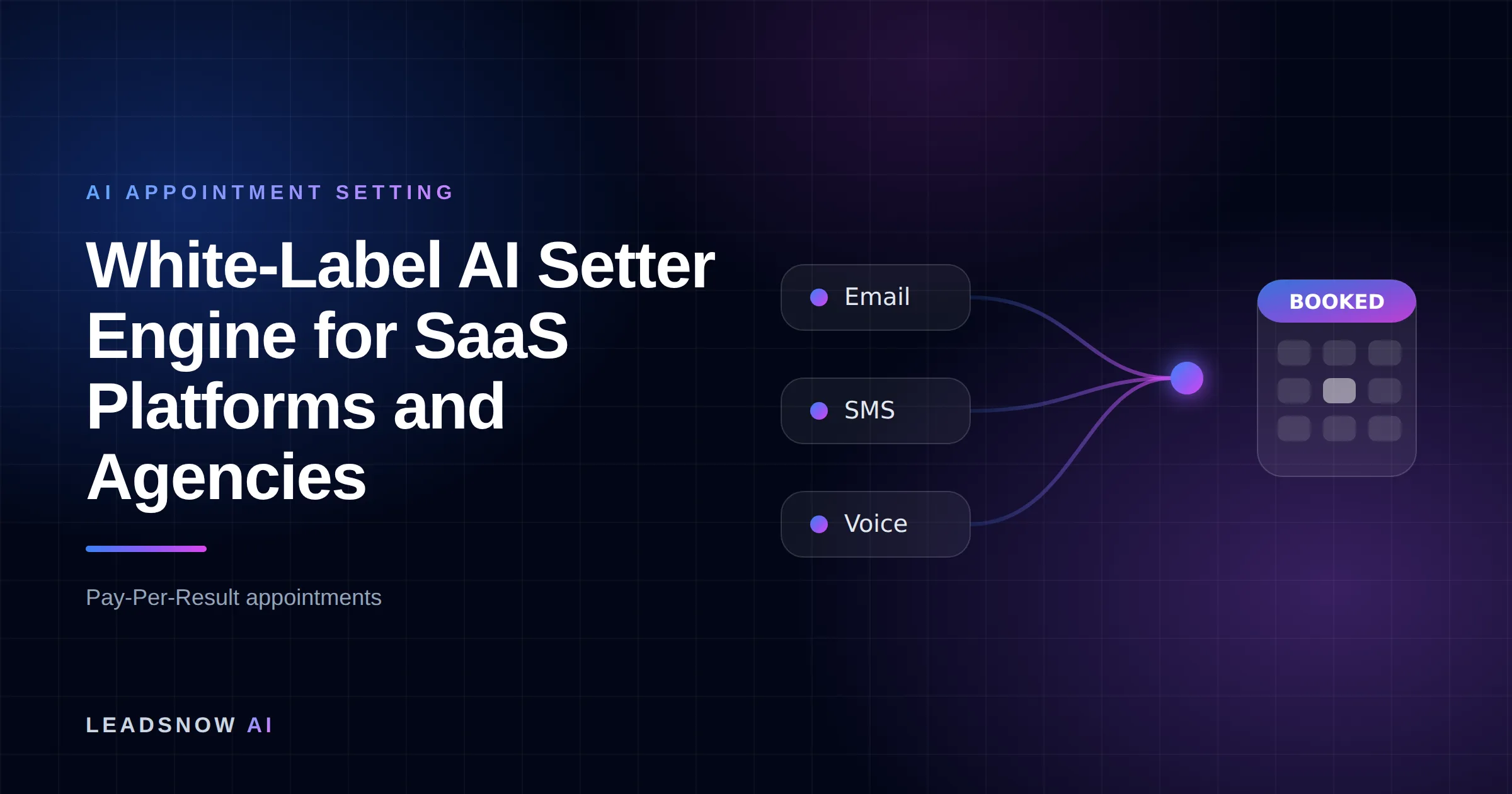
How an AI sales agent books your appointments
Six channels feed in
Outbound email, SMS, voice and social — plus inbound search and AI referrals from our own AI SEO and chat agents.
Your list or CRM
Outbound starts from data you already own — past enquiries, dormant customers, or a targeted prospect list.
Qualified against your rules
Budget, timing and fit are checked before anything reaches your team, using criteria you set.
Booked into your calendar
Only qualified prospects reach the booking step, so your closers spend their time selling.
MAKE MORE SALES.
Pay-Per-Result pricing — We scale sales HARD aligned to your interests, better than anyone else.
Why this layer rarely gets built inside a platform
Two things are required, and a platform that sells a builder usually has neither.
Data-science capability. Not a BI dashboard. Someone who can tell a genuine 2.0%-to-2.4% lift from a good fortnight, design the test so the answer holds, and resist shipping the finding early. Platform engineers are hired to make the product work reliably — a different discipline, a different person.
Cross-account volume someone is looking across. Your customers each sit in their own account, generating far too few conversations to resolve anything subtle alone. Your platform may carry serious volume in aggregate, but it is fragmented into hundreds of silos and nobody holds that aggregate as a research object. Why single-account volume is the binding constraint — and how running roughly 100 gym accounts at once compressed our learning cycle from quarters to days — is set out on cross-account learning in lead generation. We will not re-argue it here. The point for a platform is narrower: you can have the volume and still have no layer, because volume nobody analyses is just storage.
Want this done for you? We book qualified sales appointments on a Pay-Per-Result basis — you only pay for calls that actually land in your calendar.
The prompt box hands the hardest job to the least equipped person
A prompt box looks like flexibility. Functionally it transfers the hardest job in the system — deciding what to say and when — to the customer, who has the least data, no control group, and no way to know whether a change helped. Worse, it makes them feel responsible for the plateau. They tinker, the number moves within noise, they conclude the product does not work. From your side that is churn with no bug attached. The buyer-side version of the argument sits on why cheap AI setter tools plateau.
Four ways to close the gap
| Approach | What you get | What it costs | When it is right |
|---|---|---|---|
| Build the layer in-house | You own the asset outright and it compounds inside your product. | A data function, an experimentation framework, instrumentation across every account, and patience for tests that take months — competing with your roadmap for the same engineers. | If you have real cross-account volume in a few verticals, a data team with experimentation experience, and a board that will fund a two-to-three-quarter payback. If that is you, build it — it beats anything rented. |
| Bolt on a bigger model | Better fluency and interruption handling, fewer robotic turns. Real gains, shipped in a sprint. | Inference cost, a migration, and no change to the decisions setting the booked rate. | When the complaint is conversation quality — sounds wrong, talks over people, loses the thread. That is a model problem, and a model fixes it. |
| Let customers tune their own prompts | Zero build cost, and it works for the few customers who are expert operators with volume. | Every other customer runs an underpowered experiment on themselves, plateaus, and blames the product. | When your customers are agencies or in-house teams with outbound expertise and volume to test properly. For everyone else it is a default, not a decision. |
| Supply the layer on the back end | The tuning function runs behind your product, across your accounts, under your brand. Your roadmap stays yours. | A dependency on an outside partner for something customers experience as your own, plus a data-handling arrangement you must defend in a security review. | When the builder is good, outcomes are flat, and you do not want to fund a data team to find out why. This is what we do. |
If we can’t make you money, we don’t deserve yours.
Pay-Per-Result pricing — performance-based alignment.
The privacy boundary, stated precisely
This decides whether the arrangement survives your customers’ security reviews, so here it is exactly.
What crosses account lines: aggregate, de-identified technique. Which phrasing of an objection response beat which other phrasing. Which follow-up interval earned its place. Where a qualification threshold should sit for a given deal size and channel. Findings expressed as sentences about method, carrying no individual, no company and no account with them.
What never crosses account lines: contact records. Uploaded lists. Call transcripts and recordings. CRM data and field-level exports. Deal values and pipeline figures. Any client-identifying content, including offers, pricing and positioning. Seed audiences, lookalike audiences, or any suppression or match list derived from one account and used in another. None of it is disclosed to another customer, merged into a shared pool, used to build audiences for anyone else, or sold, rented or syndicated. A finding learned inside one of your customers’ accounts reaches another as a technique, never as a record.
The Australian regulator draws the line in the same place. The Office of the Australian Information Commissioner states that information which has undergone an appropriate and robust de-identification process is not personal information, and is therefore not subject to the Privacy Act 1988 (Cth) — while stressing that whether information is personal or de-identified depends on the context it is released into. That caveat is the operative part: the discipline sits in the process and the release context, not in the label. This page is general information, not legal advice; confirm your own obligations with your adviser.
Long-form answers to what procurement will actually send you — sub-processors, residency, retention, deletion, breach notification — are on data privacy and AI sales agents: what enterprise buyers ask.
How the layer is delivered
A back-end service, not a competing front end. Your product stays the product: customers log into your interface, see your brand, talk to your support team. We do not appear in the UI, contract with your customers, or market to them. No second dashboard, no co-branded logo.
We operate the tuning function — experiment design, analysis across accounts, a ranked view of what moves booked-call rate in each vertical, and the resulting configuration flowing back into your system. Anything touching a customer’s offer, claims or voice goes to them through you. We do not silently rewrite what a campaign says.
For agencies the shape differs: you resell fulfilment under your brand rather than embed a layer in a product you own — covered on white label lead generation for agencies. If you are evaluating providers rather than building a learning layer in-house, our roundup of the best white-label lead generation providers in the USA covers how that market breaks down.
Why we are the ones supplying it
We have booked more than 50,769 AI-assisted sales appointments since 2017 and generated over a million leads, across fitness, coaching, education, finance broking and commercial property. The gym era — roughly 100 accounts at once in one channel — proved the mechanism: patterns a single operator would need three quarters to trust surfaced in days.
We run the engine on ourselves too. Our own AI outbound programme booked 1,425 appointments in nine months at a 3.9% booked rate — our pipeline, not a client result, and not a number we promise anyone. On client accounts, moving an underperforming programme from around 2% to around 8% is our typical result, not a guarantee. The gap between those figures is the layer.
Where we lack density we say so. In a vertical we have never run, general technique transfers and nothing else does; expect a slower first two quarters.
Commercial terms
We do not publish them, and a tier table invented for a web page would be worth nothing to you. What a partnership looks like depends on how much of the tuning function you want us to run, your verticals, and what your product already instruments — so it is settled with you in writing before anything launches. For specifics, book a call — including if the honest answer is that you should build it yourself.
Frequently asked questions
What is a white-label AI setter engine?
Not another front end. It is the learning layer behind an existing setter product: experiment design, cross-account analysis, and tuning of objection handling, cadence, call windows and qualification thresholds. Customers keep using your interface under your brand. What changes is that someone with data and method sets the configuration, instead of each customer guessing in a prompt box.
What exactly crosses account lines, and what never does?
What crosses is aggregate, de-identified technique — which phrasing, which timing, which threshold. What never crosses is contact records, uploaded lists, transcripts, recordings, CRM data, deal values, client-identifying content such as offers and pricing, and any seed or lookalike audience. The Australian regulator’s guidance on de-identification and the Privacy Act states that information which has undergone an appropriate and robust de-identification process is not personal information, and is therefore not subject to the Privacy Act 1988 (Cth), while noting that whether information is personal or de-identified depends on the context. General information, not legal advice.
Will you compete with us or approach our customers?
No. We do not contract with your underlying customers, appear in your interface, or market to them. Non-solicitation is written into the agreement, not promised on a web page.
Can we just build this ourselves?
Sometimes you should. With real cross-account volume, a data team with experimentation experience, and appetite to fund two to three quarters before payback, build it — an internal layer wired into your own telemetry beats anything rented. Rent it when the builder is finished, outcomes are flat, and the alternative is hiring a data function that competes with your roadmap.
Why will a better model not solve this?
The ceiling is set by decisions, not fluency. A newer model handles interruptions better and sounds less robotic. It still does not know a customer’s qualification bar is two notches too low, or which objection response books more calls in that vertical. Those are measurement questions, and no model answers them from inside a single account.
How would we test this without betting the roadmap?
Run it on a subset of accounts in one vertical, hold the rest as a control, agree the success metric and kill criteria in writing first, and set a window long enough that the result is not noise. A pilot that cannot return a clear no is not a pilot. Design notes: how to run an AI outbound pilot that can fail.
What happens if we end the partnership?
Your accounts, customers and configurations stay yours, handed back in a usable form. What does not transfer is future access to the cross-account analysis, because that is the service. Settle formats, deletion timelines and wind-down before you sign; what you own when you leave a lead gen vendor lists the clauses worth arguing over.
Pay-Per-Result appointments
See if we’re a fit
We book qualified sales appointments for you and you pay on results, not retainers. Our booking page asks a few quick questions so you find out in two minutes whether that model suits your business.
- 50,769+ appointments booked without cold calling.
- Pay-Per-Result pricing — you pay for booked, qualified calls.
- Pick your own time on our live calendar, no phone tag.