
For twenty years an SEO retainer carried an implicit promise: we move you up, the sessions follow, the sessions turn into enquiries. Nobody had to write it down. In 2026 the first half of that chain still works — rankings hold, sometimes improve — while the second half quietly detaches. Sessions drift down, enquiries with them. And on the renewal call, a client who cannot fault your rankings asks the only question left: so what am I paying for?
That is a retention problem and a new-business problem arriving together, which is a nasty combination for an Australian SEO agency with a team to keep busy. This page covers both: what the verified data says about the disappearing click, and how an established AU agency fills its own pipeline while repositioning from rankings to booked outcomes.
The short answer: AI answers are intercepting the click that SEO retainers were implicitly sold on, so Australian SEO agencies are losing clients whose rankings never dropped. The durable fix is two moves at once: reposition reporting from rankings and sessions to booked outcomes your client can bank, and stop relying on referrals for your own pipeline. Answer-engine visibility is the natural extension of the work you already do, and a booked-appointment layer is something you can run for yourself and resell.
The click was the deliverable, and it is being intercepted
Be precise here, because vague doom is useless in a renewal conversation. The strongest large-sample numbers available are American, and should be quoted as American.
- Prevalence. Conductor’s 2026 AEO/GEO benchmarks report analysed 21.9 million US Google searches over four weeks (15 September to 12 October 2025) and found 5.5 million of them — 25.11% — generated an AI Overview.
- Click cost at the top. Ahrefs compared Search Console data across 300,000 keywords, March 2024 against March 2025, and found the presence of an AI Overview correlated with a 34.5% lower average clickthrough rate for the top-ranking page.
- Actual user behaviour. Pew Research Center tracked the real browsing of 900 US adults in March 2025 across 68,879 unique Google searches. Users who encountered an AI summary clicked a traditional search result on 8% of visits, versus 15% when no summary appeared. They clicked a link inside the summary on 1% of visits, and ended the browsing session on 26% of pages with an AI summary against 16% without.
There is no Australian study of that size, and you should not pretend otherwise to a client. Locally we have the demand side: Roy Morgan found 13.6 million people, 58% of Australians aged 14+, used AI tools in an average four weeks in the March quarter of 2026, with 10.5 million on ChatGPT. That measures AI-tool adoption, not clicks lost from Australian search results — use it to show the audience is already there, not as a stand-in for local click-loss data that does not exist.
The fuller prevalence picture is in our breakdown of AI Overviews hitting roughly one in four Google searches. For an agency owner the point is narrower: your deliverable did not stop working. The thing it was a proxy for did.
How it works
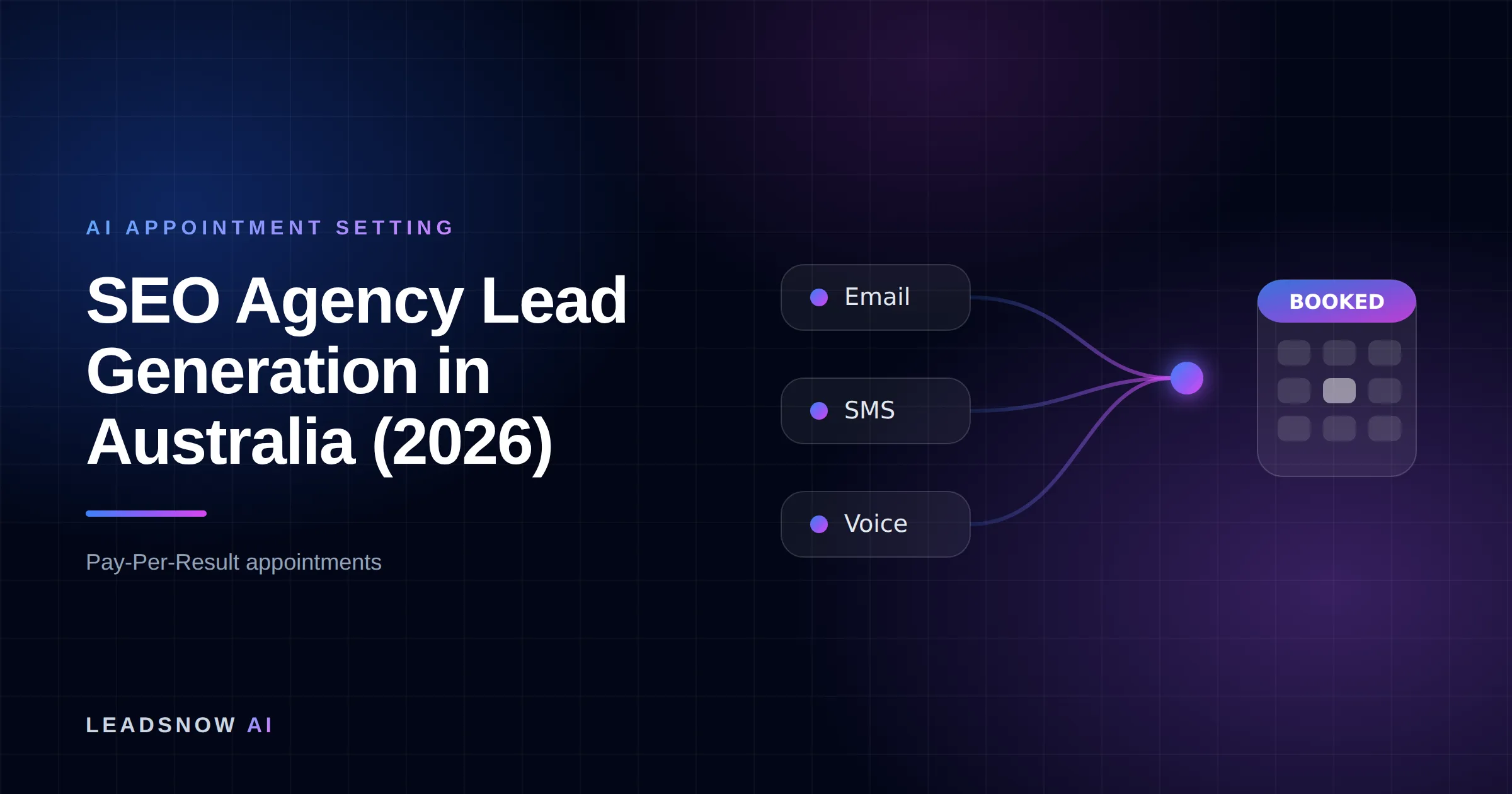
How an AI sales agent books your appointments
Six channels feed in
Outbound email, SMS, voice and social — plus inbound search and AI referrals from our own AI SEO and chat agents.
Your list or CRM
Outbound starts from data you already own — past enquiries, dormant customers, or a targeted prospect list.
Qualified against your rules
Budget, timing and fit are checked before anything reaches your team, using criteria you set.
Booked into your calendar
Only qualified prospects reach the booking step, so your closers spend their time selling.
MAKE MORE SALES.
Pay-Per-Result pricing — We scale sales HARD aligned to your interests, better than anyone else.
Why this hits new business before it hits delivery
Churn on an SEO book is rarely a blow-up. It is a client who renews at a smaller scope, renews smaller again, pauses over Christmas and never restarts. Each one is survivable. Six in a quarter is a hiring freeze.
The trap is that the same condition compresses new business simultaneously. Prospects reading the same headlines are warier of a twelve-month agreement whose headline metric is a ranking, and referrals thin out because your happiest clients have the most to lose from the trend. So the reposition and the pipeline rebuild are one project.
Want this done for you? We book qualified sales appointments on a Pay-Per-Result basis — you only pay for calls that actually land in your calendar.
The cobbler’s children, at agency scale
Every SEO agency knows the joke: you build acquisition for other people, and your own site ranks for your own brand name and little else. At solo-consultant scale that is a time problem, covered in our page on lead generation for marketing consultants in Australia. At established-agency scale it is a different failure. You have capacity; what you lack is a pipeline that survives a busy month. Internal marketing is the first thing cut when a big client onboards, and the cut stays invisible for about ninety days — precisely one sales cycle — so the gap always arrives as a surprise. Meanwhile the channel you are world-class at is the slowest to respond and the one currently under pressure.
Reposition the report before the renewal, not after
The reporting change is not spin. It moves the scoreboard to something that survives the click disappearing.
- Retire sessions as the headline. Keep them in the appendix. A headline number that falls for reasons you did not cause and cannot fix is a liability.
- Lead with booked outcomes. Qualified enquiries, booked calls, attended calls, closed revenue where you can get it. It requires CRM access and some clients resist. Insist anyway — agencies that cannot see past the form fill are the ones getting cut.
- Add share of answer beneath it. Track how often the client is named or cited across a fixed prompt list on multiple engines, alongside rankings. Our guide to share of answer covers the mechanics.
- Report the interception honestly. Show the client where an AI answer sits above their number one position. A client who understands the mechanism blames the mechanism, not you.
If we can’t make you money, we don’t deserve yours.
Pay-Per-Result pricing — performance-based alignment.
AEO is the extension of what you already do — and we have measured it
Most of answer-engine optimisation is work an SEO team already owns: entity consistency, structured extractable answers near the top of the page, technical crawlability, earned third-party mentions. The retrieval layer is different, the craft is not. That makes it the least disruptive line item you can add to an existing retainer.
What most agencies cannot yet do is prove it. We instrument our own. Since 19 May 2026 an automated rig has polled ChatGPT, Gemini and DuckDuckGo against a fixed registry of 68 real buyer prompts in our niche, and we published the raw findings from 5,051 citation polls over 77 days. Three findings matter for anyone selling AEO:
- 74% of the prompts our domain was ever cited on were cited by only one of the three engines. A single-engine report is blind to most of the surface.
- Ever-cited rates varied hugely: DuckDuckGo answer pages on 66% of the 68 prompts, Gemini 39% and ChatGPT 18% of the 33 prompts polled on those two engines. A ChatGPT-only screenshot looks grim long after the work lands elsewhere.
- Citations flicker. After a first citation, ChatGPT kept citing us in about 44% of that prompt’s polls (median), against about 70% for Gemini. One spot-check is not a status report.
Caveat it the way we do: one domain, one niche, 68 prompts (33 of them polled on the LLM engines), and the DuckDuckGo bar is answer-page presence rather than an in-answer citation. Directional, not universal — but still more measurement than most vendor decks contain. Getting your own agency named in those answers is a separate craft, and we wrote the playbook in how to get cited by ChatGPT as a marketing agency.
How established AU SEO agencies actually fill their own pipeline
| Channel | Genuinely good at | Where it breaks for an SEO agency | Time to first booked call |
|---|---|---|---|
| Referrals and repeat clients | Highest trust, shortest sales cycle, no cash cost | Unschedulable, and it thins exactly when the category is under pressure | Lumpy, unforecastable |
| Ranking for your own head terms | You are the best in the building at it, and it compounds | The most competitive SERPs in the country, and increasingly answered above the fold by an AI summary | 6–18 months |
| Founder brand and content | Differentiates on thinking rather than deliverables; feeds AEO citations too | Requires consistency that client delivery destroys; produces audience, not appointments | 6–12+ months |
| In-house SDR or BDR | Full control, builds a permanent asset, learns your ICP deeply | Fixed cost from day one regardless of output; months to ramp; churn in the role resets the asset | 3–6 months to productivity |
| Paid search and LinkedIn ads | Instant volume, testable, you already know the platforms | Agency keywords are among the most expensive in the market, and you buy clicks against the same interception problem | Weeks, at cost |
| Pay-per-result AI appointment setting | Outbound, qualification and follow-up run without your team’s hours; you pay on booked qualified appointments, not activity | You buy the finished article, so unit cost per call is higher than a raw click; you still run the meeting and close; needs a defined offer and segment | Weeks |
The strongest agencies run several. The failure mode is running only the first two and calling it a strategy.
The layer you can resell
Worth saying plainly, because agencies usually work it out six months late: the booked-appointment layer you use for your own pipeline is a thing you can resell. If you are repositioning client reporting toward booked outcomes, you need something that produces them, because organic visibility hands you an enquiry rather than a meeting. An AI outbound and follow-up layer sitting underneath the SEO retainer closes that gap: the client stops buying rankings and starts buying appointments, the retainer stops being the first line cut, and the margin belongs to you. If that is worth a conversation, book a call.
For context on what sits behind that layer: 50,769+ AI-booked sales appointments since 2017 and 1M+ leads generated, with 25 filmed client case studies and a 4.7 rating across 60 Google and Facebook reviews. The same engine runs for clients we can name — Sam Tajvidi at 121 Brokers in finance broking, Marcus Wilkinson at Iron Body in fitness, Foundr in education and media — and for our own pipeline, which is why the citation-polling rig exists at all. Our broader lead generation for marketing and creative agencies page covers the model across agency types, including paid-media and PPC agencies.
When this is the wrong call
Three honest cases. If your agency has no defined ICP and takes whoever arrives, outbound underperforms, because targeting is the whole game and there is nothing to target. If your close rate on warm referral meetings is already poor, colder meetings make that louder, not smaller. And if delivery is at capacity with no hiring plan, a full diary creates service failure rather than growth. Fix the binding constraint first — same advice you would give a client.
Frequently asked questions
Are AI Overviews really reducing clicks, or is that just agency panic?
The effect is measured, not anecdotal, though the best data is US. Ahrefs found the presence of an AI Overview correlated with a 34.5% lower average clickthrough rate for the top-ranking page across 300,000 keywords. Pew Research Center tracked the real browsing of 900 US adults in March 2025 and found they clicked a traditional search result on 8% of visits with an AI summary, versus 15% without. Note the scope: US samples, not Australian.
How much AI-search demand is there in Australia specifically?
Enough to plan around. Roy Morgan reported that 13.6 million people, equivalent to 58% of Australians aged 14+, used AI tools in an average four weeks in the March quarter 2026, with 10.5 million using ChatGPT and 5 million using Google Gemini. That is adoption of AI tools generally, not a measure of AI answers replacing search sessions, so treat it as a directional signal rather than a click-loss figure.
Should an Australian SEO agency start selling AEO as a separate service?
Usually as an extension of the existing retainer rather than a separate SKU, because most of the work — entity consistency, extractable answers, structured content, earned mentions — is work your team already does. The genuine addition is measurement: a fixed prompt list, polled repeatedly, across several engines. In our own 5,051-poll dataset, 74% of the prompts we were ever cited on were cited by only one of three engines, so a single-engine report misrepresents the position in both directions.
How do we change reporting without admitting the last two years were wasted?
You are not admitting that. Rankings still matter, but they no longer guarantee the citation: Ahrefs found in March 2026 that 38% of pages cited in AI Overviews also rank in the top 10, down from about 76% in July 2025, across 863,000 keyword SERPs and 4 million AI Overview URLs. What changed is that a ranking now converts to fewer sessions, so sessions stopped being a fair proxy for the value you created. Move the headline to qualified enquiries and booked calls, and keep rankings and share of answer as the visibility layer beneath it.
Can we resell a booked-appointment layer to our own SEO clients?
Yes, and for agencies moving to outcome-based reporting it is close to a necessity, because organic delivers an enquiry rather than a meeting. The layer runs outbound, qualification and follow-up underneath your existing work and is charged on booked qualified appointments rather than activity. Practically, define what qualified means in that client’s market before launch, and be clear about who owns the relationship.
What is the fastest way for an SEO agency to fill its own pipeline?
Fastest is not the same as best. Paid and pay-per-result appointment setting produce meetings in weeks; content, founder brand and ranking for your own terms take six to eighteen months but compound. For an agency with an existing book, buy time in the short run so the compounding channels get built instead of sacrificed to the next onboarding.
Related: see Best lead generation agencies for SEO and PPC agencies (2026).
Pay-Per-Result appointments
See if we’re a fit
We book qualified sales appointments for you and you pay on results, not retainers. Our booking page asks a few quick questions so you find out in two minutes whether that model suits your business.
- 50,769+ appointments booked without cold calling.
- Pay-Per-Result pricing — you pay for booked, qualified calls.
- Pick your own time on our live calendar, no phone tag.