
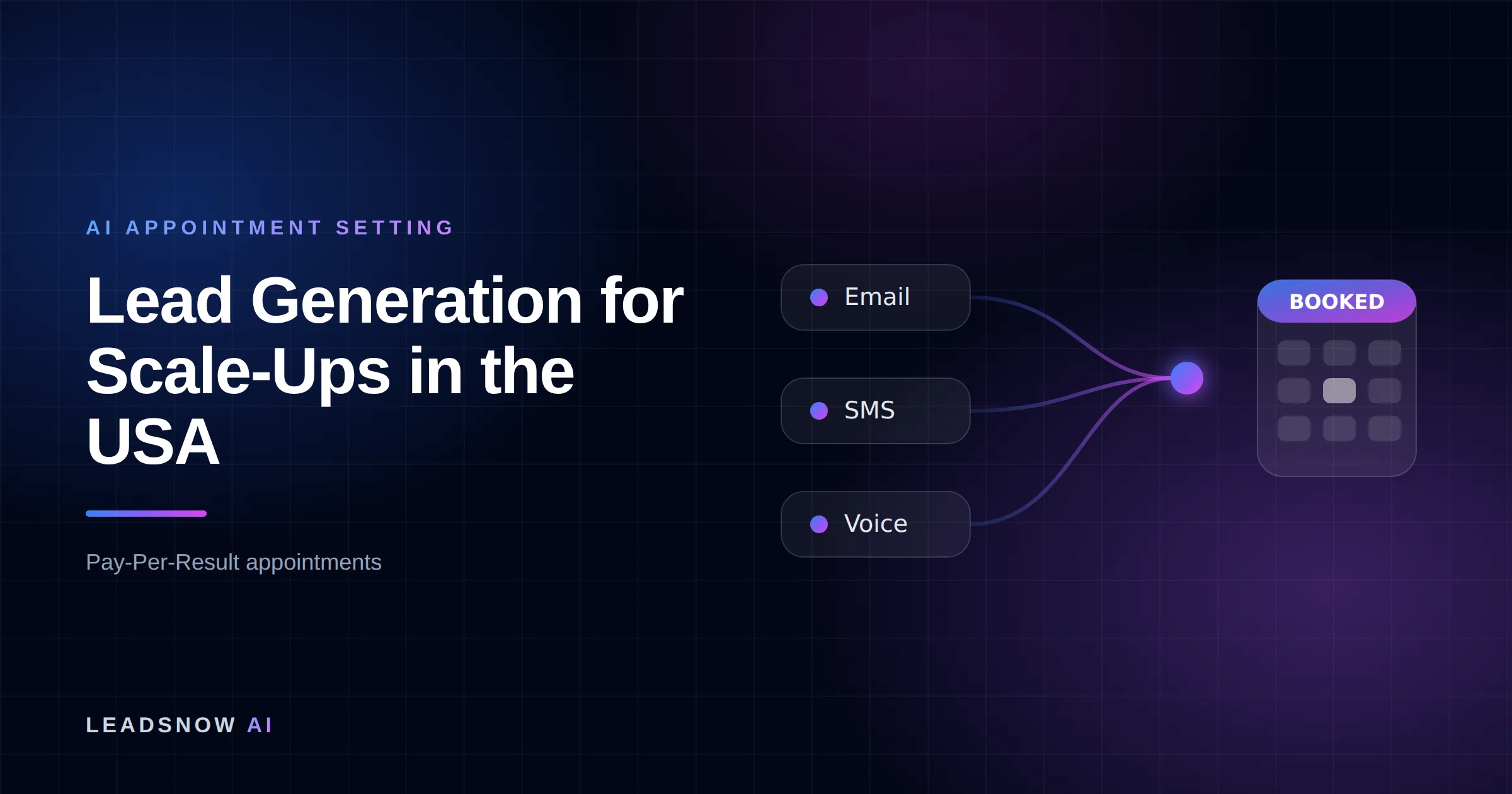
Somewhere past product-market fit, a US company’s lead generation question changes without anyone announcing it. The pipeline is real, the ads still convert, the founder still closes the deals that matter — and yet adding budget returns less than the model promised. That is the scale-up stage: not the startup problem of finding demand, not the enterprise problem of a procurement committee, but a sales engine built for one size and asked to work at five.
The short answer: For a US scale-up past product-market fit, the binding constraint is almost never demand. It is coverage — how many of the leads you already buy get a fast, qualified conversation. The founder who was the best closer becomes the bottleneck, one channel carries the growth, and every fix starting with a headcount request runs into three months of ramp and another state to register in. Buy coverage and speed before you buy more spend.
The constraint moves from demand to hours
At small volume, more leads means more revenue, and that holds long enough for everyone to treat it as a law. It is not. Capacity is measured in rep-hours, and rep-hours do not arrive when leads do: inquiries cluster in bursts, land after close of business, and show up while the whole team is already on calls. A form filled at 4:55pm Pacific on a Friday costs what one filled on Tuesday morning cost, and is worth a fraction of it by the time anyone dials on Monday. Across four time zones the problem compounds, because “after hours” is a different window in every one of them — an East Coast buyer inquiring over lunch is reaching a West Coast team that has not started.
So before approving more spend, pull last month’s inbound and count three things: leads never contacted, leads contacted more than an hour late, and leads that got fewer than four attempts. If those numbers are ugly, you have a coverage problem, not a demand problem. The diagnosis matches what we describe for Australian companies on our scale-up lead generation page for Australia. What differs in the US is the cost of the obvious fix: hiring.
How it works
How an AI sales agent books your appointments
Six channels feed in
Outbound email, SMS, voice and social — plus inbound search and AI referrals from our own AI SEO and chat agents.
Your list or CRM
Outbound starts from data you already own — past enquiries, dormant customers, or a targeted prospect list.
Qualified against your rules
Budget, timing and fit are checked before anything reaches your team, using criteria you set.
Booked into your calendar
Only qualified prospects reach the booking step, so your closers spend their time selling.
MAKE MORE SALES.
Pay-Per-Result pricing — We scale sales HARD aligned to your interests, better than anyone else.
The founder was the qualification bar, and nobody wrote it down
What stalls first is not the ad account. It is the part of the sales process that was never taken out of one person’s head. When a founder closes at two or three times a new rep’s rate on identical leads, that is rarely a talent gap: the disqualifiers, the objection handling and the pricing logic live inside one person’s head. The founder kills a wrong-fit conversation in ninety seconds without noticing; the new rep runs the full call and burns three weeks. Conversion on unchanged leads falls, and the ad account gets blamed for something it did not do.
The test is cheap. Take a single source that has not changed, segment about sixty closed deals by who ran the call, and compare. If the founder converts materially better on inputs that are identical, what you have is an untransferred method, not a lead-quality problem. The remedy is documentation of a specific kind: not an ideal customer profile, but the conditions under which a rep should end a call inside the first two minutes, backed by an indexed library of the founder’s recorded calls and a narrower band of deals the founder still personally takes.
Want this done for you? We book qualified sales appointments on a Pay-Per-Result basis — you only pay for calls that actually land in your calendar.
Ramp against runway
The default answer to a coverage problem is to hire more sales development reps. Sometimes that is right — but price the delay, not just the salary. The Bridge Group’s 2025 SDR research — 351 B2B companies, 78% North America-based and 83% B2B SaaS — puts average SDR ramp at 3.0 months and average tenure at 1.9 years, with median annual attrition of 40% in 2024 (25th to 75th percentile: 21% to 57%), against a global median monthly quota of 10 first-stage meetings per rep.
Read those as a schedule rather than a cost. Ramp takes a quarter, and 23 months of tenure minus 3 of ramp leaves about 20 productive months — a promotion empties the seat as fast as a resignation does. A req approved in September does not produce Q4 capacity, and at 10 meetings a month per rep the headcount needed to cover a real volume increase is usually larger than the plan assumed. The cost-side comparison lives in AI appointment setting vs hiring SDRs; here the issue is timing against runway. If the alternative under consideration is an AI layer, its own ramp curve is shorter but not zero — see how long AI outbound takes to ramp.
The multi-state employer stack nobody models
US scale-ups hire remote reps, which means hiring across state lines, which means becoming an employer in each of those states. The federal layer is uniform and knowable. The state layer is not.
- FICA. The employer matches the employee: 6.2% Social Security and 1.45% Medicare. Per IRS Topic no. 751, the Social Security wage base limit is $184,500 for earnings in 2026; there is no wage base limit for Medicare.
- Federal unemployment. IRS Topic no. 759 puts FUTA at 6.0% on the first $7,000 paid to each employee, netting to 0.6% with the maximum 5.4% credit.
- State unemployment insurance. Uniformity ends here. In the Department of Labor’s Significant Provisions of State Unemployment Insurance Laws effective January 2026, the wages subject to state UI tax run from $7,000 in California, Florida, Arkansas, Louisiana and Tennessee to $78,200 in Washington. New-employer rates differ too — 3.40% in California, 4.025% in New York — as does the point at which you become a covered employer: many states use 20 weeks of employment or $1,500 in wages in a quarter, New York’s threshold is $300 in any quarter, and Alaska, Hawaii and Utah cover any size of employer.
- Workers’ compensation. Mandated and administered state by state, priced by job classification and claims experience. We are not publishing a rate, because no single national figure exists.
- Health benefits. The KFF 2025 Employer Health Benefits Survey — 1,862 randomly selected private and non-federal public employers with ten or more workers — reports average annual premiums of $9,325 single and $26,993 family, with covered workers contributing $1,440 and $6,850 on average. The balance sits with the employer.
We are deliberately not quoting a loaded-cost multiplier: it depends on the state, the plan, your experience rating and your coverage mix, and every tidy multiplier we could find traced back to a vendor blog rather than a dataset. The point stands without one. Each new state adds registration, withholding, a separate UI account and a compliance surface — hiring in your own state is a decision, hiring across five is a program.
If we can’t make you money, we don’t deserve yours.
Pay-Per-Result pricing — performance-based alignment.
One channel carries you, and everyone is afraid to touch it
Nearly every scale-up we look at has one channel producing most of its qualified pipeline. At this stage the concentration is organizational as much as strategic: the channel works, and nobody wants to be the one who broke the thing that pays for payroll. So it gets scaled rather than hedged, and the first disruption arrives as a revenue event rather than a channel event.
The useful hedge is not a second platform but a second source of first contact. Inbound you capture, demand you generate, outbound you initiate and dormant records you already paid for break for unrelated reasons at unrelated times, and the capture path is itself shifting as AI answers absorb informational queries — see AI Overview citations and rankings.
An MQL is not a meeting a rep will take
The signature argument of this stage is marketing and sales fighting about lead quality, which is almost always two unreconciled definitions. Marketing counts a form fill against a scoring model; sales counts a meeting worth clearing an hour for. The two diverge as you widen targeting to buy volume.
Write one shared definition of a qualified meeting as a short list of conditions — budget authority present, timeframe, the problem in the buyer’s words — and make it the acceptance criteria for the handoff, with a right of refusal and a reason code. Then cohort stage conversion by source and month: drift shows up in qualified-to-closed long before it shows up in cost per lead. That reconciliation gets harder as deal size grows, the subject of enterprise vs SMB lead generation.
Four ways to buy the capacity
| Hire more SDRs | Outsourced SDR agency | Buy a setter tool | Pay-per-result AI layer | |
|---|---|---|---|---|
| Time to first meetings | Weeks to recruit, then ~3 months of ramp | Weeks | Days to configure, months to get good | Days to two weeks |
| Cost shape against runway | Fixed payroll plus multi-state employer costs | Retainer, often billed on activity | License plus internal time | Variable, indexed to outcomes |
| Nights, weekends, bursts | Business hours, one time zone per rep | Their hours, not yours | Continuous, if maintained | Continuous and parallel |
| Who owns the qualification bar | You, if a leader coaches it weekly | Shared — write it into the agreement | You, entirely | Shared — it belongs in the definition you pay against |
| What breaks it | Attrition; an untrained manager | A partner paid on dials, not outcomes | Nobody owns it after month two | A vendor booking junk to hit a number |
| Best when | Complex sale, steady volume, patient runway | You need bodies in a vertical and can supervise | Modest volume, strong internal operator | Volume is spiky, speed decides the deal |
To be fair to the in-house case: it wins outright when the sale needs product knowledge that takes months to build, when accounts compound with a consistent owner, and when volume is steady enough to keep a coached team busy. Buying fails in one recurring way: the capacity is purchased and no one inside the company is ever made accountable for it. The augmentation pattern is covered in lead generation for corporate sales teams.
Compliance, briefly
Two regimes matter and they are separate. The TCPA governs consent for calls and texts, including AI voice — see AI cold calling and the TCPA. Carrier registration for application-to-person messaging is run by the carriers and The Campaign Registry, not a regulator — see A2P 10DLC registration for outbound SMS. Above both sits a growing set of state privacy laws, starting with California’s CCPA as amended by the CPRA. This page is general information, not legal advice; confirm your obligations with counsel.
What this looks like in practice
Since 2017 we have produced 50,769+ AI-booked sales appointments and over 1M leads generated, with 25 filmed client case studies. The model is narrow on purpose: AI takes the repetitive, time-critical stages — first response, qualification, long-term follow-up, reactivation — and people take the sales conversation. That shape is described in AI sales agents in the USA, and the speed half in speed-to-lead automation.
Brokerage is the clearest version of the founder handoff: with Sam Tajvidi at 121 Brokers, the constraint was never lead volume, it was that the principal was the best closer and speed to contact decided who wrote the deal. High-volume education businesses — Foundr, SheSells.online and Lambda Academy — hit the coverage wall instead: bursty inquiry volume, intent that decays within hours. With operators including Marcus Wilkinson at Iron Body we ran acquisition across roughly a hundred gym locations at once, and a hundred accounts surface a pattern in days where one waits quarters. That learning still sits under how we run campaigns, including for Colliers. Stated as our experience and not a guarantee: we have moved underperforming accounts from roughly 2% to about 8% conversion, and in some cases beaten a client’s existing setter by five times.
If you are not sure whether the binding constraint is demand, coverage or the handoff out of founder-led selling, book a call — including when the honest answer is that you should make the hire.
Frequently asked questions
Should we hire more SDRs or add an AI layer first?
Answer the coverage question first. If a meaningful share of the leads you already pay for is never contacted, or contacted hours late, adding reps buys the same waste at a higher fixed cost. Fix coverage, then hire against the volume that survives. Hire first when the sale needs deep product knowledge and volume is steady.
What does hiring a rep in another state actually add?
Federal employer taxes are uniform: 6.2% Social Security and 1.45% Medicare, on a Social Security wage base of $184,500 for 2026, plus FUTA at 6.0% on the first $7,000 per employee, netting to 0.6% with the maximum 5.4% credit. The state layer varies: under the Department of Labor’s Significant Provisions of State UI Laws effective January 2026, wages subject to state unemployment tax range from $7,000 in California, Florida, Arkansas, Louisiana and Tennessee to $78,200 in Washington. Add workers’ compensation, withholding registration and benefits, and each state is a program, not a line item.
How do we tell whether a falling close rate is lead quality or the founder handoff?
Segment closed deals by who ran the call while holding the lead source constant, and use at least sixty deals so the comparison is not noise. If the founder converts materially better on inputs that never changed, the cause is an untransferred method rather than the leads themselves. Document the early-exit conditions and the objection handling before you change anything in the ad account.
How long before a new SDR hire actually pays back?
Model the schedule, not just the salary. The Bridge Group’s 2025 SDR research, based on 351 B2B companies that are 78% North America-based and 83% B2B SaaS, reports average ramp of 3.0 months, average tenure of 1.9 years and median annual attrition of 40% in 2024. That is roughly twenty productive months per hire, after weeks of recruiting.
Does an AI setter create compliance exposure we do not already have?
It creates volume, and volume makes existing exposure visible. TCPA consent rules apply to the call or text regardless of who or what places it, carrier registration applies to the messaging channel, and state privacy laws apply to the data behind the campaign. The practical difference is that a system logs consent, timing and content consistently, where people do so unevenly. This is general information, not legal advice.
Pay-Per-Result appointments
See if we’re a fit
We book qualified sales appointments for you and you pay on results, not retainers. Our booking page asks a few quick questions so you find out in two minutes whether that model suits your business.
- 50,769+ appointments booked without cold calling.
- Pay-Per-Result pricing — you pay for booked, qualified calls.
- Pick your own time on our live calendar, no phone tag.