
There is a moment in a growing business where the lead generation problem quietly changes shape. Nothing is broken — enquiries arrive, the ads convert, the founder closes what matters — but pushing volume up returns less than the model said it would. That is the scale-up problem: neither the startup problem nor the enterprise one. This page is about what changes between a lead engine that works and one that works at five times the size.
The short answer: For an Australian scale-up past product-market fit, lead generation stops being a volume problem and becomes a capacity, quality and measurement problem. The founder can no longer take every call, one channel usually carries the growth, and widening targeting quietly lowers lead quality while the dashboard still looks healthy. Cost per lead stops mattering; cost per closed deal and payback period are the numbers that survive 5x.
Where scale-ups actually sit
The Australian Bureau of Statistics counted 2,814,778 actively trading businesses at 30 June 2026: 996,203 employed anyone, 68,325 had 20 to 199 employees, and only 5,366 had 200 or more.
That distribution explains why most lead generation advice does not fit you. Nearly all of it is written for the 1.8 million non-employing businesses chasing early customers, or for the 5,366 with procurement, security review and a buying committee — the world of enterprise lead generation services. Scale-ups sit in the gap: no procurement in your deals, but past the point where one person’s judgement carries the sales function.
How it works
How an AI sales agent books your appointments
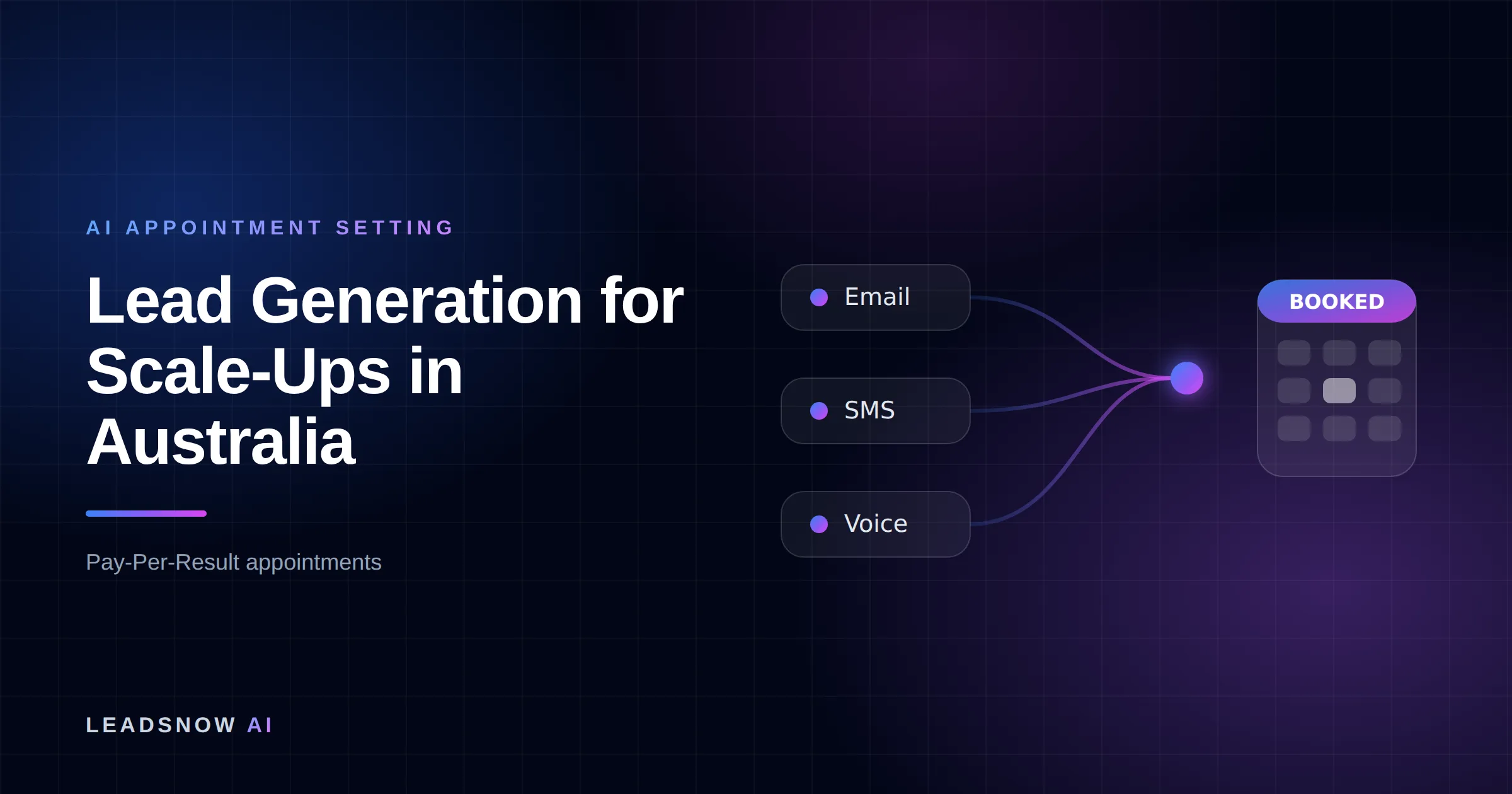
Six channels feed in
Outbound email, SMS, voice and social — plus inbound search and AI referrals from our own AI SEO and chat agents.
Your list or CRM
Outbound starts from data you already own — past enquiries, dormant customers, or a targeted prospect list.
Qualified against your rules
Budget, timing and fit are checked before anything reaches your team, using criteria you set.
Booked into your calendar
Only qualified prospects reach the booking step, so your closers spend their time selling.
MAKE MORE SALES.
Pay-Per-Result pricing — We scale sales HARD aligned to your interests, better than anyone else.
What breaks first: the founder-led sales handoff
The first thing that stops scaling is not the ad account. It is the founder’s close rate.
A founder closing at three times a new hire is rarely evidence of a talented founder and a bad hire. It usually means the qualification bar, the objection handling and the pricing logic all live inside one person’s head and have never been written down. The founder disqualifies a wrong-fit enquiry in ninety seconds without noticing. The new rep runs the full call, books a second one, and loses three weeks.
What follows is predictable: the same leads convert worse, sales concludes the leads got worse, and marketing is asked to fix a problem that is not theirs. The test is cheap. Hold one lead source constant and compare the founder’s close rate with the team’s across sixty deals. A large gap on identical leads is a transfer problem, not a lead problem.
Three things fix it, in order. Write the disqualifiers down — not the ideal customer profile, the list of reasons to end a call early. Index the founder’s recorded calls so reps learn from real conversations rather than a deck. Then narrow the founder to a defined band of deals, usually the largest, rather than leaving them as overflow capacity.
Want this done for you? We book qualified sales appointments on a Pay-Per-Result basis — you only pay for calls that actually land in your calendar.
One channel is carrying you, and the obvious hedge does not exist
Almost every scale-up we look at has one channel producing most of its qualified pipeline — usually paid search, sometimes one referral relationship, occasionally one person’s outbound. The instinct is to diversify the platform, and in Australia that runs into arithmetic. The ACCC’s ninth digital platform services inquiry report found Google had a market share of nearly 94 per cent in general search in Australia as recently as August 2024, with Bing next at 4.7 per cent. There is no second search engine to move budget into.
So the meaningful diversification here is not across platforms but across motions: demand you capture, demand you create, demand you initiate, and demand you already paid for and left in your database. Those four fail for different reasons at different times, which is the point of holding more than one.
The other half of concentration risk is efficiency rather than availability: more budget through the same channel does not buy proportionally more of the same lead — see how to scale ad spend without losing ROI.
Lead quality drifts down while the dashboard looks fine
To buy more volume you widen targeting, which necessarily reaches people further from the buyer who made the original economics work. It is nearly invisible in the metrics most teams watch, because cost per lead can hold flat while the people arriving get worse. The early warning is a stage-level conversion metric, cut by source and cohorted by month. Drift shows up in qualified-to-closed first and in cost per lead last.
Holding conversion together as volume rises is its own subject, covered in how to increase sales conversion rate at scale. The organisational point here is narrower: once the founder is out of the calls, the qualification bar has to exist as a written artefact a system can apply consistently, because nobody applies it by instinct any more.
If we can’t make you money, we don’t deserve yours.
Pay-Per-Result pricing — performance-based alignment.
The constraint moves from lead volume to sales hours
At small volume, more leads means more revenue. At scale-up volume that stops being true, well before anyone notices. A sales team has a fixed number of conversations in a day, and leads arrive in bursts, at night and during existing calls. The lead that lands at 4:55pm on a Friday costs what Tuesday morning’s cost and is worth a fraction of it by Monday.
So work out what happens to the marginal lead before buying more. If a meaningful share of what you already buy is never contacted, or contacted hours late, you are short of coverage rather than demand — and more spend makes the waste bigger, not the pipeline.
This is the problem we were built for: AI on the repetitive, time-critical stages — instant first response, qualification, long-term follow-up, reactivation of records you already own — and people on the sales conversation. Since 2017 that model has produced 50,769+ AI-booked sales appointments and over 1M leads generated. The structural argument is in scaling a sales funnel with AI without hiring more headcount.
Attribution gets harder exactly when it starts to matter
The cruel joke of this stage is that measurement degrades as spend grows. Google Ads no longer supports the first click, linear, time decay and position-based models; conversions using them were moved to data-driven attribution, now the default, leaving it and last click as the options. Data-driven attribution is a model, not a ledger — a reasonable way to allocate credit inside one platform, and a poor basis for deciding which channel earned a deal that took four months and eleven touches.
Three things beat reconciling dashboards. Ask the buyer directly, with one required free-text “how did you hear about us” field on the booking form. Push closed revenue back into the platforms so they optimise to deals rather than form fills. And geo-test any channel large enough to matter, because nothing else answers the incrementality question.
Build or buy: the in-house SDR decision
There is no universally correct answer here, but there is a cost shape difference that gets underestimated. An in-house setter is not a salary. It is salary plus superannuation at the statutory 12% rate that applied from 1 July 2025, plus the wages bill state payroll tax is assessed on — rates and thresholds differ by state, and in New South Wales it is 5.45% on Australian wages above a $1.2 million annual threshold for 2025–26 — plus tooling, a manager’s hours, a ramp period, and the replacement cost when they leave. It is a fixed, slow-moving commitment made against a pipeline forecast that is rarely as stable as it looks.
| In-house SDR team | Outsourced, paid on outcomes | Self-serve AI tooling, run by your team | |
|---|---|---|---|
| Time to first meetings | Months — hire, ramp, coach | Weeks | Days to configure, months to get good |
| Cost shape | Fixed, rises with headcount, slow to unwind | Variable, tracks outcomes | Low licence cost, high internal time cost |
| Qualification bar | Yours, if a leader coaches it | Shared — write it into the agreement | Yours entirely |
| What breaks it | Attrition, a manager who has never run setters | A partner paid on activity, not outcomes | Nobody owns it after month two |
| Best when | Technical or relationship-led sale, steady volume, real coaching capacity | Volume is spiky, speed matters, cost should follow results | Small volume, strong internal operator, patience |
To be fair to the in-house case: it genuinely wins when the sale requires product knowledge that takes months to build, when accounts compound with a consistent owner, when you already employ a sales leader who has managed setters and can coach weekly, and when volume is steady enough to keep those people busy. Under those conditions an outsourced partner will underperform your own team, and you should build. Buying goes wrong for one predictable reason: the function is bought and never given an owner. Who operates the system matters more than which system it is — see who should run your AI appointment setter.
The metrics that survive 5x
Cost per lead is a purchasing metric: it tells you what you paid a platform, and it is perfectly designed to be gamed by buying cheaper, worse leads. Three numbers survive scale.
- Cost per closed deal, by source. Cohort acquisition cost divided by the deals it produced. An expensive source with a high close rate routinely beats a cheap one, and cost per lead will never show you that.
- Payback period. Months of gross profit needed to repay the fully loaded cost of acquiring a customer. It sets how fast you can grow without funding growth from the balance sheet.
- Sales capacity utilisation. The share of purchased leads that got a real contact attempt inside your target window.
We are deliberately not quoting a benchmark payback figure: the numbers circulating for it trace back to vendor blogs with no stated sample or methodology, and a made-up benchmark is worse than none.
What this looks like in real industries
Mortgage and finance broking is the clearest version of the founder handoff. Sam Tajvidi at 121 Brokers works in a category where speed to contact decides who writes the loan and the principal broker is usually the best closer — which makes transferring that judgement the growth constraint.
Business education and online course companies — Foundr, SheSells.online and Lambda Academy sit here — hit the coverage wall instead. Enquiry volume is high and bursty, intent decays within hours, and the sales team is the bottleneck long before traffic is.
Fitness and multi-site consumer businesses taught us the sharpest lesson. Working with operators including Marcus Wilkinson at Iron Body, we ran acquisition across roughly a hundred gym locations at once. Where locations like those sit under a single franchisor rather than independent owners, the operating model changes again, which is what lead generation for franchise networks in Australia is about. One account learns only from itself and waits quarters for a signal; a hundred surface the same pattern in days. That cross-account learning still sits under how we run campaigns, including for clients such as Colliers. Stated as our own experience rather than a guarantee: we have moved underperforming accounts from roughly 2% to about 8% conversion, and in some cases beaten a client’s existing setter system by five times.
If you want to know whether your constraint is leads, coverage or the handoff, book a call and we will tell you which — including when the answer is that you should hire instead.
Running the same stage in the United States? The constraints rhyme but the arithmetic does not — see lead generation for scale-ups in the USA for the multi-state employer stack and US ramp data.
Frequently asked questions
What counts as a scale-up in Australia?
A business past product-market fit, growing fast enough that its systems rather than its demand are the limit. Most sit in the ABS 20 to 199 employee band, which held 68,325 businesses at 30 June 2026 out of 2,814,778 actively trading businesses — a small population, which is why generic advice rarely fits it.
Should we hire SDRs in-house or outsource?
Build when the sale needs deep product knowledge, volume is steady, and you have a sales leader who has managed setters and has time to coach. Buy when volume is spiky, speed matters, or you want cost to follow results rather than sit as fixed payroll. Price the in-house option honestly: salary, 12% superannuation, the wages bill payroll tax is assessed on (a state tax, so rates and thresholds vary — in NSW it is 5.45% above a $1.2 million threshold for 2025–26), tooling, management time and ramp.
Our close rate dropped after the founder stopped taking every call. Are the leads worse?
Usually not. Hold one lead source constant and compare the founder’s close rate with the team’s across at least sixty deals. A large gap on identical leads is a transfer problem: the qualification bar and objection handling were never written down. Fix that before touching the ad account.
How should we handle attribution now that the ad platforms model so much of it?
Treat platform numbers as directional. Google has retired its rule-based models — first click, linear, time decay and position-based are no longer supported, leaving data-driven attribution as the default alongside last click. Make the CRM the source of truth, add a free-text “how did you hear about us” field to the booking form, push closed revenue back into the platforms, and geo-test anything large.
Is it a problem if one channel carries our growth, as long as it is profitable?
It is a risk to price, not a fault to fix overnight. In Australia you cannot hedge search by switching engines — the ACCC found Google held nearly 94 per cent of general search as recently as August 2024. Diversify across motions instead: capture, create, initiate, and reactivate your existing database.
Pay-Per-Result appointments
See if we’re a fit
We book qualified sales appointments for you and you pay on results, not retainers. Our booking page asks a few quick questions so you find out in two minutes whether that model suits your business.
- 50,769+ appointments booked without cold calling.
- Pay-Per-Result pricing — you pay for booked, qualified calls.
- Pick your own time on our live calendar, no phone tag.