
AI voice technology got good enough, fast enough, that a lot of US business owners are now asking the same question: can I point an AI dialer at a purchased list and let it cold call all day? The pitch is seductive — infinite reps, zero salaries, no burnout. The legal reality is much less friendly. This guide covers exactly one slice of the compliance picture: cold calling, meaning outbound calls to people who have no prior relationship with your business and never asked to hear from you. For the broader rules across voice and SMS — consent capture, disclosures, opt-outs, record-keeping — see our full TCPA compliance guide for AI voice and SMS agents.
One thing before we start: this article is general information, not legal advice. TCPA law shifts constantly — everything here is accurate to the best of our research as of July 2026, but talk to a telecom compliance attorney before you run any outbound calling campaign in the US.
The short answer
AI cold calling to US consumers is effectively illegal in most cases. The FCC ruled in February 2024 that AI-generated voices are “artificial” under the TCPA, so AI marketing calls require prior express written consent — which cold prospects, by definition, haven’t given. Compliant AI calling works opted-in leads, inbound inquiries, and fresh form fills instead.
How it works
How an AI sales agent books your appointments
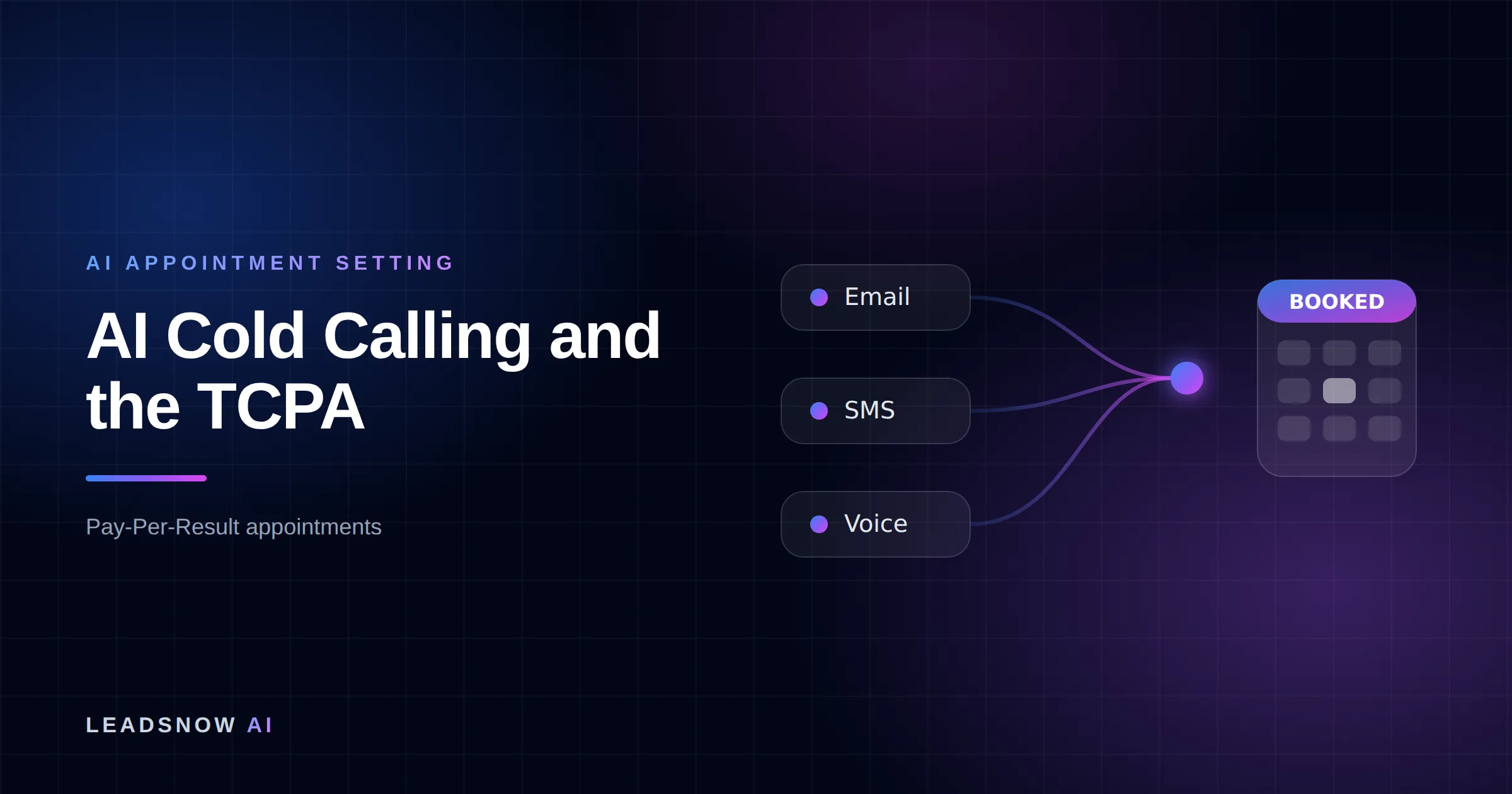
Six channels feed in
Outbound email, SMS, voice and social — plus inbound search and AI referrals from our own AI SEO and chat agents.
Your list or CRM
Outbound starts from data you already own — past enquiries, dormant customers, or a targeted prospect list.
Qualified against your rules
Budget, timing and fit are checked before anything reaches your team, using criteria you set.
Booked into your calendar
Only qualified prospects reach the booking step, so your closers spend their time selling.
MAKE MORE SALES.
Pay-Per-Result pricing — We scale sales HARD aligned to your interests, better than anyone else.
Why the FCC’s February 2024 ruling changed everything
The Telephone Consumer Protection Act of 1991 has always restricted calls made with an “artificial or prerecorded voice.” For decades that meant robocall recordings. Then, in a declaratory ruling adopted February 2024 (FCC 24-17), the FCC confirmed that AI technologies that generate or clone human voices count as “artificial” voices under the TCPA. It doesn’t matter how natural the agent sounds, whether it converses in real time, or whether it’s a clone of your top rep’s actual voice — legally, an AI voice call is treated like a robocall.
That classification carries specific consequences. Under FCC rules that have been in force since 2013, a telemarketing call made with an artificial or prerecorded voice to a residential line or a cell phone requires the called party’s prior express written consent — a signed (including e-signed) agreement that names your business specifically and authorizes marketing calls made with autodialed or artificial-voice technology to a number the consumer provides. Informational (non-marketing) AI calls to cell phones still require prior express consent, just not the written kind. The law-firm analyses of the ruling all land on the same conclusion: AI voice calls aren’t banned — they’re consent-gated.
Now apply that to cold calling. A cold prospect — someone from a purchased list, a scraped directory, a “data enrichment” export — has never signed anything naming your business. There is no consent to point to. So a marketing AI voice call to a genuine cold list is a TCPA violation from the first ring, and every additional call is another violation. This isn’t a gray area you can disclaim your way out of; the consent has to exist before the call.
Want this done for you? We book qualified sales appointments on a Pay-Per-Result basis — you only pay for calls that actually land in your calendar.
Which calls need which consent: the 2026 map
Not every outbound call is treated the same. Here’s how the main call types stack up under federal law as of July 2026 (state law can be stricter — more below):
| Call type | Consent required (marketing calls) | Cold calling viable? |
|---|---|---|
| Manual cold call, live human, hand-dialed | No prior consent required — but you must scrub the Do-Not-Call Registry, call only 8am–9pm local time, and honor company-specific do-not-call requests | Yes, within DNC and state rules |
| Autodialed live call (ATDS) to a cell phone | Prior express written consent under federal law (the Supreme Court’s 2021 Facebook v. Duguid decision narrowed what counts as an autodialer, but many state laws define it far more broadly) | No, not to cold cell numbers |
| AI voice or prerecorded marketing call | Prior express written consent — to cell phones and residential landlines. AI voices are “artificial” per the FCC’s Feb 2024 ruling | No — cold prospects can’t have given written consent |
| AI call to an opted-in lead (form fill with consent language, inbound inquiry) | Legal with properly captured prior express written consent naming your business | Not a cold call — and that’s the point |
Notice the pattern: the only row where AI calling is clearly legal is the row where the prospect asked to be contacted. The technology isn’t the problem. The list is.
The Do-Not-Call Registry still applies — even to human cold calls
Suppose you skip the AI and have humans hand-dial. You’re still not free to call anyone. The FTC’s National Do-Not-Call Registry rules prohibit telemarketing calls to registered numbers unless you have the consumer’s prior express written consent or an established business relationship — a purchase or payment within the past 18 months, or an inquiry from the consumer within the past 3 months. Telemarketers must scrub lists against the registry at least every 31 days, and calls are restricted to 8am–9pm in the recipient’s local time zone. With well over 200 million numbers registered, a raw consumer cold list is mostly numbers you can’t lawfully call for marketing at all.
B2B calls to business lines sit outside most DNC provisions, which is why human-dialed B2B cold calling survives. But the moment you use an AI or prerecorded voice for a marketing call to a cell phone — and plenty of “business” numbers are cell phones — you’re back under the written-consent requirement.
If we can’t make you money, we don’t deserve yours.
Pay-Per-Result pricing — performance-based alignment.
The 1:1 consent rule: adopted, vacated, and where it stands in 2026
If you researched this in 2024, you probably read about the FCC’s “one-to-one consent” rule — a December 2023 order requiring that consent on lead-generation forms name each individual seller, one at a time, killing the practice of a single checkbox blessing calls from dozens of “marketing partners.” That rule never took effect. On January 24, 2025, one day before its effective date, the Eleventh Circuit vacated it in Insurance Marketing Coalition v. FCC, holding that the FCC had exceeded its authority by adding requirements beyond the statute’s ordinary meaning of “prior express consent.”
As of July 2026, the practical status is this: the pre-2023 definition of prior express written consent is the governing federal standard, and the FCC has shown no appetite to revive the rule. But don’t read the vacatur as open season. Consent still has to be genuine — clear disclosure, tied to your business, given by the actual person you’re calling — and plaintiffs’ lawyers still routinely attack recycled, aged, or vaguely worded lead-gen consent in court. And the Eleventh Circuit ruling did nothing to state laws, several of which impose their own stricter consent standards. If your consent language was written to survive the 1:1 rule, keep it; specific, single-seller consent remains the safest position.
State mini-TCPAs: fifty maps, not one
Federal law is the floor, not the ceiling. Since Florida’s Telephone Solicitation Act kicked things off in 2021, a growing roster of states — Florida, Oklahoma, Washington, Maryland, Texas, and others — have passed “mini-TCPA” statutes that go further than federal law. Common features you’ll hit when calling into these states:
- Broader autodialer definitions. Florida’s FTSA covers “automated systems” for selecting or dialing numbers — sweeping in equipment that Facebook v. Duguid excluded federally. Your dialer can be fine under the TCPA and still trigger the FTSA.
- Tighter calling windows. Florida cuts marketing calls off at 8pm local time, an hour earlier than the federal 9pm limit.
- Frequency caps. Oklahoma and Maryland limit sellers to three call attempts to the same person on the same subject within 24 hours.
- Private rights of action. Several of these statutes let individual consumers — and class-action firms — sue directly, with statutory damages per call that stack on top of federal exposure.
The operational consequence: a compliant US calling program has to know which state each number sits in and apply that state’s rules, not just the federal baseline. One more reason a “spray the whole list” cold campaign is unmanageable at scale.
What violations actually cost
The TCPA has a private right of action with statutory damages of $500 per violation, trebled up to $1,500 for willful or knowing violations — and each individual call or text is a separate violation. There’s no cap, and no requirement that the consumer prove any actual harm. Run the arithmetic on even a small AI cold-calling campaign: 10,000 non-consented calls is $5 million in baseline statutory exposure before trebling, before Do-Not-Call claims (which carry their own damages under a separate section of the statute), and before state mini-TCPA claims stack on top. TCPA class actions remain one of the most-filed categories of consumer litigation in US federal courts, and professional plaintiffs actively seed their numbers into lead lists hoping to be called.
Two more 2025–2026 developments worth knowing. First, since April 11, 2025, FCC rules require you to honor a consent revocation made by “any reasonable means” within 10 business days — a consumer texting “stop,” saying “don’t call me” to your AI agent mid-call, or replying to any message all count, and you can’t force them through your preferred opt-out channel. (One element of those rules — revocation on one message type automatically covering all robocalls and robotexts from the sender — has had that waiver extended by the FCC to January 31, 2027, so it is not yet in force.) Second, carriers and analytics engines aggressively label and block suspected robocall traffic under the FCC’s STIR/SHAKEN framework, so even “we’ll risk it” campaigns increasingly die at the network layer with numbers flagged as spam.
The compliant playbook: AI calling that’s legal because of who it calls
Here’s the reframe that matters: the businesses winning with AI voice in 2026 aren’t cold calling at all. They’re using AI to call people who asked — instantly, persistently, and at a scale humans can’t match. Same technology, opposite legal posture:
Opted-in leads. Prospects who submitted a form with clear consent language naming your business — from your website, your ads, your landing pages. Written consent captured at the point of submission, timestamped and stored. This is the legal foundation everything else stands on.
Inbound-triggered calls. Someone calls you and you miss it; someone starts a chat, requests a quote, or asks to be contacted. Returning that contact isn’t a cold call — it’s an answer, backed by an inquiry-based relationship and, done properly, express consent.
Speed-to-lead on form fills. The highest-ROI use of AI voice, full stop. A lead submits your form at 9:14pm; the AI agent calls back at 9:15 while intent is at its peak, qualifies the lead, and books the appointment. Every one of those calls is consented, expected, and welcome — the exact opposite of a robocall. Our breakdown of speed-to-lead automation for US businesses covers why the first five minutes decide whether a lead becomes a meeting.
This is precisely how LeadsNow AI operates. We’re a pay-per-result AI lead generation and appointment-setting agency — headquartered in Melbourne, Australia, serving US clients fully remotely on US business hours — and our AI voice agents for sales call consented, inbound-driven leads only. No purchased lists, no scraped databases, no cold dials. DNC scrubbing, state-aware calling windows, honest AI disclosure, and opt-outs honored on every channel are built into the system, not bolted on. That posture has produced 50,769+ AI-booked sales appointments since 2017 and 1M+ leads generated — proof that the consented lane isn’t the slow lane. If you want AI on the phones without the lawsuit exposure, book a call and we’ll walk through how consent-first AI calling would work on your lead flow.
Frequently asked questions
Is AI cold calling legal in the US in 2026?
For marketing calls to consumers, effectively no. The FCC’s February 2024 ruling classifies AI-generated voices as “artificial” under the TCPA, and artificial-voice marketing calls require prior express written consent — which a cold prospect hasn’t given. AI calling is legal when it targets people who opted in: form fills, inbound inquiries, and consented lead lists you generated yourself.
Can my AI agent cold call businesses instead of consumers?
Human-dialed B2B cold calling sits outside most Do-Not-Call rules, but AI changes the analysis: TCPA restrictions on artificial-voice calls to cell phones apply regardless of whether the number is used for business, and many “office” numbers are cell phones. An AI marketing call to a cold cell number needs written consent even in B2B. Get specific legal advice before running AI voice against any cold B2B list.
What penalties do AI cold calls risk under the TCPA?
Statutory damages of $500 per call, up to $1,500 per call for willful or knowing violations, with no cap and no need for the plaintiff to show actual harm. Each call is a separate violation, Do-Not-Call violations carry separate damages, and state mini-TCPAs like Florida’s FTSA add their own per-call liability on top. Small campaigns can generate seven-figure exposure.
Didn’t a court strike down the FCC’s consent rule in 2025?
A court struck down one specific rule — the “one-to-one consent” requirement for lead-gen forms — in Insurance Marketing Coalition v. FCC (Eleventh Circuit, January 24, 2025). The underlying requirement of prior express written consent for AI, prerecorded, and autodialed marketing calls was never touched and remains fully in force as of July 2026.
What’s the compliant way to use AI calling for growth?
Point the AI at consented demand instead of cold lists: instant callbacks on your own form fills (speed-to-lead), follow-up on inbound inquiries and missed calls, and long-tail nurture of leads who opted in. You get the scale and persistence of AI with consent on record for every dial. That’s the model LeadsNow runs on a pay-per-appointment basis for US clients.
Does LeadsNow do cold calling?
No. LeadsNow’s AI agents call leads who asked to be contacted — captured through your forms, ads, and inbound channels with consent language at the point of capture — then qualify them and book appointments into your calendar. You pay for booked, qualified appointments, not for dials. Book a call to see how it fits your lead flow.
The bottom line
The TCPA didn’t kill AI calling — it killed AI cold calling. Every rule above points the same direction: the phone is still the highest-converting channel in US sales, but in 2026 it belongs to businesses that call people who raised their hand, and call them fast. Build the consent engine, wire AI to it, and compliance stops being a threat and becomes the moat your list-blasting competitors can’t cross. For the full rulebook across voice and SMS, read our complete TCPA compliance guide — or book a call and we’ll map your fastest compliant path to a full calendar.
Disclaimer: This article is provided for general informational purposes only and does not constitute legal advice. TCPA, FTC, and state telemarketing rules change frequently and their application depends on your specific facts. Consult a qualified attorney before conducting any outbound calling or texting campaign in the United States. Information current as of July 2026.
Related: see Best AI cold calling services for US businesses (2026).
Pay-Per-Result appointments
See if we’re a fit
We book qualified sales appointments for you and you pay on results, not retainers. Our booking page asks a few quick questions so you find out in two minutes whether that model suits your business.
- 50,769+ appointments booked without cold calling.
- Pay-Per-Result pricing — you pay for booked, qualified calls.
- Pick your own time on our live calendar, no phone tag.