
AI outbound typically needs 8–12 weeks before booking rate and show rate are stable enough to read, and 3–6 months before pipeline converts to closed-won revenue — and that second number is set mostly by A2P 10DLC campaign vetting, domain warm-up, and your own sales cycle, not by the AI.
The short answer: Setup runs weeks 0–2. First conversations and script iteration happen weeks 2–6. Booking rate and show rate become statistically readable weeks 6–12. Closed-won revenue shows up in months 3–6, bounded by your sales cycle — not by how good the AI is.
We’ve booked 50,769+ AI-driven sales appointments since 2017 across 1M+ leads worked, for clients from Colliers to Foundr. In that time the single most common question from a VP Sales or CRO evaluating AI outbound has been some version of “how long until this works?” The honest answer is longer than most vendor decks admit, and the reasons why have almost nothing to do with the AI itself. Below is the real ramp, phase by phase, with the two clocks — A2P 10DLC registration and your sales cycle — that actually govern it.
The ramp timeline: what happens week by week
This is the honest version, not the version in a vendor’s onboarding slide. Every phase below assumes a US net-new cold outbound program using AI voice, SMS or chat — not a database reactivation, which has a different (much faster) curve covered later in this piece.
| Phase | Timeframe | What’s happening | What you can read |
|---|---|---|---|
| Setup | Weeks 0–2 | Domain and sending-number warm-up begins; A2P 10DLC brand and campaign registration submitted; CRM integration; ICP definition; script and call-flow build | Nothing yet — there is no meaningful send volume in this window |
| First conversations / learning | Weeks 2–6 | Campaigns go live as carrier trust score and domain reputation climb; first real conversations happen; scripts get iterated against objections you didn’t anticipate | Connect rate and conversation rate, but noisy at this volume — directional only |
| Stabilization | Weeks 6–12 | Send volume reaches full run-rate; the learning-phase script changes taper off | Booking rate and show rate become statistically stable enough to make a call on |
| Pipeline to revenue | Months 3–6 | Booked meetings move through your existing sales process — discovery, proposal, procurement, close | Closed-won revenue, timed by your sales cycle length, not by the outbound program |
If you’re deciding whether to run a structured trial against this timeline rather than an open-ended engagement, our guide on how to run an AI outbound pilot that can actually fail covers how to set a falsifiable stop condition before day one. This page covers the different question: how long each stage above genuinely takes, and when each metric stops being noise.
How it works
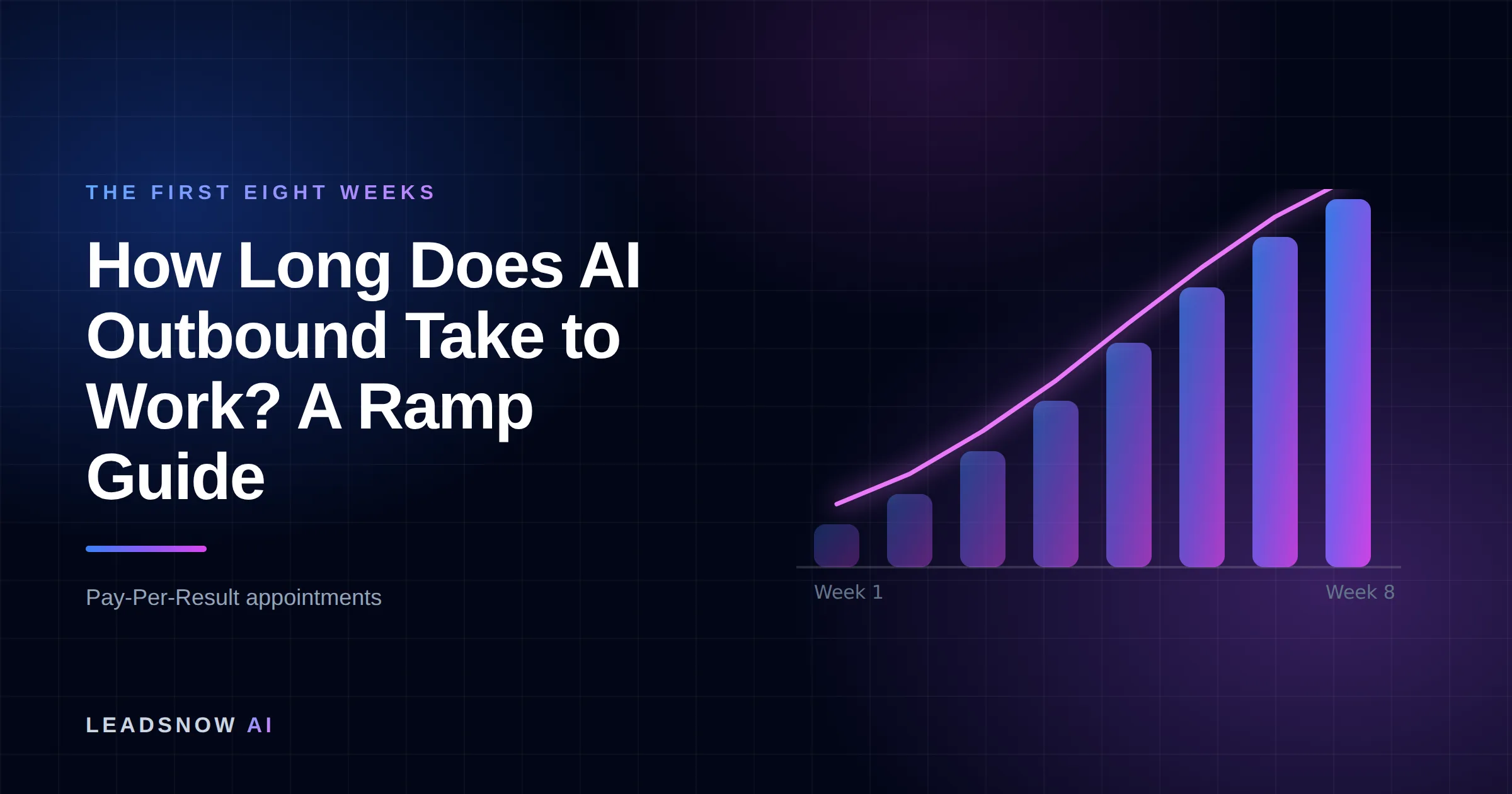
What the first eight weeks actually look like
Week 1 — data and setup
Lists built, sending infrastructure warmed, qualification rules agreed and written down.
Weeks 2–3 — first conversations
Initial outreach goes live. Replies start arriving and messaging is corrected against real responses.
Weeks 4–6 — booked volume ramps
Follow-up sequences mature and the calendar starts filling predictably.
Weeks 7–8 — optimisation
Segments that convert get more volume; the ones that do not get cut.
MAKE MORE SALES.
Pay-Per-Result pricing — We scale sales HARD aligned to your interests, better than anyone else.
Why the clock isn’t set by the AI
Vendors sell speed because speed sells. But three things bound the ramp above, and none of them are the AI’s performance.
A2P 10DLC campaign vetting. Any US business sending outbound SMS through a 10-digit long code must register a brand and a campaign with The Campaign Registry (TCR) under carrier and CTIA rules, or carriers block the traffic outright. Microsoft’s Azure Communication Services documentation states brand registration approval “typically takes two to three business days,” with campaign registration approval “typically takes three to five business days” on top of that — assuming a clean, accurate submission. In our experience the campaign step can stretch toward 10–15 business days during high-volume review periods, and every rejection restarts the clock. We cover the full registration mechanics, trust scores and throughput tiers in our A2P 10DLC registration guide for outbound SMS.
Domain and number warm-up. A brand-new sending domain or number can’t go from zero to full volume on day one without tripping spam and reputation filters. Deliverability guidance from email-verification vendor BounceCheck puts a realistic warm-up window at 1–2 weeks for a domain with some prior sending history, and 2–4 weeks minimum — 3–6 weeks is the more realistic range for B2B cold outreach — for a genuinely new domain, ramped on engagement metrics rather than a fixed calendar. Skip this and your early conversation-rate data will be contaminated by deliverability problems, not genuine buyer response.
Your own sales cycle. This is the number nobody says out loud. If your average deal takes 90 days to close, no outbound program — AI or human — can produce closed-won revenue in 30 days. The booking happened; the revenue hasn’t caught up to it yet, because it can’t. Pipeline research published by CRM vendor optif.ai covering 939 SaaS companies puts the median sales cycle at 84 days across all deal sizes, with mid-market deals ($15K–$100K) running 30–90 days and enterprise deals (over $100K) running 90–180+ days once procurement, security review and multi-stakeholder buying committees are involved. A US scale-up selling a $30K mid-market contract should expect a 60–90 day gap between a booked meeting and a signed deal, independent of anything the outbound program did right or wrong. If your buyer profile matches this, our page on lead generation for US scale-ups goes into why coverage, not demand, is usually the actual constraint at this stage.
Want this done for you? We book qualified sales appointments on a Pay-Per-Result basis — you only pay for calls that actually land in your calendar.
Leading indicators you can read early vs. the one you can’t rush
Not every metric becomes meaningful at the same time. Reading a rate off too little volume is how teams talk themselves into killing a program that was working, or keeping one that wasn’t.
| Metric | Roughly when it’s readable | Volume before it means anything |
|---|---|---|
| Connect rate | First few days of live sending | A few hundred dials or sends |
| Conversation rate | ~Week 2 of live sending | A few hundred connects |
| Booking rate | Weeks 4–6 | Several hundred conversations |
| Show rate | Weeks 6–8 | 30–50+ booked meetings |
| Closed-won rate (lagging) | Bound by your sales cycle — months, not weeks | Enough closed opportunities that one deal isn’t skewing the rate — typically 20–30+ |
Booking rate and show rate are the two you can actually manage a program on inside a single quarter. Closed-won is the one your board wants and the one you have to wait for — and it’s worth being rigorous about what’s actually causal here rather than just correlated; our piece on running an incrementality test on lead-gen spend covers how to separate genuine lift from pipeline that would have shown up anyway.
What a legitimate 30-day result looks like — and what a fake one is actually doing
Some vendors do claim closed revenue inside 30 days. Occasionally it’s real, and when it is, it’s almost never net-new cold outbound. It’s database reactivation: re-engaging people who already know the brand — past inquiries, quoted-but-not-closed leads, lapsed customers — rather than cold-calling strangers who’ve never heard of you.
Reactivation is fast for a structural reason, not a magic one: there’s no cold-start deliverability curve to climb and no stranger-to-trust gap to close, because the relationship already exists. In our Colliers-era reactivation work, AI-led re-engagement of a dormant database converted at a 4.4% average booking rate, peaking at 8.9% on the best-performing segments — well above what net-new cold outreach into a stranger list typically produces. That speed is real. It is also a different motion from net-new outbound, with a different ramp, and the two should never be quoted on the same slide as if they were the same product.
A legitimate 30-day result for net-new outbound looks like: campaigns live, connect rate and early conversation rate trending in the right direction, first bookings landing. It does not look like closed revenue, unless your sales cycle is genuinely under 30 days — which, per the benchmarks above, is rare outside pure transactional SMB sales.
If we can’t make you money, we don’t deserve yours.
Pay-Per-Result pricing — performance-based alignment.
Red flags in vendor ramp promises
- “$X in closed revenue in 30 days” for net-new cold outbound, with no mention of your sales cycle length anywhere in the pitch.
- Vague definition of “results.” Booked call, qualified meeting and closed deal are three different numbers — a vendor who won’t say which one they’re quoting is picking whichever is biggest.
- No mention of A2P 10DLC vetting or warm-up time in the proposed timeline, as if SMS sending can start at full volume on day one.
- Case studies that blend reactivation and net-new numbers without labeling which motion produced which result.
- No raw data access in the early weeks — only a polished dashboard, with no way to see actual transcripts or call dispositions behind the headline rate.
FAQ: how long AI outbound takes to work
How long does AI outbound take to work?
Expect 8–12 weeks before booking rate and show rate are stable enough to judge, and 3–6 months before booked meetings convert to closed-won revenue. The first number is set by campaign ramp and volume; the second is set by your sales cycle.
How long does A2P 10DLC registration actually take?
Per Microsoft’s Azure Communication Services documentation, brand registration approval typically takes two to three business days and campaign registration approval typically takes three to five business days once the brand is approved — longer if information is incomplete or a resubmission is needed. Our full A2P 10DLC guide walks through the trust-score and throughput mechanics behind that timeline.
Why can’t I see closed revenue in the first 30 days of a new program?
Because the sales cycle hasn’t finished, not because the program isn’t working. A meeting booked in week 4 still has to go through discovery, proposal and procurement before it’s revenue — and for a median B2B SaaS deal, that alone takes roughly 84 days.
What’s the fastest an AI outbound program can show real ROI?
Reactivating an existing, dormant database — not cold net-new outreach. There’s no domain warm-up curve or stranger-to-trust gap to climb, because the contact already knows the brand. It’s a genuinely different, faster motion, and it should be sold and measured as one.
How long is a typical B2B sales cycle?
Pipeline research published by CRM vendor optif.ai covering 939 B2B SaaS companies puts the median at 84 days across all deal sizes, with enterprise deals over $100K running 90–180+ days once procurement and multi-stakeholder buying committees are involved. Whatever your outbound engine, closed revenue can’t outrun that number.
How much volume do I need before booking rate means anything?
Rule of thumb: a few hundred conversations before booking rate stops being noise, and 30–50+ booked meetings before show rate is reliable. Below that, a single good or bad week can swing the rate by double digits.
Is database reactivation faster than net-new cold outbound?
Yes, structurally so — it skips the stranger-to-trust gap that net-new outbound has to climb. It converts at a meaningfully higher rate in our own reactivation work (4.4% average, 8.9% peak on top segments), but it is a finite motion: it works on the database you already have, not on new-market demand.
Pay-Per-Result appointments
See if we’re a fit
We book qualified sales appointments for you and you pay on results, not retainers. Our booking page asks a few quick questions so you find out in two minutes whether that model suits your business.
- 50,769+ appointments booked without cold calling.
- Pay-Per-Result pricing — you pay for booked, qualified calls.
- Pick your own time on our live calendar, no phone tag.