
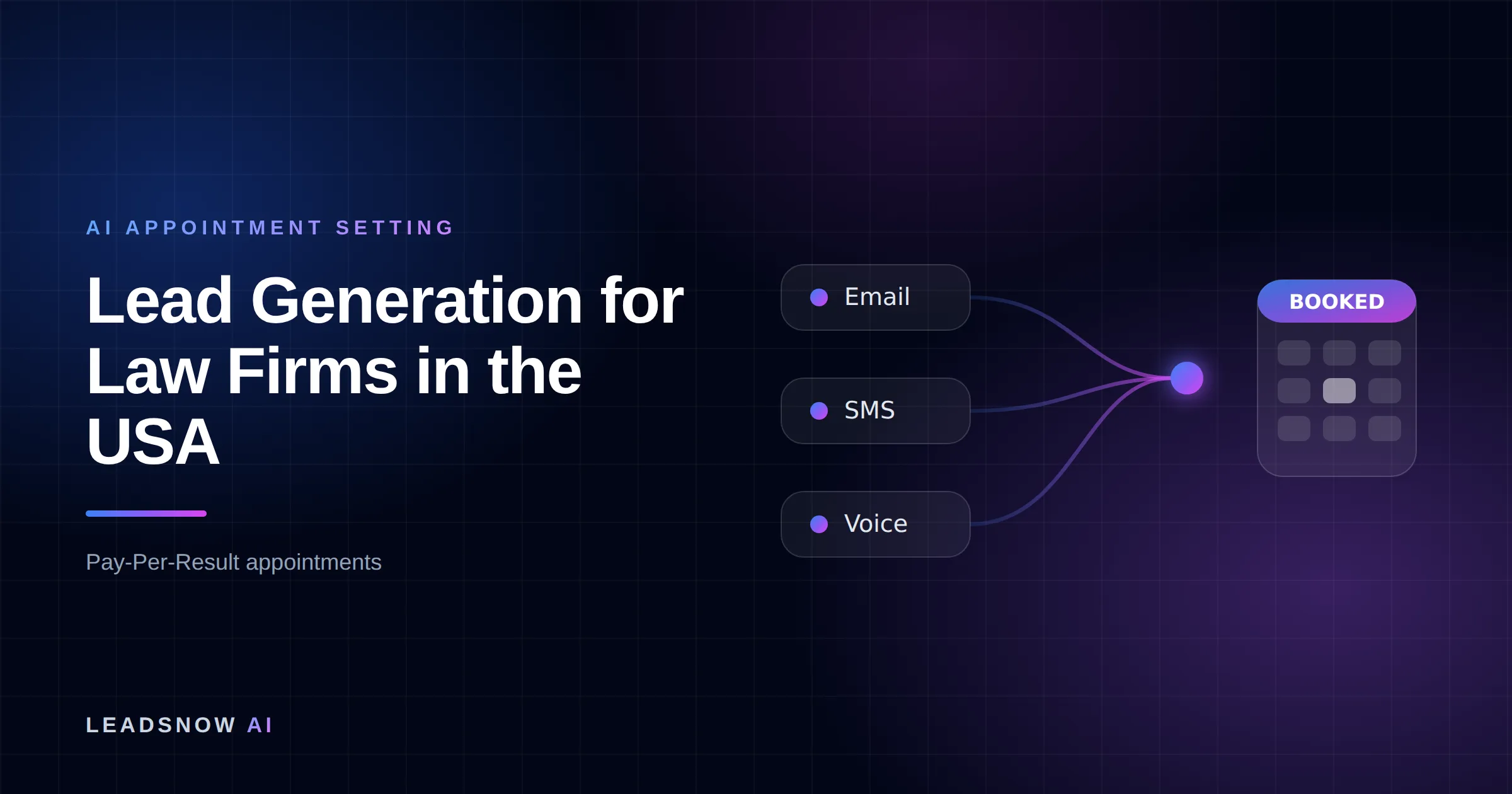
Most conversations about law firm lead generation in the USA start with the wrong question: “How much does a lead cost?” The better question — the one that decides whether your marketing budget compounds or evaporates — is “How much does a signed case cost?” This page walks through the real numbers, the intake failure hiding inside most firms, and how pay-per-result AI appointment setting changes the math.
At a glance: Law firm lead generation in the USA works best when you pay for outcomes, not inquiries. LeadsNow.ai books pre-qualified consultations directly onto attorneys’ calendars using AI outreach — 50,769+ appointments booked since 2017 — and you pay per qualified appointment held, so cost-per-signed-case, not cost-per-lead, drives the math.
American law firms rarely lose cases to a better competitor. They lose them at intake.
The data on this is blunt. In its 2024 Legal Trends Report, Clio ran a secret-shopper study across 500 US law firms, posing as prospective clients. Only 40% of firms answered the phone — down from 56% in 2019. Just 33% replied to emails from would-be clients, down from 40% in 2019.
Read that again in dollar terms. If you’re spending on Google Ads, Local Service Ads, or directory listings, and six out of ten inbound calls ring out, you are paying full retail for leads and then donating most of them to whichever firm picks up. The prospect with a fresh injury claim or a custody emergency doesn’t leave a voicemail and wait patiently — they call the next result on the page.
This is why the highest-ROI fix for most firms isn’t more traffic. It’s response infrastructure: answering every inquiry in minutes, at night, on weekends, and following up until the consultation is on the calendar. That’s the core of speed-to-lead automation, and it’s where AI has quietly become the strongest performer in legal intake.
How it works
How an AI sales agent books your appointments
Six channels feed in
Outbound email, SMS, voice and social — plus inbound search and AI referrals from our own AI SEO and chat agents.
Your list or CRM
Outbound starts from data you already own — past enquiries, dormant customers, or a targeted prospect list.
Qualified against your rules
Budget, timing and fit are checked before anything reaches your team, using criteria you set.
Booked into your calendar
Only qualified prospects reach the booking step, so your closers spend their time selling.
MAKE MORE SALES.
Pay-Per-Result pricing — We scale sales HARD aligned to your interests, better than anyone else.
Cost-per-lead is the number vendors quote. Cost-per-signed-case is the number that pays payroll.
Here’s the trap. A lead vendor quotes you a low per-lead price, and it feels cheap next to your Google Ads invoice. But leads aren’t revenue — signed engagement letters are. Rankings.io’s 2026 analysis of $3.3 million in Google Ads and Local Service Ads spend across 13 plaintiff-side firms found the average personal injury firm pays $284 per lead — but with only 7% of leads converting to cases, the real cost per signed case is $468. And that’s at firms disciplined enough to track it.
Channel choice moves the number a lot. First Page Sage’s June 2025 study of 49 personal injury firms across 36 states put average cost-per-lead at $442 for Google Search Ads, $378 for Local Service Ads, and $183 for SEO — with medical malpractice leads averaging $512 and auto accident leads $391.
Two levers control your cost per signed case: what you pay per inquiry, and what percentage of inquiries become clients. Most legal marketing only works on the first lever. Qualification and follow-up — the second lever — is where the multiple hides. Doubling a 7% conversion rate does more for your economics than any discount a lead vendor will ever offer.
Want this done for you? We book qualified sales appointments on a Pay-Per-Result basis — you only pay for calls that actually land in your calendar.
What US legal leads cost in 2026, by practice area
Benchmarks from published US sources, for context (these are industry figures, not our pricing):
| Practice area | Typical cost per lead | Source |
|---|---|---|
| Personal injury | $150–$500 | Legal Brand Marketing |
| Personal injury (paid search + LSA average) | $284 | Rankings.io, 2026 |
| Family law | $75–$300 | Legal Brand Marketing |
| Criminal defense | $50–$200 | Legal Brand Marketing |
| Employment law | $100–$400 | Legal Brand Marketing |
| Mass tort / class action | $300–$1,000+ | Legal Brand Marketing |
Notice what’s missing from every one of those quotes: whether the person ever became a client. A $75 family law lead that never picks up again is more expensive — infinitely so — than a qualified prospect holding a confirmed slot on your calendar, whatever that appointment costs per unit.
How pay-per-result AI appointment setting works for attorneys
The model is simple to describe: we don’t sell you contact records. We deliver booked, pre-qualified consultations, and you pay per appointment — not per click, per lead, or per month of retainer.
- Connect a source. Your existing web inquiries, ad leads, aged intake lists, or outreach lists we build with you — with proper consent in place.
- AI engages in minutes, not days. Our AI voice agents and SMS follow-up reach every inquiry fast and keep working evenings and weekends, when a large share of legal emergencies actually happen. Being headquartered in Melbourne doesn’t matter here — the AI operates natively in US time zones, every time zone at once.
- Every prospect is screened before your calendar sees them. For law firms, screening covers: does the matter match your practice areas; is the prospect located in a state where you’re licensed; is the matter current and time-sensitive; is the caller the actual party (or authorized decision-maker); and is the engagement financially viable for your fee model, whether contingency or retainer.
- Consultations land on your calendar. Your attorneys and intake staff spend their hours on consults, not phone tag.
- You pay per qualified appointment. If the consultation doesn’t happen, it isn’t billed.
Yes, a qualified appointment costs more per unit than a raw lead — that’s the point. Tight screening means fewer conversations that go nowhere, and the number to judge it by is what a signed case costs you end to end, not the sticker price of the inputs.
If we can’t make you money, we don’t deserve yours.
Pay-Per-Result pricing — performance-based alignment.
Advertising ethics and TCPA: the part your State Bar cares about
Legal marketing in the US operates inside real guardrails, and any vendor who won’t discuss them is a liability.
Bar advertising rules. Under the ABA Model Rules — which most states adopt in some variant — Rule 7.1 prohibits false or misleading communications about a lawyer’s services, Rule 7.2 permits paying the reasonable costs of advertising and lead generation services (while prohibiting payment for recommendations), and Rule 7.3 restricts certain live solicitation of prospective clients. A flat per-appointment marketing fee that isn’t contingent on case outcomes and involves no fee sharing is structured to sit on the right side of those lines — but state rules differ, some states require ad filing or review, and you should confirm specifics with your own State Bar. We’re a marketing company; nothing here is legal advice, which you already know better than we do.
TCPA. Automated calls and texts to US consumers require the right consent, and the FCC’s February 2024 declaratory ruling confirmed that AI-generated voices count as “artificial” under the TCPA. We build campaigns consent-first and document it. We’ve published a full breakdown in our guide to TCPA compliance for AI voice and SMS agents — worth reading before you hire anyone (including us) to touch outbound.
Traditional legal marketing vs. pay-per-result AI appointment setting
| Directory / shared leads | PPC + in-house intake | LeadsNow pay-per-result AI | |
|---|---|---|---|
| What you pay for | Contact records, converted or not | Clicks, converted or not | Qualified consultations that happen |
| Who carries conversion risk | You | You | The agency |
| Speed to first contact | Whenever staff gets to it | Business hours, if the phone is answered (Clio: 40% of firms answer) | Minutes, 24/7 |
| Nights and weekends | Voicemail | Voicemail or answering service | Live AI engagement and booking |
| Qualification before attorney time | None | Depends on intake staff | Five-point screen, every prospect |
The proof — and the honest caveat
Since 2017 we’ve booked 50,769+ AI-booked sales appointments and generated over 1 million leads for clients. We hold a 4.7-star average across 60 Google and Facebook reviews and have 25 filmed client case studies, including Sam Tajvidi at 121 Brokers, Colliers, Marcus Wilkinson at Iron Body, Foundr, SheSells.online, and Lambda Academy.
The caveat, stated plainly: that track record was built in financial services, real estate, education, and fitness — not in a US law firm. What transfers isn’t the vertical; it’s the machinery. Screening a prospect for matter type and jurisdiction uses the same engine as screening a borrower for loan size, and the pay-per-result structure means we only earn when that screening holds up. If we couldn’t qualify accurately, the model would bankrupt us, not you.
Who this fits — and who it doesn’t
A strong fit: firms with consultation capacity to spare; practice areas where one signed matter is worth four or five figures or more in fees; firms already generating inquiries that leak at intake; and partners who’d rather pay more per appointment for dramatically fewer dead conversations.
A poor fit: firms wanting a pile of cheap raw names to churn through, firms with no capacity to take new consults, or anyone expecting a lead-gen vendor to guarantee signed cases — no ethical vendor can promise retention outcomes, and you should walk away from any that does.
Frequently asked questions
Is paying per appointment compliant with attorney advertising rules?
ABA Model Rule 7.2 generally permits lawyers to pay the reasonable costs of advertising and lead generation services, while prohibiting payment for recommendations or fee sharing. A flat per-appointment marketing fee, not contingent on whether you sign or win the case, is designed around that distinction. State versions vary, so confirm with your State Bar — we’ll walk through our structure on the call.
You’re headquartered in Melbourne, Australia. Who is actually contacting our US prospects?
AI voice and SMS agents that operate natively in US time zones, in American English, under US compliance rules — supervised by our team. Because the outreach is AI-driven, geography is irrelevant to response speed: a 9 p.m. inquiry in Denver gets engaged at 9 p.m. in Denver. We disclose the Melbourne HQ up front because clients find out anyway, and honesty is cheaper.
Which practice areas does this work for?
Consumer-facing practices with meaningful case values: personal injury, family law, immigration, employment, criminal defense, estate planning, and bankruptcy. The screening criteria are configured per practice area — an immigration intake screen looks nothing like a personal injury one.
How is this different from buying leads from Avvo, Nolo, or FindLaw-style directories?
Directories sell you a contact record and the work starts there: you still have to reach them, screen them, and book them, and Clio’s 2024 secret-shopper data shows most firms fail that step. We deliver the finished article — a screened prospect holding a confirmed consultation slot — and we only get paid when it happens.
What counts as a “qualified appointment,” and what if the prospect no-shows?
Qualified means the prospect passed the five-point screen you approved: matter fit, jurisdiction, urgency, party status, and fee viability. Appointments that don’t happen aren’t billed — the no-show risk sits with us, which is exactly why our follow-up and confirmation sequences are aggressive about show rates.
Do you have US law firm case studies yet?
Not yet, and we won’t manufacture one. Our 25 filmed case studies come from other verticals. What we offer instead is a structure where the burden of proof is on us: you pay for qualified appointments that occur, not for our promises.
Book a call
If cost-per-signed-case is the number you actually manage to, the conversation is short: what a qualified consultation is worth to your firm, which practice areas to screen for, and how fast we can put the first booked consults on your calendar. Book a call — you pick the time, no phone tag, no obligation.
Pay-Per-Result appointments
See if we’re a fit
We book qualified sales appointments for you and you pay on results, not retainers. Our booking page asks a few quick questions so you find out in two minutes whether that model suits your business.
- 50,769+ appointments booked without cold calling.
- Pay-Per-Result pricing — you pay for booked, qualified calls.
- Pick your own time on our live calendar, no phone tag.