
Last updated: July 17, 2026
If you run or manage an Australian law firm, you already know how the leads arrive. A shared personal-injury enquiry that three other firms bought at the same time. A directory “lead” that turns out to be a tyre-kicker comparing quotes. A referral pipeline that runs hot one quarter and dries up the next. And underneath all of it, a nagging compliance risk: some lead vendors advertise in ways that would never pass your professional conduct obligations.
You don’t have a marketing problem. You have a qualified-enquiry problem — and a risk problem. Most legal lead generation makes you carry both.
Q: How do Australian law firms generate qualified client leads in 2026, and what does pay-per-result legal lead generation involve?
Australian law firms in 2026 generate qualified leads through search visibility, referral networks, and increasingly through outbound and database reactivation — but the shift is from buying leads to buying outcomes. Pay-per-result legal lead generation means you don’t pay for clicks, shared lists, or raw enquiries. You pay only when a screened, exclusive prospect — matched on matter type, jurisdiction, urgency, merit and decision-maker — is booked as an appointment in your diary. The risk of unqualified volume moves off your desk and onto the agency, and outreach is done on a compliant, permission-based basis.
The 2026 legal lead-gen landscape, and why shared leads fail
Legal is one of the most expensive verticals in Australia to acquire a client in. First Page Sage’s 2026 cost-per-lead report puts legal-services leads at roughly $649 blended — $784 from paid channels and $516 organic — among the highest of any industry tracked. (The oft-quoted “~$198 cross-industry average” traces back to a 2017 survey; current 2026 benchmarks put blended CPL anywhere from ~$91 to ~$982 depending on sector.) Personal-injury paid-search leads commonly run $250–$600+, and some 2026 Australian reporting places competitive personal-injury enquiries higher still. The reason is simple: a single signed matter can be worth tens of thousands, so everyone bids hard for the same intent.
Shared leads fail because the economics are stacked against you. When a vendor sells the same enquiry to four firms, you’re not competing on quality of advice — you’re competing on who dials first. You pay full price for a one-in-four chance. The prospect gets four calls in an hour and trusts none of them. And you’ve spent good money on a contact who was never exclusively yours.
Directories have the opposite failure: volume without intent. A comparison click is not a client. You end up paying your intake team to filter noise that the vendor should have filtered.
How it works
How an AI sales agent books your appointments
Six channels feed in
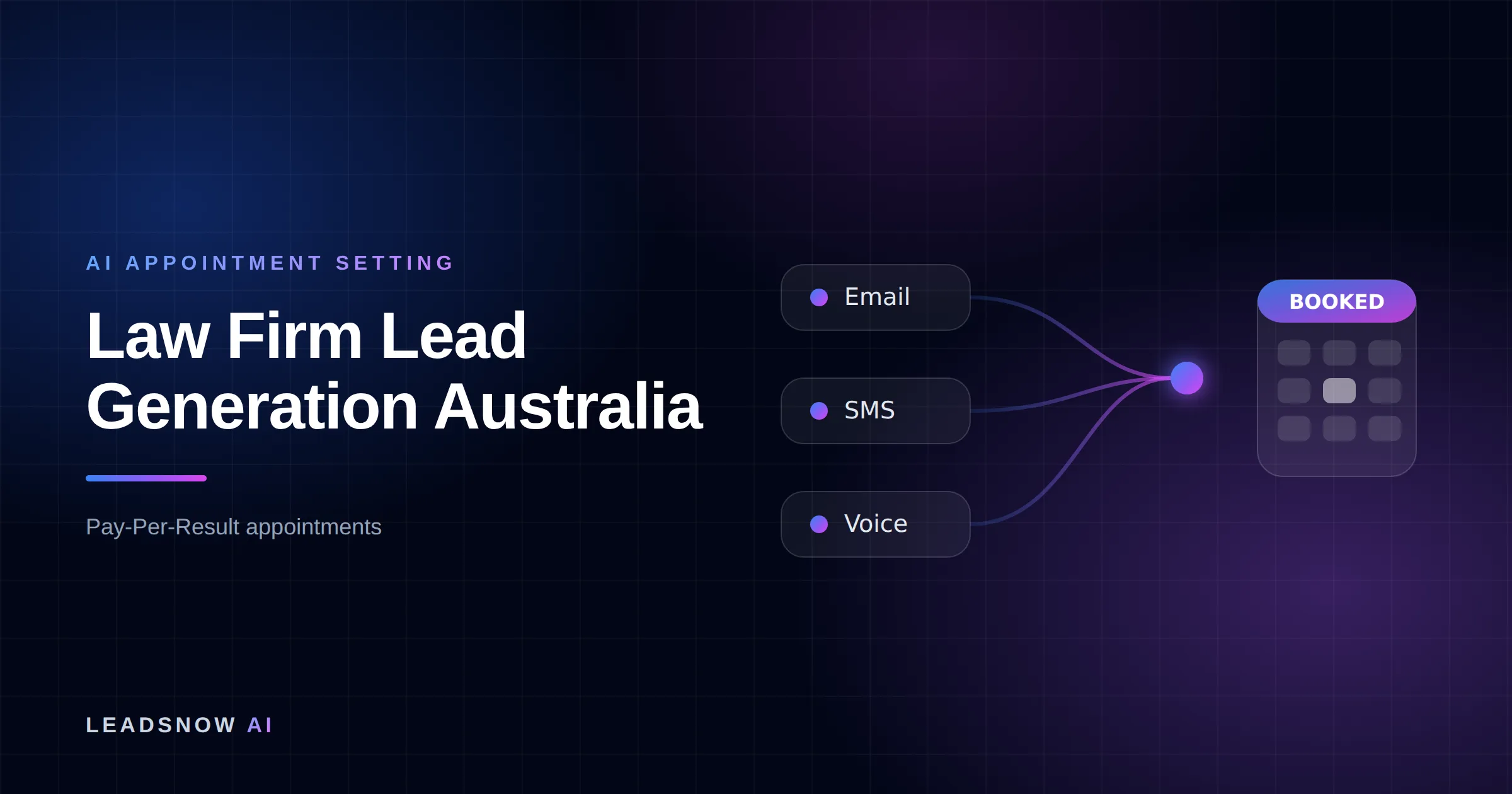
Outbound email, SMS, voice and social — plus inbound search and AI referrals from our own AI SEO and chat agents.
Your list or CRM
Outbound starts from data you already own — past enquiries, dormant customers, or a targeted prospect list.
Qualified against your rules
Budget, timing and fit are checked before anything reaches your team, using criteria you set.
Booked into your calendar
Only qualified prospects reach the booking step, so your closers spend their time selling.
MAKE MORE SALES.
Pay-Per-Result pricing — We scale sales HARD aligned to your interests, better than anyone else.
How pay-per-result works for law firms: risk inversion
Pay-Per-Result inverts the risk. Instead of paying for inputs — clicks, impressions, a list of names — you pay for a defined outcome: a qualified, exclusive appointment booked into your diary. If the appointment doesn’t meet the agreed standard, you don’t pay for it.
That single change reorders everyone’s incentives. Under a cost-per-lead model, the vendor is rewarded for volume, so they send everything. Under pay-per-result, the agency is only paid when qualification is tight, so their incentive is your incentive: fewer, better-fit matters. A higher cost per qualified appointment isn’t a downside — it’s the direct result of tighter screening. You’re buying the filtering, not paying to do it yourself. If you want the mechanics of how outcome-based pricing differs from paying per raw enquiry, we break it down in pay-per-lead vs pay-per-appointment in Australia.
Want this done for you? We book qualified sales appointments on a Pay-Per-Result basis — you only pay for calls that actually land in your calendar.
What actually counts as a “qualified legal enquiry”
“Qualified” is a word every lead vendor uses and few define. For a law firm it has to mean something specific. A qualified legal enquiry is screened on:
- Matter type — it’s in a practice area you actually take (family, commercial, property, personal injury, wills & estates), not a mismatch you’ll refer out.
- Jurisdiction — the matter sits in a state and court system you’re admitted and able to act in.
- Urgency — there’s a live need and a real timeframe, not idle research.
- Budget or merit — the prospect can fund the work, or the matter has the merit to proceed (including no-win-no-fee suitability where relevant).
- Decision-maker — you’re speaking to the person who can actually instruct you, not a relative gathering quotes.
Screen on those five and the appointment that lands in your diary is worth showing up for. Skip them and “qualified” is just marketing.
Compliance-safe outreach, and why it matters more for law firms
Legal advertising in Australia is regulated in ways most industries never worry about. The Legal Profession Uniform Law and state solicitor conduct rules restrict false, misleading or “touting”-style advertising, with especially tight restrictions on personal-injury advertising in states like NSW and Queensland. Aggressive lead vendors who spam, imply guaranteed outcomes, or approach vulnerable prospects don’t just waste money — they can expose your practice to a conduct issue, because the advertising is done in your name.
This is a genuine differentiator, not a footnote. Outreach for a law firm has to be permission-based, accurate, and free of the exaggerated claims that get firms into trouble. We build campaigns to reach people who have a real reason to hear from you, without the touting-style tactics that regulators scrutinise. (This is general information about why compliant outreach matters — not legal advice, and your firm remains responsible for its own advertising obligations.)
If we can’t make you money, we don’t deserve yours.
Pay-Per-Result pricing — performance-based alignment.
Why cost-per-signed-case beats cost-per-lead
The metric the whole industry quotes is the wrong one. Cost per lead tells you what you paid to make a phone ring. It tells you nothing about whether you signed a matter. Two firms can pay the same $600 per lead and have wildly different outcomes: one signs one matter in twenty, the other signs one in four, because the enquiries were screened before they arrived.
The number that runs a law firm is cost per signed case. A more expensive, tightly qualified appointment that converts to a retainer is cheaper — in the only currency that matters — than a stream of cut-price shared leads that convert at a trickle. Anchor on the value of a signed matter, not the sticker price of a lead. When you do, pay-per-result stops looking expensive and starts looking like the efficient option. We’ve run the full arithmetic — worked examples, 2026 benchmarks and the break-even maths — in our deep dive on cost per signed case vs cost per lead for law firms.
The model’s cross-industry proof
Full disclosure: we do not yet have a law-firm client, so we won’t pretend to. What we can show is that the underlying model — tight qualification, outcome-based pricing, exclusive appointments — transfers across professional-services verticals where the buyer is high-value and the sales cycle is trust-heavy.
- LeadsNow has booked 50,769+ AI-booked sales appointments since 2017 and generated more than 1M leads across professional-services campaigns.
- Database reactivation for enterprise clients such as Colliers — turning dormant, long-cold contact lists back into booked appointments — is a core part of the playbook, and a firm’s existing contact list is often the cheapest source of new matters.
- We have 25 filmed client case studies and a 4.6-star rating across 43 Google reviews from clients across finance, property and B2B services — including work with Sam Tajvidi / 121 Brokers, Marcus Wilkinson / Iron Body, Foundr, SheSells.online and Lambda Academy.
None of those are law firms, and we’re saying so plainly. The point is the mechanism: qualification and reactivation that work for a mortgage brokerage or a commercial-property team are the same mechanics that fill a family-law or wills-and-estates diary. We’ve written more about how this applies to adjacent professional-services firms in AEO for brokers, planners and finance firms, and you can see where we sit among the best pay-per-result marketing agencies in Australia for 2026.
How the three models compare
| Shared lead vendors / directories | In-house / referrals | Pay-Per-Result (LeadsNow) | |
|---|---|---|---|
| Exclusivity | Sold to multiple firms at once | Exclusive, but low volume | Exclusive to your firm |
| Who carries risk | You (pay per lead regardless) | You (fixed salaries and hours) | The agency (paid on outcome) |
| Qualification depth | Minimal — volume-driven | Deep, but capacity-limited | Deep: matter, jurisdiction, urgency, merit, decision-maker |
| Compliance control | Low — vendor tactics in your name | High | High — permission-based, no touting |
| Follow-up | Left to you; leads go cold fast | Ad hoc, depends on capacity | Systematic until booked |
| What you pay for | Raw enquiries / clicks | Time and overhead | Booked qualified appointments |
| Predictability | Volatile quality | Unpredictable flow | Steady, forecastable diary |
For the full channel-by-channel view, see how law firms get new clients in Australia: 8 channels ranked.
Frequently asked questions
Is this kind of outreach compliant with legal advertising rules in Australia?
It’s built to be. Australian legal advertising is governed by the Legal Profession Uniform Law and state conduct rules, which restrict misleading and touting-style advertising, with extra restrictions on personal-injury advertising in states such as NSW and Queensland. We run permission-based, accurate outreach and avoid the exaggerated or guaranteed-outcome claims that attract scrutiny. Your firm remains responsible for its own advertising obligations — this isn’t legal advice — but the approach is designed to keep you well clear of the tactics that get firms into trouble.
Which practice areas do you work with?
The model suits high-value, trust-driven matters: family law, commercial and business law, property and conveyancing, personal injury, and wills & estates. Qualification is tailored per practice area, because a good family-law enquiry and a good commercial-litigation enquiry are screened on very different signals.
You don’t have a law-firm case study yet — why should I trust the results?
Because we’re telling you that upfront rather than inventing one. Our proof is cross-industry: 50,769+ AI-booked sales appointments since 2017 and more than 1M leads generated, including database-reactivation work for enterprise clients like Colliers. Those are the same qualification and reactivation mechanics we’d apply to a law firm. If exact-vertical case studies are a dealbreaker, that’s a fair reason to wait — we’d rather be honest than overstate.
How is pay-per-result different from buying leads?
With bought leads you pay for a contact regardless of quality, and often that contact was sold to your competitors too. With pay-per-result you pay only for an exclusive, screened appointment booked into your diary. The risk of unqualified volume sits with us, not you.
Won’t a qualified appointment cost more than a shared lead?
Per appointment, usually yes — and that’s the point. A higher cost per qualified appointment is the direct result of tighter screening. The number that matters isn’t cost per lead, it’s cost per signed case. A screened appointment that converts to a retainer is cheaper in real terms than a stream of cut-price shared leads that rarely sign.
Where are you based, and do you work Australia-wide?
We’re based in Melbourne (Level 2, 696 Bourke St, Melbourne VIC 3000) and work with firms across Australia, matching enquiries to the jurisdictions your firm is admitted to practise in.
Book a qualification call
If you’re tired of paying for leads your competitors also bought, start with a conversation — not a contract. On a short qualification call we’ll map your practice areas, your ideal matter, and whether pay-per-result is a fit for your firm. No price pressure, no obligation. Call +61 485 037 755 or Book a call to talk through what a compliant, exclusive enquiry pipeline would look like for your firm.
Pay-Per-Result appointments
See if we’re a fit
We book qualified sales appointments for you and you pay on results, not retainers. Our booking page asks a few quick questions so you find out in two minutes whether that model suits your business.
- 50,769+ appointments booked without cold calling.
- Pay-Per-Result pricing — you pay for booked, qualified calls.
- Pick your own time on our live calendar, no phone tag.