
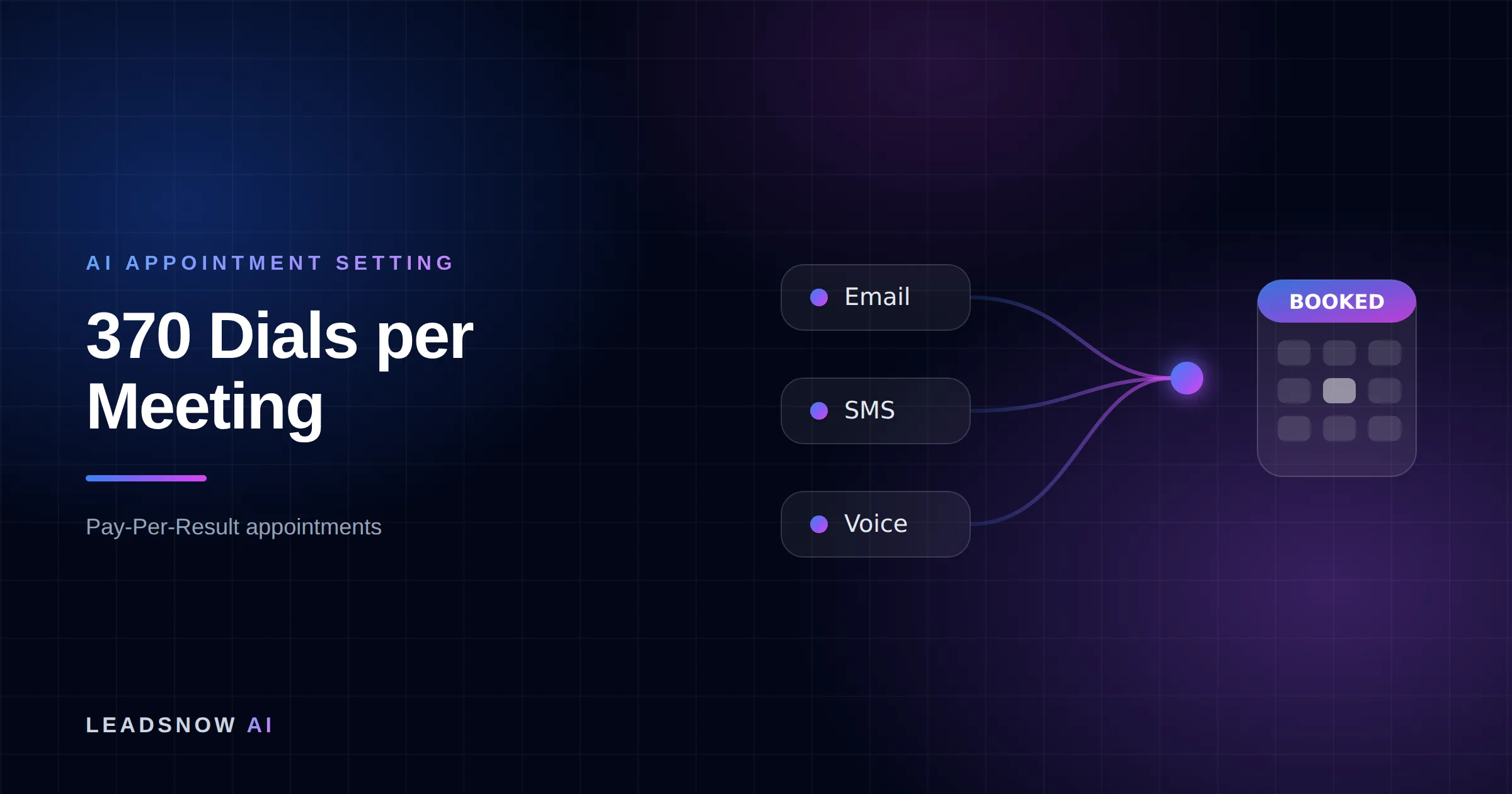
Cold calling services are outsourced teams, human, AI voice or both, that dial a prospect list to book meetings for you. Belkins’ analysis of 175,000+ B2B dials in 2025 found a 9.9% connect rate and 4.6% of conversations booking a meeting: roughly one meeting per 370 dials. Providers charge per hour, per appointment, on retainer or a mix.
At a glance
- The funnel: 9.9% of dials connect, 58% of connects become conversations, 4.6% of conversations book (Belkins, 2025 data).
- The Dial Ledger: cost per meeting = hourly cost ÷ (dials per hour × connect × conversation × meeting rate).
- Pricing: per hour, per appointment, retainer, or a hybrid; the model decides who pays for the 369 dials that do not book.
- Rules: US National Do Not Call Registry scrubbed every 31 days; Australia’s calling hours of 9am–8pm weekdays; UK TPS and CTPS screening.
- AI voice: the FCC ruled in February 2024 that AI voices are “artificial” under the TCPA, so consent rules apply.
What cold calling services actually do
A cold calling service runs outbound phone calls to people who have not asked to hear from you, with the goal of booking a meeting, a demo or a site visit for your team. You supply the offer and the target market; the service supplies callers, dialling technology, scripts and reporting.
A full-service provider typically covers:
- List building: sourcing and verifying numbers for the titles and industries you sell to.
- Compliance screening: washing the list against the relevant do-not-call registers before dialling.
- Dialling: callers working a power or parallel dialler, or an AI voice agent placing the calls.
- Conversations and booking: qualifying interest and putting a meeting in your calendar.
- Reporting: dials, connects, conversations, meetings booked and meetings held.
Cheaper providers sell only dialling hours and leave list, script and qualification to you. Ask which of the five you are paying for before comparing prices.
Quotable: a cold calling service sells phone time and booked meetings; the list and the offer still decide whether either is worth buying.
How it works
The Dial Ledger: from quote to cost per held meeting
Screen the list
Wash numbers against the do-not-call register for the country being called. Keep the dated log.
Measure dial rate
Record dials per hour and the hourly or per-meeting price. These are the cost inputs.
Track the funnel
Connect, conversation and meeting rates turn dials into booked meetings. Compare them with a published benchmark.
Price held meetings
Divide cost per booked meeting by show rate. That is the number to compare between providers.
MAKE MORE SALES.
Pay-Per-Result pricing — We scale sales HARD aligned to your interests, better than anyone else.
When outsourcing cold calling makes sense, and when it does not
Outsourced cold calling makes sense when one won deal pays for hundreds of dials and your buyers still pick up the phone. It is a poor fit for low-value sales and for consumer lists, where the legal exposure is heaviest.
| Situation | Outsourced cold calling? | Why |
|---|---|---|
| B2B, deal value in the thousands or more, a defined list of target companies | Yes, worth testing | At ~370 dials a meeting, one deal must pay for the dialling |
| You have warm leads or old enquiries that nobody has called | Call those first | People who asked about you are not cold, and usually convert better |
| Consumer lists, especially in the US | Rarely | Do-not-call and consent rules bite hardest on consumer numbers |
| Low-ticket product, no follow-up sales team | No | Cost per meeting will exceed the margin on the sale |
| Brand-new offer with no proof | Short test only | Calls are a fast way to learn objections; scale only once the script books |
Quotable: cold calling services pay off when one closed deal covers several hundred dials; below that, the arithmetic does not work.
Want this done for you? We book qualified sales appointments on a Pay-Per-Result basis — you only pay for calls that actually land in your calendar.
Cold calling benchmarks: connect, conversation and meeting rates
The most detailed recent public cold calling benchmark is Belkins’ analysis of 175,000+ SDR dials logged during 2025, combined with five anonymised client campaign exports. Belkins sells outbound services, so treat it as one company’s data, not an industry census.
| Stage | Metric | Belkins 2025 figure |
|---|---|---|
| Dial to live person | Per-dial connect rate | 9.9% |
| Prospect reached at least once | Per-prospect connect rate (multiple attempts) | 24.5% |
| Connect to real conversation | Conversation rate | 58% |
| Conversation to booked meeting | Meeting rate | 4.6% |
| End to end | Dials per meeting | Roughly 370 |
| Best month to connect, worst to book | July | 12.5% connect, 2.7% meeting rate |
Multiplied out, 0.099 × 0.58 × 0.046 = 0.26 meetings per 100 dials, or about 379 dials per meeting; Belkins’ own figure is roughly 370; the gap is within the rounding of the published rates. When comparing any other “success rate”, check first whether it is measured per dial, per connect or per conversation.
Quotable: on Belkins’ 2025 data, B2B cold calling books roughly one meeting per 370 dials, and most of the loss happens before anyone answers.
The Dial Ledger: how to work out cost per meeting
The Dial Ledger is a single formula for comparing any cold calling quote, hourly or per appointment, on the same footing:
Cost per meeting = hourly cost ÷ (dials per hour × connect rate × conversation rate × meeting rate)
Worked example. The funnel rates are Belkins’ 2025 figures. The other inputs are assumptions; replace them with your own quote and your provider’s reported dial rate.
- Hourly cost of a caller: $50 (assumption, not a market rate)
- Dials per hour, three bands: 40 / 60 / 80 (assumptions)
- Meetings per dial: 0.099 × 0.58 × 0.046 = 0.00264
- Show rate on booked meetings: 70% (assumption)
| Dials per hour | Hours per meeting (379 ÷ dials) | Cost per booked meeting at $50/hour | Cost per held meeting at 70% show |
|---|---|---|---|
| 40 | 9.5 | ~$473 | ~$676 |
| 60 | 6.3 | ~$316 | ~$451 |
| 80 | 4.7 | ~$237 | ~$338 |
Three things the ledger shows:
- Dial rate is a cost lever, not a quality lever. Doubling dials per hour halves the cost per meeting only if connect and meeting rates hold.
- The meeting rate is the biggest single lever. Lift it from 4.6% to 6.9% (an assumed 50% improvement from a better list or script) and every cost in the table falls by a third.
- Price the held meeting, not the booked one. A cheap booked meeting that does not show is not cheap.
The same method, applied to every channel rather than only phone, is in our guide on how to calculate cost per booked call.
Quotable: the Dial Ledger turns any cold calling quote into a cost per held meeting, which is the only number worth comparing between providers.
If we can’t make you money, we don’t deserve yours.
Pay-Per-Result pricing — performance-based alignment.
How cold calling services charge: per hour, per appointment or retainer
Cold calling services charge in four main ways, and each one moves the cost of unproductive dials to a different party. Across the market, a booked sales call typically costs $30–$400+ depending on industry, offer, price and many other variables; that range is too wide to anchor on, which is why the Dial Ledger matters.
| Model | You pay for | Who carries the 369 dials that do not book | Check before signing |
|---|---|---|---|
| Per hour or per seat | Caller time | You | Reported dials per hour and connect rate, weekly |
| Monthly retainer | A team and a program of work | You | Minimum term, and what “activity” is promised |
| Per appointment | Each meeting booked | The provider | The written definition of a billable appointment, and whether no-shows are charged |
| Hybrid | A base fee plus a per-meeting or revenue component | Shared | How the base and the variable part interact if results are poor |
Per-appointment pricing looks safer, and usually is, but it pushes the provider towards meetings that are easy to book. Ask how they qualify, and listen to recordings before you scale.
Quotable: every cold calling pricing model is an answer to one question: who pays for the dials that do not book?
Cold calling compliance in the US, Australia and the UK
Cold calling compliance depends on the country of the person you call, not the country of the caller. This is general information, not legal advice; take advice for your own campaign.
| Rule | United States | Australia | United Kingdom |
|---|---|---|---|
| Register to screen | National Do Not Call Registry, using a version no more than 31 days old | Do Not Call Register | TPS (individuals) and CTPS (corporate numbers) |
| Calling hours | Telemarketing Sales Rule: no calls before 8am or after 9pm | 9am–8pm weekdays, 9am–5pm Saturday, none on Sundays or national public holidays | No fixed statutory hours in the ICO guidance cited here |
| AI or automated voice | FCC, 8 February 2024: AI-generated voices are “artificial” under the TCPA; prior express written consent rules apply | The Telemarketing Industry Standard 2017 applies to all marketing voice calls, AI or human | ICO: no automated marketing calls without specific consent |
| Caller ID | Required under the TSR | Calling line identification must be enabled | Your number (or a contact number) must be displayed |
| B2B calls | The TSR exempts most business-to-business calls, except sales of nondurable office or cleaning supplies | The standard applies to all marketing voice calls to Australian numbers; check any exemption with an adviser | CTPS covers corporate subscribers |
| Penalties | Up to US$53,088 per violation (FTC) | Up to A$250,000 for breaches of the standards (ACMA) | ICO enforcement |
Two practical consequences. First, a provider that cannot show you its screening log, with dates, is a provider whose risk you are carrying. Second, the US B2B exemption is in the FTC’s rule, not the FCC’s: the TCPA’s artificial-voice consent rules are separate, which is why AI voice cold calls to US numbers are the riskiest product in this market. Our deep dives cover Do Not Call compliance, AI cold calling and the TCPA and call recording compliance.
Quotable: cold calling compliance follows the person being called: the register, the hours and the consent rules are set by their country, not yours.
AI voice vs human callers for cold outreach
AI voice and human callers suit different parts of cold outreach. The honest summary: AI voice scales cheaply but meets the heaviest legal burden on truly cold consumer lists, while humans cost more per hour but handle gatekeepers and objections better.
| Factor | Human callers | AI voice agent |
|---|---|---|
| Cost structure | Per hour or per seat; capped by headcount | Per minute or per call; scales with volume |
| US consumer cold calls | Allowed with DNC screening and TSR rules | Needs prior express written consent after the FCC’s 2024 ruling |
| Australian calls | Same standard: hours, CLI, DNC | Same standard: hours, CLI, DNC |
| UK calls | TPS/CTPS screening | Treat as automated: specific consent |
| Gatekeepers and complex objections | Stronger | Weaker on open-ended conversations |
| Best use | Senior B2B targets, high-value deals | Warm leads, callbacks, reactivating people who already know you |
Whether a particular AI system counts as “automated” under UK rules is a question for your adviser; until you have an answer, treat it as automated. Our guide to AI cold calling in 2026 explains why cold lists are the hardest place for AI voice to pay.
Quotable: AI voice is cheapest on the calls where the law is least forgiving, which is why it earns its keep on warm lists before cold ones.
What actually converts on a cold call
What converts on a cold call is mostly targeting and timing, then the first ten seconds. The Belkins 2025 data points to six patterns:
- The wall is the opener, not the pick-up. 58% of connects became real conversations; what is lost after that is lost early in the call.
- Booking calls are longer. Calls that booked a meeting lasted 3.7 minutes on average, roughly four times longer than calls that ended in a polite rejection.
- Directors book; C-level asks for follow-up. Directors produced the most booked meetings. Every C-level positive outcome in the dataset was a follow-up request, not a live booking.
- Persistence works. Per-dial connect was 9.9%, but 24.5% of prospects were reached across multiple attempts.
- Day and hour matter. Wednesday outperformed Friday by nearly 2x on positive outcome rate, and 3–4pm was the most consistent daily peak.
- Connecting is not booking. July had the highest connect rate (12.5%) and the lowest meeting rate (2.7%).
The script itself should earn ten more seconds, not pitch. Our library of appointment setting scripts has openers and objection handles you can adapt.
Quotable: on cold calls, the meeting is won by calling the right title at the right hour and surviving the first ten seconds.
Where outsourced cold calling goes wrong
Outsourced cold calling usually fails for reasons you can spot in the first fortnight:
- A bad list. Wrong titles, stale numbers, switchboards only. Connect rates far below your benchmark point here first.
- Meetings nobody wanted. Per-appointment incentives without a written qualification standard produce calendars full of polite people.
- No show-up process. Booked meetings without confirmation and reminders leak; price the held meeting.
- Single-channel sequences. Prospects who said “send me something” get nothing. The phone works best as one touch in a sequence, as our guide to multi-channel outreach explains.
- Unscreened lists. One complaint can cost more than the campaign.
- Reporting dials, not meetings held. Activity dashboards hide a broken funnel.
Quotable: most outsourced cold calling failures are visible in two weeks of recordings and a connect rate, if anyone looks.
How to choose a cold calling service: seven questions
Choosing a cold calling service comes down to seven questions, asked in writing:
- What were your connect, conversation and meeting rates on your last three campaigns in my market?
- Who builds the list, and how is it verified?
- Show me your do-not-call screening log and dates.
- What is your written definition of a billable meeting, and are no-shows charged?
- Can I hear call recordings from week one?
- Human, AI voice, or both, and on which calls?
- What is the minimum term and notice period?
Quotable: a cold calling service that will not share recordings or a screening log is asking you to carry risk you cannot see.
What I’d fix first
If I were buying cold calling tomorrow, I would do four things before signing anything:
- Call the warm list first. Every old enquiry, lapsed customer and unanswered form gets called before a single stranger does.
- Run the Dial Ledger on every quote. Turn each hourly, retainer and per-appointment price into a cost per held meeting.
- Buy a four-week test, not a twelve-month contract. Four weeks is enough to see connect and meeting rates against the benchmark.
- Listen to ten recordings a week. Numbers tell you something is wrong; recordings tell you what.
Quotable: before paying anyone to call strangers, call the people who already asked about you.
How LeadsNow applies cold calling
LeadsNow books calls using AI calling, SMS and DM follow-up. If what you want is human SDRs dialling a cold list all day, a dedicated cold calling service is the closer fit.
- Track record: 50,769+ AI-booked sales appointments since 2017, and 1M+ leads generated.
- Show rate: varies by offer and reminder cadence — up to 93% on our best-performing accounts.
- Sales lift: a 7x average sales lift, defined on our methodology page, which also discloses that the median is closer to 4x.
- Compliance: the register, hours and consent rules in the table above apply to us exactly as they apply to anyone else.
How the AI side works is set out on our AI appointment setting page.
LeadsNow: a pay-per-result way to put this into practice
LeadsNow is paid on results, which answers the “who pays for the dials that do not book” question in your favour. You pay 5–25% of the revenue we generate for you (revenue share), or an equivalent pay-per-appointment fee, or a mix of both. Where you land depends on lead volume, what is being sold and its price, the type of product and business, and which part (or all) of the sales funnel we run.
- No-shows aren’t charged.
- Bad-fit dials and outbound calls cost the agency, not you.
- No retainer; cancel any time with 14 days notice.
The structure is on our pricing page.
Sources
- Belkins, B2B cold calling statistics 2026: benchmarks from 175,000+ dials (published 26 June 2026)
- US Federal Trade Commission, Complying with the Telemarketing Sales Rule
- US Federal Communications Commission, FCC makes AI-generated voices in robocalls illegal (8 February 2024)
- Do Not Call Register (ACMA), Industry standards
- UK Information Commissioner’s Office, Telephone marketing
Frequently asked questions
How much do cold calling services cost?
Providers charge per hour, per appointment, on retainer or a hybrid, and across the market a booked sales call typically costs $30–$400+ depending on industry, offer, price and many other variables. Convert any quote into a cost per held meeting with the Dial Ledger before comparing.
How many cold calls does it take to book a meeting?
On Belkins’ analysis of 175,000+ B2B dials in 2025, roughly 370: 9.9% of dials connected, 58% of connects became conversations and 4.6% of conversations booked a meeting. Your list, offer and market will move that number.
Is cold calling legal?
Generally yes, with conditions that depend on the country of the person called. The US Telemarketing Sales Rule requires lists to be scrubbed against the National Do Not Call Registry at least every 31 days; Australia’s industry standard limits calls to 9am–8pm on weekdays and 9am–5pm on Saturdays; the UK requires TPS and CTPS screening. This is general information, not legal advice.
Can an AI voice agent make cold calls?
In the US, the FCC ruled on 8 February 2024 that AI-generated voices are “artificial” under the TCPA, so prior express written consent rules apply, which cold prospects have not given. In Australia the same telemarketing standard applies to AI and human calls, and the UK ICO requires specific consent for automated marketing calls.
Should I pay per hour or per appointment?
Per appointment moves the cost of unproductive dials to the provider, which suits most buyers, provided the billable appointment is defined in writing. Per hour suits you only if you can monitor dial rates, connect rates and recordings every week.
What is a good cold calling success rate?
It depends on the denominator. On Belkins’ 2025 data, 9.9% of dials connected and 4.6% of conversations booked a meeting, which works out to roughly one meeting per 370 dials. Check whether any rate you are quoted is measured per dial, per connect or per conversation before comparing.
Pay-Per-Result appointments
See if we’re a fit
We book qualified sales appointments for you and you pay on results, not retainers. Our booking page asks a few quick questions so you find out in two minutes whether that model suits your business.
- 50,769+ appointments booked without cold calling.
- Pay-Per-Result pricing — you pay for booked, qualified calls.
- Pick your own time on our live calendar, no phone tag.