
Do not call compliance means scrubbing your call lists against the National Do Not Call Registry every 31 days, honoring entity-specific opt-out requests within 10 business days, calling only during reasonable daytime hours in the recipient’s local time, and keeping documented proof of all three. Skip the paperwork and you lose the safe-harbor defense even if the calls themselves were legal.
TL;DR:
- Skipping the 31-day registry scrub, ignoring opt-out requests within 10 days, or calling outside designated hours can lead to legal violations and loss of safe harbor protection.
- Telemarketing encompasses lead generation and appointment setting, not just sales pitches, with exemptions only for certain political, charitable, or survey calls.
- A shared registry account or improper use of data for enrichment violates FCC and FTC rules, risking severe legal penalties.
- Maintaining detailed records of scrubs, consents, and opt-outs is essential for defending against enforcement actions and leveraging safe harbor protections.
- Outsourcing compliance management to specialized services can reduce operational burdens and ensure adherence through automated scrubbing, logging, and analytics.
Table of Contents
- What Do Not Call Compliance Actually Covers
- Key Compliance Rules and Exemptions You Need to Know
- How to Access and Use the National Do Not Call Registry
- Managing Internal DNC Lists and EBR Edge Cases
- Turning Scrubbing Rules Into Daily Operations
- Recordkeeping, Training, and the Safe Harbor Defense
- What Happens When Do Not Call Rules Get Broken
- Why Process Beats Good Intentions Here
- A Compliance-Aware Alternative to Building This In-House
- Sources
- FAQ
How it works
How an AI sales agent books your appointments
Your list or CRM
We start from data you already own — past enquiries, dormant customers, or a targeted prospect list.
The agent makes contact
Email, SMS and voice, with follow-up that persists for weeks instead of stopping after two attempts.
Qualified against your rules
Budget, timing and fit are checked before anything reaches your team, using criteria you set.
Booked into your calendar
Only qualified prospects reach the booking step, so your closers spend their time selling.
MAKE MORE SALES.
Pay-Per-Result pricing — We scale sales HARD aligned to your interests, better than anyone else.
What Do Not Call Compliance Actually Covers
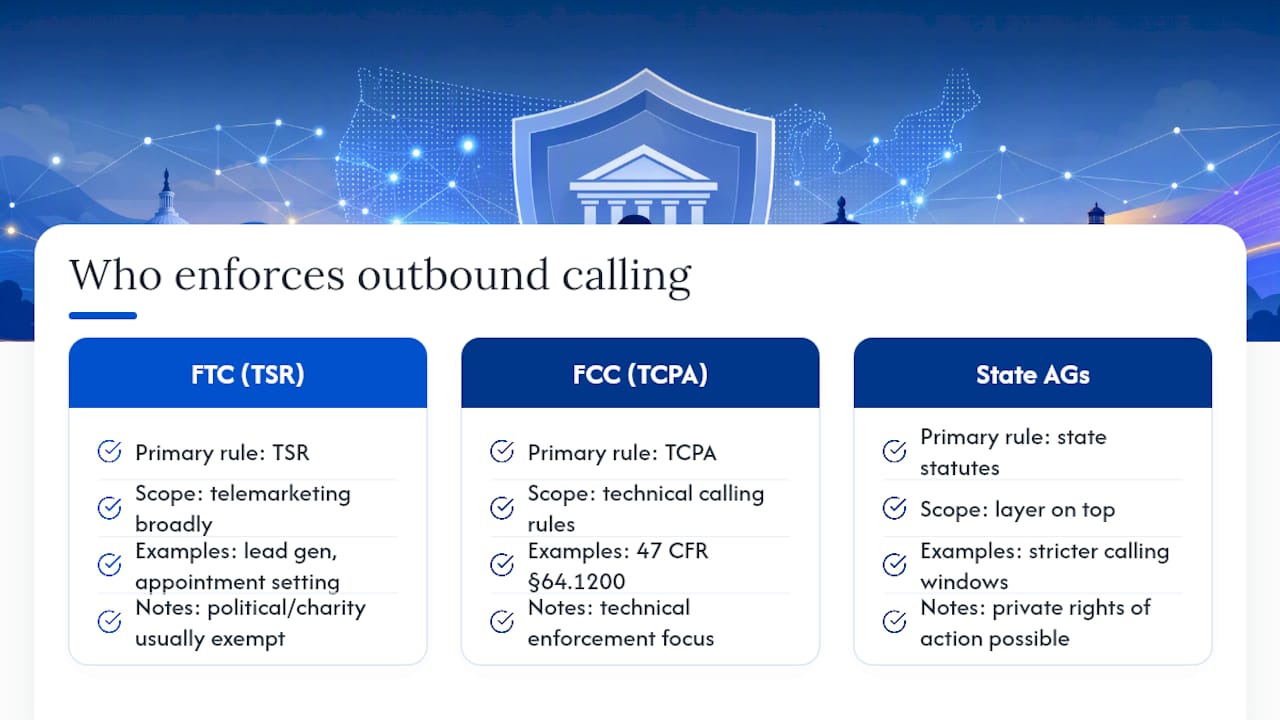
Three regulators split authority over outbound calling, and knowing who enforces what saves you from chasing the wrong rulebook. The Federal Trade Commission enforces the Telemarketing Sales Rule (TSR), the Federal Communications Commission enforces the Telephone Consumer Protection Act and the technical rules in 47 CFR §64.1200, and state attorneys general layer their own statutes on top, often with stricter calling windows or private rights of action.
“Telemarketing” under the TSR means any plan, program, or campaign to sell goods or services through interstate phone calls. That definition is broader than most people assume. It catches lead generation calls, appointment setting, and win back campaigns, not just direct sales pitches. Political campaigns, most charitable solicitations, and survey research are generally exempt, but a call that mixes a survey question with a sales pitch loses that exemption fast.
The National Do Not Call Registry sits inside this framework as the primary consumer opt-out mechanism. It’s a database of phone numbers, not an enforcement tool, and it works alongside entity-specific do-not-call lists that every business must maintain on its own.
Want this done for you? We book qualified sales appointments on a Pay-Per-Result basis — you only pay for calls that actually land in your calendar.
Key Compliance Rules and Exemptions You Need to Know
Five rules do the heavy lifting in day-to-day compliance. Miss one and the rest don’t matter much.
The 31-day scrub rule. Most telemarketers and sellers making interstate calls are required to access the National Do Not Call Registry at least once every 31 days and strip registered numbers from active calling lists. A list scrubbed on day 32 is a violation waiting to happen, even if nothing else went wrong.
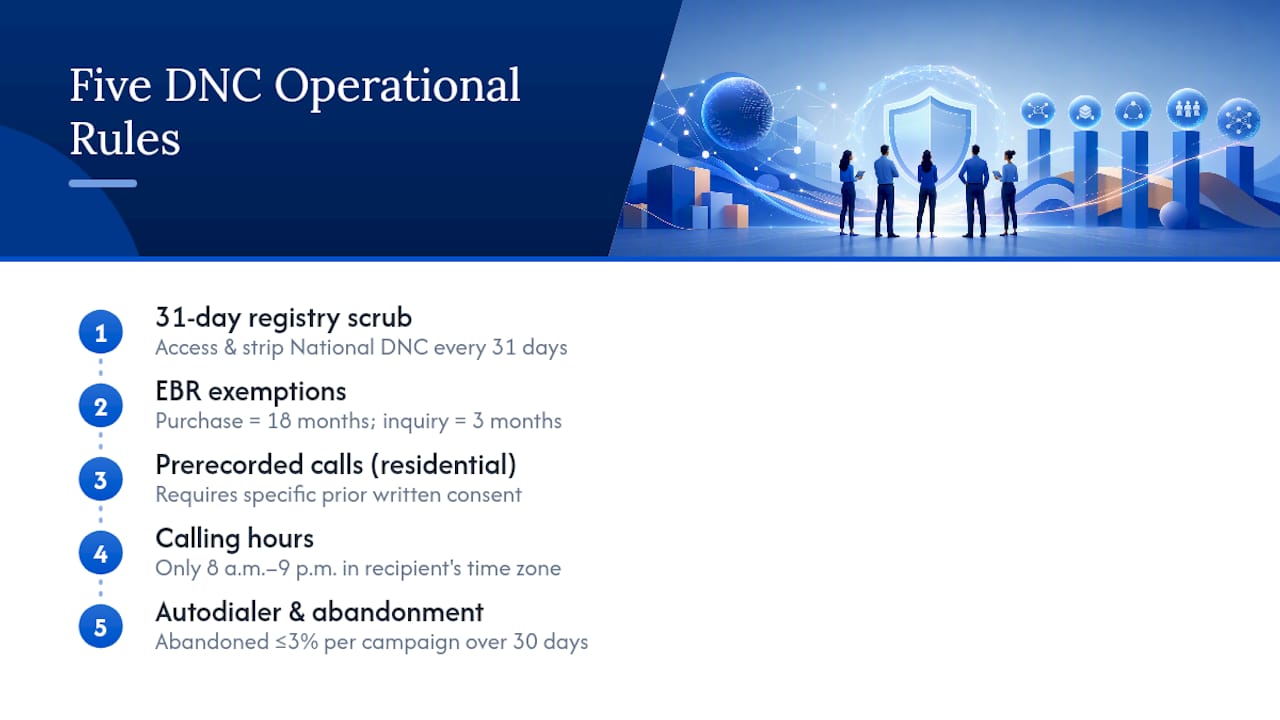
Established business relationship exemptions. Sellers and telemarketers may be exempt from National DNC Registry provisions if they have an EBR. A purchase gives you 18 months of calling room. A mere inquiry, like a quote request or a demo signup with no sale, only gives you 3 months. Both clocks reset to zero once the customer files an entity-specific opt-out, EBR or not.
Written consent for prerecorded calls. Robocalls to residential lines generally require prior express written consent, and that consent has to be specific, not buried in a terms-of-service checkbox.
Calling hours. Calls are restricted to 8 a.m. to 9 p.m. in the recipient’s time zone, not the caller’s. A call center in one zone dialing three zones east needs separate schedules for each block.
Autodialer and abandonment limits. 47 CFR §64.1200 caps abandoned calls at 3% of connected calls per campaign over a rolling 30-day window, and any prerecorded message needs a built-in opt-out.
How to Access and Use the National Do Not Call Registry
Getting registry access starts with a business subscription through the official Do Not Call Registry business portal, where you request a Subscription Account Number, or SAN. The SAN is your credential. It’s tied to a specific organization and specific area codes, and fees are charged per area code per year, with a small number of free area codes included for smaller operations.
Telemarketers calling on behalf of a seller face a subtlety a lot of agencies miss: a telemarketer generally needs its own SAN, or explicit authorization to use the seller’s SAN, for every seller it represents. Sharing one company’s paid registry download across other unpaying clients isn’t a shortcut. It’s a violation that creates joint liability for everyone involved, telemarketer and seller alike.
Registry data comes with a use restriction baked into the certification you sign at sign-up: the numbers can only support DNC compliance work. Feeding registry data into an enrichment platform or reselling it to a third party is illegal regardless of intent, and enforcement treats it as a serious violation rather than a technicality.
If we can’t make you money, we don’t deserve yours.
Pay-Per-Result pricing — performance-based alignment.
Managing Internal DNC Lists and EBR Edge Cases
Entity-specific requests carry more weight than most compliance programs give them. When someone tells your team directly to stop calling, you have to record that request immediately and honor it within a maximum of 10 business days, regardless of whether that person is on the National Registry.
Internal DNC lists need to survive longer than most CRMs retain data by default. A number that opts out has to stay suppressed indefinitely inside your own systems, not just for the life of the current campaign.
EBR claims fail more often than compliance teams expect, usually for one of these reasons:
- Treating a newsletter signup as a “purchase” to unlock the 18 month window instead of the 3 month inquiry window.
- Continuing to call past the EBR window because nobody flagged the relationship’s start date.
- Assuming nonprofit or “informational” framing exempts a call that’s actually selling something. Regulators look at what the call is actually doing, not what it’s labeled.
Run a quarterly audit that cross-references your CRM’s relationship-start dates against active calling lists. It catches EBR drift before a regulator does.
Turning Scrubbing Rules Into Daily Operations
Legal requirements only protect you if your systems actually execute them. Build the 31-day scrub into your dialer’s calendar as an automated, timestamped job, not a manual task someone might forget during a busy week.
A workable technical control checklist looks like this:
- Automate the registry scrub on a fixed monthly schedule and log the date, area codes checked, and number of records removed.
- Capture opt-outs the moment they happen, whether by keypress, spoken request, or reply text, and push them into your internal DNC list in real time, not at end of day.
- Track abandonment rate per campaign continuously; 47 CFR §64.1200 caps it at 3% over a rolling 30-day window, and creeping past that number quietly is one of the most common TCPA violations.
- Build a working opt-out mechanism into every prerecorded message before the campaign goes live, not after a complaint arrives.
- Audit your CRM’s contact data regularly, especially before layering on any enrichment tool, since dirty source data multiplies compliance risk rather than fixing it.
Dialers spike unpredictably during peak hours, and a buffer gives your team time to throttle pacing before you’re technically over the legal limit.*
Recordkeeping, Training, and the Safe Harbor Defense
The TSR’s safe harbor exists specifically for the business that makes an inadvertent call despite trying to comply, but it only protects you if you can prove the trying part. Demonstrating routine business practices requires written procedures, documented staff training, active monitoring, and a maintained internal DNC list. Good faith with no paper trail behind it isn’t enough.
Keep these records on hand and easy to retrieve:
- Scrub results with timestamps and area codes checked
- SAN records and area code subscription receipts
- Signed consent forms for any prerecorded or autodialed campaign
- Training logs showing when each caller was certified on DNC procedures
- Complaint and opt-out logs going back at least five years
If an inadvertent call does happen, the difference between a warning and a fine often comes down to whether you can hand a regulator a folder of dated logs within a day of the request.
What Happens When Do Not Call Rules Get Broken
Violations carry civil penalties that scale per call, not per campaign, which is why one bad list can turn into a five-figure exposure fast. The FTC and FCC both bring enforcement actions, and state attorneys general frequently pursue parallel cases under their own consumer protection statutes.
Consumers file complaints directly with the FTC or FCC, and regulators investigating a complaint typically request your scrub logs, consent records, and training documentation first. If you get that request, stop the campaign immediately, preserve every log untouched, loop in counsel before responding, and remediate the list that triggered the complaint before resuming any outreach.
Why Process Beats Good Intentions Here
Most compliance failures I see traced back aren’t malicious. They’re a missed scrub date, a CRM field nobody updated, an EBR clock nobody reset. The businesses that stay clean treat scrubbing and opt-out capture as infrastructure, not a task someone remembers when they have time. That same discipline tends to produce better leads too. A list that’s clean of dead numbers and irritated former customers converts higher, because you’re only calling people who can actually say yes.
— Riley
A Compliance-Aware Alternative to Building This In-House
Building a fully documented DNC compliance program, complete with scrub automation, opt-out logging, and training records, takes real operational weight, and plenty of businesses would rather put that energy into selling. If your team is stretched thin on outbound calling and the compliance overhead is eating into actual selling time, that’s usually the signal to look at an outsourced option instead of hiring another compliance hire.
An outsourced service can run AI sales agents built around compliance-aware scripting, paired with data analytics that keep calling lists clean without a manual scrub process on your end. A pay-per-result model means you are charged only when a qualified appointment lands on your calendar, not for a retainer, a seat license, or a list of leads you have to vet yourself. Such a structure aligns the agency’s incentive with yours: bad-fit calls and stale numbers cost the agency money, not you. If you want to see how the system handles outbound lead generation for a business like yours, check out Leadsnow’s pay-per-result appointment booking and get a sense of what a qualified booked appointment would actually cost you.
Sources
- Complying with the Telemarketing Sales Rule | Federal Trade Commission
- eCFR :: 47 CFR Part 64 Subpart L – Restrictions on Telemarketing, Telephone Solicitation, and Facsimile Advertising
- National Do Not Call Registry FAQs | Consumer FTC
FAQ
How do I stop getting 20 spam calls a day?
Registering your number with the National Do Not Call Registry stops legitimate telemarketers, but most high-volume spam calls come from scammers who ignore the law entirely, so pair registration with your carrier’s call-blocking app for real relief.
Is it illegal to call someone on the DNC list?
Yes, unless an exemption applies, like an established business relationship or the recipient’s prior written consent, calling a registered number without one violates the Telemarketing Sales Rule and can trigger civil penalties.
Does *57 still work?
*It traces the last incoming call for law enforcement follow up in areas where carriers still support it, but it does not block or stop future calls, so it’s not a compliance or spam-prevention tool.
Does pressing 9 stop telemarketers?
Only if the call is a legitimate prerecorded telemarketing message using a required opt-out keypress; scam calls that ask you to press 9 are usually just confirming your number is active, which invites more calls, not fewer.
What is the fastest way to check if a number is on the registry?
Businesses with an active Subscription Account Number can download and scrub their own lists directly through the registry’s business portal; there’s no public lookup tool for individual numbers.
Recommended
Pay-Per-Result appointments
See if we’re a fit
We book qualified sales appointments for you and you pay on results, not retainers. Our booking page asks a few quick questions so you find out in two minutes whether that model suits your business.
- 50,769+ appointments booked without cold calling.
- Pay-Per-Result pricing — you pay for booked, qualified calls.
- Pick your own time on our live calendar, no phone tag.