
The best multichannel outreach uses logic-based sequencing, where a reply, click, or booked call on one channel automatically triggers the right next step on another. Coordinated signals like this beat scattered coverage because they cut noise and raise reply rates. Start by picking two or three channels, then add a stop-on-reply rule before you add a fourth channel.
TL;DR:
- Coordinated multichannel outreach uses conditional triggers and shared signals to automate follow-ups and avoid repetitive messaging, increasing reply and engagement rates.
- A two- or three-channel setup is ideal for small teams or solo founders, while mid-market teams benefit from integrated email, LinkedIn, and call sequences with manageable infrastructure.
- Successful systems require native execution, shared audiences with identity resolution, and strict stop-reply or stop-booking rules to maintain deliverability and compliance.
- Measuring the true impact of multichannel strategies involves multi-touch attribution, tracking reply rates, meetings booked, and cost-per-case to evaluate ROI accurately.
- Outsourcing outreach to proven pay-per-result services can reduce operational risk, especially for under-resourced teams, by ensuring a booked appointment before incurring costs.
Table of Contents
- What Is Multi Channel Outreach, and How Is It Different From Cross-Channel?
- TL;DR: Which Multichannel Approach Fits Your Team?
- Capability Checklist: What a True Multichannel System Must Do
- Channel Coverage Matrix: How to Read Vendor Claims
- How to Design Logic-Based Multichannel Sequences
- How to Measure Multichannel Outreach and Prove What’s Working
- Implementation Risks, Deliverability, and a Compliance Note
- How LeadsNow AI Puts These Principles Into Practice
- When Outsourcing Beats Building Your Own Stack
- Get Booked Appointments Without Building the Stack Yourself
- Sources
How it works
How an AI sales agent books your appointments
Your list or CRM
We start from data you already own — past enquiries, dormant customers, or a targeted prospect list.
The agent makes contact
Email, SMS and voice, with follow-up that persists for weeks instead of stopping after two attempts.
Qualified against your rules
Budget, timing and fit are checked before anything reaches your team, using criteria you set.
Booked into your calendar
Only qualified prospects reach the booking step, so your closers spend their time selling.
MAKE MORE SALES.
Pay-Per-Result pricing — We scale sales HARD aligned to your interests, better than anyone else.
What Is Multi Channel Outreach, and How Is It Different From Cross-Channel?
Multi channel outreach means contacting prospects through more than one channel, such as email, LinkedIn, phone, and SMS. That’s the entire definition, and it’s also where most teams stop, running separate campaigns on separate channels with no shared memory between them.
Cross-channel (or omnichannel engagement, if you prefer the marketing term) is the upgrade. It’s an integrated outreach strategy in which channels share data and triggers, so an email open or a LinkedIn connection accepted automatically informs what happens next on a different channel. A reply on LinkedIn pauses the email sequence. A missed call triggers a follow-up SMS instead of another cold email. The channels talk to each other.
That distinction matters more than it sounds. Running five channels without shared signals is just multi platform communication with five times the chance of annoying someone with a duplicate touch. A genuinely channel diversified outreach program treats channels as complementary instruments, not five separate megaphones pointed at the same person. Email carries the detailed pitch. LinkedIn builds familiarity before the ask. SMS or WhatsApp adds urgency at the right moment. Phone calls resolve the objections that text can’t. Each channel does a job the others can’t do as well, and that division of labor is one of the clearest benefits of multi channel outreach over single-channel cold email.
For the rest of this guide, “multichannel outreach” refers to the coordinated version, not the scattershot one. If your current setup is five disconnected sequences firing at the same list, you’re doing multichannel coverage, not multichannel strategy. The fix starts with the checklist in the next section.
Want this done for you? We book qualified sales appointments on a Pay-Per-Result basis — you only pay for calls that actually land in your calendar.
TL;DR: Which Multichannel Approach Fits Your Team?
Not every team needs the same setup. Picking the right approach depends more on team size and compliance exposure than on budget alone.
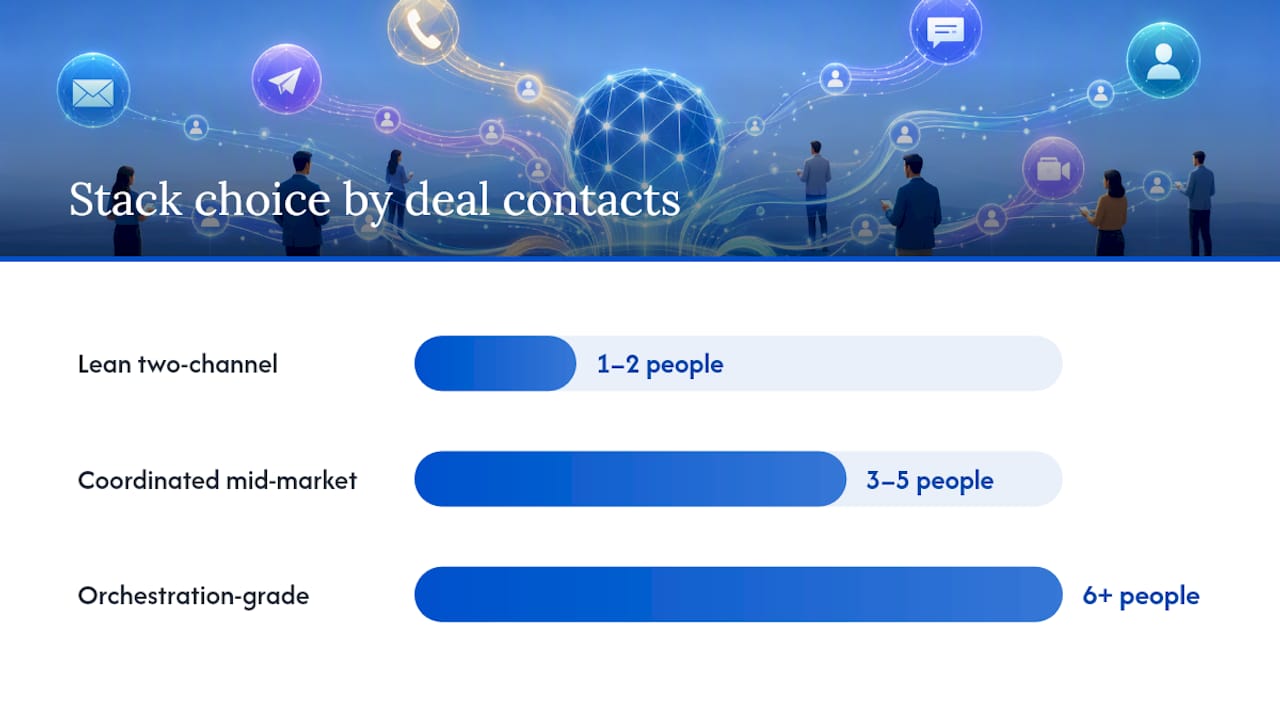
- Lean two-channel stack (email + one other channel): Best for solo founders, early-stage startups, or small sales teams testing a new market. Fast to set up, cheap to run, and easy to manage manually if volume stays under a few hundred contacts a month. The tradeoff: without a third channel, you lose the “urgency” or “familiarity” layer that speeds up replies.
- Coordinated mid-market stack (email + LinkedIn + calls): The sweet spot for most B2B sales and marketing teams with a handful of SDRs. This tier introduces conditional logic (pause on reply, escalate to a human after two no shows) without requiring a full customer data platform. Most teams in this category rely on an ESP paired with shared audience tags rather than heavier infrastructure, which keeps setup manageable without a dedicated engineering team.
- Cross-channel orchestration (shared identity resolution, CDP-backed): Built for enterprise revenue teams juggling multiple products, regions, or business units where attribution has to hold up at the account level, not just the contact level. This tier justifies the cost of identity resolution tooling because deals touch six or more people before a signature.
The quickest way to choose: count how many people typically touch a deal before it closes, and count how many reps you have managing follow-up by hand. If it’s one or two people and a founder doing outreach solo, the lean stack wins. If it’s a sales floor with SDRs, account executives, and a marketing team feeding leads in, you need the coordinated mid-market approach at minimum. If you’re running parallel go-to-market motions across multiple products or regions, orchestration-grade tooling earns its cost.
Compliance load shifts the calculation too. Teams selling into regulated industries (finance, health, insurance) usually need tighter script control and audit trails regardless of size, which pushes even small teams toward more structured, coordinated setups earlier than their headcount would otherwise suggest.
Capability Checklist: What a True Multichannel System Must Do
Most “multichannel” tools on the market handle two or three of these well and quietly fail at the rest. Before you commit to a platform or a build, run every serious candidate through this checklist.
- Native execution, not manual reminders. A tool that sends an email automatically but only reminds a rep to “call this person today” is not automating that channel. It’s automating a to-do list. True native execution means the system dials, texts, or messages without a human clicking a separate button each time.
- Shared audiences and identity resolution. The system needs one contact record per real person, synced with your CRM, so an email reply and a LinkedIn message from the same person get logged against the same lead rather than creating duplicates. This is the backbone of any real integrated outreach strategy, and it’s the single most commonly skipped requirement.
- Conditional orchestration. Look for genuine if/then branching: if no reply after three touches, escalate to a different channel; if a reply comes in, pause every other queued touch immediately; if a meeting books, stop the sequence entirely and hand off to a human.
- Deliverability infrastructure. Email and LinkedIn both punish accounts that look automated. A serious platform handles inbox warming, rotates across multiple sending domains, and monitors bounce and complaint rates without you having to babysit it manually.
- Platform policy awareness and scale limits. Networks like LinkedIn cap daily connection requests and messages. A tool worth using tells you what those limits are and throttles automatically instead of letting you find out the hard way when an account gets restricted.
Pro Tip: Ask any vendor to show you the actual “pause on reply” logic during a demo, not just describe it. Watch what happens when you send a test reply mid-sequence. If the next touch still fires, that’s a broken orchestration engine wearing a good sales pitch.
Security deserves a line of its own here. Multichannel systems touch email accounts, LinkedIn logins, and often phone numbers tied to real people at your company. Ask who owns the data if you cancel, whether messages route through the vendor’s servers or your own, and what happens to warmed sending domains if you switch providers. Those questions rarely come up in a sales demo, and they’re exactly the ones that matter six months later.
If we can’t make you money, we don’t deserve yours.
Pay-Per-Result pricing — performance-based alignment.
Channel Coverage Matrix: How to Read Vendor Claims
Every outreach platform claims to “support” email, LinkedIn, SMS, and calls. Support means almost nothing on its own. What matters is what happens inside each cell of a proper capability matrix, and most buyers never ask.
Build your matrix with channels down the side and four operations across the top: native send (does the system actually fire the message, or just remind a human), two-way sync (does a reply get captured automatically), CRM logging (does the touch write back to your CRM without manual entry), and conditional trigger support (can this channel’s activity start or stop a sequence on a different channel).
Here’s what a generic, honestly filled-out matrix tends to look like for a coordinated mid-market stack:
| Channel | Native send | Two-way sync | CRM logging | Triggers other channels |
|---|---|---|---|---|
| Yes | Yes | Automatic | Yes | |
| Often manual-assisted | Partial | Manual or delayed | Sometimes | |
| SMS/WhatsApp | Yes | Yes | Automatic | Yes |
| Phone calls | Task reminder only | Manual notes | Manual | Rarely |
That LinkedIn row is where most vendor pitches quietly fall apart. Because LinkedIn restricts third-party automation more tightly than email, plenty of tools that market themselves as “LinkedIn automation” are really semi-automated: they draft the message and remind a rep to send it, which is a task manager, not a native execution engine as defined in the checklist above.
Run these tests during any trial period before you buy:
- Send yourself a test reply on the channel with the weakest native support and time how long it takes to show up in your CRM.
- Check whether a reply on one channel actually pauses queued messages on the others, or whether they keep firing anyway.
- Ask what happens after 30 days of steady sending: does deliverability data get surfaced to you, or do you find out about a blocked account only when replies stop coming in?
- Confirm whether “CRM logging” means real-time sync or a nightly batch job. A day’s lag on lead status can mean a rep calls someone who already booked.
A tool that’s honest about a partial cell (LinkedIn native send that’s really semi-manual) is more trustworthy than one that marks every cell “yes” and makes you find out the truth during onboarding.
How to Design Logic-Based Multichannel Sequences
Building a sequence that actually coordinates channels starts before you write a single message. It starts with deciding what each channel is for.
1. Define the ICP and assign channel roles. Your ideal customer profile determines which channels even make sense. A VP of Sales at a 200-person SaaS company checks LinkedIn daily and ignores cold calls; a small business owner might do the opposite. Once you know who you’re targeting, assign each channel a specific job in the sequence rather than treating them as interchangeable. Email carries the detailed value proposition. LinkedIn builds familiarity through comments and connection requests before the pitch lands. Calls resolve objections that text-based channels can’t handle. This role-based structure is what actually makes cross-channel outreach more efficient than running the same message everywhere.
2. Build the sequence with explicit if/then branches. A workable 10-day sequence for a mid-market B2B offer might look like this:
- Day 1: Email 1 (value-focused opener) + LinkedIn connection request, no note.
- Day 3: If no reply, LinkedIn message referencing the email. If replied, pause sequence and route to a rep.
- Day 5: If still no reply, email 2 with a different angle (a case study or specific stat).
- Day 7: If no reply across both channels, first phone call attempt.
- Day 9: If call goes to voicemail, SMS with a short, specific ask (not a generic follow-up).
- Day 10: Final email, positioned as a “closing the loop” message, then move to a long-term nurture track if still silent.
A longer 30-day version simply repeats this cadence in two more waves, spacing touches further apart and rotating the value angle each time (feature-led, then proof-led, then urgency-led) so the third and fourth email don’t read as reruns of the first.
3. Personalize without repeating yourself across channels. The fastest way to blow a multichannel sequence is sending the same message on email and LinkedIn a day apart. Use different personalization variables per channel: reference a shared connection or recent post on LinkedIn, reference a specific pain point or trigger event in email, and keep SMS down to one sentence with a single clear ask. If a prospect sees the exact same paragraph twice, they notice, and it reads as automation rather than outreach.
4. Set hard handoff and stop rules. Every sequence needs an escape hatch. Pause everything the moment a reply comes in, positive or negative. Pause everything the moment a meeting books. And build an objection-detection rule, even a simple one, so a reply like “not interested right now” routes to a different, softer nurture track instead of continuing the same aggressive cadence. Practitioners who run these sequences at scale generally agree that automation should carry the repetitive volume while a human takes over the moment a conversation actually starts. That handoff point is where deals get won or lost.
5. Build the operational checklist before you scale past a pilot list. Before you push a sequence from 50 test contacts to 5,000, confirm your sending domains are separate from your core company domain, your LinkedIn accounts are warmed and within daily connection limits, and you have enough staff to handle the call and reply volume a working sequence generates. A practical scaling tactic many teams use is isolating sending infrastructure per channel, warmed inboxes and secondary domains for email, a small fleet of accounts for LinkedIn, so a deliverability problem on one channel never touches your primary domain’s reputation.
Pro Tip: Most teams add a fourth or fifth channel before they’ve earned it. Get pause-on-reply and stop-on-booking working flawlessly across two channels first. A clean two-channel sequence outperforms a messy five-channel one almost every time.
How to Measure Multichannel Outreach and Prove What’s Working
Last-click attribution lies to you in multichannel outreach. If a prospect ignores three emails, then books a call the day after a LinkedIn message, last-click credits LinkedIn for the win and makes email look worthless, when in reality the emails did most of the persuading. Account-level, multi-touch attribution solves this by crediting every touch that happened before a meeting booked, not just the final one.
Track these metrics at minimum:
- Reply rate per channel and per sequence step, so you can see which touch in the cadence is actually generating engagement.
- Meetings booked per account, not per contact, since B2B deals often involve multiple people at the same company touched by the same sequence.
- Cost per booked meeting, blending tool costs, ad spend if used, and rep hours, to compare channel combinations on a level basis.
- Time-to-book, the gap between first touch and booked meeting, which tells you whether a sequence is too slow or too aggressive.
For reporting, three formats do most of the work. A cohort funnel by sequence shows how a specific group of contacts, everyone who entered the “mid-market SaaS” sequence in a given month, moved from first touch to reply to meeting over time. A sequence-level ROI report ties cost per channel to meetings booked from that sequence specifically. A channel-combo lift analysis compares accounts touched by email-only against accounts touched by email plus LinkedIn plus a call, isolating how much the additional channels actually moved the needle rather than assuming they did.
As volume grows past a few hundred contacts a month, that manual tagging breaks down, and real-time audience syncing between your outreach tools and CRM becomes worth the investment. The switch point is usually when your team can no longer trust the spreadsheet’s accuracy, not a fixed contact count.
One data point worth internalizing: dormant leads reactivated through a coordinated, multi-touch follow-up campaign have converted at a 4.4% average rate, peaking at 8.9% in campaigns run against cold CRM databases, well above what a single cold-email blast typically pulls from the same list.
Implementation Risks, Deliverability, and a Compliance Note
The biggest operational risk in multichannel outreach isn’t a bad message. It’s identity fragmentation, the same person existing as three different unlinked records across email, LinkedIn, and your CRM, each with a different status. Fix this before scaling, not after. Every new contact needs one canonical record that every channel writes back to, or you’ll end up calling someone who already booked a meeting through a different channel, which does real damage to a prospect’s impression of your company.
Email deliverability deserves its own attention separate from everything else:
- Warm new sending domains gradually over two to four weeks before running full volume through them.
- Keep cold outreach on domains separate from your primary company domain, so a deliverability problem never touches internal or customer-facing email.
- Monitor bounce and spam-complaint rates weekly, not monthly. A rate creeping past 1 to 2% is an early warning, not something to address after it tanks your sender reputation.
Platform policy limits are the second major risk, particularly on LinkedIn, which actively restricts connection request volume and flags accounts that behave like bots. Aggressive automation patterns, sending the exact same connection note to hundreds of people in a day, are exactly what gets accounts temporarily or permanently restricted. Throttle deliberately rather than maximizing volume on day one.
On compliance: outreach automation touches personal data, and data-protection law varies by jurisdiction. The GDPR in the European Union is the clearest example of a framework that imposes specific obligations around lawful processing and data subject rights on anyone contacting EU residents, and it’s far from the only regulation that applies depending on where your prospects live. Treat this section as a starting point, not legal advice, and get counsel familiar with the specific jurisdictions your outreach touches before scaling internationally.
How LeadsNow AI Puts These Principles Into Practice
Every principle in this guide, shared signals, conditional logic, human handoff at the right moment, only matters if it survives contact with a real sales calendar. LeadsNow AI built its model around exactly that stress test, running AI-driven outreach on a pay-per-result basis rather than charging for activity.
Client data across LeadsNow AI’s campaigns shows a 7x sales lift and more than 50,769 AI-booked appointments, figures built on the coordination principles outlined above rather than raw sending volume:
- AI sales agents handle the repetitive first and second touches across channels, freeing human reps to focus on calls that have already shown buying signal.
- Shared signals across channels mean a prospect who engages on one channel doesn’t keep getting cold outreach on another, the same pause-on-reply logic covered in the sequence design section above.
- Compliance-aware scripting is built into the outbound flow rather than bolted on afterward, which matters for clients in regulated spaces like coaching, fitness, and consulting.
- Continuous funnel optimization means underperforming sequence steps get adjusted based on live reply and booking data, not a quarterly review cycle.
The Outdoor Club case illustrates the pattern in practice: a business feeding warm and cold leads through a coordinated AI-driven sequence rather than a single blasted channel, with follow-up timed around actual engagement instead of a fixed calendar schedule. Related breakdowns on channel-specific tactics, including social media approaches for attracting fitness clients and email marketing tips built for the same audience, cover the channel-role thinking from the how-to section in more depth for specific verticals.
None of this replaces doing the work described earlier in this guide. It’s what that work looks like when a team with data-driven outreach strategies at scale has already run the experiments most companies don’t have time to run themselves.
When Outsourcing Beats Building Your Own Stack
Building an in-house multichannel system makes sense when you have engineering resources sitting idle and a sales motion stable enough to justify the investment. Most companies reading this guide have neither. That’s not a criticism, it’s just a honest read of where most sales and marketing teams actually stand in 2026: understaffed on ops, overloaded on quota, and not in a position to spend three months building identity resolution logic before the first qualified appointment shows up.
Pay-per-result managed services solve a different problem than internal tooling solves. They remove the cost of getting it wrong. If a home-built sequence underperforms, that’s months of engineering time and a quarter of pipeline gone before anyone notices the pause-on-reply logic was broken. A pay-per-result model shifts that risk: you’re not paying for activity, sends, connects, dials, you’re paying for a booked, qualified appointment landing on your calendar. That alignment changes the incentive structure entirely.
The tradeoff runs the other direction on control. An internal stack gives you full visibility into every message, every branch, every data point, and full control over compliance language specific to your industry. An outsourced model asks you to trust someone else’s scripts and someone else’s sending infrastructure, which is a real tradeoff, not a small one, for companies with unusual regulatory exposure.
Where I see teams consistently under-invest, regardless of which path they choose, is in the handoff moment. Companies obsess over channel selection and sequence timing, then let a booked call sit for two days before a human follows up on the details. The five minutes after a meeting books matter more than most of the five days that led up to it.
— Riley
Get Booked Appointments Without Building the Stack Yourself
Everything covered above, shared signals, conditional logic, deliverability infrastructure, identity resolution, is real engineering work most sales teams don’t have the bandwidth to build or maintain. LeadsNow AI runs that entire system for you and charges only when a qualified appointment lands on your calendar, not for sends, dials, or campaign setup.
That pay-per-result structure fits teams that got burned by a retainer-based agency that billed the same whether meetings booked or not. A prospective client can expect an initial assessment of the current funnel, a look at what’s leaking between first touch and booked call, benchmark data from comparable campaigns, and a scripted, compliance-aware outreach sequence built around the channel-role logic covered earlier in this guide. Coaches, gym operators, consultants, and B2B service providers make up most of the client base, and the model works the same way for each: LeadsNow AI builds and runs the sequence, and the invoice only shows up once a real, qualified appointment is on the books. If you’re weighing whether to build this in-house or hand it off, the lead generation hacks breakdown is a reasonable next read before booking a call to talk through your specific funnel.
Sources
- WordStream: Cross-channel marketing
- HubSpot: Cross-channel marketing
- Amplitude: Cross-channel marketing
- EUR-Lex: Regulation (EU) 2016/679 (GDPR)
Recommended
- AEO for Consultants: How to Get Cited by ChatGPT, Claude and Perplexity (2026 Playbook)
- AEO for B2B SaaS: How to Get Cited by ChatGPT, Claude and Perplexity (2026)
- How to Price B2B SaaS Deals: A Framework Based on 1,425+ Booked Demos
- How to Price a B2B Consulting Engagement: A Framework Based on 50,769+ Booked Meetings
Pay-Per-Result appointments
See if we’re a fit
We book qualified sales appointments for you and you pay on results, not retainers. Our booking page asks a few quick questions so you find out in two minutes whether that model suits your business.
- 50,769+ appointments booked without cold calling.
- Pay-Per-Result pricing — you pay for booked, qualified calls.
- Pick your own time on our live calendar, no phone tag.