
Call recording compliance requires a documented lawful basis or consent, secure encrypted storage, a defined retention schedule, and an auditable access trail for every recorded call. When you cannot verify the law in a caller’s state or country, the safest default is universal all-party disclosure paired with automated technical controls: pause-and-resume for payment data, AES-256 encryption, and retention automation. Watch four frameworks in particular: GDPR, PCI DSS, HIPAA, and MiFID II.
TL;DR:
- Recording consent must be actively obtained and logged through clear disclosures and opt-in steps, especially for GDPR compliance and multi-jurisdictional calls.
- Automated pause-and-resume controls triggered by payment-system events are essential for meeting PCI DSS and legal requirements, not manual agent actions.
- Retention periods for financial and healthcare calls often extend to five or seven years, which must be aligned with longer industry-specific regulations alongside privacy laws.
- Searchable, tamper-evident storage with encryption, role-based access controls, and continuous testing are necessary to maintain compliance and respond to regulatory requests timely.
- Applying one-party consent rules universally is the most common compliance failure; each call must be mapped to jurisdiction and configured accordingly.
Table of Contents
- What Call Recording Compliance Actually Covers
- Which Laws Actually Apply to Your Calls?
- How Do You Get Consent That Actually Holds Up?
- What Technical Controls Actually Prevent Violations?
- What Changes for Finance, Healthcare, and Payments?
- What’s the Right Order for Rolling This Out?
- Choosing a Recording Platform: What to Test Before You Buy
- Where Do Compliance Programs Actually Fail?
- Building Compliant Recording Into High-Volume Outbound Calling
- Treat Recording as a Program, Not a Setup Task
- A Compliant Recording Program Still Needs Someone Running the Calls
- Sources
- FAQ
How it works
How an AI sales agent books your appointments
Your list or CRM
We start from data you already own — past enquiries, dormant customers, or a targeted prospect list.
The agent makes contact
Email, SMS and voice, with follow-up that persists for weeks instead of stopping after two attempts.
Qualified against your rules
Budget, timing and fit are checked before anything reaches your team, using criteria you set.
Booked into your calendar
Only qualified prospects reach the booking step, so your closers spend their time selling.
MAKE MORE SALES.
Pay-Per-Result pricing — We scale sales HARD aligned to your interests, better than anyone else.
What Call Recording Compliance Actually Covers
Call recording compliance isn’t one law. It’s a stack of overlapping obligations that treat a recorded call as either personal data, a regulated financial record, protected health information, or all three at once depending on who’s on the line and what they say.
Under GDPR, a voice recording that identifies a person is personal data the moment it’s captured, and that triggers the full weight of data protection law: a lawful basis, a disclosure obligation, and a deletion clock. In the United States, the same recording might instead trigger a state wiretapping statute, a securities recordkeeping rule, or nothing at all, depending entirely on geography. That patchwork is what makes call recording compliance genuinely hard: the legal analysis changes call by call.
Compliance teams generally need to manage five categories at once:
- Lawful basis or consent — a documented reason you’re allowed to record, whether that’s legitimate interest, legal obligation, or explicit consent.
- Notice — telling the caller, usually through an IVR prompt or verbal disclosure, before or as recording starts.
- Storage and security — encrypted, access-controlled, tamper-evident storage for however long the recording exists.
- Retention and deletion — a defined schedule that deletes recordings on time, with legal-hold exceptions when litigation or investigation requires longer retention.
- Access and audit — logs showing who accessed a recording, when, and why, plus a workflow for data subject access requests.
Getting any one of these wrong carries real teeth. GDPR fines run up to €20 million or 4% of global annual revenue, whichever is higher. In the U.S., an illegally recorded call can be thrown out as evidence and expose the recording party to civil liability from the person who wasn’t told. Regulated industries add a second layer: a finance firm that can’t produce a searchable recording during a MiFID II audit faces a different kind of exposure entirely, separate from privacy law.
Want this done for you? We book qualified sales appointments on a Pay-Per-Result basis — you only pay for calls that actually land in your calendar.
Which Laws Actually Apply to Your Calls?
Mapping the right framework to the right call is the single most useful exercise a compliance officer can do, because the obligations genuinely differ by jurisdiction, industry, and data type. Here’s how the major frameworks break down in practice.
| Framework | Who it applies to | Core recording obligation |
|---|---|---|
| GDPR | Anyone recording EU/EEA residents’ calls | Lawful basis, disclosure, Article 15 access rights, deletion when no longer necessary |
| U.S. state consent laws | Any domestic U.S. call | One-party consent in most states; all-party consent in roughly a dozen |
| PCI DSS | Any call capturing card data | No storage of CVV/sensitive authentication data after authorization |
| HIPAA | Calls containing protected health information | Safeguards, BAAs with vendors, retention aligned with health recordkeeping rules |
| MiFID II | EU investment firms, certain trading desks | 5 year retention, searchable and time-stamped audio |
| SEC / Dodd-Frank | U.S. broker-dealers and swap dealers | Recordkeeping and supervisory retention of communications |
GDPR is the most operationally demanding framework for general business calls. It requires a documented lawful basis (most companies rely on legitimate interest or consent), disclosure at the point of recording, a working process for access and erasure requests, and a Data Processing Agreement under Article 28 with any vendor that stores or processes the audio on your behalf. If recording is high-risk (large volumes, sensitive categories of data), a Data Protection Impact Assessment becomes necessary too.
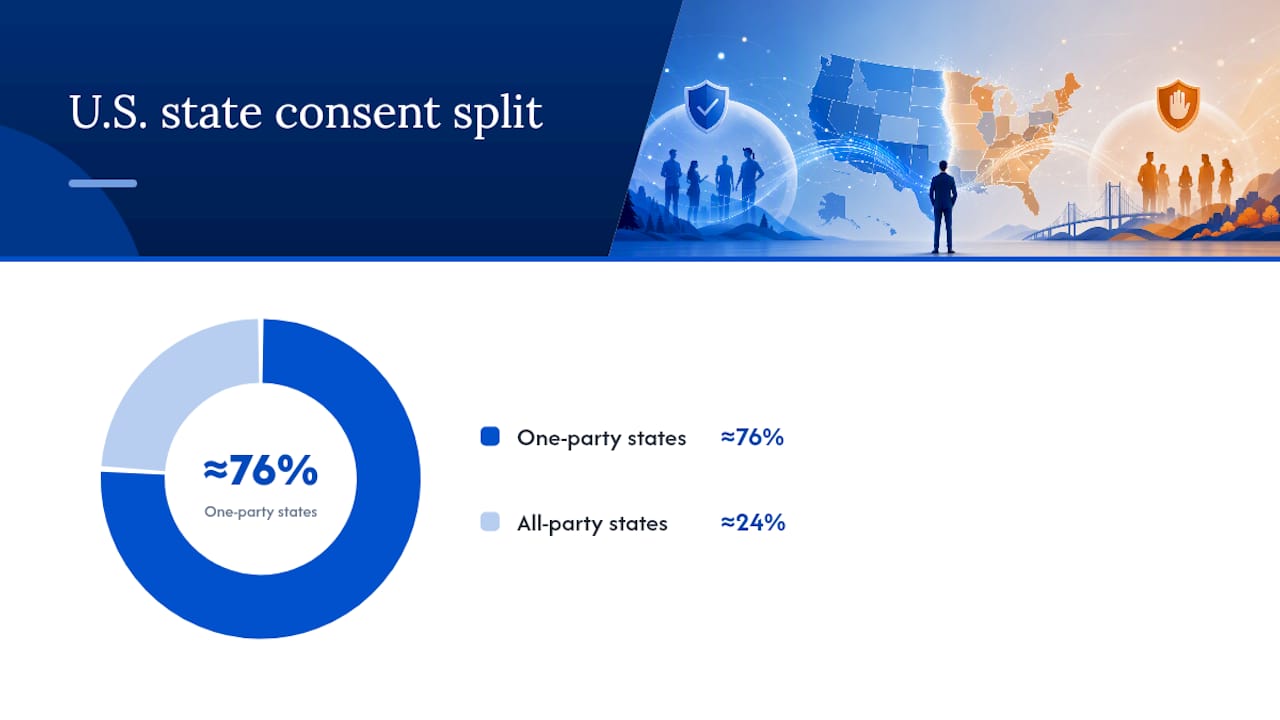
The U.S. picture is messier because it’s fifty separate answers. A 50-state survey from Justia confirms most states only require one party to the call to consent, meaning you as the recorder can consent on your own behalf. But roughly a dozen states, including California, Florida, and Pennsylvania, require every party on the call to agree. The trap is the cross-state call: a business in a one-party state calling a customer in an all-party state is bound by the stricter rule, not the friendlier one. Most compliance teams solve this by treating every outbound and inbound call as if it were subject to all-party consent, regardless of origin.
PCI DSS doesn’t care about consent at all. It cares about card data never landing in a stored recording. The PCI Security Standards Council prohibits retaining sensitive authentication data like CVV after authorization, full stop, which is why pause-and-resume during the payment segment of a call has become the industry-standard control rather than an optional nice-to-have.
Finance-specific rules layer retention duration on top of privacy law. MiFID II firms in the EU typically need five to seven years of searchable, tamper-evident audio for relevant calls, while U.S. broker-dealers face parallel obligations under SEC and Dodd-Frank recordkeeping rules. None of that retention duty overrides GDPR’s deletion principle where both apply. It just means the retention schedule itself has to satisfy the longer of the two clocks.
How Do You Get Consent That Actually Holds Up?
Disclosure and consent are not the same thing, and treating them as interchangeable is the most common compliance failure in call recording programs. A recorded IVR message that says “this call may be recorded” is notice. It is not, on its own, GDPR-valid consent, because consent under GDPR has to be freely given, specific, informed, and unambiguous, meaning the caller needs a real, easy way to say no.
Here’s how that plays out operationally:
- Play the disclosure before recording starts, not after, so the caller has genuine notice before any audio is captured.
- Build in an active opt-out or opt-in path — a “press 1 to continue” prompt or a verbal acknowledgment the agent logs — rather than relying on silence as agreement.
- Log every opt-in and opt-out event with a timestamp, tied to the call record, so you can prove consent (or its absence) months later during a rights request or audit.
- Honor a mid-call withdrawal immediately by pausing or stopping the recording the moment a caller revokes consent, and train agents on the exact phrase to use when that happens.
- Treat employee calls differently from customer calls. Workplace monitoring generally requires written notice at hiring and renewed notice whenever the recording system changes, since failing to provide that notice can bar the recordings from being used in discipline cases later.
Pro Tip: Don’t rely on disclosure language alone to satisfy GDPR. Build a genuine opt-in step into the call flow and log the event separately from the recording itself, so you have proof of consent even if the recording is later deleted.
For cross-border operations, the same all-party default that solves the U.S. state problem also solves most GDPR ambiguity: script an active consent step on every call, everywhere, and you rarely have to relitigate the jurisdiction question call by call.
If we can’t make you money, we don’t deserve yours.
Pay-Per-Result pricing — performance-based alignment.
What Technical Controls Actually Prevent Violations?
Legal policy means nothing if the platform can’t enforce it. The controls below are what auditors and PCI assessors actually check, not just what vendors advertise.
- Automated pause-and-resume, triggered by the payment application or desktop event rather than by the agent manually hitting a button. Agent-initiated pausing fails constantly under stress; automated triggers tied to the payment screen are far more reliable, which is why the PCI framework treats prevention as the standard, not after-the-fact redaction.
- Redaction as a backup, not a primary control. Automated redaction depends on transcription accuracy, and a transcription engine with a high word error rate will simply miss the card number it was supposed to catch. Redaction accuracy has to be validated against real conversational audio during acceptance testing, not just clean lab samples.
- Encryption in transit and at rest, with AES-256 as the practical baseline and independent signals like SOC 2 or ISO 27001 certification as evidence you can hand an auditor.
- Key management separate from storage access, so a compromised storage credential doesn’t automatically expose decrypted audio.
- Role-based access control and tamper-evident storage, so recordings can’t be altered or deleted outside the retention policy without a logged, attributable action.
- Searchable indexing, because an Article 15 access request has a one-month statutory response window, and you cannot search what you cannot index.
One number worth remembering: GDPR’s Article 15 access right gives data subjects the right to receive a copy of their recorded call within one month of the request. If your storage system can’t locate a specific call by caller ID and date within days, that deadline is already in jeopardy.
Testing has to be continuous, not a one-time procurement checkbox. Run periodic word-error-rate checks on your transcription model against live-style audio, and run end-to-end test calls that actually trigger the pause event to confirm the system behaves the way the vendor’s data sheet claims.

What Changes for Finance, Healthcare, and Payments?
Regulated industries add retention and evidentiary requirements on top of the baseline privacy rules, and the differences are substantial enough that a generic recording policy usually fails an industry-specific audit.
- Financial services under MiFID II generally need five to seven years of retention for relevant calls, with searchable, time-stamped, tamper-evident audio that can be produced on request during a regulatory review.
- Healthcare organizations must treat any call containing protected health information as subject to HIPAA safeguards, meaning encrypted storage, a signed Business Associate Agreement with any recording vendor, and retention consistent with healthcare recordkeeping rules rather than a generic corporate schedule.
- Payment-handling businesses should never store card verification values or full PANs in recordings, period. Pause-and-resume during the payment segment, or live redaction where pausing isn’t feasible, is the accepted way to satisfy PCI DSS without breaking the recording entirely.
- Trading floors and turret systems typically require continuous capture with no gaps, certified integrations with the trading platform itself, and archives built for long-term retrieval rather than short-term customer service review.
The common thread: every one of these carries the same safety caveat. If your storage or access system doesn’t have the audit trail and encryption controls covered above, the industry-specific retention requirement just means you’re storing risk for longer, not managing it better.
What’s the Right Order for Rolling This Out?
Deployment order matters because some steps depend on others being finished first. This sequence reflects how most compliance-mature organizations actually build the program.
- Map every call type to its jurisdiction and lawful basis — sales calls, support calls, employee calls, and payment calls each need their own basis documented, not one blanket policy.
- Standardize the disclosure script and build the opt-in event log before recording goes live in any new market or channel.
- Enable pause-and-resume for any call that touches payment data, then run live test calls specifically designed to trigger the pause and confirm it actually fires.
- Configure automated retention schedules with legal-hold exceptions so litigation or investigation can pause deletion without a manual scramble.
- Set role-based access controls and turn on audit logging, then schedule periodic access reviews rather than a one-time setup.
- Document your DPAs, legitimate interest assessments, and DPIAs, and keep that documentation current, since it’s the first thing a regulator or auditor asks to see.
Pro Tip: Keep a running folder of your DPAs, access logs, and pause-and-resume test results as you go rather than reconstructing them after an audit request lands. Auditors reward documentation trails far more than they reward a policy that merely sounds thorough.
Choosing a Recording Platform: What to Test Before You Buy
Most organizations don’t build recording infrastructure from scratch. They integrate a certified third-party recorder with their existing communications platform, layered with policy-based rules that decide what gets recorded and how it’s retained.
Microsoft’s Teams model is the clearest public example of how this typically works. Teams doesn’t record natively at enterprise compliance grade; instead, it relies on certified compliance recording partners integrated through policy-based recording rules, with specific licensing requirements and defined notification methods for participants. Administrators have to verify the partner’s certification status directly and test the integration boundaries themselves, because “Teams-compatible” and “Teams-certified for compliance recording” are not the same claim.
Whatever platform you evaluate, run these procurement tests before signing:
- Confirm pause-and-resume actually fires on a live test payment call, not just in the vendor’s demo environment.
- Verify legal-hold capability exists and doesn’t silently override your standard retention schedule.
- Check that encryption, key management, and audit logging meet the standards above, in writing, in the contract.
- Confirm the vendor will sign a Data Processing Agreement, and for healthcare use cases, a Business Associate Agreement.
Where Do Compliance Programs Actually Fail?
Auditors see the same failures repeatedly, and most of them are process gaps rather than technology gaps.
- Applying one-party consent logic to every call, including calls to all-party states or EU residents, is the single most common legal mistake. The fix is a uniform disclosure default, not a state-by-state exception engine that someone eventually forgets to update.
- Silent pause-and-resume failures happen more often than teams expect, especially after a platform update changes how the payment event fires. Regular test calls that deliberately trigger the pause, then confirm the gap exists in the stored audio, catch this before an assessor does.
- Retention misconfigurations, particularly legal-hold blind spots where a deletion schedule runs on schedule despite an active hold, are a frequent audit finding. The remediation is usually a manual reconciliation between the legal-hold list and the deletion job, run monthly until the systems talk to each other automatically.
- Missing audit logs or overly broad role-based access is what auditors check first, because it’s the fastest way to tell if a program is enforced or just documented. If everyone on the sales team can access every recording indefinitely, that’s a finding regardless of how good the retention policy looks on paper.
Building Compliant Recording Into High-Volume Outbound Calling
Running compliance-aware recording at outbound campaign volume is a different problem than recording a handful of support lines. Leadsnow’s experience running AI-driven outbound for coaches, gyms, and B2B service businesses points to a few practical lessons: disclosure has to be embedded directly into the automated call flow, scripted early enough that it doesn’t read as an afterthought, or contact rates drop noticeably.
Pause-and-resume events in an AI agent’s call flow need the same live-test validation as a human agent’s would, since an automated flow that skips the trigger under load is just as much a compliance gap. Retention and Article 15 request handling also need a defined workflow before volume scales, not after, because reconstructing consent logs for thousands of historical calls after the fact is far harder than logging them correctly from day one.
Treat Recording as a Program, Not a Setup Task
Most compliance failures I see in this space don’t come from a missing policy document. They come from treating call recording as something you configure once and walk away from. A retention schedule that was correct in 2024 is not automatically correct after a state passes a new consent law or a vendor changes its default settings during an update.
Controller accountability under GDPR assumes ongoing governance: periodic audits, refresher training for agents on disclosure scripts, and revalidation of every vendor’s certification status, not just at signing but on a recurring cycle. The organizations that pass audits without scrambling are the ones that scheduled these reviews before they were forced to.
If there’s one practical priority worth acting on this quarter, it’s building the test cases: the live calls that trigger pause-and-resume, the mock access requests that test your one-month response window, and the retention job that respects a legal hold. Policy on paper doesn’t survive an audit. Tested systems do.
— Riley
A Compliant Recording Program Still Needs Someone Running the Calls
Getting call recording compliance right solves the legal and technical side of things. It doesn’t solve the separate problem of who’s actually making the calls, qualifying the leads, and booking the appointments that keep a sales pipeline full.
Some companies build compliance-aware outbound and follow-up workflows for coaches, gyms, consultants, and service businesses, with disclosure scripting and call handling built into the AI agent flow rather than bolted on afterward. Unlike a traditional agency retainer, some agencies only charge when a qualified appointment actually lands on your calendar, so the recording and disclosure work you’re reading about here may be accounted for in how the campaigns run. If you’re weighing whether to build compliant outbound calling in-house or hand it to a team that’s already solved the disclosure and pause/resume logistics at scale, take a look at how AI-booked appointments compare to a human SDR on cost and speed, and check the Leadsnow landing page to see how a pay-per-result outbound program could plug into your funnel without adding a compliance headache to your plate.
This article is general information, not a substitute for advice from a qualified lawyer. Consult a qualified legal professional about your own circumstances before acting on anything here.
Sources
- Microsoft Teams compliance recording
- Otter
- PCI DSS — PCI Security Standards Council
- Recording phone calls and conversations – 50 state survey | Justia
- Laws & Regulations | HHS
FAQ
Am I legally allowed to record my own phone calls?
In most U.S. states, yes, as long as you’re a party to the call, because those states follow one-party consent rules. Roughly a dozen states require every party to consent, so the legal answer depends on which state the other person is in, not just your own.
Is it legal to record a call without telling the other person?
It depends entirely on jurisdiction: one-party consent states generally allow it, all-party consent states and GDPR-covered calls generally do not. The safest operational rule, especially for businesses making calls across state or national lines, is to disclose and obtain active consent on every call regardless of where it originates.
What can someone do if they were recorded without consent?
In an all-party consent state or under GDPR, a person recorded without valid consent may have grounds for a civil claim, and in some cases the recording itself may be inadmissible as evidence. The specific remedy depends on the jurisdiction’s wiretapping or privacy statute, so affected individuals should consult a local attorney rather than relying on general guidance.
Do businesses legally have to tell customers a call is being recorded?
Under GDPR and in all-party consent U.S. states, yes, disclosure is required before or as recording begins. Even in one-party consent states where it isn’t strictly required, most compliance programs disclose on every call anyway, since it’s the only practical way to manage cross-jurisdictional risk without checking the law on every single call.
Recommended
Pay-Per-Result appointments
See if we’re a fit
We book qualified sales appointments for you and you pay on results, not retainers. Our booking page asks a few quick questions so you find out in two minutes whether that model suits your business.
- 50,769+ appointments booked without cold calling.
- Pay-Per-Result pricing — you pay for booked, qualified calls.
- Pick your own time on our live calendar, no phone tag.