
Appointment setting outsourcing makes sense once your account executives are closing deals, but starving for meetings, or your outbound pipeline swings unpredictably month to month. Done right, it delivers qualified, calendar-confirmed meetings that actually show up. The delivery model matters more than the decision itself: a pay-for-result specialist agency lowers your risk far more than building an in-house team from scratch or signing a flat-fee retainer.
TL;DR:
- Outsource appointment setting when your account executives have capacity but low or inconsistent meeting volume, and avoid in deep technical or niche markets.
- Choose delivery models based on control, ramp time, and cost, with AI systems offering rapid deployment and scaled outreach, but less control than in-house SDRs.
- Expect two to four weeks of calibration and onboarding before performance stabilizes, making early results generally modest rather than immediate.
- Prioritize vendors that report key KPIs such as show-rate, rep-accepted rate, and cost per meeting, and verify their documented processes and compliance measures.
- Use a pay-for-result model that charges only when qualified meetings are booked to minimize the risk of paying for unproductive activity.
Table of Contents
- What Is Appointment Setting Outsourcing?
- Should Your Company Outsource Appointment Setting?
- Partner Landscape and Delivery Models
- What Does Appointment Setting Outsourcing Cost?
- The Vetting Playbook: Questions To Ask Every Partner
- Onboarding And Handoff: Making It Work Day One
- Metrics And Benchmark KPIs To Demand
- Common Risks And How To Mitigate Them
- LeadsNow AI’s Pay-For-Result Approach
- How Long Does Ramp Time Actually Take?
- Legal And Compliance Considerations You Can’t Skip
- Tech Stack And Integration Realities
- What Successful Outsourcing Programs Look Like
- A Pragmatic Path Forward
- Get Qualified Meetings Without Paying For Empty Calendars
- Sources
How it works
How an AI sales agent books your appointments
Your list or CRM
We start from data you already own – past enquiries, dormant customers, or a targeted prospect list.
The agent makes contact
Email, SMS and voice, with follow-up that persists for weeks instead of stopping after two attempts.
Qualified against your rules
Budget, timing and fit are checked before anything reaches your team, using criteria you set.
Booked into your calendar
Only qualified prospects reach the booking step, so your closers spend their time selling.
MAKE MORE SALES.
Pay-Per-Result pricing – We scale sales HARD aligned to your interests, better than anyone else.
What Is Appointment Setting Outsourcing?
Appointment setting outsourcing means handing the front end of your sales pipeline, prospecting, qualification, and scheduling, to a third-party team or system so your reps only show up for the conversation that actually matters. Some buyers call this outsourced appointment scheduling, others call it lead generation outsourcing, but the mechanics are the same: someone else finds the right person, confirms interest, and locks a time on your calendar.
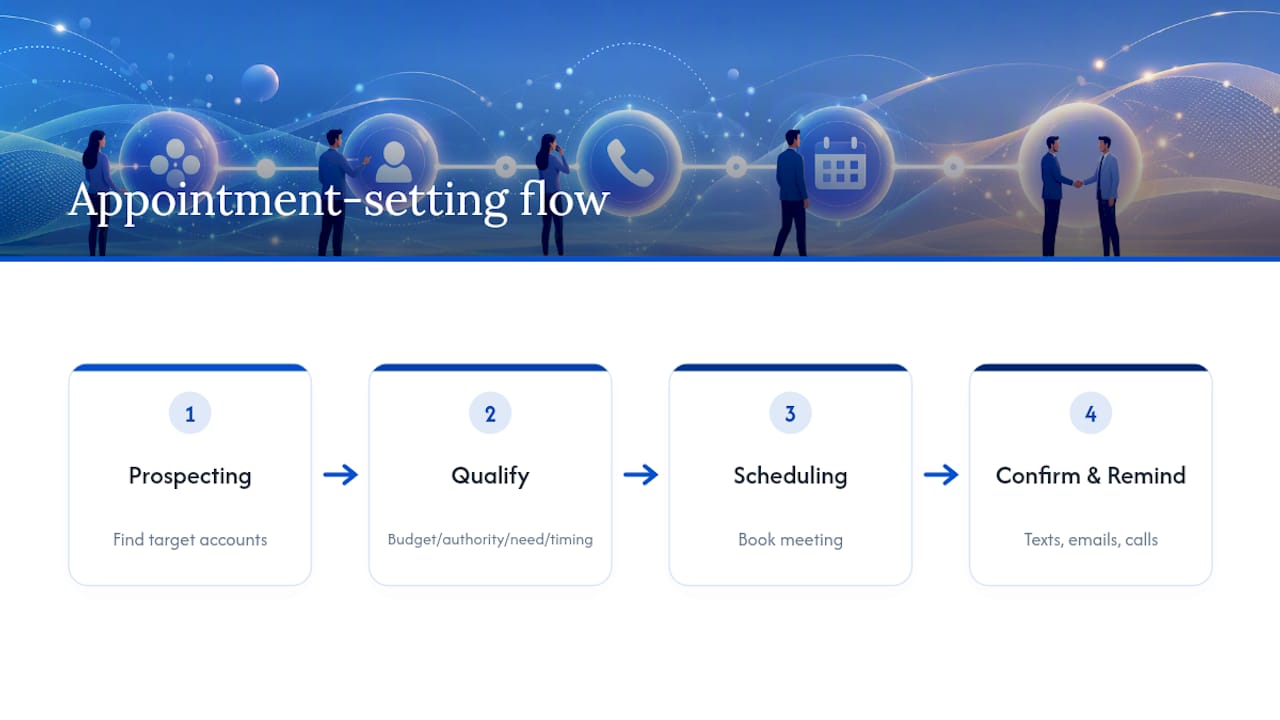
The scope typically covers four stages. Prospecting identifies target accounts and contacts. Qualification filters for budget, authority, need, and timing, so your reps aren’t wasting time on tire kickers. Scheduling books the actual meeting. And confirm-and-remind cadences, the follow-up texts, emails, and calls that happen between booking and the meeting itself, keep that appointment from becoming a no-show. That last piece gets ignored constantly, and it’s often the difference between a program that works and one that quietly bleeds money. What those four stages do to your sales numbers is in increase sales with appointment setting.
Want this done for you? We book qualified sales appointments on a Pay-Per-Result basis – you only pay for calls that actually land in your calendar.
Should Your Company Outsource Appointment Setting?
Outsourcing works best when the constraint is capacity or consistency, not product complexity. If your AEs are closing at a healthy rate but their calendars are half-empty, that’s a signal. If outbound volume swings from feast to famine depending on who’s covering it internally, that’s another. And if you need to test a new vertical or geography fast without hiring a full team first, appointment setting outsourcing gives you a way to do it without a six-month ramp.
In-house setups still win in a few specific situations, mostly where deep product knowledge is the whole game.
- Constrained AE time: reps are closing well but spending too many hours on cold outbound instead of live conversations.
- Inconsistent outbound: volume depends on whoever happens to have bandwidth that week, and pipeline health is unpredictable as a result.
- Fast market testing: you want to validate demand in a new segment before committing to a permanent hire.
- Deep technical demos: your sales motion requires a subject-matter expert on the very first call, not just a qualifying conversation.
- Hyper-niche buyers: your total addressable market is a few hundred named accounts and relationships matter more than volume.
Before signing anything, run a quick readiness check. Do you have a documented ideal customer profile a vendor can actually target? Is your CRM clean enough to hand off leads without confusion? Can you commit a manager’s time to weekly QA calls for at least the first month? If the answer to any of those is no, fix that first. A vendor can’t outperform a target list that doesn’t exist or a calendar system nobody maintains.
Partner Landscape and Delivery Models
Four delivery models dominate this space, and each one trades control for cost in a different way.
Outsourced agencies run appointment setting as their core service, usually with a team of trained setters, established scripts, and QA processes already built. In-house SDRs are full-time hires who work exclusively for you, giving you maximum control but the slowest ramp and the highest fixed cost. Fractional SDRs are part-time or shared reps, often through a staffing firm, offering a middle ground between dedicated attention and lower overhead. AI-driven and automated appointment scheduling systems use conversational agents and data models to handle outreach and booking at a scale no human team could match on the same budget.
Here’s how they actually stack up against each other:
- Control: in-house wins outright; agencies and fractional models require trust in someone else’s process; AI systems require trust in the model’s tuning.
- Ramp time: agencies and AI tools can go live in days to a few weeks; in-house hiring and training typically takes one to three months before a new SDR is fully productive.
- Cost structure: in-house carries salary, benefits, and management overhead regardless of output; agencies and AI-driven models often scale cost with results.
- Quality consistency: agencies with mature QA programs and AI systems with structured scripts tend to be more consistent than a single new hire still finding their footing.
- Compliance exposure: any model handling outbound calls or personal data carries risk, but agencies with documented compliance processes typically manage this better than an unsupported junior hire.
If your priority is speed and testing a new market, agencies or AI-driven automated appointment scheduling tend to fit best. If you need someone embedded in complex, technical sales cycles, in-house or fractional SDRs who can grow into product experts make more sense.
If we can’t make you money, we don’t deserve yours.
Pay-Per-Result pricing – performance-based alignment.
What Does Appointment Setting Outsourcing Cost?
Three pricing models dominate the market, and understanding what each one covers determines whether you’re getting a good deal.
- Per-held-meeting pricing charges you only when a qualified meeting actually happens and shows. This aligns the vendor’s incentive directly with your outcome, since pay-for-result pricing reduces the buyer’s risk during pilot phases far more effectively than paying for activity alone.
- Dedicated-setter monthly pricing puts a specific person or small team on retainer for your account, billed monthly regardless of output. You get more predictability in who’s working your leads, but less protection if results lag.
- Hourly pricing bills for time spent, which works for narrow, well-defined projects but offers the weakest incentive alignment of the three.
Pro Tip: Ask any vendor quoting a flat monthly rate what happens to your invoice if show-rates drop below an agreed floor. If there’s no answer, that’s your answer.
Cost ranges vary widely by geography, industry, and deal complexity, so treat any number you hear as a starting point for negotiation, not a market price. What matters more is distinguishing “price only” quotes from fully loaded costs. A vendor’s headline rate rarely includes onboarding fees, CRM integration time, or the management hours your team spends reviewing QA calls. Build those into your comparison or you’ll underestimate true cost by a wide margin.
Running a simple ROI check takes five minutes. Divide total monthly spend (agency fee plus your internal oversight hours, valued at a manager’s loaded rate) by the number of held meetings that actually happened. That’s your cost per held meeting. Compare it against the in-house alternative: SDR salary benchmarks plus benefits, tools, and management time, divided by that rep’s realistic monthly output once fully ramped. If an outsourced program delivers meetings at a lower fully loaded cost with comparable show-rates, the math favors outsourcing. If it doesn’t, you’ve just avoided a bad contract.
The Vetting Playbook: Questions To Ask Every Partner
Most vendor pitches sound identical. The questions you ask separate the ones who can actually deliver from the ones who talk a good game.
Start with operational proof, not promises.
- Ask for their average show-rate (the percentage of booked meetings that actually happen), not just the number of appointments booked.
- Request their rep-accepted rate, meaning how often the receiving sales team considers the meeting worth their time.
- Ask to review anonymized QA call recordings from an existing client, not a scripted demo.
- Get a written breakdown of what “qualified” means in their qualification criteria, since this term gets stretched constantly.
Compliance deserves its own line of questioning, especially if your outbound touches regulated industries or international contacts.
- Ask exactly what CRM access they need and whether it can be scoped to specific fields or lists rather than full account access.
- Confirm their process for scrubbing do-not-call lists and how they handle regional privacy rules like GDPR.
- If your data involves anything sensitive enough to require a business associate agreement, confirm they have documented controls in place before you sign anything.
On commercial terms, insist on transparent pricing with no hidden onboarding fees buried in the fine print, a replacement clause if your assigned setter turns over, and a pilot period, typically 30 to 60 days, with an exit clause if performance targets aren’t met.
The most revealing probe isn’t on any standard checklist: ask for a sample handover note from a recent booked meeting, along with their reschedule recovery rate. A vendor with a mature process will have both ready instantly. One that hesitates or has to “check with the team” is telling you something about how organized their operation really is.
Onboarding And Handoff: Making It Work Day One
The first 30 days determine whether an outsourced program succeeds or quietly underperforms for months before anyone notices.
- Week one: finalize scripts, define mandatory qualification fields (budget range, decision timeline, current solution), and map exactly how booked meetings flow into your CRM.
- Week one to two: run test calls with your sales manager listening live or reviewing recordings same-day, catching tone and qualification issues before they compound.
- Week two: set calendar rules, meaning which reps get which meeting types and how double-bookings get resolved.
- Week three to four: implement your confirm-and-remind cadence, the sequence of reminder emails, texts, and calls between booking and the meeting date.
- Ongoing: sample a percentage of QA recordings weekly, hold a standing review call, and update scripts incrementally based on what’s actually working on live calls.
Every booked meeting needs mandatory handoff fields attached: what the prospect said, why they’re interested, and what they expect to happen on the call. Guides from specialist vendors consistently recommend treating outsourced setters as an extension of your own sales team, which in practice means weekly coaching sessions, not a quarterly check-in. Programs that skip this step tend to see rep-accepted rates fall within weeks, because AEs stop trusting the meetings landing on their calendar.
Metrics And Benchmark KPIs To Demand
Four numbers tell you almost everything about program health, and any vendor unwilling to report them regularly is a warning sign.
Qualified-show rate (also called held rate) measures the percentage of booked meetings that actually happen with a genuinely qualified prospect. Rep-accepted rate measures how often your AEs consider the meeting worth their time after the fact, a gut-check that raw booking numbers can’t fake. Cost per held meeting combines vendor fees and internal oversight cost divided by meetings that showed. Appointments per setter per month measures raw throughput, useful for capacity planning but meaningless without the other three attached.
Vendor-audited programs running a strict confirm-and-remind cadence reported an 84% show-rate with 71% reschedule recovery, compared to meaningfully lower show-rates when no confirmation cadence exists at all.
That gap illustrates something worth internalizing: the booking is only half the job. A vendor that books aggressively but skips reminder texts and reconfirmation calls will show impressive volume and a disappointing number of actual conversations. Build a simple weekly dashboard tracking all four KPIs, review it in a standing 20-minute call, and treat any sustained show-rate below the high 70s as a process problem to fix immediately, not a metric to tolerate.
Common Risks And How To Mitigate Them
Quality leakage is the most common failure mode. A setter who sounds great on a sample call can drift over months without oversight. Fix this with regular QA samples, a rep-acceptance gate (meetings under a certain acceptance threshold trigger a review), and mandatory call notes attached to every booking.
Compliance risk grows with scale, especially across regions with different telemarketing and privacy rules. Scope CRM access tightly, require documented do-not-call scrubbing, and get signed agreements covering any sensitive data before outbound starts.
Turnover at the vendor side can quietly gut your pipeline if a trained setter leaves and nobody tells you. Address this contractually.
- Require a written continuity plan describing how a departing setter’s knowledge transfers to a replacement.
- Insist on a service-level clause guaranteeing a trained backup within a defined window, not an open-ended “we’ll get someone.”
- Ask how often turnover has actually happened on similar accounts in the past year, and get a real number, not a reassurance.
LeadsNow AI’s Pay-For-Result Approach
Leadsnow addresses what its team calls the leaking bucket problem: businesses routinely lose the majority of potential revenue to weak follow-up and inconsistent lead generation. The model charges clients only when a qualified appointment is actually booked, with no retainers or flat monthly fees, which removes the misalignment that plagues so many outsourcing arrangements.
Some results reported include a 7× sales lift for clients and more than 50,000 AI-booked appointments delivered to date. That volume comes from combining AI sales agents with continuous data analytics, letting the system adjust targeting and scripts in near real time rather than waiting for a quarterly review.
This hybrid structure directly addresses common pain points such as ramp time and cost per held meeting. Because the AI layer handles volume and the qualification logic runs on data rather than a new hire’s judgment, programs can go live faster than a traditional hiring cycle, with human QA layered on top to catch what automation misses.
How Long Does Ramp Time Actually Take?
Most outsourced programs need two to four weeks before performance stabilizes, and any vendor promising results from day one is overselling. The first week is almost entirely calibration: scripts get tested against real objections, qualification criteria get refined based on what prospects actually say, and your team learns to trust or distrust the meetings landing on the calendar.
A short, scripted onboarding period with daily QA for the first two to four weeks dramatically shortens this curve compared to programs that skip structured onboarding and hope the vendor figures it out independently. Skipping this step is the single most common reason a promising pilot fizzles: the vendor never gets tight feedback, so the same qualification mistakes repeat for months.
Realistic expectations matter here. Expect show-rates and rep-accepted rates to improve steadily over the first month rather than starting strong. A program that opens hot and fades usually means the initial list was cherry-picked; one that starts modest and climbs is usually building a sustainable process. If a vendor hasn’t hit acceptable benchmarks by day 45, that’s the point to have a hard conversation, not day five.
Legal And Compliance Considerations You Can’t Skip
Outbound calling and data handling sit inside regulated territory almost everywhere, and the rules vary sharply by jurisdiction. In the United States, telemarketing activity intersects with the Telephone Consumer Protection Act and do-not-call registry requirements; in the European Union and UK, GDPR governs how personal data can be collected, stored, and used for outreach. None of this is optional scenery, it directly shapes what a vendor can legally do on your behalf.
Before any outbound campaign starts, confirm who owns compliance liability contractually. Many outsourcing agreements are vague on this point, leaving the client exposed if a vendor’s calling practices violate local rules. Require documentation of how contact lists get scrubbed against do-not-call registries and how consent is tracked for any jurisdiction where opt-in rules apply.
If your appointment setting touches sensitive personal data, healthcare information, financial details, anything covered by a specific regulatory framework, confirm the vendor maintains documented data-handling agreements rather than assuming standard practice covers you. This matters even more when the vendor’s team works across borders, since data residency rules differ by country and a casual assumption about “where the data lives” can create real exposure. Build compliance review into your vetting checklist, not as an afterthought after commercial terms are settled.
Tech Stack And Integration Realities
An outsourced setter is only as good as the systems feeding them leads and receiving their bookings. At minimum, expect to connect your CRM (Salesforce, HubSpot, or similar), your calendar system, and whatever intent or enrichment data source you use to prioritize outreach.
The friction usually shows up in three places. Field mapping mismatches happen when a vendor’s qualification fields don’t align with your CRM’s required data, leaving AEs staring at incomplete records. Calendar conflicts arise when booking rules aren’t clearly defined, leading to double-bookings or meetings assigned to the wrong rep. And reporting gaps appear when a vendor’s dashboard doesn’t sync with your internal analytics, forcing manual reconciliation every week.
Solve field mapping before day one by documenting every required field and testing the integration with sample records, not live prospects. Solve calendar conflicts with clear, written booking rules assigning specific meeting types to specific reps or teams. Solve reporting gaps by requiring API access or automated exports rather than relying on a vendor’s static weekly report. Programs that skip this integration groundwork tend to look fine on paper for the first two weeks and then generate a growing pile of AE complaints about messy handoffs. The technical setup is unglamorous, but it’s the difference between a program that scales cleanly and one that generates constant friction between your outsourced setters and your closing team.
What Successful Outsourcing Programs Look Like
The programs that work share a common shape regardless of industry: a tight feedback loop between the setter and the closing team, clear qualification criteria agreed on before the first call, and a pricing structure that rewards meetings that actually happen rather than meetings that get booked and then evaporate.
Consulting and professional services firms tend to succeed with outsourcing when they define qualification narrowly, meaning a specific budget range and decision timeline, and reject looser leads rather than padding volume. Firms exploring this model can see how the economics shake out in a cost-per-meeting benchmark breakdown for consultants built around exactly this kind of qualification discipline.
Fitness and coaching businesses, where speed to first conversation often determines whether a lead converts at all, tend to benefit from automated, always-on scheduling layered with human follow-up. A database reactivation program that converted dormant CRM leads at a 4.4% average and 8.9% peak rate shows what’s possible when outreach cadence and qualification logic are tuned specifically to leads that already exist in a system, rather than cold outbound built from scratch. High-ticket coaching operations exploring similar structures can review approaches built specifically around that audience segment. B2B SaaS teams weighing demo-booking specifically will find a more direct comparison in agency options built for that segment.
A Pragmatic Path Forward
If you’re staring at this decision right now, here’s the short version: pilot before you commit. Pick a vendor willing to align pricing with held meetings, not just bookings, insist on a written show-rate SLA before day one, and keep your AEs focused entirely on closing while someone else handles the qualifying conversation.
Scale an outsourced program once it’s proven show-rates and rep-accepted rates over a full 60 to 90 day cycle, not a single good week. Build in-house only when your sales motion genuinely requires deep product expertise on the first call, not because outsourcing feels like giving up control.
The single most useful thing you can do this week isn’t signing a contract. It’s requesting QA call recordings and reschedule recovery data from two vendors and comparing them side by side. That one exercise will tell you more than any sales deck.
– Riley
Get Qualified Meetings Without Paying For Empty Calendars
Leadsnow flips the usual outsourcing math: instead of paying a flat fee and hoping for results, you pay only when a qualified appointment actually lands on your calendar. That single structural difference removes the biggest risk covered throughout this playbook, the mismatch between what you’re paying for and what you’re actually getting.
AI sales agents can handle outbound prospecting and qualification while continuous data analytics refine targeting in real time, often backed by human QA to catch what automation misses. Some reported outcomes include a significant sales lift for clients and many AI-booked appointments delivered without retainers or long-term contracts standing in the way.
If you’re weighing a pilot against building an in-house team, start with a KPI-aligned conversation rather than a lengthy RFP process. Visit the Leadsnow pay-per-result platform to discuss what a 30-day pilot would look like for your specific pipeline and how show-rate guarantees would apply to your account.
Sources
- Appointment Setting Outsourcing Philippines | Calendars Full of Qualified Meetings – PITON-Global 2026
Recommended
- How to Price a B2B Consulting Engagement: A Framework Based on 50,769+ Booked Meetings
- Cost Per Booked Discovery Meeting for B2B Consultants: 2026 Australian Benchmarks
- How to Price B2B SaaS Deals: A Framework Based on 1,425+ Booked Demos
- AI Appointment Setter vs Human SDR for Coaches: 2026 Cost & Performance Breakdown
Made with BabyLoveGrowth to create useful content
If you sell in Australia and want names, our comparison of the best sales appointment setting companies in Australia puts AI-led, retainer and DIY options side by side.
Pay-Per-Result appointments
See if we’re a fit
We book qualified sales appointments for you and you pay on results, not retainers. Our booking page asks a few quick questions so you find out in two minutes whether that model suits your business.
- 50,769+ appointments booked without cold calling.
- Pay-Per-Result pricing – you pay for booked, qualified calls.
- Pick your own time on our live calendar, no phone tag.