
B2B appointment setting is the process of scheduling meetings between vetted prospects and a company’s sales closers, using research, outreach, and screening to filter out anyone who isn’t a real fit. Done well, it saves account executives from wasting hours on unqualified calls and speeds up how fast deals move through the pipeline. The rest of this guide covers the process, the tools, the KPIs worth tracking, and where a pay-per-result vendor fits into the picture.
TL;DR:
- Using a pay-per-result model ensures vendors only get paid when a qualified appointment is scheduled, aligning incentives effectively.
- Defining a clear ideal customer profile with both fit and intent signals improves lead quality and reduces wasted outreach efforts.
- Automating scheduling with CRM integration and intake forms minimizes friction and prevents lost opportunities due to manual coordination.
- Monitoring booked meetings, show rates, opportunity conversions, and cost per meeting provides a comprehensive view of appointment-setting effectiveness.
- Outsourcing makes sense when internal AE capacity is constrained, qualification is clear and well-defined, and vendors demonstrate measurable, transparent results.
Table of Contents
- What Is B2B Appointment Setting, Exactly?
- Why Appointment Setting Matters for Pipeline and Revenue
- The Step-by-Step Appointment Setting Process
- Outreach Tactics That Actually Raise Show Rates
- Scheduling Tools and Tech That Remove Friction
- Metrics That Tell You If Appointment Setting Is Working
- How Pay-Per-Result Appointment Booking Actually Works
- See How Pay-Per-Result Appointment Setting Works for Your Business
- In-House or Outsourced: A Quick Way to Decide
- Sources
How it works
How an AI sales agent books your appointments
Your list or CRM
We start from data you already own – past enquiries, dormant customers, or a targeted prospect list.
The agent makes contact
Email, SMS and voice, with follow-up that persists for weeks instead of stopping after two attempts.
Qualified against your rules
Budget, timing and fit are checked before anything reaches your team, using criteria you set.
Booked into your calendar
Only qualified prospects reach the booking step, so your closers spend their time selling.
MAKE MORE SALES.
Pay-Per-Result pricing – We scale sales HARD aligned to your interests, better than anyone else.
What Is B2B Appointment Setting, Exactly?
B2B appointment setting schedules meetings between qualified sales leads and the reps who close deals. It sits in a specific slot in the funnel: after prospecting identifies who might buy, and before an account executive runs a demo or pitches a proposal. Get that sequencing wrong and you either flood your closers with tire kickers or lose good leads to a slow follow-up.
The confusion usually starts with job titles. A prospector or researcher builds the list. An appointment setter, often called a sales development representative (SDR), makes contact and qualifies interest. The account executive (AE) or closer takes the meeting and tries to win the business. Some companies run all three functions in-house. Others outsource the entire setting function to a specialized team or an AI-driven agency, keeping only the closing conversation internal.
Here’s where people often blur the lines:
- Prospecting finds the right companies and contacts, often through firmographic and intent data.
- Appointment setting makes contact, qualifies interest and authority, and locks a meeting on the calendar.
- Closing runs the actual sales conversation, demo, or proposal that turns a meeting into revenue.
Treating these as one job is the most common structural mistake in B2B sales organizations. An AE who spends the morning cold calling and the afternoon closing deals is doing two jobs badly instead of one job well. Appointment setting works as a distinct discipline precisely because qualifying a stranger’s interest requires different skills and a different rhythm than negotiating a contract. The setter’s entire job is volume and screening; the closer’s job is depth and persuasion. Split them, and both get better at their half.
Want this done for you? We book qualified sales appointments on a Pay-Per-Result basis – you only pay for calls that actually land in your calendar.
Why Appointment Setting Matters for Pipeline and Revenue
The business case for structured appointment setting comes down to time allocation. Every hour an AE spends cold prospecting is an hour not spent closing. When a dedicated setter (human or AI) handles outreach and qualification, closers only see meetings that already meet a baseline fit and intent threshold, which shortens the sales cycle and raises win rates on the meetings that do happen.
Buying behavior backs up why this separation matters more now than it used to. Forrester’s research on business buying shows B2B purchases increasingly involve more stakeholders and more self-directed research before a buyer ever wants to talk to a rep. That shifts the burden onto the first conversation: if a setter books a meeting with someone who hasn’t done any of that homework, or who lacks buying authority, the AE just inherited a dead end dressed up as a lead.
The real cost of unqualified meetings shows up in AE calendars, not in marketing reports. A closer who takes five meetings a week and converts one has a very different economics profile than a closer who takes five meetings and converts three, even if lead volume looks identical on a dashboard.
Pay-per-result and managed appointment-setting models change this equation further. Instead of paying a flat retainer for a team that may or may not deliver quality meetings, a business pays only when a qualified appointment actually lands on the calendar. That structure aligns incentives directly: the vendor only gets paid when the qualification criteria are met, which removes the guesswork of judging whether a monthly retainer produced enough value.
Benefits worth weighing when you build or buy an appointment-setting function:
- Closers spend meeting time selling instead of screening.
- Sales cycles shorten because qualification happens before the first call, not during it.
- Forecasting improves because booked meetings correlate more tightly with revenue than raw lead counts.
- Pay-per-result pricing ties cost directly to outcomes instead of activity.
The Step-by-Step Appointment Setting Process
A repeatable process is what separates a scalable appointment-setting operation from a founder cold-calling their network. The sequence below reflects how most effective B2B teams structure the work, whether they run it in-house or hand it to a specialized partner.
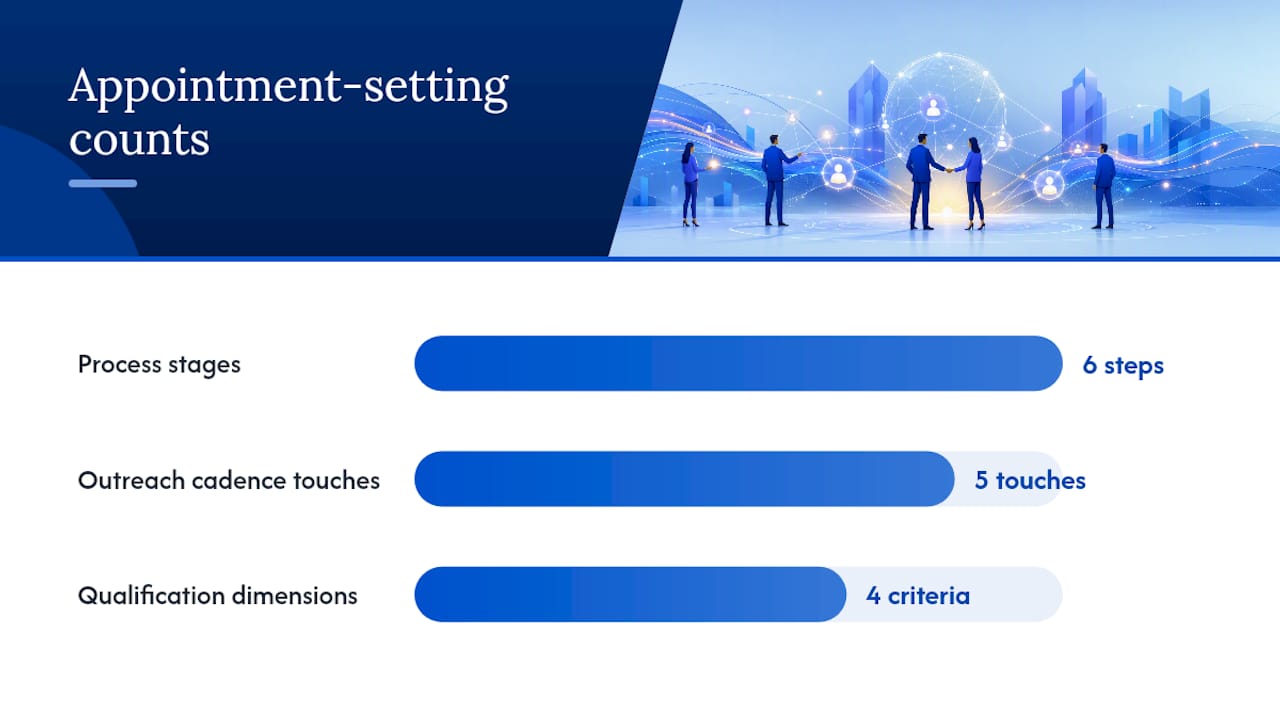
1. Define the ideal customer profile using fit and intent scoring.
Start with your closed-won customers, not your wish list. Look at company size, industry, tech stack, and buying triggers that show up repeatedly among deals that actually closed. Clay’s lead generation playbook recommends combining firmographic fit with active buying signals, funding rounds, new hires in relevant roles, or public tech changes, to rank which accounts deserve outreach first. A prospect who fits your ICP on paper but shows zero buying signals is a much colder call than one who fits loosely but just posted three sales job openings.
2. Build and enrich your contact list from reliable data sources.
Once you know who to target, you need accurate contact data: verified emails, direct phone lines, and current job titles. Stale data is the single biggest silent killer of outreach performance, since a setter can run a flawless script and still get nowhere if the contact left the company eight months ago. If you would rather hand the lists and outreach over, see LeadsNow’s outbound appointment setting service.
3. Run outreach across a deliberate channel mix.
Most effective programs blend cold calling, email sequences, and LinkedIn outreach rather than betting everything on one channel. A sample five-touch cadence over two weeks might look like:
- Day 1: Personalized email referencing a specific trigger (funding, hire, product launch).
- Day 3: Phone call attempt, voicemail if no answer.
- Day 5: LinkedIn connection request with a brief note.
- Day 8: Follow-up email with a different angle, often a relevant case study or benchmark.
- Day 12: Final call attempt paired with a short “should I close your file” email.
4. Qualify against clear screening criteria before booking anything.
A “booked meeting” only counts if it meets your bar. Most teams qualify on four dimensions: fit, intent, authority, and timeline. Structuring qualification as a short checklist rather than a gut-feel conversation makes it possible to audit later and, for pay-per-result arrangements, makes billing defensible on both sides.
5. Handle scheduling mechanics so the meeting actually happens.
This is where booking links, calendar sync, and buffer times matter more than most teams realize. A setter who has to manually check an AE’s calendar and email back and forth to find a time adds friction that kills momentum, since a prospect’s interest is highest right after they agree to meet, not three days later once you’ve finally coordinated schedules.
6. Hand off to the closer with full context.
The handoff should include CRM notes on why the prospect qualified, what pain points came up, and any materials already shared. A closer walking into a meeting blind wastes the first ten minutes re-asking questions the setter already answered.
7. Manage the post-book workflow: reminders, reschedules, no-shows.
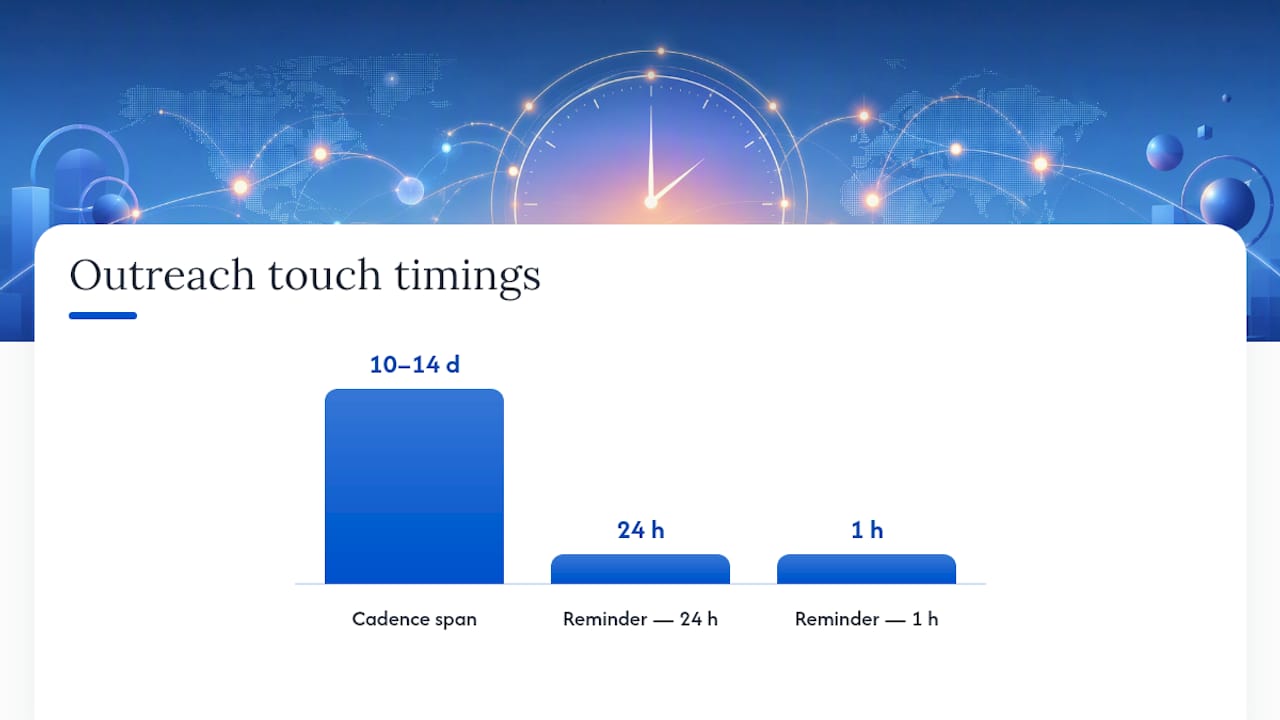
Automated reminders 24 hours and one hour before the meeting cut no-show rates meaningfully. When someone does need to reschedule, a self-service link beats a phone tag chain every time.
Pro Tip: Build your qualification checklist before you write a single outreach script. Teams that qualify first and script second end up with cold-call scripts that actually ask the right disqualifying questions, instead of scripts optimized purely for booking anything with a pulse.
One legal note worth flagging here: cold calling and cold emailing rules vary by jurisdiction. Some regions require opt-out mechanisms in commercial email, and certain call types face restrictions under telemarketing regulations. Check the rules that apply in your operating market before scaling outbound volume, and build compliance language into your scripts rather than treating it as an afterthought.
If we can’t make you money, we don’t deserve yours.
Pay-Per-Result pricing – performance-based alignment.
Outreach Tactics That Actually Raise Show Rates
Booking a meeting and getting someone to actually show up are two different problems, and most appointment-setting advice only addresses the first one.
Cadence and timing matter more than most scripts. Reaching out once and giving up wastes the effort already spent on research. A cadence stretched across ten to fourteen days, mixing email, phone, and social touches, consistently outperforms a single-channel blast, mainly because different prospects respond to different channels depending on their role and how they work.
Signal-driven personalization beats generic outreach by a wide margin. A cold email that opens with “I saw you’re hiring three account executives this quarter” gets read differently than one that opens with “I wanted to reach out about how we help companies like yours.” The first proves you did homework; the second proves you didn’t.
A short voicemail script that works better than most:
“Hi [Name], this is [Setter] with [Company]. I noticed [specific trigger, like a funding round or job posting] and had an idea relevant to that. I’ll follow up with a quick email, but if you want to skip ahead, my number is [number].”
A follow-up email fragment that pairs well with it:
“Following up on the voicemail I left. Quick context: we helped [similar company] reduce [specific metric] by [result]. Worth 15 minutes to see if something similar applies to you?”
Reducing no-shows comes down to removing friction and adding accountability at the right moments:
- Send a confirmation immediately after booking, not just a reminder the day before.
- Use two-step booking: a short qualifying question before the calendar link appears, which filters out low-intent clicks.
- Share one relevant piece of pre-call material, a case study or a short agenda, so the prospect arrives with context.
- Send a reminder 24 hours out and another one hour before, since automated CRM workflows that trigger these reminders without manual setter effort tend to produce the most consistent results.
Pro Tip: If your show rate sits below 70%, the problem is rarely the reminder cadence. It’s usually that the meeting got booked too easily. Add one qualifying question before the calendar link unlocks, and watch your show rate improve even as your raw booking count drops slightly.
Scheduling Tools and Tech That Remove Friction
The tools you choose for scheduling and follow-up matter less for their features and more for how well they eliminate the back-and-forth that kills momentum between “interested” and “booked.”
Calendar-syncing schedulers solve the most basic friction point: nobody wants to trade five emails to find a meeting time. Calendly connects up to six calendars and lets prospects self-book against real-time availability, and similar platforms like Acuity Scheduling and Zoho Bookings offer branded booking pages with intake forms built in. Acuity’s own data shows 75% of businesses using its reminder and deposit features reduced no-shows, which tells you the scheduling layer isn’t a minor convenience. It’s a lever on your actual show rate.
CRM integration is where a lot of appointment-setting operations quietly fall apart. If a booked meeting doesn’t automatically create a record with the qualification notes, trigger, and contact history, the closer walks in blind and the setter’s research gets lost. Zoho Bookings and comparable platforms support two-way calendar sync plus workflows that update CRM records and fire reminder sequences without manual intervention, which frees setters to spend their time qualifying instead of doing administrative cleanup.
Tools worth evaluating for a serious appointment-setting stack:
- Two-way booking links (Calendly, Acuity, Zoho Bookings) that let prospects self-schedule against live availability.
- Intake forms attached to the booking flow that capture qualification data before the meeting happens.
- CRM automation that logs the booking, updates the contact record, and assigns the meeting to the right closer.
- Reminder sequences that fire automatically at set intervals rather than relying on a setter to remember.
Platforms like Appointy build similar automation directly into the booking flow, which points to a broader pattern: the friction that kills conversion from “interested” to “booked” almost always lives in the handoff points, not in the initial outreach message. Manual scheduling still works for low-volume operations, but any team booking more than a handful of meetings a week loses real time to coordination that a booking link would eliminate instantly.
Metrics That Tell You If Appointment Setting Is Working
Four numbers tell you almost everything about whether an appointment-setting program is earning its keep.
Booked meetings is the rawest volume metric: how many meetings got scheduled in a given period. It matters, but on its own it can mask a quality problem, since ten meetings that generate one deal isn’t better than three meetings that generate one deal.
Show rate measures what percentage of booked meetings actually happen.
Conversion to qualified opportunity tracks how many of the meetings that do happen turn into a legitimate sales opportunity, a demo request, a proposal stage, or whatever your pipeline calls the next real step.
Cost per booked meeting divides total spend on the appointment-setting function (salaries, tools, vendor fees) by the number of meetings that met your qualification bar. This is the number that makes pay-per-result pricing easy to evaluate against an in-house team’s fully loaded cost.
| Metric | What it measures | How to calculate it |
|---|---|---|
| Booked meetings | Raw volume of scheduled meetings | Count of meetings booked in the period |
| Show rate | Meetings that actually occur | Meetings attended ÷ meetings booked |
| Opportunity conversion | Meeting quality and qualification accuracy | Qualified opportunities ÷ meetings attended |
| Cost per booked meeting | Efficiency of spend | Total program cost ÷ qualified meetings booked |
Report these weekly during ramp-up and monthly once the program stabilizes, and treat any sudden show rate drop as a data quality signal before you assume it’s a messaging problem. A/B test one variable at a time, subject line, call opener, or cadence length, since testing multiple changes simultaneously makes it impossible to know what actually moved the number. If cost per booked meeting climbs steadily while show rate and conversion stay flat, that’s usually a sign your target list has thinned out and needs re-scoring against fresh intent signals, not a sign your setters are underperforming.
How Pay-Per-Result Appointment Booking Actually Works
Most appointment-setting arrangements charge for activity: a monthly retainer for a certain number of dials or emails sent, regardless of what actually lands on the calendar. Some agencies work differently, charging clients only when a qualified appointment gets booked. That structure removes the guessing game of whether a retainer is producing real pipeline or just busywork.
Some AI-driven sales agents handle outbound contact, qualification, and follow-up, paired with data analytics that continuously refine which contacts get prioritized and when. Those numbers come from combining AI-driven contact selection with ongoing cadence optimization rather than a static script run on repeat.
When does a managed, pay-per-result partner make more sense than building an in-house SDR team from scratch? A few situations stand out:
- You need appointment volume now and don’t have six months to hire, train, and ramp a setting team.
- Your in-house team is strong at closing but weak at consistent outbound cadence and follow-up.
- You want cost tied directly to qualified outcomes instead of fixed headcount, regardless of how many meetings that headcount produces.
- You operate in a niche (coaching, gyms, consulting, startups) where compliance-aware scripting and tailored qualification criteria matter more than generic outreach templates.
An in-house team still makes sense when the sales motion is highly technical and requires deep product knowledge before the first conversation, but for most standard B2B qualifying calls, the incentive alignment of pay-per-result pricing solves a problem that retainer-based models never quite fix.
See How Pay-Per-Result Appointment Setting Works for Your Business
Some pay-per-result appointment booking services charge nothing until a qualified appointment actually lands on your calendar, which flips the usual math on outsourced appointment setting from “hope the retainer pays off” to “pay for the meeting you actually got.” AI sales agents can handle outreach, qualification, and follow-up continuously, refining which prospects get contacted based on the data.
If you want to see the benchmark numbers behind this approach, the cost per booked meeting breakdown for consultants lays out real pricing frameworks worth comparing against whatever you’re currently paying an in-house team or a retainer-based agency. Coaches and gym operators weighing AI-driven setting against a traditional SDR hire should also look at the AI appointment setter versus human SDR cost and performance breakdown, which walks through the tradeoffs in plain numbers.
If your calendar has more empty slots than qualified meetings this quarter, the fastest way to find out what pay-per-result booking looks like for your business is to visit Leadsnow and see what a benchmarking call would actually project for your pipeline.
In-House or Outsourced: A Quick Way to Decide
Three rules cut through most of the debate about building an internal setting team versus outsourcing it. First, if you can’t clearly articulate your ICP and qualification checklist in one paragraph, fix that before hiring or buying anything, since no team, internal or external, can qualify well against a vague target. Second, if your current AEs spend more than a third of their week on outbound instead of closing, that’s a structural problem outsourcing solves faster than hiring usually does. Third, treat the first ninety days of any new setting function, in-house or vendor, as a calibration period, not a verdict. The scripts and targeting will need adjusting no matter who runs the program.
When evaluating a vendor, four things matter more than a slick sales deck: documented outcomes with real numbers attached, transparency about how qualification actually happens, some form of performance guarantee tied to results rather than activity, and genuine integration with your CRM so handoffs don’t create data gaps. A vendor that can’t answer specifically how they define a “qualified” meeting is one to walk away from regardless of price.
The most common mistake I see is treating appointment setting as a volume game when it’s actually a filtering game. Teams chase booked-meeting counts and wonder why their close rate cratered, when the fix was tightening the qualification bar, not loosening outreach. The second most common mistake is skipping the handoff step entirely, letting a closer walk into a meeting with zero context the setter already gathered. Both are cheap to fix once you see them for what they are.
– Riley
Sources
- What Is B2B Appointment Setting? (Plus Importance and Tips) | Indeed
- How to Generate B2B Leads: The Complete Playbook for 2026 | Clay
- Calendly – Scheduling software
- Zoho Bookings – Appointment scheduling
Recommended
- AI Appointment Setter vs Human SDR for Coaches: 2026 Cost & Performance Breakdown
- How to Price B2B SaaS Deals: A Framework Based on 1,425+ Booked Demos
Pay-Per-Result appointments
See if we’re a fit
We book qualified sales appointments for you and you pay on results, not retainers. Our booking page asks a few quick questions so you find out in two minutes whether that model suits your business.
- 50,769+ appointments booked without cold calling.
- Pay-Per-Result pricing – you pay for booked, qualified calls.
- Pick your own time on our live calendar, no phone tag.