
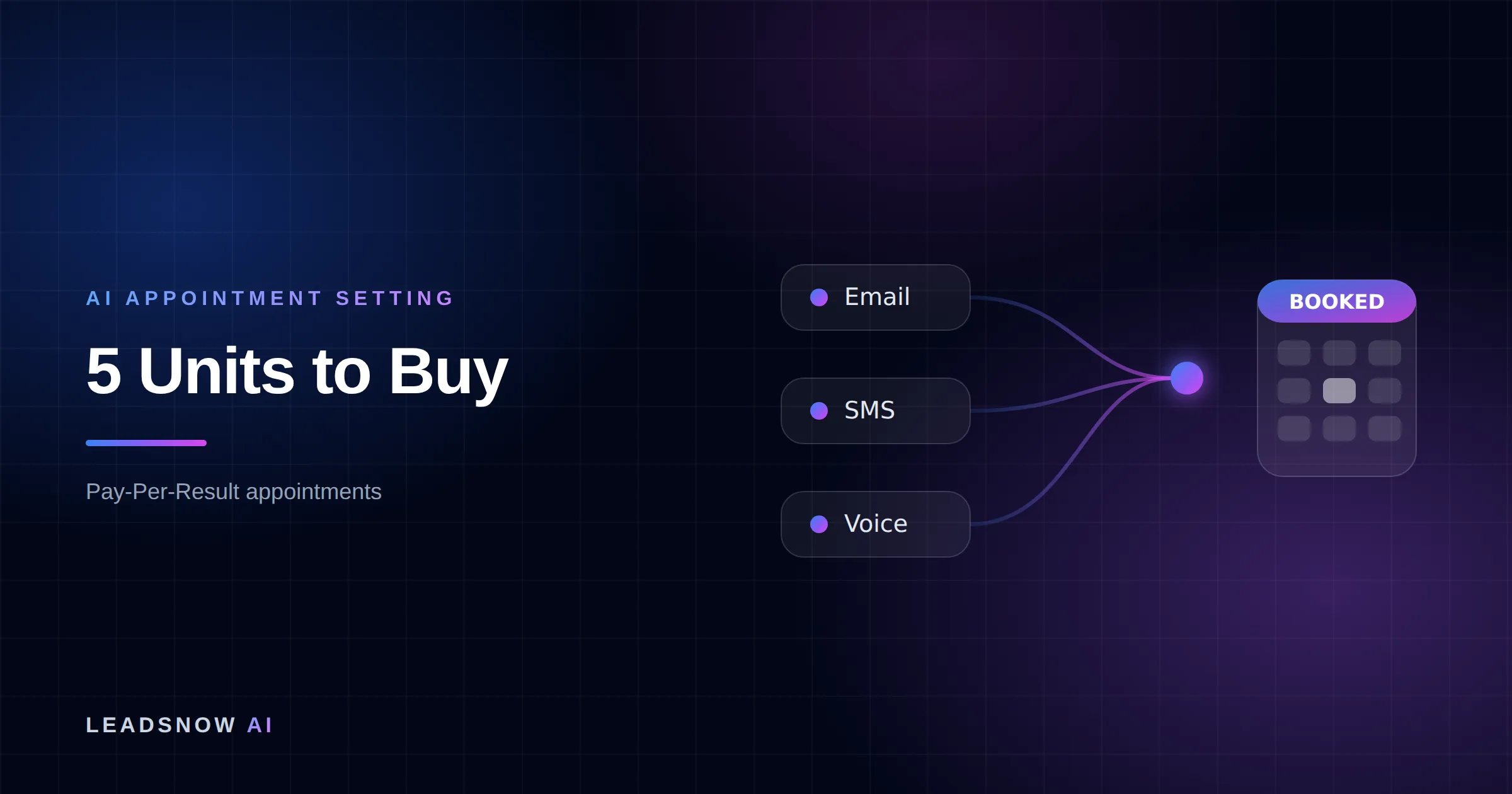
Lead generation services sell one of five units: contact data, raw leads, qualified leads, booked appointments, or attended appointments and revenue. The unit you buy decides who carries the risk. Across the market a booked sales call costs $30–$400+ depending on industry, offer, price and many other variables, so compare units, not vendors.
At a glance
- What you buy: one rung of the unit-of-purchase ladder: data, leads, qualified leads, booked appointments, or attended appointments and revenue.
- Who carries the risk: the lower the rung, the more of the funnel (calling, qualifying, booking, reminding) stays with your team.
- Pricing models: monthly retainer, pay per lead, pay per appointment, revenue share, or a hybrid.
- The number that matters: cost per attended sales call, including your own staff hours, not cost per lead.
- Speed decides lead value: in a Harvard Business Review audit of 2,241 US companies, 23% never answered a web lead at all.
- Compliance: the FTC’s Telemarketing Sales Rule in the US, PECR and UK GDPR in the UK, the Spam Act 2003 in Australia.
What lead generation services actually sell
A lead generation service is an outside firm that produces sales opportunities for your business: names, enquiries or sales conversations that your team would otherwise have to create itself. The label covers firms that do very different work, from a data broker selling a spreadsheet of job titles to a done-for-you team that calls, qualifies and books prospects onto your sales calendar.
That range is why two quotes for “lead generation services” can differ by a factor of ten and both be fair. They are not quoting the same thing. One is selling a name; the other is selling a conversation with a buyer who has agreed to a time.
Lead generation services usually combine some of these activities:
- Demand creation: paid social, paid search, content and SEO that make strangers raise their hand.
- Outbound prospecting: cold email, cold calling, LinkedIn and SMS to lists the firm builds or buys.
- Lead handling: answering new enquiries fast, qualifying them and following up until they reply.
- Appointment setting: getting a qualified prospect to accept a time on a salesperson’s calendar, then reminding them so they turn up.
- Reactivation: working an old CRM of past enquiries and lapsed customers.
The quotable version: a lead generation service is defined by the last step it owns, not by the channels it uses.
How it works
How to choose a lead generation service
Measure your response time
Pull 30 days of enquiries and time to first reply. Hours, not minutes, means you should not buy raw leads.
Pick your rung
Choose data, leads, qualified leads, booked or attended appointments. Each rung up moves one more funnel stage to the provider.
Define the unit in writing
Write down what counts as a lead, qualified lead or appointment. The definition is the contract.
Judge cost per attended call
Add provider fees, ad spend and your staff hours, then divide by calls actually held.
MAKE MORE SALES.
Pay-Per-Result pricing — We scale sales HARD aligned to your interests, better than anyone else.
The unit-of-purchase ladder: five things you can buy
The unit-of-purchase ladder is the framework this page uses to compare lead generation services. Each rung up the ladder moves one more stage of the sales funnel from your team to the provider, and with it the risk that the stage fails.
| Rung | Unit you pay for | Funnel stages the provider owns | Stages your team still owns | Usual price basis |
|---|---|---|---|---|
| 1 | Contact data (names, emails, phone numbers) | List building | Outreach, reply handling, qualifying, booking, reminders, selling | Per record or subscription |
| 2 | Raw leads (form fills, enquiries) | Ads or outreach that create an enquiry | Speed to lead, qualifying, booking, reminders, selling | Per lead or retainer |
| 3 | Qualified leads (MQL/SQL) | Enquiry plus a qualification check | Booking, reminders, selling | Per qualified lead or retainer |
| 4 | Booked appointments | Enquiry, qualification, booking | Showing up (shared), selling | Per appointment |
| 5 | Attended appointments or revenue | Everything up to a held sales call, sometimes the close | Selling, delivery | Per attended call, revenue share, or a mix |
Three things follow from the ladder:
- Price per unit rises as you climb, and so does value per unit. A booked call is always dearer than a lead, because several leads were worked to produce it.
- Every rung below 5 leaves a hand-off. The hand-off is where most money leaks, because nobody is paid to make it work. Our page on sales funnel leakage maps where those drops happen.
- The definition of the unit is the contract. “Qualified” and “appointment” mean whatever the agreement says they mean, so write the definition before you compare prices.
Want this done for you? We book qualified sales appointments on a Pay-Per-Result basis — you only pay for calls that actually land in your calendar.
How lead generation services are priced
Lead generation services use five pricing structures, and each one tells you which side carries the risk of poor results. The pricing models themselves are covered in depth in our guide to performance-based lead generation, so this section is the short version.
- Monthly retainer: a fixed fee for activity (campaigns run, emails sent, hours worked). You carry the result risk. Good for brand and content work where results are slow and hard to attribute.
- Pay per lead: a fee per enquiry. The provider carries the cost of creating the enquiry; you carry everything after it, including leads that never answer.
- Pay per appointment: a fee per booked or attended call. The provider carries outreach, qualifying and booking.
- Revenue share: a percentage of revenue the provider generates. Both sides carry the close; it only works when sales are trackable.
- Hybrid: a smaller fixed fee plus a performance component, or a fee per appointment plus a revenue share.
The honest trade-off: retainers are cheaper per unit when a campaign works well, and performance pricing costs more per unit because the provider is pricing in the campaigns that do not work. A side-by-side of the two models is in pay-per-result vs retainer agencies.
What good looks like: benchmarks for lead generation services
Few honest public benchmarks exist for lead generation services, because results depend on the offer, the price point and the sales team on the receiving end. The figures below are the ones that hold up at source.
| Measure | Figure | Source and scope |
|---|---|---|
| Companies answering a web lead within 1 hour | 37% | HBR audit of 2,241 US companies (2011) |
| Companies that never answered the test lead | 23% | Same HBR audit |
| Average response time (responders within 30 days) | 42 hours | Same HBR audit |
| Likelihood of qualifying a lead when contact is attempted within 1 hour vs an hour later | Nearly 7x | A separate study of 1.25 million leads at 42 US companies, reported in the same HBR article |
| Typical cost per booked sales call across the market | $30–$400+ | LeadsNow’s market range; depends on industry, offer, price and many other variables |
| Median pay, US wholesale and manufacturing sales representatives | $76,460 a year ($36.76 an hour) | US BLS, 2025 median pay |
The speed figures come from Oldroyd, McElheran and Elkington’s “The Short Life of Online Sales Leads” in Harvard Business Review. They are old and US-only, but they measure the exact failure that sits between rung 2 and rung 4: a lead that was paid for and never worked. For cost per lead by industry, see our US cost per lead benchmarks rather than a single headline number.
What a good lead generation service should be able to show you, at minimum:
- Its definition of a lead, qualified lead and appointment, in writing.
- Median response time to a new enquiry, in minutes, measured from its own system.
- Lead-to-booked and booked-to-attended rates for accounts like yours, with the number of accounts behind each figure.
- How it handles no-shows: charged, not charged, or rebooked.
If we can’t make you money, we don’t deserve yours.
Pay-Per-Result pricing — performance-based alignment.
How to measure a lead generation service
The right way to measure a lead generation service is cost per attended sales call, fully loaded, then cost per sale once you have enough calls to trust your close rate. Cost per lead on its own rewards the cheapest, least-worked enquiry.
Use these formulas, and run them per source:
- Contact rate = leads you spoke or messaged with two-way ÷ leads received.
- Booking rate = appointments booked ÷ leads contacted.
- Show rate = appointments attended ÷ appointments booked.
- Close rate = sales ÷ appointments attended.
- Cost per attended call = (provider fees + ad spend you pay directly + internal hours × loaded hourly cost) ÷ appointments attended.
- Cost per sale = the same numerator ÷ sales.
The internal-hours line is the one most buyers skip. If your setter spends 40 hours a month chasing the provider’s leads, those hours are part of the price. Our funnel conversion rate guide covers stage-by-stage tracking in more detail.
The quotable rule: a lead generation service that cannot be measured to the attended call is being measured on the vendor’s terms.
Worked example: one $100 lead price, three outcomes
This worked example shows why the same lead price can produce very different costs per attended call. Every input is an assumption chosen for illustration, not a measured benchmark and not a LeadsNow figure. Replace each one with your own numbers.
Assumptions: a provider sells 100 leads at $100 each ($10,000). Your team contacts, books and reminds them. Three bands describe how well that hand-off works.
| Step | Weak hand-off | Average hand-off | Strong hand-off |
|---|---|---|---|
| Leads bought | 100 | 100 | 100 |
| Contact rate (assumption) | 40% → 40 | 60% → 60 | 75% → 75 |
| Booking rate of contacted (assumption) | 30% → 12 | 40% → 24 | 50% → 37.5 |
| Show rate (assumption) | 65% → 7.8 | 75% → 18 | 85% → 31.9 |
| Cost per booked call ($10,000 ÷ booked) | $833 | $417 | $267 |
| Cost per attended call ($10,000 ÷ attended) | $1,282 | $556 | $314 |
The same $100 lead costs between $314 and $1,282 per attended call, a 4.1x spread, and the difference is created entirely on your side of the hand-off.
Now add the hours. Assume each lead gets 6 call or message attempts at 4 minutes each: 100 × 6 × 4 = 2,400 minutes, or 40 hours. At the US BLS 2025 median pay for wholesale and manufacturing sales representatives of $36.76 an hour (a proxy; use your own loaded cost), that is $1,470. In the average band the fully loaded cost becomes $11,470 ÷ 18 = $637 per attended call. If one in four attended calls closes (another assumption), that is 4.5 sales and $2,549 per sale.
Two conclusions hold whatever inputs you use:
- A cheaper lead price beats a dearer one only if your hand-off is at least as good on both.
- Buying a higher rung (booked or attended appointments) moves the contact, booking and show-rate risk to the provider, which is what the higher unit price pays for.
How to choose a lead generation service: the one-hour rule
The one-hour rule is a working decision rule, not a measured benchmark: if your team cannot reach most new enquiries within one hour, do not buy raw leads. Buy a rung where the provider owns the first contact. The rule rests on a study reported in the same HBR article: firms that tried to contact leads within an hour were nearly seven times as likely to qualify them as firms that tried an hour later.
| Your situation | Rung to buy | Why |
|---|---|---|
| A setter or SDR who reaches most new leads inside 1 hour, every day including weekends | 2 (raw leads) | Your hand-off is strong enough to turn cheap units into calls |
| No one free to call new leads inside 1 hour | 4 or 5 (booked or attended appointments) | The provider owns the stage you cannot staff |
| Long B2B sales cycle, several decision makers | 3 or 4 (qualified leads or meetings) | Qualification criteria matter more than volume; see our lead qualification framework |
| Fewer than about 30 tracked attended calls, close rate unknown | 4 (per appointment) | Neither side can price a revenue share without a close rate |
| 30+ tracked attended calls and sales visible in a CRM | 5 (attended calls, revenue share, or a mix) | Both sides can model the outcome and share it |
| Brand building, long content horizon | Retainer | Results are slow and hard to attribute; performance pricing does not fit |
Questions to put to every lead generation service before signing:
- What exactly is the unit, and what makes one count?
- Are leads exclusive to us, or sold to others too?
- What is your median response time to a new enquiry, in minutes?
- What happens to a no-show: charged, not charged, or rebooked?
- Which stages do you run, and which do you hand back to us?
- Who owns the data and the contact history if we stop?
- What notice period applies, and is there a minimum term?
- How do you get consent, and which law are you working under in each market we sell into?
Where lead generation services go wrong
Most lead generation services fail at a definition or a hand-off, not at the ads. These are the failure patterns, roughly in the order they show up:
- The unit is defined loosely. A “qualified lead” that only needed a valid phone number will hit any target the vendor sets.
- Leads sit unworked. The HBR audit found the average response time among companies that responded within 30 days was 42 hours. A purchased lead that waits two days is a different product from the one you paid for.
- Shared leads. A lead sold to four businesses is answered by whichever one calls first.
- Incentives point at activity. A retainer paid for emails sent rewards sending emails.
- No-shows are billed. A booked call that does not happen is a cost with no sales conversation.
- Double counting. The provider and your own ads both claim the same enquiry, and you pay twice.
- Compliance is assumed, not checked. Covered in the next section.
Compliance: who carries the risk when a lead generation service calls or texts
Outsourcing outreach does not outsource the legal exposure. Rules differ by country, so check each market you sell into. This is general information, not legal advice.
- United States: the FTC’s guide to the Telemarketing Sales Rule says sellers and telemarketers must delete numbers on the National Do Not Call Registry from their call lists at least every 31 days, and that sellers and telemarketers are both prohibited from calling registered numbers. The TCPA and state rules add further consent requirements for calls and texts. Our Do Not Call compliance guide goes deeper.
- United Kingdom: the ICO’s business-to-business marketing guidance says the PECR rule on marketing by email or text does not apply to corporate subscribers, but sole traders and some partnerships are treated as individuals, and UK GDPR still applies to personal data used in a business context.
- Australia: the Spam Act 2003 requires consent for commercial electronic messages, as set out in the ACMA’s guide to avoiding spam.
Ask any lead generation service which rules it works under and how it records consent. A provider that cannot answer clearly is a risk you carry.
What I’d fix first before hiring a lead generation service
If I were about to hire a lead generation service, I would spend two weeks measuring my own funnel before talking to anyone. In order:
- Time to first contact. I would pull the timestamp of every enquiry from the last 30 days and the timestamp of the first reply. If the median is measured in hours, that is the first fix, and no service selling raw leads will survive it.
- Show rate. I would count booked calls against held calls. If a third of calls never happen, reminders and confirmation are cheaper to fix than lead volume.
- The old database. I would check how many past enquiries sit untouched in the CRM. Those are leads already paid for.
- Close rate on held calls. I would get to 30 held calls with a known outcome so I can price a revenue share or judge a per-appointment fee.
- Only then the rung. With those four numbers, the ladder table above usually picks the rung for me.
The pattern I would expect: most businesses that think they need more leads need the leads they already have worked faster.
How LeadsNow applies the unit-of-purchase ladder
LeadsNow works at the top of the ladder: rung 4 and rung 5. We book sales calls onto a client’s calendar using AI calling, SMS and DM follow-up, and run as much of the funnel before the call as the client wants handed over, from new enquiries to an old CRM.
- Volume: 50,769+ AI-booked sales appointments since 2017 and 1M+ leads generated.
- Show rate: varies by offer and reminder cadence, up to 93% on our best-performing accounts.
- Sales lift: a 7x average sales lift, defined on our methodology page, which also discloses that the median is closer to 4x.
- Evidence: 24 filmed client case studies and a 4.6 rating from 43 Google reviews.
The ladder also says when we are the wrong choice. If you already reach new leads within an hour and your show rate is strong, buying raw leads and working them yourself is likely cheaper.
LeadsNow: a pay-per-result way to put this into practice
LeadsNow is priced on results: 5–25% of the revenue we generate for you (revenue share), or an equivalent pay-per-appointment fee, or a mix of both. Where a client lands in that range depends on lead volume, what is being sold and its price, the type of product and business, and which part (or all) of the sales funnel we run.
- No retainer.
- No-shows aren’t charged.
- Bad ad creative, bad lists and the cost of contacting the thousands of people who never book are our cost, not yours.
- Cancel any time with 14 days notice.
How this works in detail is on our AI appointment setting page and the pricing page.
Sources
- James B. Oldroyd, Kristina McElheran and David Elkington, “The Short Life of Online Sales Leads”, Harvard Business Review, March 2011.
- US Bureau of Labor Statistics, Occupational Outlook Handbook: Wholesale and Manufacturing Sales Representatives (2025 median pay).
- US Federal Trade Commission, Complying with the Telemarketing Sales Rule.
- UK Information Commissioner’s Office, Business-to-business marketing.
- Australian Communications and Media Authority, Avoid sending spam.
Frequently asked questions about lead generation services
What do lead generation services cost?
Lead generation services cost whatever their unit costs: data is priced per record, leads per lead, and appointments per appointment or as a revenue share. Across the market a booked sales call costs $30–$400+ depending on industry, offer, price and many other variables. Compare the fully loaded cost per attended call, not the headline unit price.
Is pay per lead or pay per appointment better?
Pay per lead is better only if your team reaches new leads fast and books them well. Pay per appointment is better if you cannot staff that first contact. In the worked example above, the same $100 lead ranged from $314 to $1,282 per attended call depending on the hand-off.
How fast should a lead generation service respond to a new lead?
Within the hour at most, and faster is better. In a study of 1.25 million sales leads at 42 US companies, reported in Harvard Business Review, firms that tried to contact a lead within an hour were nearly seven times as likely to qualify it as firms that tried even an hour later.
Are lead generation services worth it for a small business?
They are worth it when the cost per attended call, including your own staff hours, is lower than what you produce in-house, and when your average sale can carry it. If you sell a low-priced product, a single sale may not cover a qualified sales call, and cheaper self-serve channels usually fit better.
Who is responsible if a lead generation service breaks telemarketing rules?
Usually both of you. The FTC’s Telemarketing Sales Rule guidance applies its Do Not Call provisions to sellers and telemarketers alike, including the 31-day list scrub. Check the rules in every country you sell into, and get legal advice for your own case.
What is the difference between a lead generation service and an appointment setting service?
A lead generation service may stop at the enquiry, while an appointment setting service owns the step from enquiry to a booked call on your calendar. On the unit-of-purchase ladder, lead generation can be any rung from 1 to 5, and appointment setting is rung 4 or 5.
Pay-Per-Result appointments
See if we’re a fit
We book qualified sales appointments for you and you pay on results, not retainers. Our booking page asks a few quick questions so you find out in two minutes whether that model suits your business.
- 50,769+ appointments booked without cold calling.
- Pay-Per-Result pricing — you pay for booked, qualified calls.
- Pick your own time on our live calendar, no phone tag.