
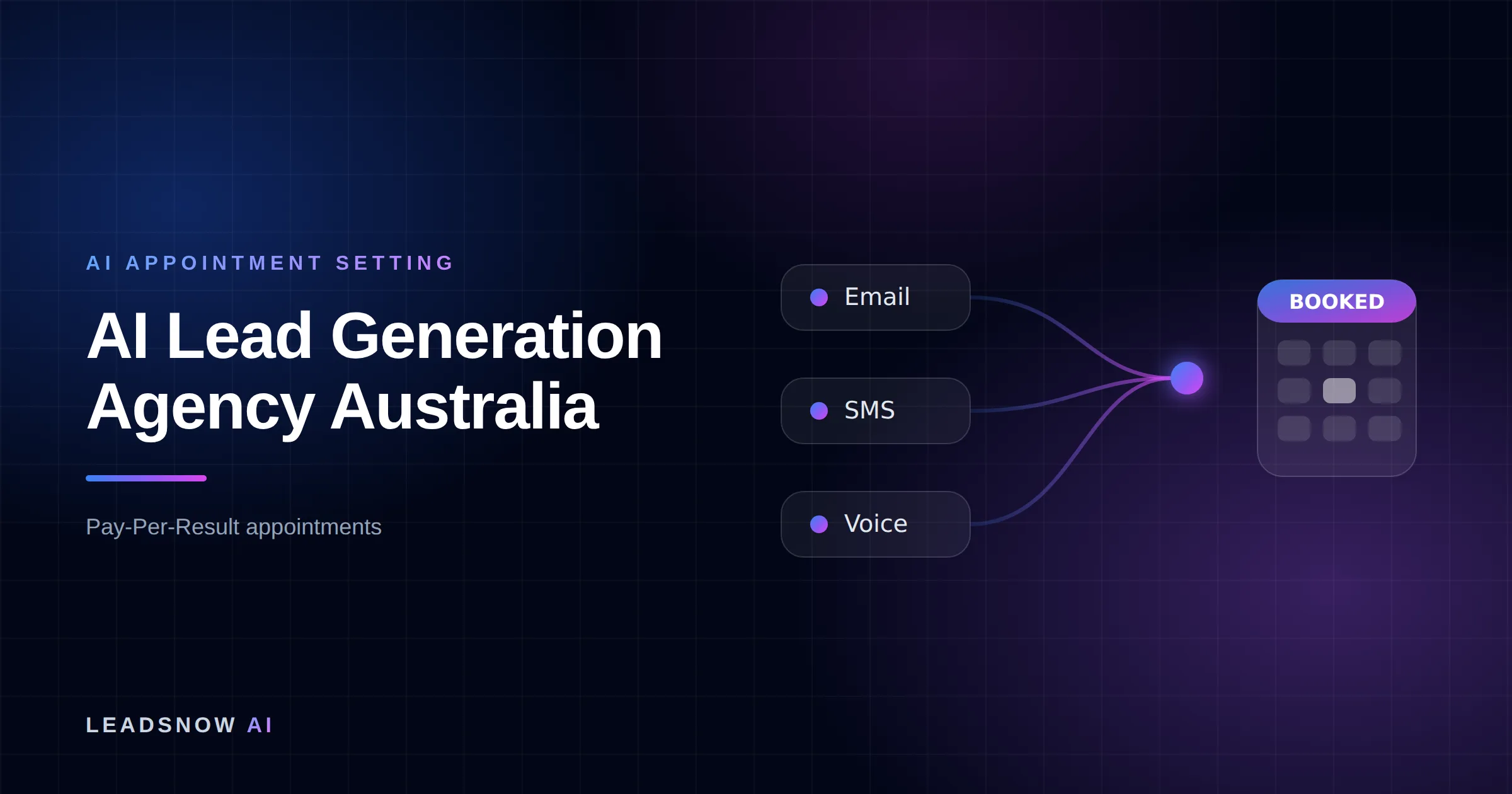
An AI lead generation agency runs outbound contact and qualification on your behalf and hands your salespeople booked appointments. It is not a list vendor and it is not software. In Australia it operates under the Spam Act 2003 and the Do Not Call Register Act 2006, which permit telemarketing calls 9.00am–8.00pm on weekdays and 9.00am–5.00pm on Saturdays, and nothing on Sundays or national public holidays.
The short answer: the category splits into three jobs vendors routinely blur.
- Data — who to contact. A list, decaying at roughly 22.5% a year.
- Outreach — conversations at volume across email, SMS, voice and your dormant CRM.
- Qualification — who is worth a salesperson’s hour, against criteria written down in advance.
A list gives you the first. Software gives you tooling for the second. An AI lead generation service is accountable for all three, and is the only one where “qualified appointment” is a contractual term rather than a marketing word. LeadsNow has booked 50,769+ AI-set sales appointments since 2017 and generated over 1M leads on that model.
Data, outreach, qualification: three jobs, usually one invoice
Almost every vendor does one of the three well, implies all three, and prices as though it delivered them. Naming which one you are buying is the most useful thing you can do before a sales call.
Data is a snapshot with a shelf life. HubSpot’s Database Decay Simulation, drawing on MarketingSherpa research, puts B2B database decay at 2.1% per month — an annualised 22.5%. A list bought in January is materially different by December, and nobody sends you a correction.
Outreach is sequencing, timing, follow-up discipline, deliverability, sender reputation and knowing when to stop. Woodpecker’s analysis of over 20 million cold emails puts its platform-wide average reply rate at 3.43%, and reports campaigns with three to five follow-up steps reaching 8.3% versus 4.1% for single-touch sends. The gap is not the message. It is whether anyone ran the sequence to completion.
Qualification is the expensive job and the one that gets skipped. Somebody has to decide whether a reply is worth 45 minutes of a closer’s day. If that decision runs on an unstated rule, your sales team ends up qualifying in the first ten minutes of every call — the exact cost you were trying to remove.
How it works
How an AI lead generation engagement actually starts
Prepare the data
Clean and segment your CRM records and any new list, and wash phone numbers against the Do Not Call Register within the last 30 days.
Write the criteria
Agree in writing what makes an appointment qualified across budget, authority, timing and fit, including the disqualifiers and who arbitrates a dispute.
Run a calibration cohort
Low-volume email, SMS and voice conversations in weeks three and four. Rejected appointments are the point, not the problem.
Scale to volume
Once the criteria stop moving, typically week five or six, volume increases and you pay only on booked qualified appointments.
MAKE MORE SALES.
Pay-Per-Result pricing — We scale sales HARD aligned to your interests, better than anyone else.
What it is not: a lead list, and it is not software
Buying leads is a data transaction: the list arrives, the responsibility stays with you. The ACMA is explicit in its guidance on avoiding sending spam — when you buy or use a marketing list, “you are still responsible for making sure you have consent for any addresses you use.” A vendor’s assurance that a list is opt-in is not a defence. Under the Spam Act it is on you to prove consent.
Buying software is a tooling transaction. You get a platform and inherit the operating burden: writing the offer, building sequences, sourcing and cleaning data, warming domains, registering sender IDs, monitoring reply quality. Most tools are capable. They are also inert without someone whose job it is to run them daily. Our comparison of AI lead generation agencies in Australia answers the “who else is doing this” question; this page answers “what am I buying”.
A service sits between the two: you buy an outcome and the labour behind it. The honest test is what happens if no appointments are booked this month. The list vendor has been paid. The software vendor has been paid. A pay-per-result partner has not.
Want this done for you? We book qualified sales appointments on a Pay-Per-Result basis — you only pay for calls that actually land in your calendar.
The channel stack: what each one is actually good at
Four channels do the work in Australian outbound. They are not interchangeable, and the common failure is running one for a job another does better.
Email is the volume channel and the cheapest per touch: good for cold contact and for anything needing a link or a proposal. Its weaknesses are the reply rate — low single digits on cold lists, per the Woodpecker figures above — and fragility. Domain reputation takes weeks to build and one bad send to damage. Email is a compounding asset, not a tap.
SMS is the response channel. TextUs’s 2026 SMS Engagement and Benchmark Report, a March 2026 survey of 763 revenue professionals, reports an average 1:1 SMS response rate of 34.7% against 8.5% for outreach email. Treat that as directional: it is self-reported vendor survey data and the gap narrows on genuinely cold audiences. The direction is right — SMS gets answered. Its weakness is that it burns goodwill fast, punishes poor targeting, and in Australia needs sender ID registration handled properly.
Voice agents are the qualification channel. A conversation surfaces budget, timing and intent in ninety seconds in a way no form does, and it is the only channel where an objection can be handled before the person disengages. It is also the most constrained: calling hours are legislated, the Do Not Call Register applies, and connect rates on cold mobiles are low enough that voice on a cold list is usually the wrong tool. On a warm or inbound list it is the right one.
Re-engagement of existing CRM data is the underrated channel and usually the first thing we run. Any business with a few years of trading holds records of people who enquired, got a quote and never bought. They are not cold — they gave you their details. On database reactivation campaigns, Colliers-era database reactivation results ran at 4.4% average conversion with an 8.9% peak on a single campaign, on data the client already owned and had written off.
What “qualified” has to mean before you sign anything
Pay-per-result only works if both sides agree in advance what a result is. If “qualified appointment” is undefined, the vendor is incentivised to book anyone who says yes and you are incentivised to reject anything that does not close. That argument ends the relationship inside two months. The definition needs to be written down before launch, in four categories:
- Budget — a stated spend band, loan size, headcount or revenue floor. Something the prospect said, not something inferred.
- Authority — the person on the call can sign, or can bring whoever signs. For mid-market and enterprise, name the role rather than the person.
- Timing — a decision window. “Looking in the next 90 days” is a criterion. “Interested” is not.
- Fit — the disqualifiers: wrong state, wrong licence, wrong industry, existing supplier under contract, previously refunded. These matter more than the positive criteria, because they are what stops a technically-qualified appointment wasting an hour.
Then agree the mechanics: who arbitrates a disputed appointment, how quickly it must be disputed, and what evidence settles it. We agree all of this before launch and expect to tighten it after the first cohort, because the first cohort always reveals a criterion nobody thought to write down. If a vendor will not put the definition in writing, the pay-per-result label is decorative. Our page on pay-per-lead versus pay-per-appointment works through where the unit of payment sits in each model.
If we can’t make you money, we don’t deserve yours.
Pay-Per-Result pricing — performance-based alignment.
AI lead generation service vs buying leads vs hiring an SDR vs software
All four are legitimate purchases. They fail differently, which is the useful part.
| AI lead generation service | Buying leads | Hiring an SDR | Lead-gen software | |
|---|---|---|---|---|
| What you get | Booked, pre-qualified appointments | Contact records | A person doing all three jobs | Tooling to run outreach yourself |
| Who owns qualification | The vendor, against written criteria | You, after the records arrive | The SDR, against criteria you set and coach | You |
| Time to first conversation | Weeks — setup, compliance, calibration first | Days, if someone works the list | Months — Bridge Group puts average ramp at 3.0 months | Weeks, plus whoever runs it |
| Cost structure | Pay on booked qualified appointments — no seats, no retainer | Per record, upfront | Salary and OTE regardless of output | Per seat or contact, upfront |
| Compliance exposure | Shared in practice, but the legal obligation stays yours — so the contract must name it | Yours — ACMA is explicit that consent stays your obligation | Yours | Yours |
| Fails when | “Qualified” was never defined, or the offer is weak | The list is stale or never consented | They leave — average tenure 1.9 years, 60% at quota | Nobody operates it daily |
To be fair to the SDR option: a good in-house SDR learns your product in a way no external partner does and becomes an account executive in eighteen months. The economics are the problem, not the model. Australian SDR pay averages around $85,000 per talent.com’s analysis of 10,000 Australian salaries (entry-level $62,500, experienced to $112,375), and The Bridge Group’s 2025 SDR Models and Metrics report, covering 351 B2B companies, puts ramp at 3.0 months, average tenure at 1.9 years and 60% of reps at quota. One SDR is a single point of failure. Three is a management job.
Australian compliance: Spam Act, Do Not Call Register, ACMA
General information, not legal advice — the source links below are worth reading yourself. Any vendor who cannot discuss this section fluently is a liability.
Email and SMS fall under the Spam Act 2003. The ACMA’s guidance on avoiding spam sets three obligations. Consent, either express or inferred from a provable existing relationship where the marketing is directly relevant to it. Identification — correct legal name or name plus ABN, with contact details that stay correct for at least 30 days after sending. And an easy unsubscribe: instructions presented clearly, honoured within 5 working days, free, functional for at least 30 days, with no login or extra personal information required. You also cannot send an electronic message asking for consent, because that message is itself marketing.
Voice falls under the Do Not Call Register Act 2006 and the Telecommunications (Telemarketing and Research Calls) Industry Standard 2017. Per the Do Not Call Register’s industry guidance, the prohibition on calling a registered number does not apply if you washed your list against the register within the last 30 days and the number was not on it. Express consent, where no period was set, is taken to expire three months after it was given. Some call types sit outside the definition of a telemarketing call altogether — appointment reminders, rescheduling, payments, and solicited calls about an order or enquiry — which matters if you are re-engaging existing customers rather than prospecting.
The industry standard applies to every telemarketing or research call to an Australian number, including numbers not on the register. Calling line identification must be enabled, the return number must stay reachable for at least 30 days, and a call must be terminated immediately on request.
ACMA is the regulator and it enforces. Penalties under the Act are civil rather than criminal, and are recovered by infringement notice or by court action. Most of the maximums are set in Commonwealth penalty units, which are indexed periodically, so the dollar figures published on the Do Not Call Register’s compliance and breaches guidance are pegged to a superseded unit value and understate current exposure — check the penalty unit in force before you rely on any number. Contraventions of the industry standards are the exception, because section 570 of the Telecommunications Act 1997 fixes those in dollars: up to $250,000 for each contravention by a body corporate, and $50,000 for an individual. The same guidance lists as a breach failing to include an express provision in your agreements requiring compliance when you outsource calling, including to call centres based overseas. If you engage an outbound partner, that clause belongs in the agreement.
Ramp expectations: this is not a switch
The most common reason these engagements fail is that someone expected volume in week two. A vendor promising that is either about to spam your market or about to send you appointments you will reject.
A realistic shape: the first fortnight is unglamorous — data preparation and list washing, offer and script development, domain and sender setup, sender ID registration, and getting the qualification criteria agreed in writing. First conversations land in weeks three and four at deliberately low volume, because that cohort is for calibration, not throughput. You will reject some of them; that is the mechanism working, because each rejection sharpens the definition. Volume follows once the criteria stop moving, typically week five or six.
The Bridge Group’s 3.0-month SDR ramp is the fair benchmark. An AI-run channel is generally faster, because the ramp is about the offer and the data rather than one person’s learning curve. Faster is not instant. Speed matters most once leads are arriving, which is where speed-to-lead response times take over.
What we can actually show you
LeadsNow has booked 50,769+ AI-set sales appointments since 2017 and generated over 1M leads, with 25 filmed client case studies, a 4.7 rating from 60 Google and Facebook reviews, and named clients who will talk about it: Sam Tajvidi at 121 Brokers, Colliers, Marcus Wilkinson at Iron Body, Foundr, SheSells.online and Lambda Academy.
The model is pay-per-result: you pay on booked qualified appointments, not on seats or a retainer — which is why the written definition of “qualified” carries the weight it does. To test the numbers against your own average deal value and close rate, book a call and bring your current cost per appointment. If the arithmetic does not favour us, we will say so. The service that runs the conversations is described on our AI sales agents page.
Frequently asked questions
Is an AI lead generation agency the same as buying leads?
No. Buying leads is a data purchase: you receive contact records and every downstream obligation stays with you. The ACMA states in its guidance on avoiding spam that when you buy or use a marketing list you are still responsible for making sure you have consent for any addresses you use, and that under the Spam Act it is on you to prove consent. An agency engagement covers outreach and qualification too, and should name where compliance responsibility sits.
What counts as a qualified appointment?
Whatever you and the vendor wrote down before launch, across four categories: budget, authority, timing and fit. A workable definition is specific enough to be disputed — a stated spend band rather than “has budget”, a 90-day decision window rather than “interested” — and it lists disqualifiers. We agree these criteria before any campaign goes live and expect to tighten them after the first cohort.
Which channel produces the most appointments in Australia?
It depends on the temperature of the list. On cold prospecting, email carries the volume: Woodpecker’s analysis of over 20 million cold emails reports a 3.43% platform-wide reply rate, rising to 8.3% for campaigns with three to five follow-up steps versus 4.1% with none. On existing CRM data, re-engagement outperforms everything. Voice is the strongest qualifier but the most constrained by calling hours and the Do Not Call Register.
Can AI voice agents legally call Australian numbers?
Calls are subject to the Do Not Call Register Act 2006 and the Telecommunications (Telemarketing and Research Calls) Industry Standard 2017, which applies to every telemarketing or research call to an Australian number whether or not it is on the register. The Do Not Call Register’s industry standards guidance requires calling line identification enabled, a return number reachable for at least 30 days, and calling only within permitted hours: 9.00am–8.00pm weekdays and 9.00am–5.00pm Saturdays for telemarketing, none on Sundays or the seven national public holidays unless the account-holder has expressly consented to be called then. General information, not legal advice.
How long before we see booked appointments?
Setup and compliance work in the first fortnight, calibration conversations at low volume in weeks three and four, then meaningful volume from week five or six once the qualification criteria stop moving. For comparison, The Bridge Group’s 2025 SDR Models and Metrics report, based on 351 B2B companies, puts average in-house SDR ramp at 3.0 months.
Does database reactivation actually work, or is it a way to bill for old data?
It works when the data is genuinely yours and the people in it genuinely enquired. Colliers-era database reactivation results ran at 4.4% average conversion with an 8.9% peak on a single campaign, on records the client already owned. It stops working when the list was bought, or is so old that consent can no longer reasonably be inferred — the Do Not Call Register’s guidance notes that express consent, where no period was specified, expires three months after it was given.
Pay-Per-Result appointments
See if we’re a fit
We book qualified sales appointments for you and you pay on results, not retainers. Our booking page asks a few quick questions so you find out in two minutes whether that model suits your business.
- 50,769+ appointments booked without cold calling.
- Pay-Per-Result pricing — you pay for booked, qualified calls.
- Pick your own time on our live calendar, no phone tag.