
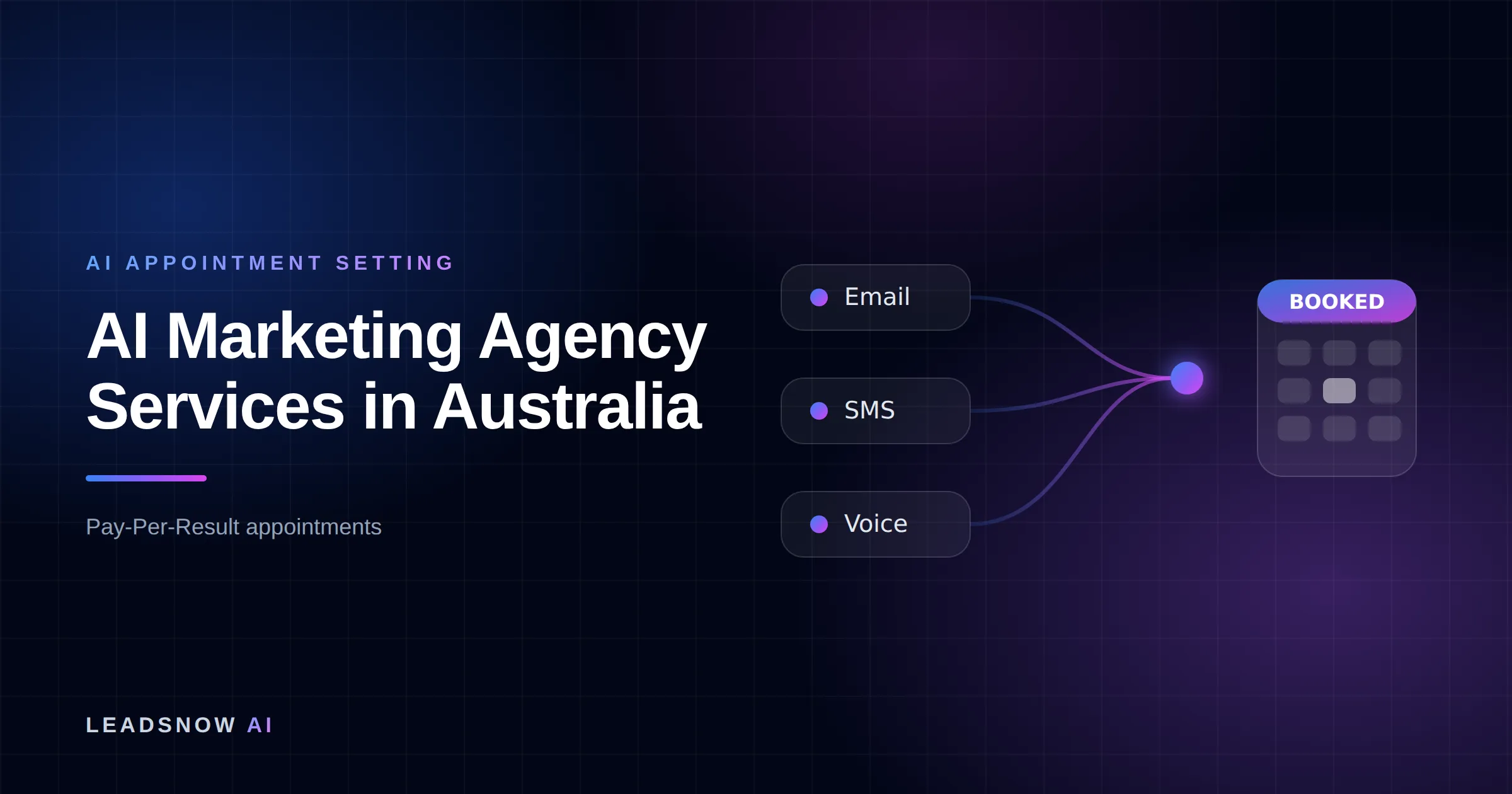
An AI marketing agency service is done-for-you demand generation: software runs the repetitive layer — content drafts, ad creative variants, email and SMS follow-up, first-touch qualification — while people own the offer, the approvals and the sales call. The ABS put Australian business AI adoption at 12% in 2024–25, and 35% among large businesses.
At a glance
- What you buy: six service lines — AI-assisted content and SEO/AEO, paid media creative and testing at volume, conversational agents for email, SMS and voice, database reactivation, lead qualification and appointment setting, and reporting.
- What stays human: the offer, pricing, brand and legal claims, the objection library, weekly transcript review, and the sales call itself.
- What you supply: a CRM export with consent evidence, written qualification criteria, real calendar availability, ad account and domain access, and one named approver who turns copy around inside 48 hours.
- Australian compliance floor: the Spam Act 2003 requires consent, sender identification and an unsubscribe honoured within 5 working days, enforced by the ACMA.
- What breaks it: dirty CRM data, vague qualification criteria, and a sales team that will not ring back.
- Commercials: pay-per-result — you pay on booked, qualified appointments, not on retainers or seats.
The shortlist or the service: which page you actually want
If you are comparing providers — building a shortlist, working out who does AI creative versus AI media buying versus AI sales agents, checking who is a rebranded retainer shop — read our ranked list of the best AI marketing agencies in Australia. It covers King Kong, Megaphone, Online Marketing Gurus, XPON, Rocket Agency and others, with what each is good at and where they are a poor fit, including us.
If you want it done for you — you have decided to buy AI marketing as a service and want to know what turns up, who does what, and what it costs you operationally — this is the service page.
How it works
How an AI marketing engagement is actually built
Audit data and consent
We export your CRM, dedupe it and check what consent evidence exists segment by segment. Under the Spam Act the burden of proving consent sits with you, not the agency.
Write the qualification bar
Your criteria and disqualifiers go in writing before anything sends. If “qualified” is undefined, the agent books everyone and sales calls the leads rubbish.
Run agents, read transcripts
Email, SMS and voice agents work the list and book into your calendar. A human reads transcripts weekly and cuts the scripts where prospects drop off.
Pay on held meetings
The billable unit is a booked, qualified appointment, not a retainer or a seat. By day 90 there are enough held meetings to measure cost per meeting properly.
MAKE MORE SALES.
Pay-Per-Result pricing — We scale sales HARD aligned to your interests, better than anyone else.
What an AI marketing agency service includes, line by line
“AI marketing” is not one product. It is six delivery lines that share a technology. An agency that cannot state this split for its own delivery is selling a ChatGPT subscription with an account manager on top.
| Service line | What the AI does | What a human still does |
|---|---|---|
| Content, SEO and AEO | Clusters query data, drafts outlines and first drafts, generates FAQ and schema variants, rewrites for answer-engine formats. | Picks the angle, supplies proprietary numbers and client stories, verifies every external claim at source, signs off brand and legal claims. |
| Paid media creative and testing | Produces headline, hook, thumbnail and body-copy variants against a brief at a volume a copywriter cannot match; summarises what won. | Sets the offer and budget, writes the landing-page argument, decides what to kill, handles platform policy rejections. |
| Conversational agents (email, SMS, voice) | Sends first touch and follow-ups, answers common questions, handles reschedules, books into the calendar, processes STOP and unsubscribe requests. | Writes the objection library, reviews transcripts weekly, takes over anything involving pricing, contracts or a complaint. |
| Database reactivation | Segments dormant records, runs a conversational re-open across email and SMS, re-qualifies the ones that reply. | Decides what consent exists per segment, sets the offer, calls the warm replies back personally. |
| Qualification and appointment setting | Asks your qualifying questions in order, scores against your criteria, books, confirms and reminds. | Writes the criteria and the disqualifiers, arbitrates borderline leads, runs the sales call. |
| Reporting | Assembles the numbers daily and flags anomalies against the previous period. | Explains why a number moved and decides what changes next week. |
Voice is the least forgiving line. An agent that talks over people, or pauses a second and a half before answering, gets hung up on. Australian mobile reception, accents and background noise degrade transcription, so the honest design sets a low bar: qualify and book, then route to a human at the first complaint keyword, pricing question, or third failed transcription.
Reactivation pays fastest, because the consent and the relationship already exist. On a Colliers-era reactivation programme we averaged 4.4% of a dormant database converting to booked appointments, peaking at 8.9%. That is a claim about what a well-consented, well-segmented list can do when someone follows up every reply — not a forecast for yours. Our database reactivation service covers the scoping.
Be sceptical about the AEO line. Getting cited by ChatGPT, Perplexity and Google AI Overviews is a real objective, but the measurement is immature: engine answers vary by session, geography and day. Anyone quoting a guaranteed citation rate is quoting you noise. Ask how they measure it and across how many prompts.
Want this done for you? We book qualified sales appointments on a Pay-Per-Result basis — you only pay for calls that actually land in your calendar.
AI advertising agency work: creative volume, not media magic
People searching for an “AI advertising agency” usually imagine an algorithm that finds cheaper clicks. That part is already commoditised: Google’s Performance Max and Meta’s Advantage+ have done machine-learning bidding, placement and audience expansion inside the platforms for years, and no agency has a private version of it.
What an AI-native paid team changes is the creative testing rate. Instead of four concepts a month, you brief a positioning and get dozens of variants a week — hooks, first three seconds, static and video cuts, landing-page headline pairs — and you kill on evidence rather than on the account manager’s taste. Creative is the last lever with real variance in it.
The unflattering part: if your account produces a handful of conversions a week, no bidding algorithm has enough signal to learn from and neither does any testing programme. Below that threshold, fix the offer, the landing page and how fast you respond to the leads you already get before buying more traffic.
What the first 30, 60 and 90 days look like
Days 1–30 — access, audit, plumbing. CRM export, deduplication, consent audit segment by segment. Sending domain configured and warmed. SMS sender ID registration started if you use an alphanumeric header. Qualification criteria written down and agreed. Objection library built from your last 20 sales calls. Calendar, routing and reminders wired. First reactivation send to the best-consented segment, because that is the fastest legitimate path to a meeting.
Days 31–60 — first cohort and script surgery. Meetings land. You read transcripts, not summaries. Scripts get cut where prospects drop off; disqualifiers get tightened where salespeople complain. Paid creative testing starts in parallel, alongside show-rate work: confirmations, reschedule flows, same-day reminders.
Days 61–90 — the numbers stop being noise. Enough held meetings exist to calculate cost per held meeting and meeting-to-close with some confidence, which is when scaling decisions become defensible rather than hopeful.
Anyone promising booked meetings in week one is either reactivating a database you already own, or selling you bought leads. The first is legitimate; the second is a different product with different economics.
If we can’t make you money, we don’t deserve yours.
Pay-Per-Result pricing — performance-based alignment.
What the agency needs from you, and what breaks
The failure modes are almost never the model. They are inputs and follow-through.
- Bad CRM data. Duplicates, dead mobiles, and most commonly no field recording where a contact came from or what they agreed to. Under the Spam Act the burden of proving consent sits with you, so a list with no consent evidence is not a list you can email or text, however large it is.
- No written qualification criteria. If “qualified” is undefined, the agent books everyone, sales calls the leads rubbish, and the argument is unresolvable. Write the disqualifiers first: minimum budget, timeframe, decision authority, and the enquiry types you never want to see.
- A sales team that will not follow up. Booked meetings decay. If nobody rings a no-show back within the hour and nobody works the reschedules, the show rate collapses and the programme gets blamed for it.
- One person’s calendar. Four slots a week is your ceiling, regardless of demand.
- Approval bottlenecks. Copy that waits ten days for sign-off kills the testing rate the whole model depends on.
AI marketing service vs agency retainer vs building in-house
Three ways to get an artificial intelligence marketing agency capability. They fail differently.
| AI marketing service (pay-per-result) | Traditional agency retainer | Build in-house | |
|---|---|---|---|
| What you pay for | Booked, qualified appointments | A monthly fee for deliverables and hours | Salaries, tools and licences |
| Who carries the risk | The agency — no result, no fee | You — the invoice arrives regardless | You, plus the hiring risk |
| Cost when volume drops | Falls with output | Unchanged | Unchanged and hardest to reverse |
| Time to first meetings | Fastest where a consented database exists | Campaign build first | Slowest — hire, onboard, then build |
| Where the AI sits | In the live sales pipeline: outreach, qualification, booking | Usually backroom productivity and reporting | Wherever your team has time to build it |
| Institutional knowledge | Scripts and criteria are yours; model tuning is ours | Sits with the account team and leaves when they do | Stays with you, if the person stays |
| Best for | Considered-purchase offers with a sales team and a database | Brand, PR, creative campaigns, complex multi-channel work | Sustained volume plus an existing data function |
| Fails when | The offer is low-ticket, or nobody follows up | Output is measured in deliverables, not revenue | The one person who built it resigns |
Our model is pay-per-result: you pay on booked, qualified appointments, not on retainers or seats, and the number that matters is closed-deal value against total programme cost, not cost per lead. That alignment cuts both ways — we decline offers where the unit economics cannot work, and we are the wrong call if you need brand, PR or a television campaign. The trade-offs are set out in pay-per-result vs retainer.
What to ask an AI marketing agency before you sign
Six questions. Get the answers in the agreement, not the pitch deck.
- Where does our customer data go? Name the sub-processors and the countries they operate in. Ask what is retained after termination, in what format it is returned, and whether your data trains any model that serves other clients. “It’s secure” is not an answer.
- Is anything sent without a human reading it? Ask what proportion of outbound a person reviews, who that person is, and whether you can see last week’s sent messages and call transcripts on request. A vendor who cannot produce transcripts is not monitoring the agent either.
- Who owns the accounts and assets? Ad accounts, pixels, domains, phone numbers, SMS sender IDs, the CRM instance, the scripts and the prompts. If they were created under the agency’s business manager or its telephony account, you do not own them and cannot take them with you.
- How is a “result” defined? Get the definition of a qualified appointment in writing: what counts as a no-show, what happens on a reschedule, who adjudicates a disputed booking, and whether you are billed for a meeting your own team cancels.
- How is performance measured, against what baseline? Insist on held meetings and closed revenue, not impressions or “leads”. Ask for the pre-engagement baseline, because without one nothing that follows is attributable.
- What happens on exit? Notice period, data export format and timing, whether numbers and sender IDs port to you, whether the agents keep running during notice, and who holds the domain registrations.
Ask which claims you can verify. We publish 25 filmed client case studies and hold a 4.7 rating from 60 Google and Facebook reviews, against 50,769+ AI-booked sales appointments and 1M+ leads generated since 2017. Named operators include Sam Tajvidi at 121 Brokers, Marcus Wilkinson at Iron Body, Foundr, SheSells.online and Lambda Academy.
Spam Act 2003 and ACMA: the Australian compliance floor
General information, not legal advice — take your own advice for your situation. But do not sign an AI marketing agreement without understanding three obligations, because they sit with you, not the agency. The Spam Act 2003 governs commercial electronic messages sent to Australian addresses, and the ACMA’s guidance on avoiding spam sets out what compliance looks like:
- Consent, express or inferred. The ACMA states that under the Spam Act it is up to you to prove you have a person’s consent, and that you cannot send an electronic message asking for consent, because that message is itself marketing. It also states that even if someone else sends your marketing for you, you must still have consent from each recipient — outsourcing to an agency does not outsource the obligation.
- Identify. The message must accurately identify your name or business name with correct contact details — the correct legal name, or your name and ABN — and that information must remain correct for at least 30 days after sending.
- Unsubscribe. Every commercial message needs an unsubscribe option that is clearly presented, costs no more than a standard message, stays functional for at least 30 days, does not require a login or new account, and is honoured within 5 working days.
Enforcement is not theoretical. In March 2026 Lululemon paid a $702,900 penalty for sending more than 370,000 emails with commercial content and no way to unsubscribe: shipping and order-confirmation emails carrying promotional links, which the ACMA treats as commercial regardless of any other purpose. In July 2026 Tabcorp paid more than $2.7 million, including over 217,000 messages sent in a 16-day window to customers who had unsubscribed from that channel. The ACMA noted businesses had paid more than $12 million in spam and telemarketing penalties over the preceding 18 months.
Two consequences for an AI programme. An agent that appends an offer to a booking confirmation has converted a service message into a commercial one, so keep the two structurally separate. And an alphanumeric SMS header generally cannot receive replies, so the unsubscribe path must be something else and the header needs SMS sender ID registration. Where personal information is used for direct marketing, the OAIC’s Australian Privacy Principle 7 guidance applies to the extent the Spam Act and the Do Not Call Register Act do not. To talk it through, book a call.
Frequently asked questions
What does an AI marketing agency do that a normal agency doesn’t?
It puts AI inside the live sales pipeline rather than the back office. A traditional agency may draft copy with AI and still hand you a campaign; an AI marketing service runs the outreach, answers replies, qualifies against your criteria, books meetings and hands your salespeople a calendar. Most AI use is still shallow: the Australian Bureau of Statistics reported around 12 per cent of Australian businesses used AI in 2024–25, rising to 38 per cent in information, media and telecommunications.
Is AI email and SMS marketing legal in Australia?
Yes, when it complies with the Spam Act 2003. The ACMA requires consent before you send, accurate sender identification with contact details that stay correct for at least 30 days, and an unsubscribe honoured within 5 working days. It also states that if someone else sends messages on your behalf, you must still have consent from each recipient. Penalties are real: Lululemon paid $702,900 in March 2026 for sending more than 370,000 emails without an unsubscribe option. General information, not legal advice.
How much of the work is actually done by AI?
Drafting, variant generation, sending, follow-up sequencing, first-touch qualification, booking and reporting assembly are AI. Offer design, pricing, brand and legal claims, the objection library, weekly transcript review, escalations and the sales call are human. If a vendor says the whole thing is autonomous, ask them to show you last week’s call transcripts and tell you who read them.
How long before we see booked appointments?
Reactivating a consented database you already own is the fastest legitimate route and can produce meetings inside the first month. Paid acquisition takes longer, because the account needs enough conversion volume for testing to mean anything, and you generally need 60 to 90 days before cost per held meeting is measurable rather than noisy.
Should I read your agency list or buy this service?
Read the list if you are comparing providers and building a shortlist — it ranks AI marketing agencies operating in Australia, including where we are a poor fit. Use this page if you have already decided to buy the service and want to know what delivery looks like, what we need from you, and how the commercials work.
Who owns the ad accounts and data if we leave?
You should, and you should confirm it before signing. Ad accounts, pixels, domains, phone numbers, SMS sender IDs and CRM records created for your business should be registered in your name, with the agency holding access rather than ownership. Ask for the export format and the notice period in writing, because a vendor exit is exactly when goodwill stops being a substitute for a clause.
Pay-Per-Result appointments
See if we’re a fit
We book qualified sales appointments for you and you pay on results, not retainers. Our booking page asks a few quick questions so you find out in two minutes whether that model suits your business.
- 50,769+ appointments booked without cold calling.
- Pay-Per-Result pricing — you pay for booked, qualified calls.
- Pick your own time on our live calendar, no phone tag.