
If you are weighing up an AI-first lead generation partner against a traditional marketing agency, you have probably heard both pitches. The agency says AI is a shortcut that burns your brand. The AI crowd says agencies are slow and expensive. Neither pitch is honest. Both models solve real problems – just different ones – and picking the wrong one for your situation wastes months and a lot of money. Here is the comparison we wish more buyers saw before signing anything, including with us.
The short answer: Traditional agencies win on brand-building, creative and complex multi-channel strategy, usually on a monthly retainer paid regardless of results. AI-first, pay-per-result lead generation wins on speed-to-lead, 24/7 follow-up, volume and cost-per-outcome. Choose an agency to build demand; choose AI-first to capture and convert it. Many businesses eventually run both.
What each model actually is
A traditional marketing agency sells expertise and execution: strategy, creative, media buying, SEO, content, sometimes PR. You pay a monthly retainer or project fee for the work itself. Industry pricing guides such as ClicksGeek’s 2026 retainer guide put typical small-to-mid-market retainers in the roughly US$2,500–$10,000-per-month band – billed whether the campaign produced three enquiries or three hundred. The risk sits with you.
An AI-first, pay-per-result lead generation partner sells outcomes: qualified leads or booked sales appointments, generated and followed up by AI systems that respond within seconds and never stop chasing. You pay per lead or per appointment that meets an agreed definition. The delivery risk sits mostly with the provider. (If you are comparing the pricing structures themselves, we have broken that down separately in pay-per-lead vs pay-per-appointment – this article is about the two kinds of partner, not the two kinds of invoice.)
How it works
How an AI sales agent books your appointments
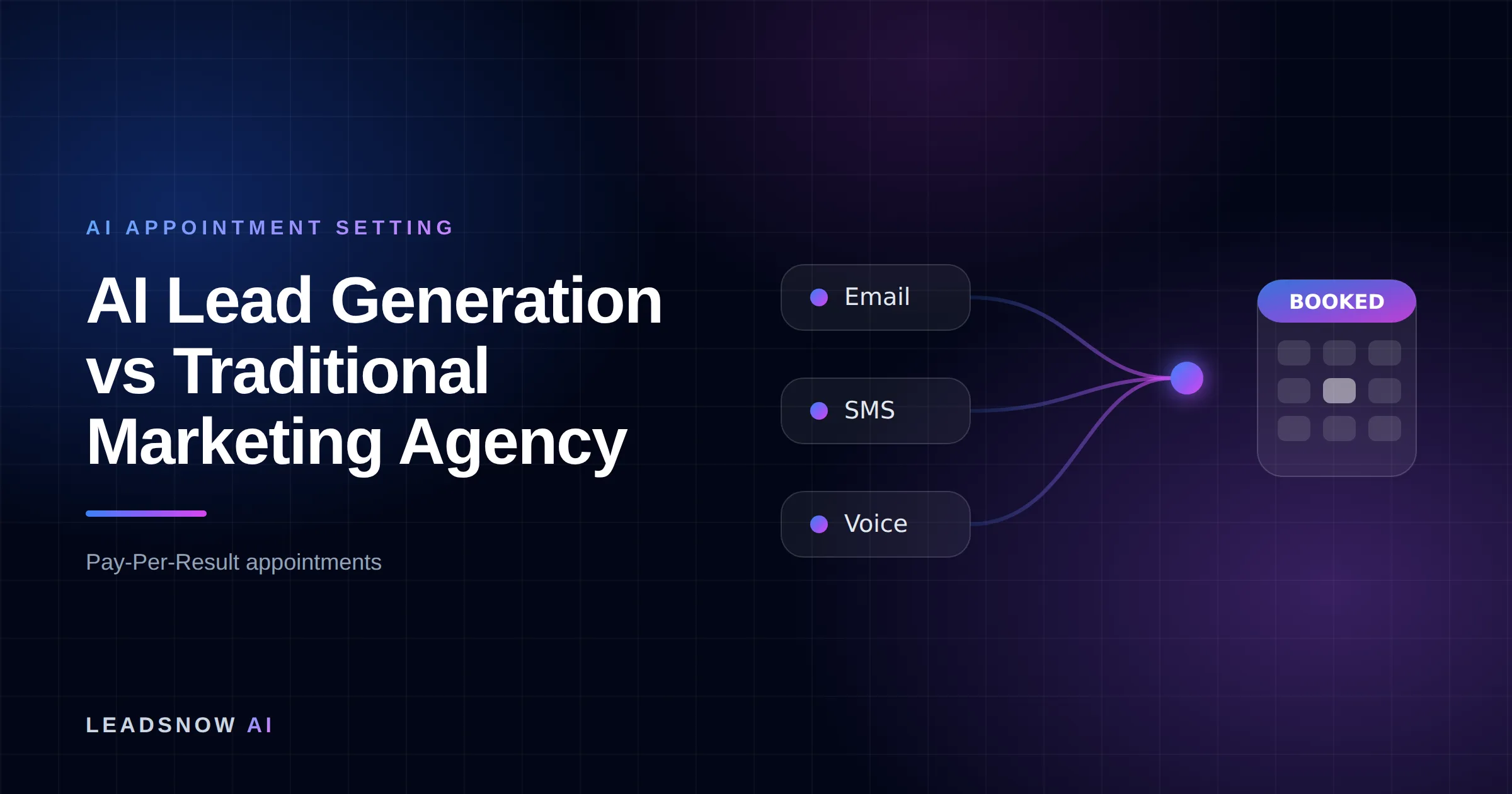
Six channels feed in
Outbound email, SMS, voice and social – plus inbound search and AI referrals from our own AI SEO and chat agents.
Your list or CRM
Outbound starts from data you already own – past enquiries, dormant customers, or a targeted prospect list.
Qualified against your rules
Budget, timing and fit are checked before anything reaches your team, using criteria you set.
Booked into your calendar
Only qualified prospects reach the booking step, so your closers spend their time selling.
MAKE MORE SALES.
Pay-Per-Result pricing – We scale sales HARD aligned to your interests, better than anyone else.
The comparison, dimension by dimension
| Dimension | Traditional marketing agency | AI-first, pay-per-result |
|---|---|---|
| Pricing model | Monthly retainer or project fee, paid regardless of outcomes | Pay per qualified lead or booked appointment delivered |
| Who carries the risk | The client – you pay for effort and hours | Mostly the provider – no results, minimal bill |
| Speed to first result | Typically 2–6 months (strategy, creative, campaign ramp) | Typically days to a few weeks – systems are pre-built |
| Speed-to-lead (response time) | Limited by human hours; most firms respond slowly | Seconds, 24/7, including nights and weekends |
| Follow-up persistence | Depends on the client’s sales team picking up the baton | Automated multi-touch follow-up that never gets bored |
| Scalability | Scales with headcount – more volume means more fees and more people | Scales with compute – 50 or 5,000 conversations run the same playbook |
| Transparency & attribution | Reports on activity and proxy metrics (reach, traffic, engagement); attribution often fuzzy | Attribution is the billing unit – every lead and appointment is counted, or you don’t pay |
| Brand building | Wins clearly – creative, positioning, long-term equity | Weak – not what the model is built for |
| Creative & big-idea campaigns | Wins clearly | Functional at best |
| Complex multi-channel strategy | Wins – senior strategists earn their keep here | Narrow – optimised for one job: leads and appointments |
| Cost-per-outcome clarity | Hard to isolate; retainer covers many activities | Explicit by design – you know your cost per appointment to the dollar |
Want this done for you? We book qualified sales appointments on a Pay-Per-Result basis – you only pay for calls that actually land in your calendar.
Where the traditional agency still wins
Let’s be fair, because this is where a lot of AI-first marketing content gets dishonest.
- Brand and positioning. No AI pipeline will reposition your company, name your product or build the kind of brand equity that lets you charge a premium in five years. That is strategy-and-creative work, and good agencies are genuinely good at it.
- Creative that moves markets. Category-defining campaigns come from experienced creative teams, not from outreach automation.
- Complex, multi-stakeholder strategy. If you are launching in three markets with four product lines and a PR problem, you want senior humans who have done it before, on retainer, thinking about your business every week.
- Breadth. One agency relationship can cover SEO, paid media, content, email and design. An AI lead generation partner does one thing.
If your bottleneck is demand – not enough people know or want what you sell – an agency is probably the right call, and an AI appointment engine will just follow up faster with people who were never going to buy.
Where AI-first, pay-per-result wins
And here is where the traditional model genuinely struggles, no matter how talented the team.
- Speed-to-lead. The MIT/InsideSales.com Lead Response Management study (archived) by Dr. James Oldroyd found that contacting a lead within 5 minutes rather than 30 makes you about 21 times more likely to qualify them. A separate Harvard Business Review audit of 2,241 companies found the average firm took 42 hours to respond to a web lead. Humans on business hours cannot fix that. AI responds in seconds, at 2am, on a Sunday.
- Follow-up persistence. Sales follow-up research compiled by IRC Sales Solutions found that 44% of salespeople give up after a single follow-up. An AI system runs the sixth and seventh touch with exactly the same energy as the first. Most “agency leads didn’t work” stories are actually follow-up failures.
- Volume without headcount. Doubling conversations at an agency means more hours and a bigger retainer. Doubling conversations in an AI system is a configuration change.
- Cost-per-outcome. When you pay per appointment, the ROI maths is brutally simple: appointments × show rate × close rate × deal value versus what you paid. A cost-per-appointment can look higher than a cost-per-click ever did – but that number reflects tighter qualification, and the figure that actually matters is cost per closed deal. We have covered that maths in more depth in how to improve your marketing ROI.
- Accountability. When the invoice is denominated in results, there is nowhere for underperformance to hide inside an activity report.
If we can’t make you money, we don’t deserve yours.
Pay-Per-Result pricing – performance-based alignment.
The honest caveats on the AI side
Three things AI-first providers should admit more often. First, AI-generated conversations are only as good as the qualification logic behind them – a badly configured system books enthusiastic tyre-kickers at scale. Second, an AI can book the meeting but it cannot close a complex, high-trust deal; your humans still do that, which is why we wrote an entire honest comparison of AI sales agents vs human SDRs. Third, if nobody wants your offer, AI will simply prove that faster. Pay-per-result models filter for providers confident enough to carry that risk – but they do not conjure demand from nothing.
Verdict: who should choose which
Choose a traditional agency if:
- Your primary problem is awareness, positioning or brand – not conversion of existing demand
- You need broad, multi-channel execution (SEO, content, paid, PR) under one roof
- You are launching something new and need senior strategic thinking, not just pipeline
- You have the budget to fund 3–6 months of ramp before judging results
Choose an AI-first, pay-per-result partner if:
- You already have demand – enquiries, an ad budget that produces leads, or a database going cold – and the leak is in response speed and follow-up
- You sell a higher-ticket product where each closed deal justifies a real cost per appointment
- You want to pay for outcomes, not activity, and judge the relationship on cost per closed deal
- You need pipeline in weeks, not quarters
Run both if:
You are past the survival stage. The strongest setups we see use an agency (or in-house team) to build demand and an AI engine to make sure not one lead of it dies waiting for a call back. They are complements more often than competitors.
Where LeadsNow sits in this
We are the AI-first side of this table, so weigh our bias accordingly – but also weigh the receipts. Since 2017 our AI systems have generated over 1 million leads and booked 50,769+ sales appointments for clients including Colliers, Foundr, Lambda Academy, SheSells.online, Sam Tajvidi’s 121 Brokers and Marcus Wilkinson’s Iron Body. We have 25 filmed client case studies and a 4.7-star rating across 60 Google and Facebook reviews. We charge per result, not per month, because we think the provider should carry the delivery risk.
If you have already landed on the AI-first side, our AI lead generation service for Australian businesses sets out exactly what we run and what it costs. If you are still trying to work out which side of this comparison your business actually needs, book a call. If the honest answer is “hire an agency first,” we will tell you that on the call.
Frequently asked questions
Is AI lead generation better than hiring a marketing agency?
Neither is universally better. Agencies are better at building demand: brand, creative and multi-channel strategy. AI-first lead generation is better at converting demand: responding in seconds, following up persistently and booking appointments at a known cost per outcome. Match the model to your bottleneck, not to the loudest pitch.
Why do traditional agencies charge retainers instead of per result?
Because much of their work – brand, creative, strategy – produces value that cannot be counted as discrete units, and outcomes depend heavily on the client’s product and sales team. Retainers are a reasonable model for that work. They become a problem only when you are buying leads and appointments, which can be counted, but paying for hours instead.
Is AI lead generation more expensive per appointment?
Often the per-unit price looks higher than cheap leads or clicks, because you are paying for a qualified, booked outcome rather than a raw contact. The comparison that matters is cost per closed deal: fewer, better-qualified appointments that close usually beat a large volume of cheap leads that don’t.
How fast does each model produce results?
A traditional agency engagement typically takes two to six months to show results, because strategy, creative and campaign ramp come first. An AI-first pay-per-result system typically produces its first booked appointments within days to a few weeks, because the infrastructure already exists and is configured to your offer.
Can I use an AI lead generation company and a marketing agency together?
Yes, and it is often the strongest setup: the agency builds demand and brand, while the AI system captures every enquiry within seconds and follows up until a meeting is booked. They solve different problems, so they rarely tread on each other.
What should I check before signing with either?
For an agency: named references, realistic timelines and how they will attribute results. For an AI-first provider: the exact definition of a billable lead or appointment, qualification criteria, what happens with no-shows, and real client proof – filmed case studies and reviews, not just logos.
Pay-Per-Result appointments
See if we’re a fit
We book qualified sales appointments for you and you pay on results, not retainers. Our booking page asks a few quick questions so you find out in two minutes whether that model suits your business.
- 50,769+ appointments booked without cold calling.
- Pay-Per-Result pricing – you pay for booked, qualified calls.
- Pick your own time on our live calendar, no phone tag.