
If your business sends texts that arrive under your brand name rather than a phone number, that header is now a regulated object in Australia. Since 1 July 2026, branded SMS sender IDs must be registered with the ACMA’s SMS Sender ID Register, and Australian telcos must over-stamp anything unregistered with the word “Unverified”.
The failure mode here is silent: your messages still send, they just arrive looking like a scam. Below: what the register says, the two scope limits that get overstated, what it changes operationally, and how it differs from US A2P 10DLC.
The short answer: Australian businesses that send SMS or MMS under a branded alphanumeric sender ID must have that sender ID registered with the ACMA, through a participating telco or message provider. From 1 July 2026, telcos over-stamp unregistered sender IDs with “Unverified” and group them in one thread alongside scam messages. The rules do not apply to messages sent from an ordinary phone number, and do not apply to messaging apps.
What the SMS Sender ID Register is, and why it exists
A sender ID is the short branded header at the top of a text message — why a message shows as from “AusPost” or “myGov” instead of a mobile number. Handsets group every message with the same header into one thread, which makes a sender ID a trust token: anything sent under it inherits the credibility of everything sent before. That is why scammers wanted it. The ACMA describes the register as part of the government’s Fighting Scams initiative to address scams and online fraud and protect Australians from financial harm.
The mechanism is the Telecommunications (SMS Sender ID Register) Industry Standard 2025, on the Federal Register of Legislation since October 2025. Note who it binds: the obligations fall on telcos — carriage service providers, carriers and electronic messaging service providers — not directly on the business whose brand appears in the header. Telcos must apply to participate, offer to register sender IDs for customers, verify a legitimate reason for each, and over-stamp unregistered ones. The ACMA states that messages sent by non-participating telcos and message providers will be blocked. Because the standard’s obligations sit with telcos, what reaches you as a sender is not a direct duty under this instrument — it is that your carrier does this to your traffic whether you engage with it or not.
How it works
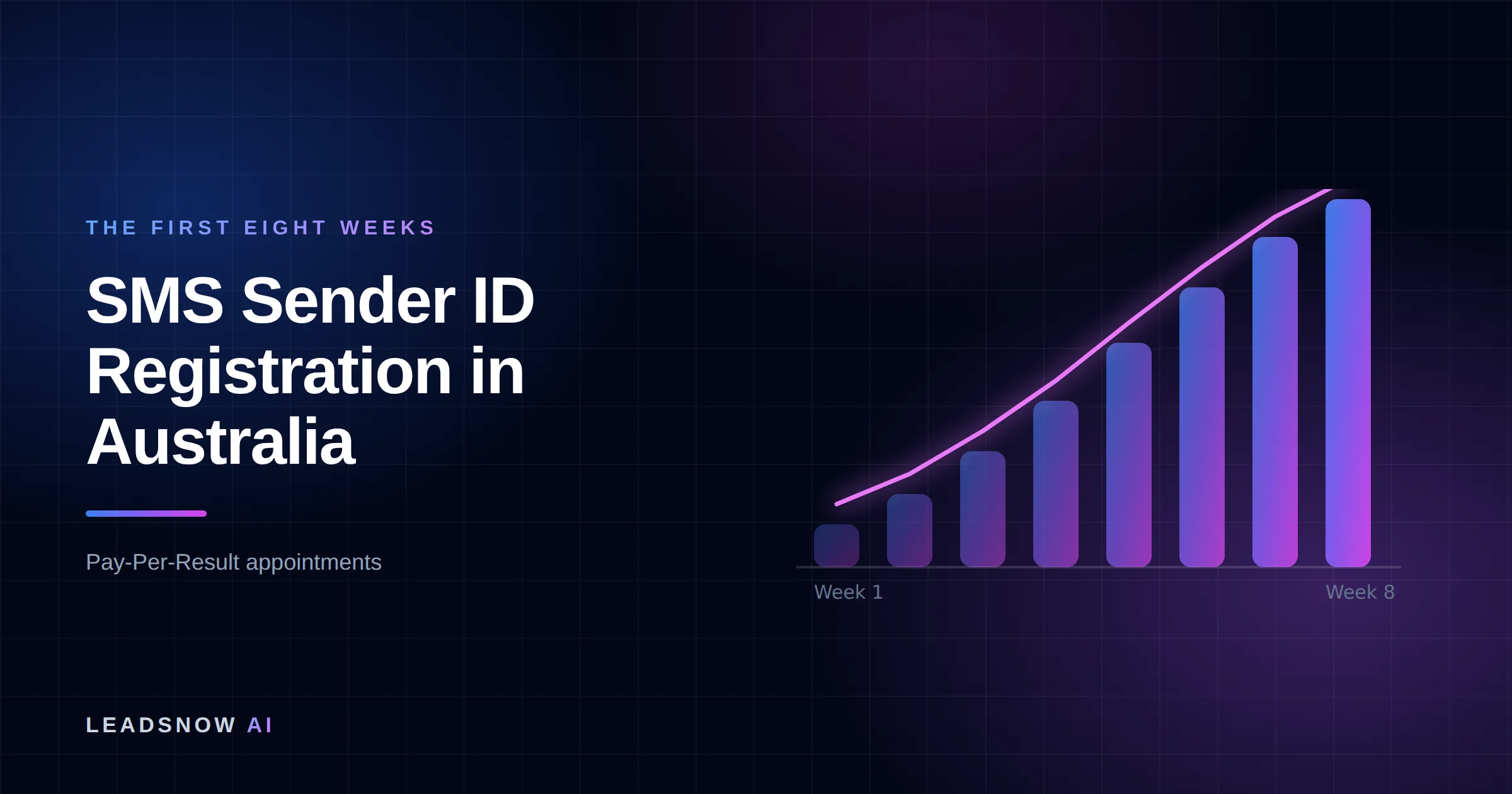
What the first eight weeks actually look like
Week 1 — data and setup
Lists built, sending infrastructure warmed, qualification rules agreed and written down.
Weeks 2–3 — first conversations
Initial outreach goes live. Replies start arriving and messaging is corrected against real responses.
Weeks 4–6 — booked volume ramps
Follow-up sequences mature and the calendar starts filling predictably.
Weeks 7–8 — optimisation
Segments that convert get more volume; the ones that do not get cut.
MAKE MORE SALES.
Pay-Per-Result pricing — We scale sales HARD aligned to your interests, better than anyone else.
Who it applies to — and the two limits people overstate
It applies to any organisation, Australian or international, sending SMS or MMS to Australian handsets under a branded sender ID; the ACMA explicitly includes SMEs, not-for-profits and agencies. International senders without an ABN must go through an Australian certified telecommunications provider.
It does not cover messages sent from a phone number. The ACMA’s own FAQ answers this directly: you do not need to register if your organisation only sends SMS messages using a phone number and does not use a branded sender ID. Most conversational outbound — the two-way, reply-expected kind that books appointments — runs from long numbers because replies need somewhere to land, and is untouched by the register.
It does not cover messaging apps. The ACMA states that the new rules only apply to text messages (SMS/MMS) and do not apply to messaging apps such as WhatsApp, iMessage and Facebook Messenger. If someone tells you your WhatsApp outbound needs ACMA sender ID registration, they are wrong. Those channels run their own platform-level verification.
Want this done for you? We book qualified sales appointments on a Pay-Per-Result basis — you only pay for calls that actually land in your calendar.
What actually happens to an unregistered sender ID
Assuming your provider is participating in the register, nothing bounces. The message is delivered with your brand name stripped out and replaced by the word “Unverified”. Every unregistered sender in the country then lands in one shared thread next to genuine scam messages, which the ACMA says indicates to the recipient that it may be a scam. So reply rates degrade, message history fragments because prior branded messages sit in a different thread, and your reputation takes the hit rather than your dashboard, which happily reports 100 per cent delivery. Sender ID registration is only one input into that reputation; list hygiene, throughput pacing and provider selection are covered separately in our guide to email and SMS deliverability for outbound at scale.
How a business registers
You do not lodge with the ACMA directly. Contact each telco or message provider you use for branded sending, check it is on the ACMA’s approved list, supply the sender IDs and evidence of a valid use case for each, then confirm the registration yourself using myID at Standard strength or above.
The identity plumbing catches people out. To register against an ABN, the email you use must already be an authorised contact or service-of-notice address on the Australian Business Register, and the ACMA has confirmed it does not check Relationship Authorisation Manager for this register. If nobody has touched your ABR record in five years, fix that first.
A valid use case means the sender ID is clearly linked to you. With an ABN it must match your registered business name, company name, trademark or domain name; a shortened form, an acronym, or the name plus a word describing role, location or purpose is fine. Format rules are tight: 2 to 11 characters, ASCII 32–126, not numbers only, no leading or trailing space or underscore, nothing offensive, deceptive or misleading, and it cannot contain the word “Unverified”. One sender ID can be held by several organisations if each proves its own use case.
The ACMA says most applications are approved within 24 hours but warns that due to a high number of applications some reviews are taking longer than usual. On cost, its published position is that it will consult on fees in the future — so do not budget from a vendor blog, and expect your provider to have its own charges regardless.
If we can’t make you money, we don’t deserve yours.
Pay-Per-Result pricing — performance-based alignment.
If someone else sends under your brand: the entity associate rule
This is the part that matters most to anyone running outsourced outbound, and the part almost nobody knows about. The register uses the term entity associate for a business that sends using a sender ID belonging to another organisation — the ACMA names a marketing agency running campaigns under a client’s sender ID as an example.
An entity associate cannot use another organisation’s sender ID unless three things are true: the associate is approved to participate, the sender ID is registered, and the owner has confirmed consent for the associate to use it. Two applications are needed, both lodged by an approved telco. Critically, if your sender ID is already registered, your agency must still lodge as an entity associate so consent is recorded.
So, when procuring an outbound vendor: are you approved to participate, and have you lodged as an entity associate for our sender ID? A vendor who has never heard the phrase has not run branded AU SMS since the rules bit. The wider due diligence sits in our AI outbound compliance checklist for enterprise.
Australia versus the United States: two regimes, opposite triggers
Operators running both markets assume these are the same rule with different paperwork. They are close to opposites. The Australian register governs the name you display and ignores phone-number sending. US A2P 10DLC governs the number you send from, and is triggered by exactly the sending Australia exempts.
| Australia — SMS Sender ID Register | US — A2P 10DLC | |
|---|---|---|
| What is registered | The branded alphanumeric header on the message | The business (Brand) and each use case (Campaign) tied to 10-digit numbers |
| Who runs it | The ACMA, under a legislative instrument | US carriers, via a registry reached through your messaging provider |
| What triggers it | Using a brand name as the sender | Application-to-person traffic over 10-digit long codes |
| Phone-number sending | Out of scope entirely | Precisely what is in scope |
| Identity check | ABN or overseas equivalent, ABR record, myID, valid use case | Brand vetting and a registry trust score |
| If you do not register | Over-stamped “Unverified”, pooled with scam traffic | Twilio documents that messages to US numbers sent from unregistered 10DLC numbers are blocked (error 30034), plus extra carrier fees on unregistered traffic |
| Effect on send rate | None; registration does not set throughput | Throughput tiers vary by brand type and trust score |
| Consent law on top | Spam Act 2003 | TCPA |
A single “SMS compliance” workstream is therefore the wrong shape: Australia is a brand-and-identity exercise, the US a numbers-and-use-case one. Our companion page on A2P 10DLC registration for outbound SMS in the USA handles the American side.
What this changes in an outbound program
Lead time. Sender ID approval is now a dependency on your launch date, between contract and first send. Most applications clear in 24 hours, some take longer, and your provider adds its own queue. Plan in weeks, not days.
Brand-name consistency stops being a design preference. Because a valid use case ties the sender ID to a registered name, trademark or domain, the header is constrained by your registrations. A marketing team that wanted a punchy campaign header will find the register is not interested.
Multiple trading names cost effort, not dollars. Franchise groups, multi-site operators and holding companies with a dozen consumer-facing brands need a sender ID per brand they want on handsets, each with its own use case and each authorised to whoever sends on its behalf. We have run around 100 gym accounts simultaneously; per-brand admin does not scale on goodwill. Audit once, centrally, rather than finding gaps one franchisee at a time.
Channel mix may shift. Branded headers generally cannot receive replies, so conversational programs already run from long numbers, which the register does not touch. Broadcast goes branded; conversation goes numbered. Our AI SMS outbound automation guide covers the mechanics, and AI voice agents for sales in Australia the channel most operators pair it with.
How it sits alongside the Spam Act
The register changes nothing about the Spam Act 2003. Registering a sender ID does not grant permission to message anyone; it establishes that the brand on the header is really you. Consent, identification and unsubscribe obligations apply as before, and the ACMA notes that where someone else sends on your behalf, the message must still identify you as the business that authorised it.
They intersect in one place, flagged by the ACMA in its guidance on avoiding spam: alphanumeric headers are generally not capable of receiving return messages. So “Reply STOP” does not work on a branded sender ID. You need a working alternative unsubscribe path in the message — honoured within 5 working days, costing no more than a standard message, functional for at least 30 days, and never requiring the recipient to log in or hand over more personal information. Sector overlays sit on our page for AI outbound in regulated industries in Australia.
This page is general information about how the rules are described by the regulator, not legal advice. Confirm your own obligations with the ACMA and your telco or message provider before relying on any of it.
Frequently asked questions
Do I need to register a sender ID if I send SMS from a normal phone number?
No. The ACMA states in its register FAQ that you do not need to register if your organisation only sends SMS messages using a phone number and does not use a branded sender ID, and that if your messages display a phone number instead of a sender name, no action is required. It is the most misunderstood point about the regime, and it exempts most two-way conversational outbound.
Does the SMS Sender ID Register apply to WhatsApp or iMessage?
No. The ACMA is explicit that the rules only apply to text messages (SMS and MMS) and do not apply to messaging apps such as WhatsApp, iMessage and Facebook Messenger. Those platforms run their own sender verification schemes, which are commercial arrangements with the platform rather than an Australian regulatory requirement.
What happens to my messages if my sender ID is not registered?
They are still delivered, but your brand name is replaced with the word Unverified and the messages are grouped into a single thread on the handset alongside scam messages. Australian telcos have had to apply that over-stamping since 1 July 2026. Nothing in your delivery reporting looks wrong, which is why the problem goes unnoticed until reply rates fall.
How long does registration take and what does it cost?
The ACMA says most applications are approved within 24 hours, but also warns that due to a high number of applications some reviews are taking longer than usual. On price, the regulator’s published position is that it will consult on fees in the future, so treat any specific dollar figure quoted for the register itself with suspicion. Your provider may charge its own handling fee.
Our agency sends SMS under our brand. Who registers it?
Both of you have work to do. The brand owner registers the sender ID and records consent for the agency to use it. The agency must separately be approved to participate as what the ACMA calls an entity associate, and must lodge that application even if the sender ID is already registered. Ask any vendor whether they are an approved participant and have lodged as an entity associate for your sender ID.
Does registering a sender ID mean I can message anyone?
No. Registration establishes identity, not permission. The Spam Act 2003 consent, identification and unsubscribe rules apply exactly as before, and the burden of proving consent still sits with you. A registered sender ID on a non-consented list is a well-branded compliance problem.
If you want a second pair of eyes on the channel split, registration dependencies and vendor questions for an Australian outbound program, book a call. We have booked 50,769+ AI sales appointments since 2017 and generated over 1M leads, and we do this set-up work on client accounts rather than handing over a PDF.
Pay-Per-Result appointments
See if we’re a fit
We book qualified sales appointments for you and you pay on results, not retainers. Our booking page asks a few quick questions so you find out in two minutes whether that model suits your business.
- 50,769+ appointments booked without cold calling.
- Pay-Per-Result pricing — you pay for booked, qualified calls.
- Pick your own time on our live calendar, no phone tag.