
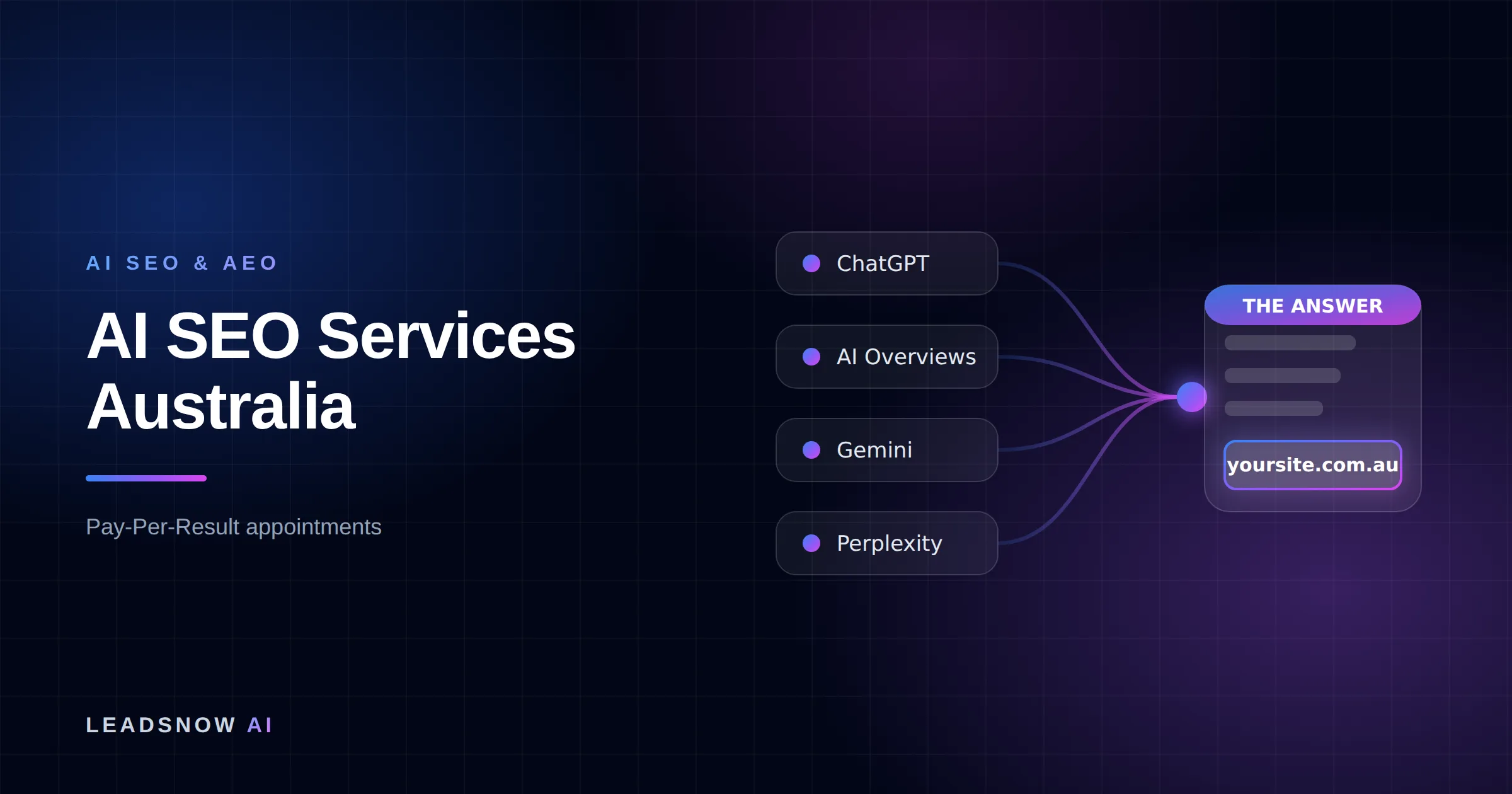
An AI SEO service in Australia is a done-for-you retainer covering technical SEO, entity and topical coverage, schema, internal linking and content refresh — plus AEO, being cited inside AI answers. It matters because only 38% of pages Google cited in AI Overviews in March 2026 also ranked in Google’s own top 10.
The short answer: An AI SEO service is an outsourced team that runs your organic search and your AI-answer visibility as one program — technical audits, entity and topical coverage, schema, internal linking at scale, a publishing and refresh cadence, and citation tracking across ChatGPT, Google AI Overviews, Google AI Mode, Perplexity and Gemini. The AI does the scale work. Humans do the proof, the primary research and the judgement about what is actually true.
- What it covers: technical SEO, entity and topical coverage, schema markup, internal linking at scale, content production, refresh cadence, and AEO citation tracking.
- Where the search behaviour went: 13.6 million Australians — 58% of people aged 14+ — used AI tools in an average four weeks in the March quarter 2026, per Roy Morgan.
- Who runs it here: LeadsNow AI, Melbourne — 50,769+ AI-booked sales appointments since 2017 and 1M+ leads generated.
- Not the same thing as: a list of agencies to choose from. If you are still shortlisting, read our comparison of AI SEO and AEO agencies in Australia instead.
- Next step: Book a call — you pick the slot, no phone tag.
What an AI SEO service actually delivers, week by week
Most AI SEO pitches are a list of nouns. Here is the operating cadence instead, because that is what you are buying: a set of things that happen on a schedule whether or not anyone feels inspired that week.
Weekly. New pages ship against a keyword and entity map, not a content calendar someone brainstormed. Internal links are added both ways — new page into the relevant hubs, hubs back into the new page — because an orphaned page is invisible to a crawler and to a retrieval index. Schema is regenerated for anything that changed, and the visible HTML and the JSON-LD are diffed so the FAQ questions match verbatim. Broken links, redirect chains and indexing errors get cleared while they are still small.
Fortnightly. Citation polls run against the AI engines: a fixed set of buyer-phrased prompts is asked of ChatGPT, Google AI Overviews, Gemini and Perplexity, and the answers are parsed for whether your domain appears. This is the measurement layer that classic SEO reporting simply does not have, and it is the one thing you should insist on before signing anything.
Monthly. A technical crawl, a coverage review against the entity map, and a refresh pass. The refresh pass is the underrated half: pages decay, statistics go stale, and a page carrying a superseded number is worse than no page, because an engine that quotes it will quote the wrong thing. Our own refresh cadence playbook sets out how we decide what gets rewritten and what gets left alone.
Quarterly. Entity consistency across the whole footprint — the same business name, address, founding date, service descriptions and author identity everywhere the brand appears, on and off the site. It is the least glamorous work in the discipline and it decides whether an engine can confidently say who you are at all. The long version is in entity consistency for AI search.
How it works
How an AI SEO and AEO retainer actually runs
Map the entity and the gaps
Who the engines currently think you are, which questions your buyers ask, and which of those you have no page for.
Ship pages, schema and links
Weekly publishing against that map, with schema regenerated and internal links added in both directions every time.
Poll the engines for citations
A fixed prompt set is asked of ChatGPT, AI Overviews, Gemini and Perplexity on a schedule, and the answers are checked for your domain.
Refresh, cut, repeat
Pages that decayed get rewritten, clusters that never got cited get dropped, and budget moves to the shapes that worked.
MAKE MORE SALES.
Pay-Per-Result pricing — We scale sales HARD aligned to your interests, better than anyone else.
AI SEO is not “AI writes the articles”
This is the part the category refuses to say out loud, so we will. If an AI SEO service is generating your articles end to end and shipping them, you are buying a machine that produces the average of what is already indexed. Engines are being asked to summarise the internet; the last thing they will cite is a page that says what every other page already said.
What AI genuinely does well in this discipline is narrow and real:
- Scale. Producing and maintaining hundreds of pages against a coverage map, at a rate a two-person content team cannot match, with schema and internal links generated correctly every time.
- Entity and topical coverage. Enumerating the sub-questions, adjacent entities and long-tail phrasings a topic needs, then finding which of them you have never addressed.
- Refresh detection. Scanning a footprint for stale figures, superseded regulations, dead links and internal contradictions between pages — the kind of audit no human does voluntarily on page 180.
- Technical audits. Crawl analysis, log parsing, redirect chains, schema validation, index-coverage triage.
And here is what it does not do, at all:
- Original proof. Your case studies, your client numbers, your before-and-after. A model cannot invent these, and if it appears to, you have a liability, not an asset.
- Primary research. Running your own study, publishing your own dataset, surveying your own customers. This is the single highest-leverage AEO asset there is, and it is entirely human work.
- Judgement about claims. Deciding whether a statistic is real, whether the source actually says what a summary claims it says, and whether a sentence is defensible. Every number on this page was opened at its source before it was written down. That step is not automatable and it is where most AI-produced SEO content quietly falls over.
- Taste and positioning. Knowing which argument to make, which competitor to concede a point to, and what your buyer actually objects to on a sales call.
A good AI SEO service uses the machine for the first list and staffs humans against the second. A bad one uses the machine for both and calls the output a content strategy.
Want this done for you? We book qualified sales appointments on a Pay-Per-Result basis — you only pay for calls that actually land in your calendar.
AEO: the half of the service that decides your next three years
Answer Engine Optimisation is the work of getting quoted inside an AI answer rather than listed underneath one. It is now a separate discipline from ranking, and there is hard evidence for that separation. Ahrefs analysed 4 million AI Overview URLs across 863,000 keyword SERPs and published the result on 2 March 2026: 38% of URLs cited in AI Overviews also appeared in the first 10 organic results for that query. In the July 2025 version of the same study, the figure was roughly 76%. Citations and rankings have come apart, and we unpacked what that means for a marketing team in our write-up of the decoupling.
The practical consequence is that “get us to page one” is no longer a complete brief. You can rank in the top 10 and be absent from the answer above it, or be cited in the answer from position 60. A service reporting on only one of those is reporting on half your visibility.
It also means engine coverage is not interchangeable. Semrush’s 2026 AI Visibility Index, built on 126 million US AI search prompts across ChatGPT, Gemini, Google AI Mode and AI Overviews between January and April 2026, found ChatGPT averages 15 sources per response while Gemini averages 3. A page that comfortably makes ChatGPT’s wide citation set has a far harder job making Gemini’s narrow one, so any single “AI visibility score” that is not split by engine is flattening away the thing that matters.
The honest concession most AI SEO sellers will not put in writing
There is no secret markup. Google’s own documentation on AI features in Search states plainly: “There are no additional requirements to appear in AI Overviews or AI Mode, nor other special optimizations necessary,” and “You don’t need to create new machine readable files, AI text files, or markup to appear in these features. There’s also no special schema.org structured data that you need to add.” On the llms.txt convention specifically, Google’s John Mueller told Search Engine Journal in June 2026 that llms.txt is “purely speculative for now (the file has existed for years, yet none of the AI systems use it)”.
So when a vendor sells you AEO as a proprietary schema, an llms.txt file and a set of AI-specific tags, they are selling you something the largest engine has publicly said is not a requirement. We still ship schema on every page, because it makes machine extraction cleaner and it powers rich results in classic search. We do not pretend it is a citation cheat code. What we have actually seen move citation rates is unglamorous: pages that answer a real question in the first paragraph, carry a number a model can quote, name specific entities, and are internally linked so a crawler can reach them.
AI SEO service vs AI SEO consultant vs AI SEO specialist
These three phrases get used interchangeably in job ads and sales pages, and they describe three genuinely different purchases. Choosing the wrong one is the most common way this budget gets wasted.
| What you are buying | What it is | Who it suits | Where it fails |
|---|---|---|---|
| AI SEO service | A team that does the work. Strategy, production, technical, schema, publishing and citation measurement, delivered on a cadence. You approve; they ship. | Operators who already have revenue and want output without building a department. The most common fit for a mid-market or scale-up business. | If you have no internal owner at all, nobody supplies the proof, the case studies and the product truth only you have. |
| AI SEO consultant | An advisor. Audits, roadmaps, prioritisation, a review of what your team or your current agency is doing. Usually project-based or a small monthly advisory retainer. | Businesses that already have a marketing team with capacity and need direction, or anyone diagnosing why an existing program is not working. | Advice does not publish itself. If nobody has time to execute the roadmap, you have bought a document. |
| AI SEO specialist (hire) | A salaried in-house person. Deep on your product, available every day, but one person’s throughput and one person’s skill set. | Businesses where organic search is the primary channel and the volume justifies a permanent seat. | One person cannot be strong at technical SEO, entity strategy, writing, schema and multi-engine measurement at once. Also a single point of failure. |
In practice the strongest setups we see in Australia pair one internal owner — often a marketing manager, not a specialist — with an outside service that supplies throughput and measurement. The internal person owns truth and approvals. The service owns volume and cadence.
If we can’t make you money, we don’t deserve yours.
Pay-Per-Result pricing — performance-based alignment.
Traditional SEO agency vs AI SEO service vs in-house
Three delivery models, three different failure modes. None of them is universally correct.
| Traditional SEO agency | AI SEO service | In-house team | |
|---|---|---|---|
| Primary goal | Keyword rankings and organic sessions | Rankings plus citation share inside AI answers | Whatever the internal owner is measured on |
| Typical monthly output | A handful of articles, a technical ticket list | Continuous publishing against a coverage map, schema and links regenerated each time | Bounded by one or two people’s available hours |
| Entity and schema work | Often quoted as an extra | Baseline, on every page, regenerated when content changes | Depends entirely on the hire’s background |
| AI answer measurement | Rare. Usually a rankings dashboard with an AI Overviews column bolted on | Prompt-level polling across multiple engines, reported per engine | Possible, but it is a build, and nobody has time |
| Speed to scale | Linear with headcount | Fast, provided a human is checking every claim | Slowest — hiring cycle plus ramp |
| Cost shape | Fixed monthly retainer | Retainer or performance-linked, depending on the vendor | Salary, on-costs and a tools budget, whether or not it works |
| Where it breaks | Optimises for a metric that is decoupling from revenue | Volume without proof, if the vendor lets the machine write unsupervised | Single point of failure and a narrow skill set |
| Best fit | Local or single-service businesses where classic search still converts | Mid-market and scale-up businesses with real spend that need coverage and measurement | Businesses where organic is the primary channel at serious volume |
Buying AI SEO in Australia specifically
Two things make the Australian market different, and neither is the usual “we understand the local landscape” filler.
The first is adoption. Roy Morgan’s March quarter 2026 data has 13.6 million Australians — 58% of the population aged 14+ — using AI tools in an average four weeks, with ChatGPT at 10.5 million users (45%), Google Gemini at 5 million (21%) and Microsoft Copilot at 4 million (17%). Usage peaks at 74% among 25 to 34 year-olds and 72% among 35 to 49 year-olds, which is the exact age band that makes B2B purchasing decisions. Australian buyers are already researching inside these tools; the question is only whether your business is in the answer.
The second is that AU search volumes are small enough that the classic keyword-volume playbook misleads you. A query with 60 monthly impressions here can still be the most commercially valuable phrase in your account, because the total addressable query set is smaller. A competent service therefore works from buyer language, Search Console query data and the questions that actually arrive on sales calls, not from a volume threshold in a keyword tool — and a handful of decisively-won queries can beat a broad ranking improvement.
If you would rather run the measurement side yourself before you outsource it, our guide to tracking your own AI search visibility sets out the DIY version.
Our own credibility test, and which of our pages answers what
We run an AEO citation monitor on our own site. A fixed set of buyer-phrased prompts is polled against multiple AI engines on a schedule and the answers are parsed for whether leadsnow.ai is cited. We do it on ourselves first, we publish what it teaches us, and we have published findings that contradicted things we had previously written when the data went the other way. That is a fair thing to demand of any vendor: not a claim that they do AEO, but a description of how they would know whether it worked.
To be clear about where to go next, because these are two different questions:
- “I want someone to do this for me.” This page. It describes the service, the cadence and the delivery model. Book a call and we will tell you plainly whether it is a fit.
- “I want to compare providers first.” Our list of AI SEO and AEO agencies in Australia, which grades ten agencies including us against the same criteria and says where someone else is the better pick.
For the record, LeadsNow AI’s core business is pay-per-result lead generation and appointment setting — 50,769+ AI-booked sales appointments since 2017, 1M+ leads generated, 25 filmed client case studies and a 4.7 rating from 60 Google and Facebook reviews. AI SEO and AEO exist inside that, because a citation in an AI answer is an inbound channel that feeds the same pipeline. If you sell SEO yourself and the problem is your own pipeline rather than your clients’, we wrote a separate page on lead generation for SEO agencies in Australia.
Frequently asked questions
What is an AI SEO service?
An AI SEO service is an outsourced team that runs organic search and AI-answer visibility as one program: technical SEO, entity and topical coverage, schema markup, internal linking at scale, content production and refresh, and citation tracking across ChatGPT, Google AI Overviews, Google AI Mode, Gemini and Perplexity. AI is used for the scale work — coverage mapping, drafting, refresh detection, technical audits — while humans supply proof, primary research and the judgement about whether a claim is defensible.
Is AI SEO just using AI to write the articles?
No, and a service that works that way will underperform. A model generates the average of what is already indexed, and engines summarising the web have little reason to cite a page that repeats what every other page says. AI is genuinely strong at scale, entity coverage, refresh detection and technical auditing. It cannot produce original proof, run primary research, or judge whether a statistic is real. The differentiated material on any page — your data, your case studies, your argument — is human work.
Do I need special schema or an llms.txt file to appear in AI Overviews?
No. Google’s documentation on AI features in Search states that “there are no additional requirements to appear in AI Overviews or AI Mode, nor other special optimizations necessary” and that there is “no special schema.org structured data that you need to add.” On llms.txt, Google’s John Mueller told Search Engine Journal in June 2026 that it is “purely speculative for now”. Ship schema because it helps machine extraction and classic rich results, not because a vendor calls it a citation cheat code.
What is the difference between an AI SEO service, a consultant and a specialist?
A service is a team that does the work on a cadence. A consultant advises — audits, roadmaps and prioritisation — and leaves execution to you. A specialist is a salaried in-house hire with deep product knowledge but one person’s throughput and skill range. Most mid-market Australian businesses get the best result from one internal owner who supplies truth and approvals, paired with an outside service that supplies volume, technical work and multi-engine measurement.
Does ranking well in Google mean I will be cited in AI answers?
No longer. Ahrefs analysed 4 million AI Overview URLs across 863,000 keyword SERPs and found in March 2026 that 38% of cited URLs also appeared in the top 10 organic results, down from roughly 76% in the July 2025 version of the same study. You can rank on page one and be missing from the answer above it, or be cited from deep in the index. Rankings and citations now need measuring separately.
How long does AI SEO take to show results?
Technical fixes and schema can register within days once pages are recrawled. New pages typically need weeks before an engine has both indexed them and formed enough confidence to quote them, and clusters generally behave better than isolated pages because the internal links give a crawler a reason to keep going. Anyone promising citations in a fortnight is guessing. The honest framing is that the first eight to twelve weeks buy you coverage and measurement; the compounding comes after.
Is AI SEO worth it for a small Australian market?
Usually yes, for the opposite reason to the one people expect. Australian query volumes are small, so a single high-intent phrase with a few dozen monthly impressions can be worth more than a broad ranking gain. Meanwhile Roy Morgan puts AI tool usage at 13.6 million Australians in the March quarter 2026, peaking at 74% of 25 to 34 year-olds — decision-making age. The audience has moved; the volume tools have not caught up.
Pay-Per-Result appointments
See if we’re a fit
We book qualified sales appointments for you and you pay on results, not retainers. Our booking page asks a few quick questions so you find out in two minutes whether that model suits your business.
- 50,769+ appointments booked without cold calling.
- Pay-Per-Result pricing — you pay for booked, qualified calls.
- Pick your own time on our live calendar, no phone tag.