
AI sales forecasting applies machine learning to CRM and engagement data to generate probability-weighted revenue predictions, replacing gut-feel rep roll-ups with continuously updated, bias-reduced numbers. The primary benefit is accuracy that improves in real time as deals move, not once a quarter when someone finally updates a spreadsheet. RevOps teams, sales managers, and finance departments use it to catch pipeline risk earlier and plan headcount, quota, and go-to-market shifts with more confidence.
TL;DR:
- AI sales forecasting provides real-time, continually updated probability-weighted revenue predictions, unlike traditional static stage-based estimates.
- The most accurate models layer algorithms like ensemble methods and NLP, which improve with higher data quality and consistent input processes.
- Reliable forecasting depends heavily on cleaning and standardizing CRM, activity, and engagement data before training models to avoid leaks and inaccuracies.
- A four-phase rollout process—including data auditing, shadow running, coaching, and ongoing monitoring—reduces trust issues and enhances forecast accuracy over time.
- Using verified booked appointments as inputs offers higher-quality signals that significantly boost forecast precision and help detect pipeline weaknesses early.
Table of Contents
- What Is AI Sales Forecasting and How Does It Differ From Traditional Forecasting?
- How AI Forecasting Works: Core Methods and Model Types
- Benefits and Business Impact of AI Sales Forecasting
- Data and Integrations Required for Reliable AI Forecasting
- A Practical Four-Phase Plan to Roll Out AI Forecasting
- Accuracy, Limitations, and What Breaks a Forecasting Model
- Choosing Tools: CRM-Native Forecasting vs. Specialist Revenue Intelligence Platforms
- How Booked Appointment Data Strengthens Forecast Inputs
- Why Human Judgment Still Decides the Forecast
- A Cleaner Way to Feed Your Forecasting Model
- Sources
How it works
How an AI sales agent books your appointments
Your list or CRM
We start from data you already own — past enquiries, dormant customers, or a targeted prospect list.
The agent makes contact
Email, SMS and voice, with follow-up that persists for weeks instead of stopping after two attempts.
Qualified against your rules
Budget, timing and fit are checked before anything reaches your team, using criteria you set.
Booked into your calendar
Only qualified prospects reach the booking step, so your closers spend their time selling.
MAKE MORE SALES.
Pay-Per-Result pricing — We scale sales HARD aligned to your interests, better than anyone else.
What Is AI Sales Forecasting and How Does It Differ From Traditional Forecasting?
Traditional forecasting asks a rep to eyeball a deal and assign a stage-based probability, usually the same 25/50/75/90 percent buckets everyone in the company uses regardless of how the deal is actually behaving. AI sales forecasting instead trains a model on historical deal outcomes and applies that pattern to live opportunities, producing a probability score grounded in what similar deals actually did, not what a rep hopes they’ll do.
The model ingests signals like deal age, email response time, stakeholder count, and competitive mentions, then outputs a probability-weighted revenue figure for each deal and for the pipeline as a whole. Gartner notes that sales analytics and AI improve forecast accuracy specifically by surfacing behavior and activity signals that human roll-ups miss, and by enabling proactive revenue actions instead of reactive quarter-end scrambling.
The typical output set includes:
- Expected revenue by deal, team, and period, weighted by win probability rather than a flat stage assumption
- Win-probability scores that update automatically as new activity data arrives
- Risk flags on stalled deals, missing stakeholders, or unusual gaps in communication
- Commit versus best-case ranges that reflect model confidence, not rep optimism
That last point matters more than it sounds. A spreadsheet forecast gives you one number and a rep’s confidence level attached to it. A model gives you a range and a reason.
Want this done for you? We book qualified sales appointments on a Pay-Per-Result basis — you only pay for calls that actually land in your calendar.
How AI Forecasting Works: Core Methods and Model Types
Most production forecasting systems don’t rely on a single algorithm. They layer several, each suited to a different piece of the problem.
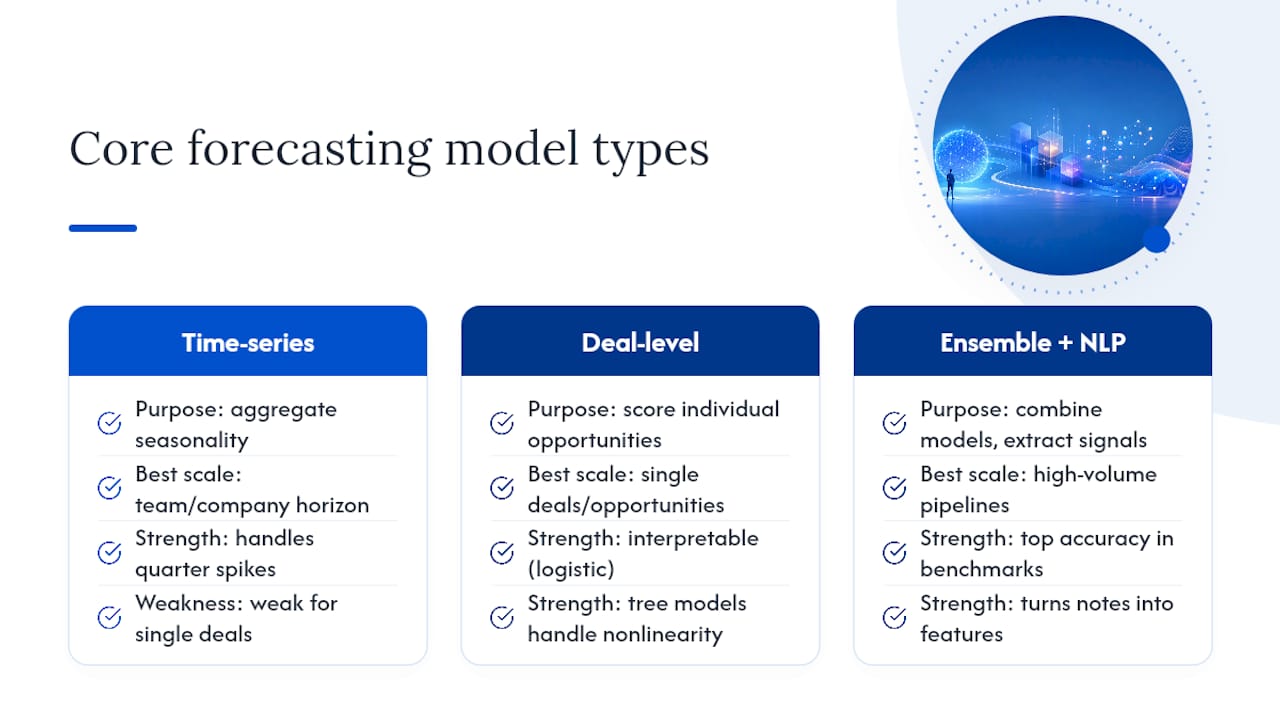
Time-series models (ARIMA, Prophet, and similar approaches) handle aggregate seasonality, things like quarter-end spikes or industry-specific buying cycles. They’re strong for horizon planning at the team or company level but weak at predicting whether one specific deal closes.
Regression and classification models work at the deal level, scoring individual opportunities based on features like deal size, days in stage, and engagement frequency. Logistic regression is the simplest version; tree-based methods handle messier, non-linear pipeline data better.
Ensemble methods like XGBoost, LightGBM, and CatBoost combine many weaker models into one stronger prediction, and they currently dominate the accuracy leaderboards in practitioner benchmarks. The SaleFore AI project on GitHub documents this approach directly, pairing ensemble models with automated feature engineering and TimeSeriesSplit validation to avoid the classic mistake of testing a model on data it already learned from.
NLP and clustering techniques extract qualitative signal from call transcripts and CRM notes, turning phrases like “budget approved” or “waiting on legal” into structured features a numeric model can use.
Practitioner guides report that teams often start near 45–55 percent forecast accuracy and climb toward 80 percent or higher after several quarters of cleaning inputs and adopting model-driven forecasts, according to Tomba’s 2026 forecasting guide. That climb rarely comes from a fancier model. It comes from fixing the data the model eats.
Simpler models beat complex ones when data volume is low (under a few hundred closed deals a year) or when a sales leader needs to explain exactly why a deal is flagged at risk. A logistic regression coefficient is easy to defend in a forecast review. An ensemble’s feature importance score is harder to translate into coaching advice.
Benefits and Business Impact of AI Sales Forecasting
The accuracy uplift isn’t cosmetic. When a forecast moves from a rough guess to a calibrated probability, it changes what leaders can do with it. Xactly’s research on AI forecasting frames this as a shift from reactive reporting to predictive revenue intelligence, where behavioral signals feed decisions before a deal slips, not after.
Practical use cases stack up quickly once the forecast is trustworthy:
- Headcount planning: hire ahead of a pipeline surge instead of reacting to a missed quarter
- Go-to-market adjustments: shift ad spend or SDR focus toward segments the model shows converting faster
- Inventory and delivery planning: align production or service capacity with probability-weighted demand rather than optimistic bookings
- Executive reporting: give the board a range with a confidence interval instead of a single number pulled from rep sentiment
Quota attainment tends to improve as a side effect, mainly because managers can prioritize the deals the model flags as winnable instead of spreading coaching time evenly across a pipeline that was never equally weighted to begin with.
One caveat deserves to sit right next to the benefits, not buried at the end: AI forecasting supports decisions, it doesn’t replace the judgment of a manager who knows a deal’s politics better than any model can. A forecast is an input to a conversation, not the final word in one.
If we can’t make you money, we don’t deserve yours.
Pay-Per-Result pricing — performance-based alignment.
Data and Integrations Required for Reliable AI Forecasting
A forecasting model is only as good as the pipeline data it’s trained on, and most first attempts fail here, not in the algorithm.
The essential data sources are:
- CRM opportunity records: stage history, deal value, close date changes, and ownership
- Activity data: emails, calls, meetings, and how quickly reps respond to prospect actions
- ERP order history: actual closed-revenue outcomes to validate what “won” really looked like
- Marketing engagement data: content downloads, webinar attendance, and lead scoring history
- External indicators: firmographic data, funding events, or industry benchmarks where relevant
Before any of that reaches a model, it needs cleanup: standardizing stage definitions across teams (a “qualified” deal in one region shouldn’t mean something different in another), enriching contact records so multi-threading is actually visible, and enforcing activity logging so the model isn’t training on gaps.
Feature engineering turns raw records into signal. Deal velocity (days per stage compared to the historical average), recency of last contact, frequency of competitive mentions in notes, and stakeholder count are the features that consistently show up as top predictors in practitioner pipelines.
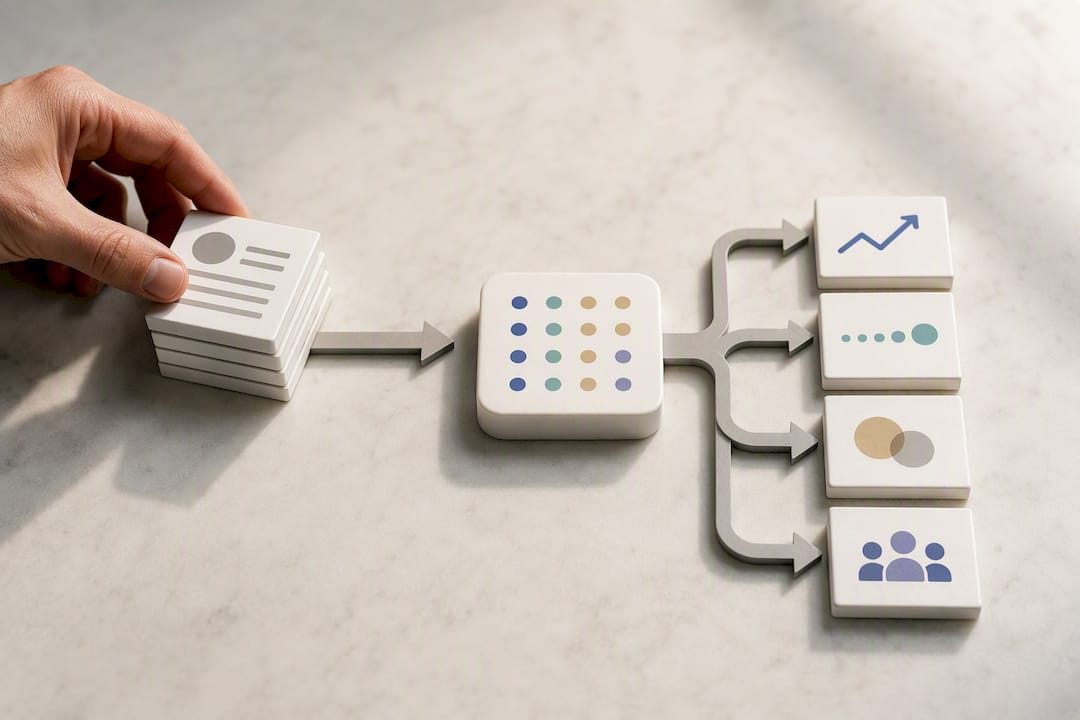
The integration pattern that works in practice: CRM and marketing data flow through an API into a warehouse like Snowflake or BigQuery, the model trains and scores against that warehouse, and results flow back into BI dashboards and the CRM itself so reps see forecasts where they already work, leveraging insights from marketing data and AI to enhance signal quality. Pipedrive’s guide for SMB sales leaders makes the same point: forecasts that live outside the CRM rarely get used consistently.
Pro Tip: Audit your CRM’s “closed won” data for at least four quarters back before you train anything. If half those records are missing close dates or have stage histories that jump straight from “prospecting” to “won,” your model will learn from noise, not signal.
A Practical Four-Phase Plan to Roll Out AI Forecasting
Rolling out a forecasting model without a plan is how most implementations lose trust in month one. A four-phase approach echoed across practitioner deep guides for revenue teams keeps technical validation and human adoption moving together, rather than one racing ahead of the other.
- Data audit and fixes. Standardize stage definitions, enrich contact and account records, and close the activity-logging gaps before any model sees the data.
- Shadow mode. Run the model alongside existing manual forecasts for at least one full quarter, comparing predictions to actual outcomes without letting anyone act on them yet.
- Coach with AI signals. Once shadow-mode accuracy holds up, surface model and rep disagreements in forecast reviews as coaching opportunities, not gotchas.
- Productionize. Set a retraining cadence (quarterly is common), and monitor the model in production rather than assuming it stays accurate forever.
A short metric checklist keeps phase four honest:
- Forecast error (predicted versus actual revenue, by period)
- Calibration (do deals scored at 70 percent actually close about 70 percent of the time?)
- Drift indicators (is accuracy quietly degrading as market conditions or sales motion change?)
Skipping the shadow-mode phase is the single most common shortcut that backfires. A model that looks great in a backtest can still embarrass everyone in its first live quarter if reps weren’t given time to see it prove itself first.
Accuracy, Limitations, and What Breaks a Forecasting Model
Accuracy depends on three things in order of importance: data quality, data volume, and signal richness. A company with a thousand well-logged closed deals and consistent activity tracking will out-forecast a company with ten thousand messy records every time.
Common failure modes show up in predictable places:
- Leaky features: accidentally training the model on information that only exists after a deal closes, which makes backtest accuracy look great and live accuracy collapse
- Bad stage mapping: inconsistent stage definitions across teams or regions that scramble what “50 percent probability” even means
- Insufficient sample size: trying to forecast a new product line or region with too few historical closed deals to learn from
Validation has to catch these before deployment, not after. Time-series splits (training on past quarters, testing on the next one, never the reverse) prevent the model from peeking at the future. Calibration plots show whether predicted probabilities match real outcomes. Backtesting against several past quarters, not just one, reveals whether accuracy holds up across different market conditions. The SaleFore AI documentation is explicit about using non-leaky TimeSeriesSplit validation for exactly this reason.
None of this replaces a manager’s judgment. The model’s job is to flag what deserves a second look. A manager’s job is to know why a deal that looks healthy on paper is actually stuck because the champion just left the company, something no model sees until it’s already in the CRM.
Choosing Tools: CRM-Native Forecasting vs. Specialist Revenue Intelligence Platforms
CRM-native forecasting tools cost less, integrate with zero extra setup, and handle disciplined, mid-volume pipelines well. Specialist revenue intelligence platforms cost more but add conversation intelligence, call transcription analysis, and deeper customization that most CRM-native tools don’t attempt.
The rule of thumb: if your pipeline is disciplined, your stage definitions are consistent, and your volume is moderate, start with what your CRM already offers. If you’re running a complex, multi-product, enterprise motion where deal-level nuance matters more than aggregate trends, a specialist platform earns its price tag.
Before committing to either, ask any vendor:
- What validation approach do you use to prevent overfitting or data leakage?
- How explainable are the probability scores when a rep or manager challenges one?
- What integration support exists for our specific CRM and warehouse setup?
- How often does the model retrain, and who monitors for drift?
Vague answers to the last two questions are a reliable warning sign that the “AI” is a static scoring rule wearing a machine learning label.
How Booked Appointment Data Strengthens Forecast Inputs
Forecasting models are only as trustworthy as the upstream signals feeding them, and verified, qualified appointments are some of the cleanest signal a pipeline can produce. When an appointment is confirmed with a real decision-maker rather than a generic form-fill, the resulting conversion velocity and qualification rate become features a model can actually trust.
Verified qualified appointment data illustrates the mechanism:
- Booked appointments carry verified contact and role data, improving multi-threading visibility in the CRM
- Time-to-first-meeting becomes a clean velocity feature instead of a noisy estimate
- Qualification outcomes feed directly into win-probability training data
Pro Tip: If your forecast keeps misfiring on top-of-funnel deals, check whether your lead source data distinguishes a qualified booked appointment from a cold inbound form. Models trained on the two blended together tend to underperform on both.
Why Human Judgment Still Decides the Forecast
Rolling out a forecasting model is a change management project wearing a data science disguise. Reps who feel judged by an algorithm will quietly ignore it, and a forecast nobody trusts is worse than no forecast at all.
The fix isn’t more accuracy. It’s framing the model as decision support from day one, showing reps the same shadow-mode backtests leadership sees, and treating every disagreement between a rep’s gut and the model’s score as something worth discussing out loud in the next pipeline review.
Before your next forecast meeting, ask three questions: Where does the model disagree most with reps, and why? Which deals has it flagged as risk that nobody else noticed? And has anyone actually checked calibration this quarter, or is everyone just assuming it still works?
— Riley
A Cleaner Way to Feed Your Forecasting Model
Every model in this article runs on one thing: signal quality. One approach to improving forecasting data is by generating qualified, booked sales appointments through AI outbound and charging only when that appointment actually lands on the calendar.
That pay-per-result structure means the appointment data flowing into your CRM isn’t a mix of cold form-fills and half-qualified leads. It’s verified meetings with real decision-makers, which is exactly the kind of clean, high-confidence input that improves conversion velocity and win-probability features rather than muddying them. For coaches, gym operators, consultants, and startups trying to get a forecasting model off the ground with better data from day one, that distinction shows up fast in model accuracy.
If your forecast has been struggling because the pipeline feeding it is thin or inconsistent, the fix might start upstream of the model entirely. Visit the Leadsnow landing page to see how pay-per-result appointment booking works, or check out how it applies to your fitness business lead generation needs specifically.
Sources
- Sales analytics improve sales forecasting | Gartner
- AI Sales Forecast: A No‑Fluff 2026 Guide – Tomba Blog
- SaleFore AI — Ultra-Accurate Sales Forecasting (GitHub)
- AI Sales Forecasting: Importance, Benefits, & Impact | Xactly
Recommended
- AI Appointment Setter vs Human SDR for Coaches: 2026 Cost & Performance Breakdown
- Database Reactivation: How We Hit 4.4% Average (and 8.9% Peak) Conversion on Dormant CRM Leads
- FITNESS SALES – WHY TRACK YOUR DATA
Pay-Per-Result appointments
See if we’re a fit
We book qualified sales appointments for you and you pay on results, not retainers. Our booking page asks a few quick questions so you find out in two minutes whether that model suits your business.
- 50,769+ appointments booked without cold calling.
- Pay-Per-Result pricing — you pay for booked, qualified calls.
- Pick your own time on our live calendar, no phone tag.