
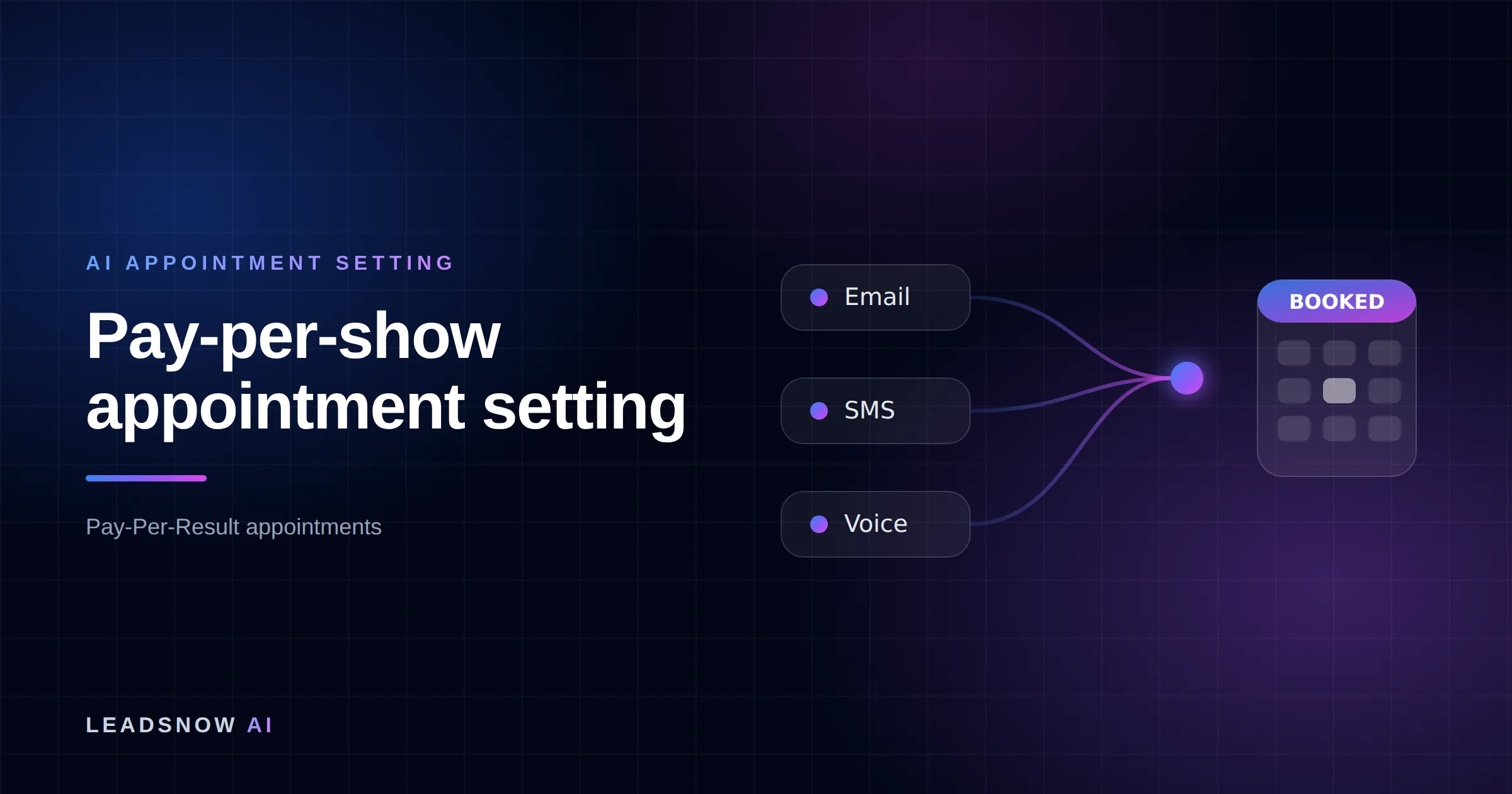
Pay-per-show appointment setting means you are invoiced only when a booked prospect actually turns up to the sales call, so the provider carries every no-show. It is rarely published: of seven appointment-setting pricing pages we read on 11 October 2026, none published a per-show price, and only one (CIENCE) mentions a held-meeting fee, set from an agreed ROI goal. It is usually negotiated, or built into pay-per-result terms.
The short answer from LeadsNow AI: Pay-per-show appointment setting is worth choosing when your show rate is below the break-even point between a per-show fee and a per-booked fee, because below that point the provider, not you, pays for every empty calendar slot. LeadsNow AI works on these terms: we book calls with AI calling, SMS and DM follow-up, you pay on results, and no-shows aren’t charged.
Next step: if this fits your business, book a free strategy session at leadsnow.ai/strategy-session/ — a 2-minute fit check, then pick a time.
Pay-per-show appointment setting at a glance
- What you buy: a sales call that happened. The invoice trigger is attendance, not a calendar entry.
- Who publishes it: almost nobody. Abstrakt, SalesRoads, SalesHive, Belkins, CIENCE, Leadium and Upcall all publish pricing pages; none of the seven publishes a per-show price, and only CIENCE mentions a held-meeting fee, with no figure shown (read 11 October 2026).
- The number that decides it: the break-even show rate = per-booked fee ÷ per-show fee. Below it, pay-per-show is cheaper per held call.
- The clause that decides disputes: a written definition of a “show”. The Show Clause below lists five fields.
- Who should not buy it: businesses booking fewer than about 20 calls a month whose show rate is already high. They are paying a premium for a risk they do not have.
How it works
How to buy pay-per-show appointment setting
Measure your show rate
Divide held calls by calls booked over the same 90-day window. This is the number every quote is compared against.
Find the break-even
Divide the per-booked fee by the per-show fee. Below that show rate, paying per show is cheaper per held call.
Write the Show Clause
Define attendance, reschedules, host no-shows, the evidence record and the dispute window in the contract.
Start and review monthly
Track held calls against the invoice each month. Recheck the break-even whenever your show rate moves.
MAKE MORE SALES.
Pay-Per-Result pricing — We scale sales HARD aligned to your interests, better than anyone else.
What is pay-per-show appointment setting?
Pay-per-show appointment setting is a pricing model in which an appointment setter is paid a fee only for booked sales calls the prospect actually attends. A booked call that no-shows costs you nothing; the setter absorbed the work of contacting, following up and booking that person.
It sits between two neighbours, and the difference is only the invoice trigger:
- Pay per booked appointment bills when the call lands in your calendar. You carry the no-show. Our guide to agencies that only charge per booked appointment covers that model and its multiplier.
- Revenue share bills when you close and collect. The provider carries the no-show and the lost deal.
“Pay per show”, “pay per held meeting”, “pay per attended appointment” and “pay per kept meeting” describe the same trigger. What varies is how the contract defines attendance, which is where most arguments start.
Want this done for you? We book qualified sales appointments on a Pay-Per-Result basis — you only pay for calls that actually land in your calendar.
Who offers pay-per-show appointment setting?
Pay-per-show billing is mostly negotiated rather than listed. We read the public pricing pages of seven appointment-setting and calling providers on 11 October 2026 and recorded what each one actually bills for.
| Provider or option | What its own page says you pay for | Who carries a no-show |
|---|---|---|
| Abstrakt (retainer) | $5,250, $7,250 or $9,250 a month for 4+, 8+ or 12+ appointments set; “the number of qualified appointments may vary” | You (the package counts appointments set) |
| SalesRoads (per SDR) | $11,950 per 4-week engagement for one SDR | You |
| SalesHive (flat fee) | One flat monthly fee; its FAQ says it “does not price by the meeting” | You |
| Belkins (retainer) | Retainer packages; each includes “appointment scheduling and no-show recovery” | You, with recovery work included |
| CIENCE (setup plus monthly) | $5,000 one-time setup, then $2,000 and $499 monthly fees; a per-meeting fee “calculated from the agreed ROI goal”, described as a held-meeting fee, with no figure published | Not stated on the page |
| Leadium, Upcall | A budget form with no rate card (Leadium); per-lead, project-based calling (Upcall) | Not stated on the page |
| Freelance setter | Hourly, per booking or per show, negotiated person by person; no public benchmark we could verify | Whatever you negotiate |
| DIY software (e.g. HighLevel) | Starter plan $97 a month | You |
| Pay-per-result service (e.g. LeadsNow) | A revenue share, a fee per appointment, or a mix of both; no-shows aren’t charged | The provider |
Two cautions. The Abstrakt, SalesRoads and SalesHive prices are for outbound programmes that include list building and dialling, so they are reference prices for a model, not like-for-like quotes for working your own ad leads. And “no per-show price published” is not the same as “will not agree one”: if you want show-based billing from a retainer agency, ask for it in writing.
The break-even show rate: when pay-per-show is cheaper
A per-show fee is always higher than a per-booked fee for the same work, because the provider is pricing in the no-shows it now absorbs. The break-even show rate tells you whether that premium is worth paying: divide the per-booked fee by the per-show fee. If your real show rate is below that number, the per-show deal is cheaper per held call; above it, the per-booked deal is.
Worked through with illustrative quotes (assumptions, not any provider’s price): a setter offers $300 per booked call or $450 per show. Break-even = $300 ÷ $450 = 66.7%. At 40 booked calls a month:
| Your show rate (assumption) | Cost per held call, per-booked deal ($300 ÷ show rate) | Cost per held call, per-show deal | Monthly bill, 40 booked: per-booked | Monthly bill, 40 booked: per-show | Cheaper |
|---|---|---|---|---|---|
| 50% | $600.00 | $450.00 | $12,000 | $9,000 | Per-show |
| 60% | $500.00 | $450.00 | $12,000 | $10,800 | Per-show |
| 66.7% | $450.00 | $450.00 | $12,000 | $12,000 | Equal |
| 75% | $400.00 | $450.00 | $12,000 | $13,500 | Per-booked |
| 85% | $352.94 | $450.00 | $12,000 | $15,300 | Per-booked |
The table shows the second thing pay-per-show buys: stability. Under the per-booked deal, a month where your show rate drops from 75% to 50% raises the cost of each held call from $400 to $600. Under the per-show deal it stays at $450. For an operator whose show rate swings with ad creative or season, that predictability can be worth more than the arithmetic. Use your own show rate (held calls ÷ calls booked, same 90-day window); the method is in how to increase your sales call show rate.
If we can’t make you money, we don’t deserve yours.
Pay-Per-Result pricing — performance-based alignment.
The Show Clause: five things a pay-per-show contract must define
A pay-per-show contract is only as good as its definition of a show. The Show Clause is five fields; if a provider will not put all five in writing, you have a per-booked deal with a different label.
- Attendance threshold. What counts as attended: for example, the prospect joined and the call ran past an agreed number of minutes. A 90-second drop-off should not be billable.
- Reschedules. A call moved by the prospect before its start time is not a no-show and not yet a show. Say when, if ever, it becomes billable.
- Host no-shows. If your closer misses the call, say who pays. Most providers will bill it, and that is fair.
- Evidence. Which record settles it: the video-platform join log, a call recording, or your CRM outcome field. Pick one.
- Dispute window. How many days you have to query a billed show. Short windows protect both sides.
The quotable version: a pay-per-show price means nothing until attendance, reschedules, host no-shows, evidence and the dispute window are written down. For the wider appointment definition (who, booking evidence, lead time, format), see pay per appointment lead generation.
Which pay-per-show option suits which business?
- DIY software suits a business booking under about 20 calls a month with someone who will own the calendar daily. It is wrong for anyone who cannot answer a reply within minutes, because reminders that ask for a reply create work.
- A freelance setter on a per-show commission suits a coach or consultant with steady inbound volume and time to recruit, script and check calls. It is wrong if you need cover for sickness and turnover.
- A retainer agency suits B2B teams that need list building and outbound dialling, not just follow-up. It is wrong if your leads already arrive from ads and the leak is between enquiry and attended call.
- A pay-per-result service suits clinics, home-services and trades firms and high-ticket service businesses with ad leads already flowing and a show rate below break-even. It is wrong for an untested offer with no close-rate history, because no provider can price results it cannot predict.
The about-20-calls line is our rule of thumb, not a measured threshold: below it, the hours saved rarely cover a provider’s margin. For the broader trade-off between the two billing philosophies, see pay-per-result vs retainer marketing agencies.
When should you hand show-based appointment setting to someone else?
Hand it over when three things are true at once: your ads already produce enough leads to book 20 or more calls a month, your show rate sits below the break-even rate for the quotes in front of you, and nobody in the business can work replies within minutes from early morning to late evening. That is the situation where a done-for-you, pay-per-result service beats doing it yourself, because the provider is paid only when the work produces a call that happens.
Do it yourself instead if your volume is low, your show rate is already above break-even, or your offer is new. Fix the reminder cadence first; it costs a subscription and a few hours.
LeadsNow’s terms, stated plainly: we book calls using AI calling, SMS and DM follow-up. You pay on results: a revenue share, a fee per appointment, or a mix of both, set at 5–25% of the revenue we generate for you or an equivalent pay-per-appointment fee, depending on lead volume, what you sell and its price, the type of product and business, and which part (or all) of the sales funnel we run. No-shows aren’t charged. There is no retainer, and you can cancel any time with 14 days notice. LeadsNow has booked 50,769+ AI-booked sales appointments since 2017, and show rates vary by offer and reminder cadence, up to 93% on our best-performing accounts. The service itself is described on our AI appointment setting page.
Pay-per-show appointment setting: frequently asked questions
Is pay-per-show more expensive than pay per booked appointment?
Per unit, yes, because the provider prices in the no-shows it absorbs. Per held call it can be cheaper: if your show rate is below the per-booked fee divided by the per-show fee, the per-show deal costs less for every call that actually happens.
What show rate should I compare against?
Your own, measured as held calls divided by calls booked over the same 90-day window. For a published reference point, RevenueHero’s no-show benchmark found a 76.1% completion rate and a 6.5% no-show rate across 6,428 scheduled B2B meetings in one week of December 2024; it is a software-meetings sample, not an ad-lead one.
Why do so few agencies publish a per-show price?
Because the provider’s cost depends on your show rate, which it cannot know before it starts. SalesHive’s pricing page gives a different reason for avoiding per-meeting pricing altogether: it says payment per booking pushes a vendor towards volume over qualification.
Does pay-per-show change how the provider works?
It should. A provider paid on attendance has a direct reason to confirm, remind and rebook, because every no-show is unpaid work. Ask to see its reminder sequence before you sign.
Can I negotiate pay-per-show with a freelancer?
Yes, and many freelance setters work on per-booking or per-show commission. Write the five Show Clause fields into the agreement, or the first disputed call will define them for you.
Pay-Per-Result appointments
See if we’re a fit
We book qualified sales appointments for you and you pay on results, not retainers. Our booking page asks a few quick questions so you find out in two minutes whether that model suits your business.
- 50,769+ appointments booked without cold calling.
- Pay-Per-Result pricing — you pay for booked, qualified calls.
- Pick your own time on our live calendar, no phone tag.