
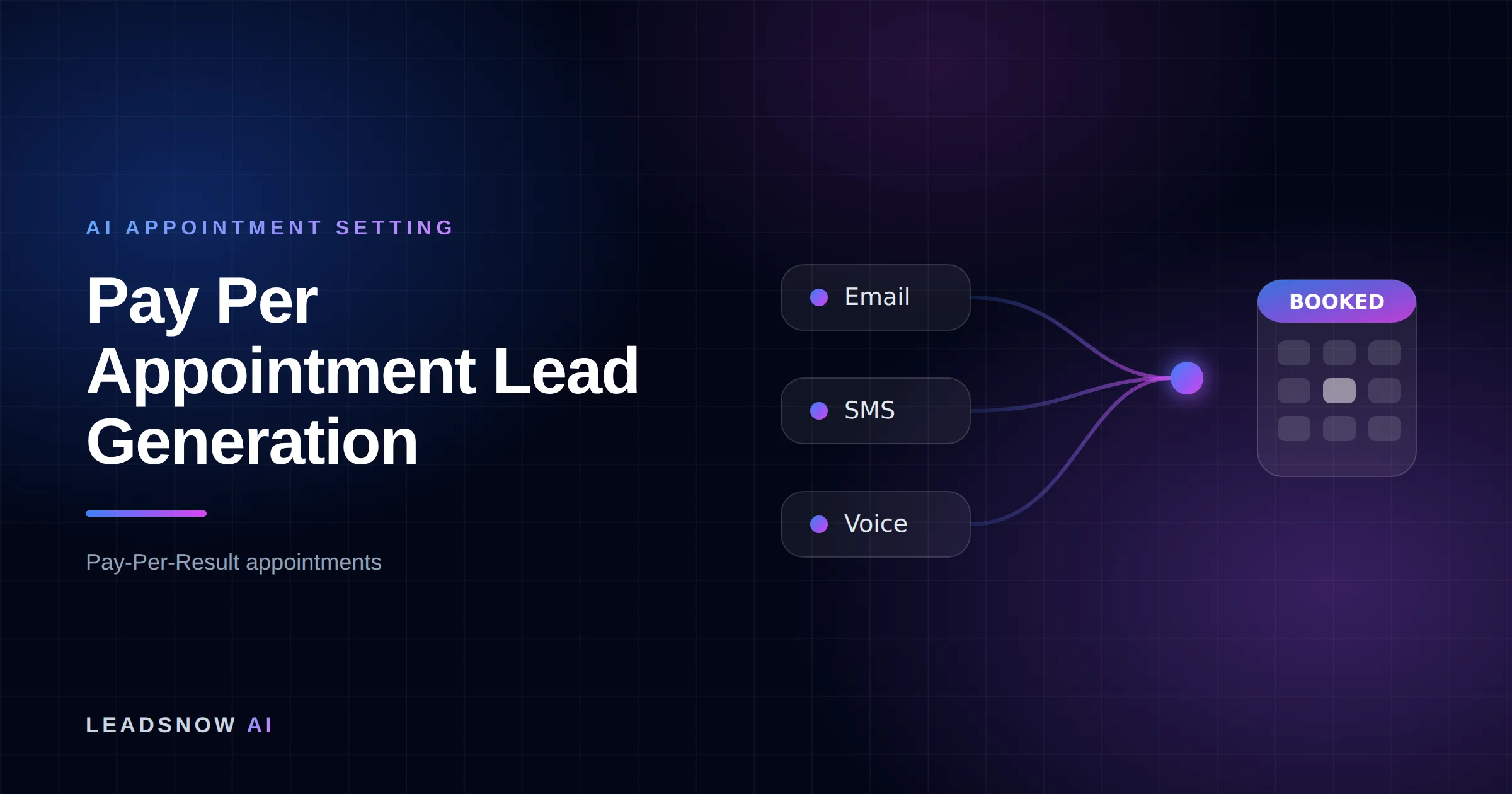
Pay per appointment lead generation means you pay a provider only when a qualified prospect is booked into your calendar, not for leads or a retainer. For example, at an assumed $7,200 gross profit per deal, a 20% close rate and 30% of profit spent on acquisition, the most you can pay is $432 per held appointment.
At a glance
- What you buy: a booked conversation with a screened prospect, not a contact record. The provider does the contacting, follow-up, qualification and booking.
- The number that decides it: the Appointment Ceiling = gross profit per deal × your close rate on held appointments × the share of profit you will spend to win a deal.
- Market price: a booked call typically costs $30–$400+ depending on industry, offer, price and many other variables.
- The clause that matters most: a written definition of “appointment”. Six fields, set out below.
- The legal point people miss: hiring a caller does not hand over your telemarketing obligations (ACMA, FTC).
- Where it fails: low-margin offers, unproven offers with no close-rate history, and sales teams that cannot take the volume.
What is pay per appointment lead generation?
Pay per appointment lead generation is a pricing model in which a lead generation or appointment setting provider is paid a fee for each sales appointment it books with a qualified prospect, instead of a retainer, an hourly rate or a price per lead. The provider absorbs the cost of work that produces no appointment.
Three parts make up every pay per appointment arrangement:
- A source of prospects. Your own inbound leads, your dormant CRM records, or a list the provider builds. These are three different jobs; the difference between inbound and outbound leads changes both the fee and the legal exposure.
- A booking engine. Human setters, AI calling and SMS, or a mix, across several touches.
- An invoice trigger. The event that creates a fee: an appointment booked, an appointment held, or a deal closed.
For cost-per-acquisition, revenue share and hybrid deals, the broader guide to performance-based lead generation lays out all of them.
How it works
How to buy pay per appointment lead generation without overpaying
Define the appointment
Write the six fields: who, booking evidence, lead time, format, attendance and newness. Every quote is then priced against the same thing.
Calculate your ceiling
Multiply gross profit per deal by your close rate on held appointments and your acquisition share. That is the most one held appointment is worth.
Convert every quote
Divide any per-booked fee by your show rate to get cost per held appointment. Compare it with your ceiling.
Cap it to capacity
Set a monthly cap your closers can run well, then check compliance and exit terms before signing.
MAKE MORE SALES.
Pay-Per-Result pricing — We scale sales HARD aligned to your interests, better than anyone else.
What counts as an appointment? The Six-Field Appointment Spec
An appointment is whatever your contract says it is, and most disputes start with a definition nobody wrote down. The Six-Field Appointment Spec is the minimum a definition needs before any price per appointment means anything.
| Field | What the contract should state | What goes wrong without it |
|---|---|---|
| 1. Who | The prospect criteria the setter screens against before booking: role or decision rights, the need, the timing, and any minimum size or budget | Calendars fill with people who cannot buy |
| 2. Booking evidence | A specific date and time accepted by the prospect, with a calendar invite sent to them | “Asked for a call back next week” gets counted as booked |
| 3. Lead time | How far ahead an appointment may be booked, for example no more than 14 days out (pick your own number) | Appointments booked five weeks ahead, when intent has gone cold |
| 4. Format | Phone, video or in person, the expected length, and who from your side attends | Prospects expect a 10-minute chat and you run a 60-minute demo |
| 5. Attendance | What “held” means if you pay on held: for example, the prospect joined and the call ran past the introductions | A two-minute dial-in is argued as a held meeting |
| 6. Newness | Prospects already in an open opportunity in your CRM are excluded, and how that is checked | You pay for people your own team was already talking to |
The quotable version: a pay per appointment price is meaningless until the six fields of the appointment are written into the contract. For the screening questions themselves, the lead qualification framework covers the screening criteria in depth.
Want this done for you? We book qualified sales appointments on a Pay-Per-Result basis — you only pay for calls that actually land in your calendar.
Why do buyers pay per appointment instead of per lead?
Buyers move to pay per appointment lead generation because it moves the expensive, unglamorous middle of the funnel, from first contact to a confirmed time in the calendar, onto the provider. A lead is an input that your team still has to work; an appointment is an output.
- Risk moves. The provider, not you, carries the cost of every prospect who never answers.
- Measurement gets simpler. You compare one number, cost per held appointment, with what an appointment is worth to you.
The unit price is higher, and it is a distraction. The full side-by-side of the two models, with a worked cost-per-closed-deal comparison, is on the page comparing pay per lead vs pay per appointment. If you are still deciding whether to buy leads at all, our separate pay per lead guide covers lead definitions, exclusivity and returns policies; this page assumes you have decided you want appointments.
What does pay per appointment lead generation cost?
A booked sales call typically costs $30–$400+ depending on industry, offer, price and many other variables. That range is too wide to budget from, which is the point: the fee for pay per appointment lead generation is driven by a handful of inputs you can name.
- What you sell and its price. A $40,000 engagement supports a far higher fee than a $900 package.
- Where the prospects come from. Following up your own inbound leads is cheaper per appointment than building and dialling a cold list.
- Qualification depth. Every extra screening question removes prospects, so each appointment costs more contacts to produce.
- The invoice trigger. A fee per held appointment is higher than a fee per booked one because the provider carries the no-shows.
- How much of the funnel the provider runs. Booking only, or reminders and no-show recovery too.
To compare a quote fairly, convert it to cost per held appointment: a fee per booked appointment divided by your show rate. The arithmetic, with three show-rate bands, is set out in the guide to choosing an agency that only charges per booked appointment, and the method for working out your current in-house figure is in how to calculate cost per booked call.
If we can’t make you money, we don’t deserve yours.
Pay-Per-Result pricing — performance-based alignment.
How much can you afford to pay per appointment? The Appointment Ceiling
The Appointment Ceiling is the most you can pay for one held appointment before pay per appointment lead generation stops being profitable at the acquisition cost you have chosen. It needs three of your own numbers and no benchmark.
Appointment Ceiling (per held appointment) = gross profit per closed deal × close rate on held appointments × acquisition share
- Gross profit per closed deal. Average first-sale value minus the direct cost of delivering it. Use first-sale value unless repeat revenue is reliable and you are willing to wait for it.
- Close rate on held appointments. Closed deals divided by appointments that actually took place, over the last 90 days or the last 30 held appointments, whichever is larger.
- Acquisition share. The percentage of gross profit you are prepared to spend to win the deal. This is your decision, not a benchmark; the examples here use 30%.
If the provider bills per booked appointment, multiply the ceiling by your show rate to get the ceiling per booked appointment. Worked end to end with assumptions you should replace:
- Average deal $12,000, gross margin 60%: gross profit per deal = $7,200.
- Close rate on held appointments 20%: each held appointment is worth $7,200 × 0.20 = $1,440 in gross profit.
- Acquisition share 30%: ceiling = $1,440 × 0.30 = $432 per held appointment.
- Show rate 70%: ceiling per booked appointment = $432 × 0.70 = $302.40.
The rule that falls out of it: if a quote converted to cost per held appointment sits above your Appointment Ceiling, the deal loses money at your chosen margin however good the appointments look.
Appointment Ceiling by close rate and gross profit per deal
This threshold table applies the Appointment Ceiling formula at a 30% acquisition share. Every cell is gross profit per deal × close rate × 0.30, per held appointment. Find your row and column, then compare the cell with quotes converted to cost per held appointment.
| Gross profit per closed deal | Close rate 10% | Close rate 20% | Close rate 30% |
|---|---|---|---|
| $2,000 | $60 | $120 | $180 |
| $5,000 | $150 | $300 | $450 |
| $10,000 | $300 | $600 | $900 |
| $25,000 | $750 | $1,500 | $2,250 |
How to read it:
- Ceiling under about $100: pay per appointment is hard to make work, because the cell sits near the bottom of the $30–$400+ range booked calls typically cost. Fix your close rate or your offer price first, or book in-house.
- Ceiling between about $100 and $400: it works if you buy per held appointment, or per booked with a strong show rate. Negotiate the invoice trigger before the price.
- Ceiling above about $400: most pay per appointment offers clear the bar, and the decision turns on contract terms, capacity and fit rather than price.
The bands are this page’s editorial cut-offs drawn from the market range above, not an industry standard. The single biggest lever in the table is close rate: moving from 10% to 20% doubles every ceiling, which is why the funnel after the appointment matters as much as the appointment. If your close rate is the weak number, finding where your sales funnel leaks after the appointment is the better first project.
Six clauses to check in a pay per appointment contract
A pay per appointment lead generation contract should be readable in ten minutes and answer six questions in writing. If any one is answered only in a sales call, treat it as unanswered.
- The appointment definition. The six fields above, in the contract or a schedule to it, not in the proposal deck.
- The invoice trigger. Booked, held or closed, and who pays for a no-show. Five questions for testing this are set out in the Invoice Trigger Test; do not sign until the trigger is one word in the contract.
- Calendar capacity and a monthly cap. The provider can only book into times you make available, so state how many slots a week you will hold open and the maximum number of appointments you will pay for in a month. A cap protects you from paying for more appointments than your closers can run well.
- Source of prospects. Whether the provider works your inbound leads, your old database, a list it builds, or all three, and who owns any list it builds when the contract ends.
- Compliance and records. Who captures consent, who checks numbers against the do-not-call registers, how the provider discloses AI calling where it uses it, and who keeps the call recordings and consent evidence. Ask for these records to be retrievable by you on request.
- Minimums, set-up and exit. Any set-up fee, minimum block of appointments or monthly floor, the ramp period before full volume, the notice period, and who keeps the phone numbers, sender registrations and conversation history when you leave.
Clause 3 is the one most buyers skip. A pay per appointment contract without a monthly cap turns a good month for the provider into a bad month for your closers.
Who is liable when an appointment setter calls on your behalf?
When a pay per appointment provider calls or texts prospects for you, the legal obligations do not stay with the provider. The rules differ by country, so name the one that applies to the people being contacted:
| Country | Regulator and rule | What its own guidance says |
|---|---|---|
| Australia | ACMA: spam and telemarketing laws | Businesses “cannot outsource their obligations under the spam and telemarketing laws”; “Ultimately, the business is responsible.” |
| United States | FTC: Telemarketing Sales Rule | The rule applies to businesses that take part in telemarketing, whether as telemarketers making calls or as sellers arranging to provide the goods or services |
| United Kingdom | ICO: PECR | Marketing calls must not be made to numbers on the TPS or Corporate TPS unless that person has specifically consented, so call lists need screening |
When you buy pay per appointment lead generation, you also buy the provider’s compliance process, so check it as carefully as the price: consent capture, list screening, and how opt-outs reach your CRM. This is general information, not legal advice; for US-specific scrubbing and penalty detail see the do not call compliance guide, and take advice on your own situation.
Where pay per appointment lead generation fails
Pay per appointment lead generation fails in predictable places, most of them visible before you sign. Each has a test you can run on your own numbers.
| Failure | The test | What to do instead |
|---|---|---|
| Margin too thin | Appointment Ceiling under about $100 per held appointment | Raise price or close rate first; book in-house |
| Unproven offer | Fewer than 30 held sales conversations on record, so no reliable close rate | Run the first 30 yourself to establish a close rate |
| No sales capacity | Closers already run more calls a week than they can prepare for | Hire or free a closer before buying appointments |
| Committee buying | The deal needs three or more sign-offs and the first meeting rarely includes the buyer | Pay for a later-stage outcome, or keep account-based outreach in-house |
| Wrong incentive | Billed per booked, with no show-rate data shared and no cap | Switch to per held, or add a cap and a shared show-rate report |
| Slow hand-off | Appointments land, but nobody confirms or prepares and show rate falls | Agree who sends reminders, and when, before launch |
The common thread: pay per appointment lead generation amplifies whatever happens after the appointment, good or bad. If held appointments are not turning into sales, the problem is downstream; if booked appointments are not turning into held ones, fixing booked calls that don’t show is the cheaper project.
A worked example: a $12,000 consulting offer
This example uses labelled assumptions, not a client’s results. Replace every input with your own.
- Offer: a $12,000 consulting engagement at 60% gross margin, so $7,200 gross profit per deal (assumption).
- Close rate on held appointments: 20% (assumption, from the last 90 days).
- Acquisition share: 30% of gross profit (owner’s choice).
- Closer capacity: 20 held appointments a month.
The arithmetic:
- Appointment Ceiling = $7,200 × 0.20 × 0.30 = $432 per held appointment.
- Maximum monthly spend at capacity = 20 × $432 = $8,640.
- Expected deals = 20 × 0.20 = 4. Expected gross profit = 4 × $7,200 = $28,800.
- Check: $8,640 ÷ $28,800 = 30%, the acquisition share chosen.
- Two assumed quotes, not any provider’s actual price: a quote of $350 per booked appointment at a 70% show rate costs $350 ÷ 0.70 = $500 per held appointment, which is $68 over the ceiling. A quote of $300 per booked at the same show rate is $428.57 per held, just under it.
The lesson: a lower sticker price per booked appointment can cost more per held appointment than a higher price per held one, so always convert. And the cap of 20 is part of the maths: past it, you buy appointments your closer cannot run at a 20% close rate.
What I’d fix first before buying appointments
If I were about to sign a pay per appointment lead generation contract tomorrow, these are the five things I would do this week, in this order.
- Pull 90 days of held appointments and closed deals from the CRM and calculate a real close rate. If the CRM data is too messy to do that, cleaning it is the first job.
- Write the Six-Field Appointment Spec before talking to any provider, so every quote is priced against the same definition.
- Calculate my Appointment Ceiling and convert every quote to cost per held appointment.
- Decide my monthly cap from closer capacity, not from the provider’s minimum.
- Ask for the compliance process in writing: consent capture, register screening, opt-out handling and record retention.
If step 1 shows a weak close rate, I would not buy appointments yet: more appointments into a weak close rate is the most expensive way to learn the offer needs work.
How LeadsNow applies pay per appointment lead generation
LeadsNow is a pay-per-result appointment setting agency, so this is a model we run rather than one we only describe. We book sales calls using AI calling, SMS and DM follow-up and have booked 50,769+ AI-booked sales appointments since 2017 and generated 1M+ leads.
- Show rate: it varies by offer and reminder cadence, up to 93% on our best-performing accounts. It is not a typical figure, and your own show rate is what belongs in the Appointment Ceiling maths.
- Sales lift: our 7x figure is an average, defined on our methodology page, and the same page says the median is closer to 4x.
- Proof you can check: 24 filmed client case studies and a 4.6 rating from 43 Google reviews. Clients we can name include Iron Body, Foundr, SheSells.online and Lambda Academy.
The service behind the model is described on the AI appointment setting page.
LeadsNow: a pay-per-result way to put this into practice
LeadsNow charges 5–25% of the revenue we generate for you (revenue share), or an equivalent pay-per-appointment fee. Where the rate falls depends on your lead volume, what you sell and its price, the type of product and business, and which part, or all, of the sales funnel we run. The structure can be a revenue share, a fee per appointment, or a mix of both.
- No-shows aren’t charged.
- Bad ad creative, bad lists and the cost of contacting the thousands of people who never book are our cost, not yours.
- No retainer. Cancel any time with 14 days notice.
Who should not use us: if your Appointment Ceiling sits under about $100, or you have no closing history yet, book your own first 30 conversations before paying anyone per appointment. Pricing detail is on the pricing page, and you can book a call to run your own numbers.
Sources
- ACMA, Telemarketing and e-marketing: common issues and mistakes (outsourced marketing; the business remains responsible).
- FTC, Complying with the Telemarketing Sales Rule (sellers and telemarketers both covered).
- ICO, Telephone marketing under PECR (TPS and Corporate TPS screening).
FAQ
Is pay per appointment lead generation worth it?
It is worth it when the fee, converted to cost per held appointment, sits below your Appointment Ceiling: gross profit per deal times close rate on held appointments times the share of profit you will spend to win a deal. At $7,200 gross profit, a 20% close rate and a 30% share, the ceiling is $432.
How much does pay per appointment lead generation cost?
A booked sales call typically costs $30–$400+ depending on industry, offer, price and many other variables. The fee rises with deal value, cold rather than inbound prospects, deeper qualification, harder-to-reach buyers and billing per held rather than per booked appointment.
Am I responsible if an appointment setting company breaks telemarketing rules?
Often, yes. Australia’s regulator says businesses that outsource telemarketing cannot outsource their obligations, and ultimately the business is responsible. In the US, the FTC’s Telemarketing Sales Rule guidance covers sellers as well as telemarketers. This is general information, not legal advice.
Is pay per appointment the same as pay per lead?
No. Pay per lead charges for a contact record that your team still has to call, qualify and book. Pay per appointment charges for a prospect who has already agreed to a time in your calendar, so the provider carries the cost of everyone who never books.
Do I pay for no-shows on a pay per appointment deal?
It depends on the invoice trigger. If you pay per booked appointment you usually pay for no-shows, so divide the fee by your show rate to get the true cost per held call. If you pay per held appointment or on closed revenue, the provider carries no-shows.
Does pay per appointment work for B2B sales in the UK?
It can, but UK marketing calls must be screened: the ICO says marketing calls must not go to TPS or Corporate TPS numbers without specific consent. Ask any provider how it screens lists before you compare prices.
Pay-Per-Result appointments
See if we’re a fit
We book qualified sales appointments for you and you pay on results, not retainers. Our booking page asks a few quick questions so you find out in two minutes whether that model suits your business.
- 50,769+ appointments booked without cold calling.
- Pay-Per-Result pricing — you pay for booked, qualified calls.
- Pick your own time on our live calendar, no phone tag.