
Most lead generation advice is written for a sale with one decision-maker, a two-week cycle and a credit card at the end of it. Enterprise is a different machine. The person who takes your first meeting usually cannot buy, the people who can buy will not take a first meeting, and somewhere between those two facts sit procurement, security review, legal and a budget cycle that does not care about your quarter.
This page is about what actually changes when you run outbound into that environment — and what AI agents can and cannot do about it.
The short answer: Enterprise lead generation services differ from mid-market outbound in three structural ways: you are selling to a committee rather than a person, the cycle runs in quarters rather than weeks, and procurement plus security review are part of the sale, not paperwork after it. AI agents are genuinely good at research, multi-threading and staying present across a ten-month cycle. They do not shorten a security questionnaire, and nobody should sell you that they do.
What “enterprise” actually changes
Forrester’s State Of Business Buying, 2026 — drawn from its Buyers’ Journey Survey of nearly 18,000 global business buyers surveyed the previous year — reports that on average 13 internal stakeholders and nine external participants influence buying decisions, and that the number rises for more expensive or complex purchases. That is the whole problem in one sentence. Not thirteen people who all say yes. Thirteen people who each have a different reason to say no.
The second change is time. 6sense’s 2025 B2B Buyer Experience Report, based on two surveys totalling more than 4,000 responses from buyers in North America, the UK and Ireland, continental Europe and Asia-Pacific, put the average buying cycle at 10.1 months, down from 11.3 months the year before. In separate 6sense research published in February 2024 on how large purchases differ from smaller ones, deals above US$700,000 ran longer still — roughly 15 months, with buying teams of nearly 14 people against just under 10 on smaller deals.
The third change is who is in the room. The same Forrester analysis found that procurement professionals now serve as decision-makers more than half the time (53%) in the average business buying cycle. Procurement is no longer a rubber stamp at the end. It is a stakeholder with veto power, and it evaluates you on things your champion never asked about: data handling, subprocessors, insurance, contract terms, exit.
Put those together and the honest conclusion is that at enterprise, outbound is not a booking engine. It is a way to start and hold a multi-year relationship long enough for a buying window to open.
How it works
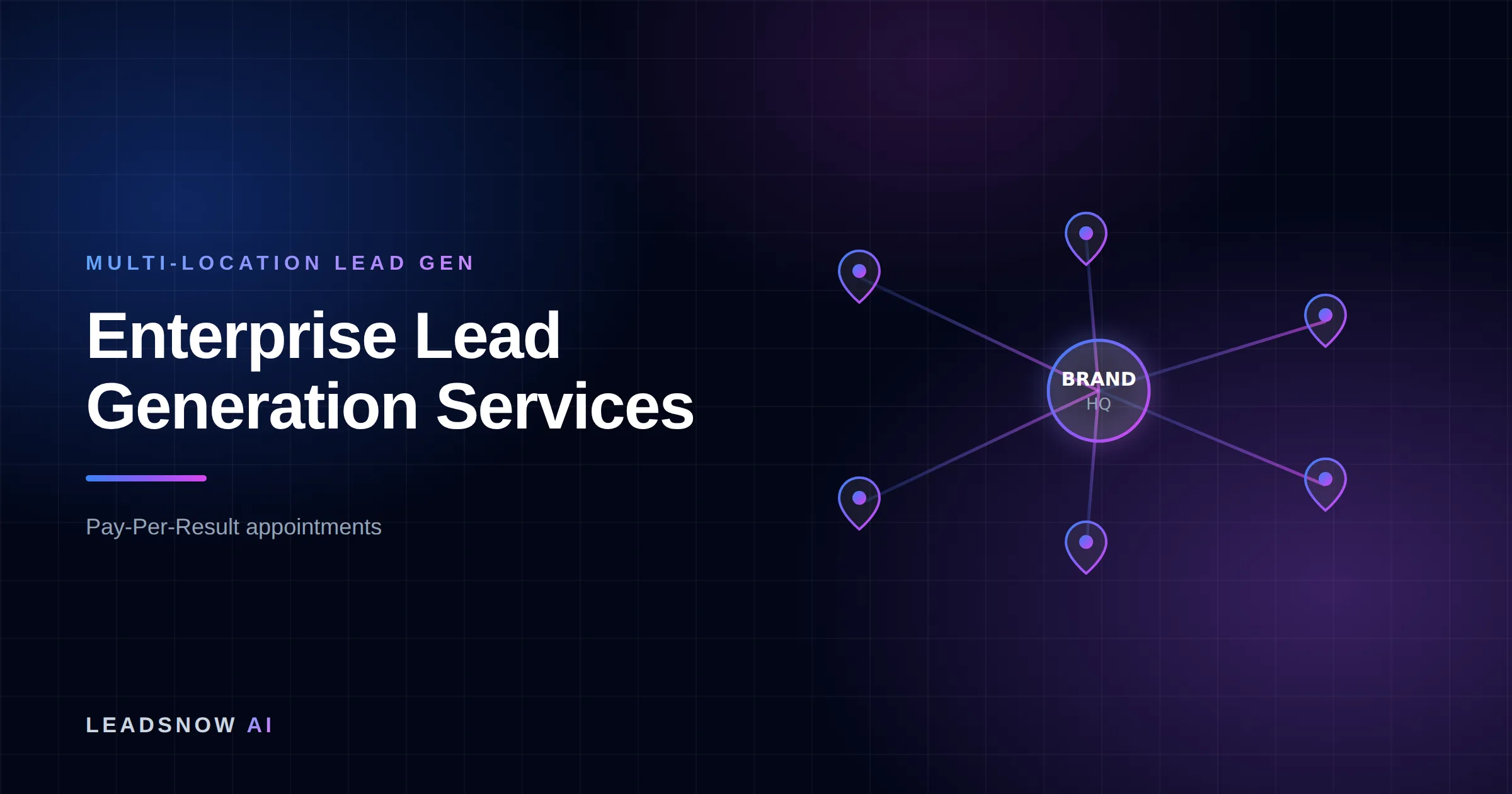
How lead generation works across a multi-location network
Head office sets the rules
Brand standards, qualification criteria and messaging are defined once, centrally.
Campaigns run per territory
Each location gets its own outreach, without every operator building their own marketing.
Leads routed by location
A prospect reaches the location that can actually serve them — the part that usually breaks at scale.
Per-location reporting
Head office sees which territories convert and which need support, instead of one blended number.
MAKE MORE SALES.
Pay-Per-Result pricing — We scale sales HARD aligned to your interests, better than anyone else.
What counts as a qualified enterprise meeting
This is where most enterprise lead generation engagements fail. The vendor is paid on meetings, so meetings get booked — and a demo with a junior analyst who was told to “go look at the market” counts as one. It sits in the report. It never becomes anything.
A meeting is only worth counting at enterprise if it clears four tests:
- Authority or proximity to it. The attendee either controls budget or can convene the people who do. An analyst who will be asked to build the shortlist counts. An analyst doing coursework does not.
- A named problem with a cost attached. Not interest. A specific operational pain someone senior has already complained about.
- A plausible buying window. Budget cycle, renewal date, contract expiry, a mandate with a deadline. “Sometime next year” is a real answer at enterprise, but it needs to be a date, not a mood.
- A second thread. One contact is a single point of failure. Enterprise champions get promoted, reorganised and made redundant mid-cycle, and when they go, an un-threaded deal goes with them.
We would rather book fewer meetings against that definition than more against a looser one. It is also why cost per booked meeting is higher on enterprise work than on volume outbound — you are paying for filtering, not for dials. The number that matters is cost against closed contract value, and on a seven-figure deal that arithmetic stops being close.
Want this done for you? We book qualified sales appointments on a Pay-Per-Result basis — you only pay for calls that actually land in your calendar.
Account-based targeting vs volume outbound
Neither approach is wrong. They solve different problems, and the failure mode is running one while measuring the other.
| Volume outbound | Account-based enterprise outbound | |
|---|---|---|
| Target list | Thousands of accounts matching firmographic filters | 50–300 named accounts chosen deliberately, reviewed quarterly |
| Contacts per account | One, occasionally two | Five to twelve, mapped to the committee |
| Message | Segment-level, tested at scale | Account-level, built on the account’s own filings, tenders, hiring and public commitments |
| Primary metric | Meetings booked, cost per meeting | Accounts engaged, threads per account, pipeline created |
| Time to first revenue | Weeks | Two to four quarters |
| When it is the right call | Repeatable offer, short cycle, deal sizes where one buyer can sign | Deal size justifies months of unpaid effort per account and the committee is unavoidable |
| Main failure mode | Burning a finite market with a message that was not ready | Spending two quarters on accounts that were never going to buy |
The practical answer for most businesses with real volume is both, run separately, with separate scorecards. Problems start when a team runs an account-based motion and gets judged on weekly meeting counts — the motion gets abandoned in month two, right before it would have worked.
Where AI agents genuinely help — and where they don’t
We build and run AI voice, SMS and chat outbound, so treat this as an interested party being specific about limits.
Research at account depth. Reading an annual report, a tender notice, a set of job ads and three months of executive posts to find the one line worth opening with is expensive human work and cheap machine work. This is the single biggest real gain.
Multi-threading. Reaching six people in one account with six genuinely different angles — the operations angle for operations, the risk angle for risk — is what humans skip when they are busy. Agents do not get busy.
Persistence across a long cycle. A ten-month deal generates a dozen “not now” moments. Human SDRs lose those to CRM hygiene, territory changes and turnover. An agent still has the thread in month eight, remembers the reason, and re-opens with it rather than with a fresh introduction.
Speed to a live conversation. When an enterprise buyer does raise a hand, an agent picks it up in seconds at any hour, across time zones, without a queue.
Now the limits, stated plainly. AI agents do not close enterprise deals, and we do not let them try. They do not shorten a security review — a vendor risk assessment takes as long as the assessing organisation’s process takes, and no amount of automation on our side changes theirs. They do not build the executive trust that gets a project sponsored; a person does that, in a room. And they should never be the counterparty for commercial terms.
Our position is narrow on purpose: AI opens and sustains the conversation. Humans run the deal. If a vendor tells you their agent will negotiate your enterprise contract, that is the moment to end the call.
If we can’t make you money, we don’t deserve yours.
Pay-Per-Result pricing — performance-based alignment.
What procurement will ask about data handling
If your outbound partner has never been through an enterprise security review, you will find out during one. Expect these, and expect them in writing:
- Where does the data live? Data residency is commonly a stated requirement in Australian government, financial services and health procurement, and it turns up as a contract term elsewhere. Under the Australian Privacy Principles, APP 8 sets out the steps an APP entity must take to protect personal information before it is disclosed overseas — and the disclosing organisation stays accountable.
- Who are the subprocessors? Every model provider, telephony carrier, CRM and enrichment vendor in the chain gets named. “We use AI” is not an answer.
- Is customer data used for training? The expected answer at enterprise is no, in the contract, not in a blog post.
- Retention and deletion. How long call recordings, transcripts and contact records are held, and what deletion actually does.
- Disclosure on calls. Whether the recipient is told they are speaking with an AI system, and how consent and recording notification are handled in each jurisdiction you dial.
- Breach notification. Timeframes, and who tells whose regulator.
The long-form version, with the Australian and US rules set against their primary sources, is our AI outbound compliance checklist for enterprise buyers. On certifications and audits: ask a vendor what they hold, and treat an unevidenced claim as a red flag.
None of this is exotic. It is standard for anyone who has sold into a large organisation. But it is the reason enterprise pilots start later than everyone plans for, and it is worth pricing that delay into your forecast rather than discovering it in week six.
What we have actually done at scale
Our headline number is 50,769+ AI-booked sales appointments since 2017 and more than 1M leads generated. That volume is across many client types, not enterprise alone, and we would rather say so than imply otherwise.
The enterprise-scale name we can point to is Colliers, the global commercial real estate firm, where the work was database reactivation rather than cold enterprise outbound. On dormant CRM records we averaged 4.4% conversion to booked appointment, with a peak of 8.9%. The reason that matters here is that large organisations almost always have a bigger dormant database than they have a prospecting list — years of enquiries, stalled deals, and contacts from people who have since moved into buying roles somewhere else. Reactivating that is usually the fastest enterprise-adjacent win available, and it produces conversations with people who already know the brand. We have written up the mechanics in our database reactivation breakdown.
Beyond that, we hold 25 filmed client case studies and a 4.7 rating across 60 Google and Facebook reviews. For the cost side rather than the capability side, our comparison of AI appointment setting against hiring SDRs lays out the loaded-cost maths, and our AI appointment setting overview covers how the engagement runs.
We work on pay-per-result terms rather than pure retainer, which changes the incentive on meeting quality: a meeting that goes nowhere costs us as well as you. Book a call if you want to test whether that structure fits an enterprise motion.
For the analytical version of this argument — what genuinely changes between an SMB and an enterprise motion, and what vendors reprice anyway — see enterprise vs SMB lead generation. If you already have an in-house team and need pipeline for it rather than a replacement for it, start with lead generation for corporate sales teams.
Frequently asked questions
How many stakeholders are really involved in an enterprise purchase?
Forrester’s State Of Business Buying, 2026, based on its Buyers’ Journey Survey of nearly 18,000 global business buyers, reports an average of 13 internal stakeholders and nine external participants influencing buying decisions, rising for more expensive or complex purchases. Treat that as a planning assumption for how many threads a serious account needs, not as a headcount to schedule meetings with.
How long should we expect an enterprise cycle to take?
6sense’s 2025 B2B Buyer Experience Report, covering more than 4,000 buyer responses across North America, Europe and Asia-Pacific, put the average B2B buying cycle at 10.1 months, down from 11.3 the previous year. A separate 6sense study from February 2024 found deals above US$700,000 ran about 15 months, with buying teams of nearly 14 against just under 10. Budget for quarters, and measure accounts engaged before you measure revenue.
Is a booked demo the right metric for enterprise?
On its own, no. A demo with someone who cannot convene the committee is an activity, not pipeline. We count a meeting when there is authority or proximity to it, a named problem with a cost, a plausible buying window and a second thread inside the account.
Can AI agents replace enterprise SDRs?
Not in the part of the job that closes anything. Agents are better than people at research depth, multi-threading and persistence across a ten-month cycle, and worse at everything requiring judgement, executive credibility or negotiation. The working model is agents for reach and continuity, humans for the deal.
Does outbound even work when buyers shortlist early?
It works if it happens earlier. 6sense found buyers now make first contact with vendors at about 61% of the journey, versus 69% the year before, and that they fill an average of 3.6 shortlist spots on day one. Outbound at enterprise is largely a fight to be known before the shortlist is written, which is an argument for account-based presence over a burst of activity at tender time.
What will procurement ask about an outbound vendor’s data handling?
Data residency, named subprocessors, whether customer data trains any model, retention and deletion, AI disclosure and recording consent per jurisdiction, and breach notification timeframes. Australian entities disclosing personal information overseas also have obligations under APP 8, and remain accountable for it.
Will AI outbound speed up our security review?
No. A vendor risk assessment moves at the assessing organisation’s pace. AI shortens the time to a first conversation and keeps the account warm while the review runs; it does not compress the review itself. Any vendor claiming otherwise is describing something they do not control.
Pay-Per-Result appointments
See if we’re a fit
We book qualified sales appointments for you and you pay on results, not retainers. Our booking page asks a few quick questions so you find out in two minutes whether that model suits your business.
- 50,769+ appointments booked without cold calling.
- Pay-Per-Result pricing — you pay for booked, qualified calls.
- Pick your own time on our live calendar, no phone tag.