
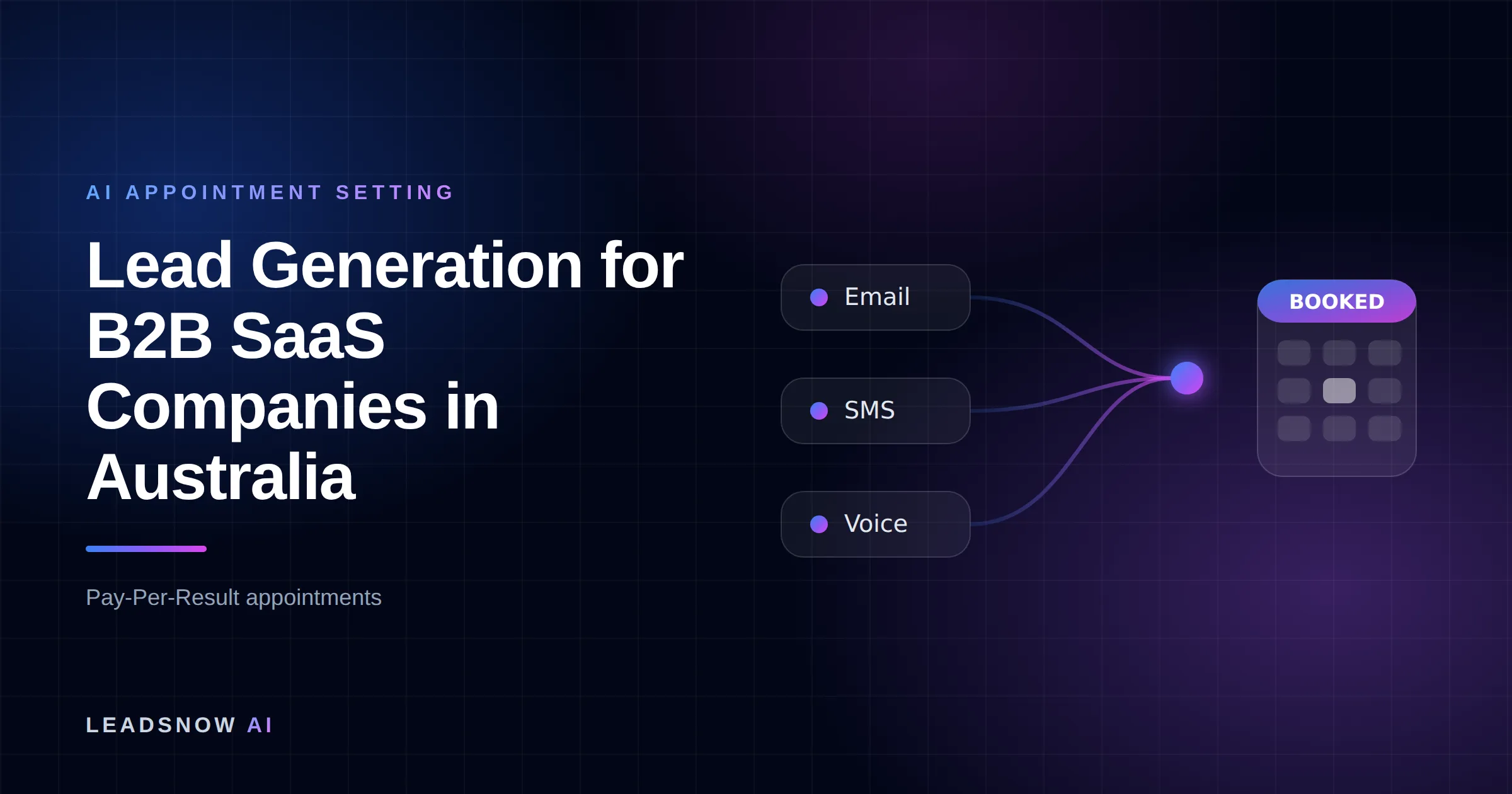
Every B2B SaaS founder in Australia has lived some version of this quarter: the product is good, the trials are trickling in, the board wants pipeline coverage — and the actual sales calendar is a mix of no-show demo slots, “circling back after budget review” threads, and an SDR hire you’re not sure is paying for itself. This page is about B2B SaaS lead generation in Australia as it actually works in 2026: why SaaS pipelines stall in predictable places, and where pay-per-result AI appointment setting fits when the metric that matters is qualified demos booked, not activity logged.
At a glance: Most Australian B2B SaaS companies don’t have a lead problem — they have a conversion-to-meeting problem. Trials sign up and go cold before anyone calls, demos no-show, and the in-house SDR maths only works at a headcount most local SaaS businesses can’t justify. LeadsNow runs the outbound, the instant trial follow-up and the long-cycle nurture, and charges per qualified demo booked — a decision-maker with a real problem your product solves, budget authority and a live timeline, sitting in your AE’s calendar. We run the same AI outbound engine on our own pipeline that we sell to yours, and you judge it the way your board judges everything else: on the ROI of closed ARR, not on dials made.
Five pipeline problems specific to B2B SaaS
1. Long sales cycles that outlast your follow-up
B2B SaaS deals in Australia routinely run months from first touch to signature, with more stakeholders in the room every year — procurement, security review, a CFO gating anything material. The lead that isn’t ready in March is often genuinely ready in July; the question is whether anyone from your side is still in the conversation by then. Most SaaS teams follow up twice, mark the deal “gone dark” and move on, which means the pipeline you paid to create quietly expires before the buying window opens.
2. Demo no-shows eat your AE calendar
A booked demo that doesn’t show costs you three times: the AE hour you blocked, the pipeline you forecast against it, and the momentum with a prospect who’s now awkward about rebooking. No-shows are mostly a qualification and confirmation failure, not a prospect character flaw — meetings booked with the wrong person, at the wrong stage, without a reason to turn up, don’t get turned up to.
3. The in-house SDR equation rarely closes at AU scale
A single SDR in Australia costs a full salary plus super, plus data, tooling and sequencing software, plus a ramp measured in months, plus a manager’s attention — before the first meeting is booked. At US-enterprise scale that maths can work. For an Australian SaaS company doing hundreds of thousands to a few million in ARR, one SDR is a concentrated bet: if they ramp slowly, leave at month nine, or simply aren’t good, you’ve spent a six-figure year learning it. You’re paying for activity and hoping for pipeline.
4. PLG vs sales-led is a false binary
Product-led growth is real, but “the product will sell itself” is doing a lot of unpaid work in most SaaS plans. The benchmark data is sobering: First Page Sage’s B2B SaaS funnel benchmarks (updated June 2025) put opportunity-to-close rates at 32–40% depending on channel — and that’s for opportunities, the leads that already made it to a real sales conversation. The signups that never get a human (or convincingly human) touch mostly never become opportunities at all. The companies winning in 2026 aren’t choosing PLG or sales-led; they’re putting a sales motion behind the product motion, so the hand-raisers inside the self-serve funnel actually get a hand back. That motion shouldn’t stop at the demo either — the same conversational layer that books demos also works registration, trial-to-paid, failed payments and cancellations, which is the full sequence we map out in our SaaS lifecycle revenue playbook.
5. Speed-to-lead on trial signups: the window is minutes, not days
Someone who starts a trial at 9:40pm on a Tuesday is at peak intent at 9:41pm. By the time an SDR works the list on Thursday morning, they’ve evaluated a competitor, hit a setup snag with nobody there to help, or simply cooled. Trial signups and demo requests are the most perishable leads in B2B — which is why we treat speed-to-lead automation as the first thing to fix in any SaaS engagement: an AI agent that responds within minutes, around the clock, qualifies in natural conversation and books the demo while intent is still hot.
How it works
How an AI sales agent books your appointments
Six channels feed in
Outbound email, SMS, voice and social — plus inbound search and AI referrals from our own AI SEO and chat agents.
Your list or CRM
Outbound starts from data you already own — past enquiries, dormant customers, or a targeted prospect list.
Qualified against your rules
Budget, timing and fit are checked before anything reaches your team, using criteria you set.
Booked into your calendar
Only qualified prospects reach the booking step, so your closers spend their time selling.
MAKE MORE SALES.
Pay-Per-Result pricing — We scale sales HARD aligned to your interests, better than anyone else.
Honest comparison: in-house SDRs vs PLG-only vs pay-per-result
| Approach | What it’s genuinely good at | Where it breaks for AU B2B SaaS | Cost structure |
|---|---|---|---|
| In-house SDR team | Deep product knowledge; tight feedback loop with AEs; full control of messaging and ICP | Salary, super, tooling and ramp are sunk whether or not meetings book; one or two hires is a fragile, concentrated bet; nights, weekends and 18-touch follow-up don’t happen; churn resets the ramp clock | Fixed cost, paid on activity — pipeline is the hoped-for output |
| PLG / self-serve only | Low CAC on the segment that self-converts; product is the demo; scales without headcount | Trial and freemium conversion leaves most signups on the table without a sales touch; nobody works the high-intent hand-raisers or expands them into larger contracts; enterprise and mid-market buyers still expect a human conversation | Low marginal cost, but conversion capped by what the product alone can close |
| Pay-per-result AI appointment setting | Instant response to trials and enquiries, 24/7; qualification against your ICP before anything hits an AE calendar; follow-up that persists for months without a human getting bored; charged per qualified demo booked | You’re buying the finished meeting, so unit price is higher than a raw lead; your AEs still have to run a good demo and close; needs a defined ICP and a clear offer to aim at | Variable — you pay when a qualified demo lands, not for the activity behind it |
These aren’t mutually exclusive — the strongest AU SaaS teams run a product motion and a sales motion and use pay-per-result to cover the gap between them. If you’re weighing up the charging models themselves, our breakdown of pay-per-lead vs pay-per-appointment in Australia covers why we anchor on the appointment, not the lead.
Want this done for you? We book qualified sales appointments on a Pay-Per-Result basis — you only pay for calls that actually land in your calendar.
How pay-per-result works when the client is a SaaS company
The model is simple to state: we build and run the outbound and inbound response, the AI handles qualification and follow-up, and you pay when a qualified demo is booked into your AE’s calendar. Not for a contact list, not for a retainer, not for “meetings-influenced” — for the meeting.
For B2B SaaS, “qualified” gets defined before anything launches, and it’s stricter than a trial signup:
- Decision-maker or genuine champion: someone who can buy your product or run the internal case for it — not a student poking at the free tier.
- ICP fit: right company size, industry and tech context, agreed with you up front.
- A live problem your product solves: a workflow breaking, a tool being replaced, a compliance or growth trigger — a reason your AE would want the meeting.
- A real timeline: evaluating this quarter, not “always happy to see a demo.”
Under the hood it’s the same machinery we run across professional services and finance: AI sales agents that respond to trial signups and demo requests in minutes, qualify in natural conversation, send the confirmations and reminders that keep no-show rates down, and — the part almost no SDR sustains — keep politely following up for as long as a SaaS buying cycle actually takes. The full mechanics are on our AI appointment setting page; the short version is that the system never gets bored on touch nine, and SaaS deals are routinely won on touch nine.
Two things this model deliberately does not do. It doesn’t replace your AEs — you still run the demo and close the deal; we get the right person into the room, showed up and pre-qualified. And it doesn’t hide behind activity metrics: because you pay per qualified demo, the only honest scoreboard is closed ARR against what the demos cost.
Proof: we run this engine on our own pipeline first
Across the wider business, the numbers are: 50,769+ AI-booked sales appointments since 2017 and 1M+ leads generated, for Australian clients including Foundr, Colliers, 121 Brokers, Iron Body, SheSells.online and Lambda Academy.
But here’s the proof point that matters most on a SaaS page: LeadsNow is itself a business that sells with AI outbound, and we drink our own champagne. Over the past nine months, our own internal pipeline — run on exactly the same AI outbound engine we deploy for clients — booked 1,425 appointments at a 3.9% booking rate. That’s not a client case study; it’s our own sales calendar, and it’s the same speed-to-lead, qualification and long-cycle follow-up machinery we’d point at your trial signups and target accounts.
On persistence specifically: the clearest client demonstration is 121 Brokers, where the AI re-engaged leads the team had already worked and written off and booked roughly 450 appointments from that dead database. SaaS teams have the same asset gathering dust — every closed-lost opportunity, expired trial and gone-quiet evaluation is a future deal if someone is still there when the timing turns.
Book a call — bring your ICP and your funnel numbers; we’ll tell you honestly whether pay-per-result fits.
If we can’t make you money, we don’t deserve yours.
Pay-Per-Result pricing — performance-based alignment.
Frequently asked questions
We’re product-led — trials convert on their own. Why add outbound at all?
Because the benchmarks say most of them don’t. First Page Sage’s SaaS free-trial benchmarks (updated September 2025) put opt-in trial-to-paid conversion at 18.2% for organic traffic and 17.4% for paid, and freemium-to-paid at under 3%. Even a well-run self-serve funnel leaves roughly four in five trialists unconverted — and inside that group are qualified buyers who hit a snag, got busy or needed one conversation to commit. A fast, well-qualified sales touch on that pool isn’t a betrayal of PLG; it’s the conversion layer PLG needs. And because you pay per qualified demo booked, working your own trial list carries no cost when nothing books.
What counts as a “qualified demo” for a SaaS company?
Whatever we agree before launch — and it’s written down, not vibes. Typically: ICP-fit company, a decision-maker or genuine internal champion, a live problem your product addresses, and an evaluation timeline this quarter. If a booked meeting doesn’t meet the agreed bar, it doesn’t count as a result. That definition exists precisely so the incentive stays honest: we’re paid for meetings your AEs thank us for, not for warm bodies on a calendar.
Wouldn’t hiring our own SDR be cheaper in the long run?
At sufficient scale, an in-house team is the right call, and we’ll say so when you’re there. Below that, compare totals honestly: an Australian SDR is a full salary plus super, data, tooling and months of ramp — all paid before and regardless of results — against a variable cost that only lands when a qualified demo does. The deeper difference is risk shape: one SDR is a single point of failure that sleeps, takes leave and might resign mid-ramp; the AI engine answers a 9:40pm trial signup at 9:41pm and runs the same cadence every day. Many clients eventually run both — the engine fills the calendar, humans close.
What about demo no-shows — how do you deal with them?
No-shows are mostly prevented, not managed. They spike when meetings are booked with poorly qualified prospects who had no real reason to attend, and drop when the person booked is a decision-maker with a live problem, booked while intent was hot, and reminded properly. That’s why the engine qualifies before booking and runs confirmation and reminder sequences as standard — and why responding within minutes of a trial or enquiry matters so much: meetings booked at peak intent get attended. How no-shows are treated against the qualified-appointment definition is agreed up front on the first call, in writing.
What does it cost?
We don’t publish a rate card, because the honest answer depends on your ACV, ICP and how strict the qualification bar is — that’s the first call. The structure is the point: you pay for qualified booked demos, not for activity, lists or a monthly retainer, and you judge it the way your board judges everything: closed ARR against what the demos cost. For a SaaS business with meaningful contract values, a single closed deal typically covers a long run of appointments — and if your numbers say otherwise, we’ll tell you and part friends. Our pay-per-lead vs pay-per-appointment comparison explains why we price on the meeting.
Stop forecasting hope
Pipeline coverage built on unworked trials and twice-touched leads isn’t coverage — it’s hope with a spreadsheet. The first step is a conversation: what a qualified demo looks like for your product, what your funnel is leaving on the table, and whether pay-per-result fits — straight answers either way.
Book a call — you pick the slot, no obligation.
Pay-Per-Result appointments
See if we’re a fit
We book qualified sales appointments for you and you pay on results, not retainers. Our booking page asks a few quick questions so you find out in two minutes whether that model suits your business.
- 50,769+ appointments booked without cold calling.
- Pay-Per-Result pricing — you pay for booked, qualified calls.
- Pick your own time on our live calendar, no phone tag.