
At a glance
You scale a sales funnel without hiring by putting AI on the repetitive, time-critical stages — instant lead response, qualification, long-term follow-up, appointment reminders and database reactivation — and keeping humans on the sales calls those systems book. AI removes the bottlenecks that normally force you to add headcount, so volume can double without your payroll doubling. Since 2017 this hybrid approach has booked 50,769+ AI-booked sales appointments and generated 1M+ leads.
Every growing business hits the same wall. Marketing works, lead volume climbs — and suddenly the funnel that ran fine at 100 leads a month is leaking badly at 300. The reflex answer is “hire another SDR.” Sometimes that’s right. Usually it’s expensive, slow and temporary, because the next growth spurt puts you straight back in the same spot.
The better question isn’t “how many people do we need?” It’s “which stages of this funnel actually need a person?” When you walk a funnel stage by stage, most of the leakage happens in work that is repetitive, time-critical and thankless — exactly the work AI now does better than a stretched human team. What’s left is the work humans genuinely win at: the sales conversation itself.
This post walks the funnel top to bottom — five bottlenecks, and for each one: why it breaks under volume, what AI does about it, and what stays human. It’s the same hybrid AI + human model we run for our own clients, so we’ll be specific about where the line sits.
How it works
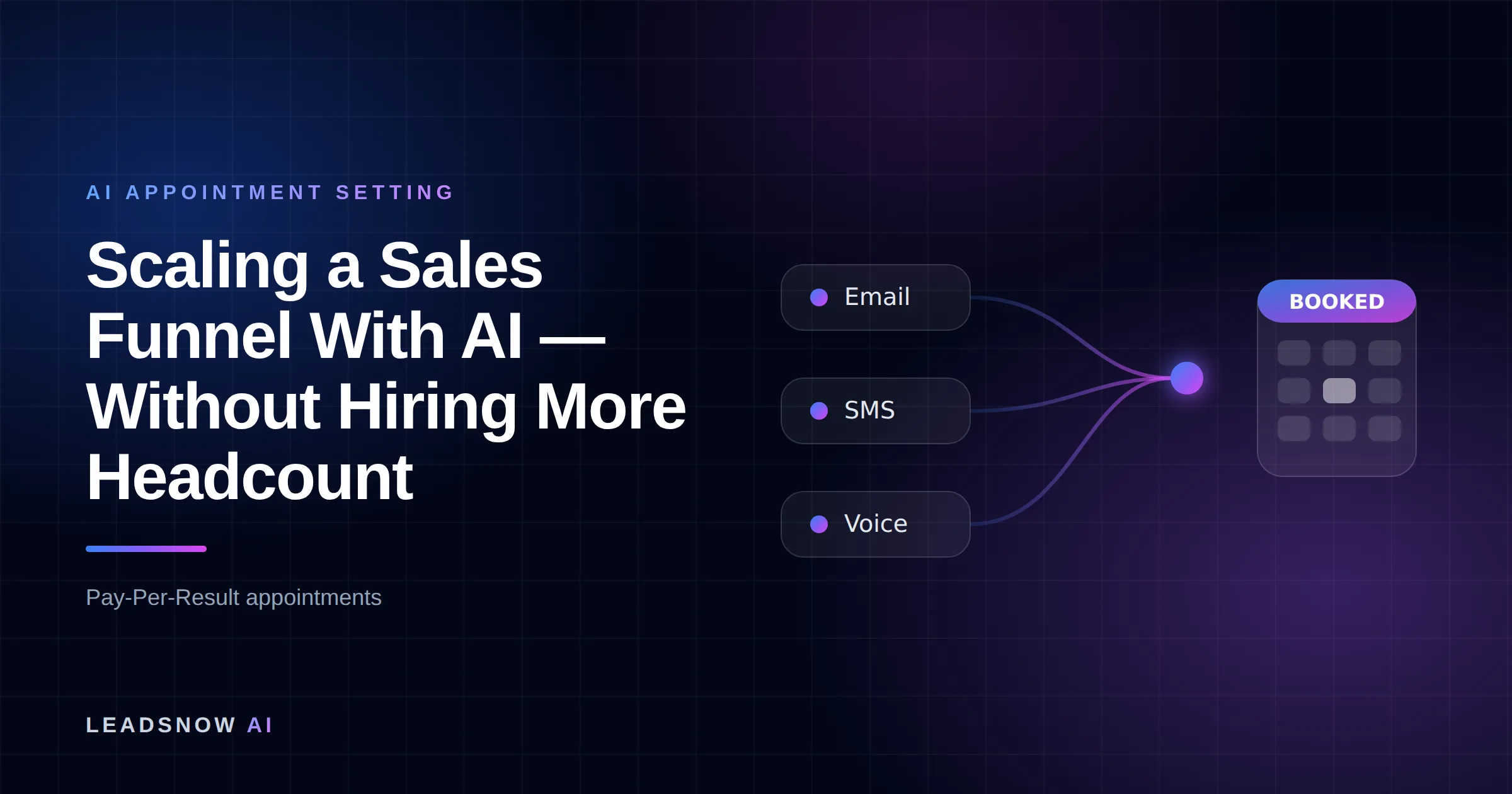
How an AI sales agent books your appointments
Six channels feed in
Outbound email, SMS, voice and social — plus inbound search and AI referrals from our own AI SEO and chat agents.
Your list or CRM
Outbound starts from data you already own — past enquiries, dormant customers, or a targeted prospect list.
Qualified against your rules
Budget, timing and fit are checked before anything reaches your team, using criteria you set.
Booked into your calendar
Only qualified prospects reach the booking step, so your closers spend their time selling.
MAKE MORE SALES.
Pay-Per-Result pricing — We scale sales HARD aligned to your interests, better than anyone else.
Why scaling with headcount alone stalls
Headcount scales linearly at best. Ten times the leads means roughly ten times the SDR hours — plus recruitment, ramp time, management overhead and churn. In Australia, a single SDR is a six-figure annual commitment once you count salary, super, tools and the manager time they consume, and they typically take months to reach full productivity. Then a percentage of them leave, and you start again.
Worse, humans don’t just cost more at scale — they get less consistent at scale. The tenth follow-up call of the afternoon is not as sharp as the first. Friday-evening leads wait until Monday. Nobody works the 11pm enquiry. None of that is a character flaw; it’s what happens when you ask people to do machine-shaped work.
So the goal isn’t “replace the sales team with AI.” Pure-AI funnels break at the close, where trust and judgment decide the deal. The goal is to stop buying human hours for the five funnel stages below, and spend them where they compound.
Want this done for you? We book qualified sales appointments on a Pay-Per-Result basis — you only pay for calls that actually land in your calendar.
Bottleneck 1: Speed to lead — the first response
Why it breaks: the maths of lead response are brutal and old news. The Lead Response Management study — run with Professor James Oldroyd on three years of data covering more than fifteen thousand leads and over a hundred thousand call attempts — found a 21x decrease in the odds of qualifying a lead when response time stretched from 5 minutes to 30 minutes, with the odds of making contact at all dropping more than tenfold within the first hour. Oldroyd’s follow-up research in Harvard Business Review concluded most companies simply aren’t responding anywhere near fast enough. (You’ll see wilder numbers quoted around the internet — “100x more likely!” — that we can’t verify at the primary source, so we won’t use them. The verified numbers are damning enough.)
What AI does: responds to every enquiry within minutes, 24/7, no roster gaps, no Mondays. An AI responder greets the lead, opens a natural conversation and moves them toward a booking while their interest is at its peak. Volume is irrelevant to it: lead number 300 this month gets the identical two-minute response that lead number 3 got. This is the single highest-leverage automation in the funnel, which is why we built speed-to-lead automation as a standalone service.
What stays human: nothing, at this stage — and that’s the point. No human team can match a two-minute response at midnight, and pretending otherwise is how pipeline dies quietly.
Bottleneck 2: Qualification
Why it breaks: as volume grows, the ratio of tyre-kickers to real buyers gets worse, and your best people spend more of their day discovering that a “lead” has no budget, no authority and no timeline. Qualification done by salespeople is the most expensive filtering mechanism ever devised.
What AI does: asks the qualifying questions in conversation — budget range, timeline, decision-maker, fit — naturally, before anything hits a calendar. Good leads get booked straight in; poor-fit leads get a polite exit or a nurture track; edge cases get flagged to a human. The filter applies your criteria identically every time, which humans, honestly, don’t.
What stays human: setting the criteria, and handling the flagged edge cases. A conversation the AI marks as “high value, unusual situation” should reach a person quickly. The machine sorts; a human judges the exceptions.
If we can’t make you money, we don’t deserve yours.
Pay-Per-Result pricing — performance-based alignment.
Bottleneck 3: Long-term follow-up and nurture
Why it breaks: most leads aren’t ready this week, and human follow-up decays fast — a couple of attempts, then the lead slides into CRM sediment. Persistence over weeks and months is precisely the task humans abandon first when they’re busy, and busy is the definition of a scaling team.
What AI does: runs patient, personalised follow-up over 6, 12, 24 months without ever getting bored or embarrassed about the ninth touch. The moment a “not yet” lead replies “actually, let’s talk,” it books the call. We’ve written up how this works in practice in our guide to AI lead nurture and long-term follow-up. The commercial effect is that leads you already paid to acquire keep converting for years instead of weeks — volume growth without any new spend.
What stays human: the occasional strategic touch on named, high-value accounts, and the sales call when the lead re-engages. Nobody should be manually sending “just checking in” messages in 2026.
Bottleneck 4: Show-rate protection
Why it breaks: booking the appointment is only half the job. No-shows scale with volume too, and every empty calendar slot is a closer’s hour incinerated. Teams under load skip confirmations first — it feels optional right up until a third of the calendar doesn’t show.
What AI does: runs the whole confirmation choreography automatically: instant booking confirmation, reminders on the right cadence, easy rescheduling instead of silent no-shows, and immediate rebooking chases when someone does miss. It never forgets a reminder because it never has a busy day.
What stays human: the appointment itself, run well and on time — and the judgment call on chronic reschedulers. A protected show rate is what makes every upstream automation actually pay.
Bottleneck 5: Database reactivation — the volume you already own
Why it breaks: scaling conversations always assume new leads, while thousands of old ones sit dormant in the CRM — already paid for, already familiar with you, ignored because working an old list is slow, awkward manual labour no one has capacity for.
What AI does: re-opens those conversations at scale with a natural, low-pressure message, filters the responses and books the warm ones. This is “found volume”: pipeline growth with zero acquisition cost and zero new hires. In our own reactivation campaigns for Colliers, we booked appointments from a dormant database at a 4.4% average conversion of the list contacted, peaking at 8.9% — on leads the business had already written off. Details on how we run these are in our database reactivation service page.
What stays human: the calls. A reactivated lead who books a meeting deserves your best closer, not another bot.
Headcount vs AI: what scaling actually looks like
| Scaling with headcount | Scaling with AI + existing team | |
|---|---|---|
| Cost shape | Linear or worse — every step up in volume means salaries, super, tools and management overhead | Largely flat — the same system handles 100 or 1,000 leads a month; costs step up far more slowly than volume |
| Ramp time | Months per hire: recruit, onboard, train, wait for productivity | Weeks to configure and integrate; no ramp per additional lead |
| Capacity ceiling | Hard ceiling per person — hours in a day, calls per hour, one conversation at a time | Effectively none at the response, qualification and follow-up stages; hundreds of simultaneous conversations |
| Consistency | Varies by person, mood, day and workload; Friday-night leads wait until Monday | Identical response speed and script discipline for every lead, 24/7 |
| Coverage hours | Business hours, minus meetings, leave and sick days | 24/7 including weekends and public holidays |
| What breaks first | Follow-up persistence and after-hours response — then morale, then retention | Complex edge cases and closing conversations — which is exactly where the humans are |
Read the last row twice. Both models break somewhere. The difference is that the AI model breaks precisely where you’ve kept your people, while the headcount model breaks in the invisible, repetitive stages where nobody notices until pipeline dries up.
What stays human — and why this is a hybrid model, not a robot takeover
Everything above funnels toward one moment: a qualified, confirmed prospect on a call with a human who can build trust, handle a curly objection and close. AI doesn’t do that moment well, and we don’t pretend it does. What AI does is make sure that moment happens far more often per salesperson — because nobody on your team is burning hours chasing, filtering, reminding or re-warming.
That’s the whole argument for the hybrid model: machines for leverage, humans for judgment. It’s how we’ve booked 50,769+ AI-booked sales appointments since 2017 and generated over 1M leads for clients like Sam Tajvidi of 121 Brokers, Colliers and Marcus Wilkinson of Iron Body — there are 25 filmed client case studies if you want to hear it in clients’ own words, and we hold a 4.6/5 rating from 43 Google reviews. The economics anchor on closed deals: if the appointments the system books don’t turn into revenue that comfortably outweighs the cost, the model has failed — which is why we price on results rather than retainers.
How to sequence it (if you’re doing this yourself)
You don’t have to automate all five stages at once. The order that pays fastest, in our experience:
1. Speed to lead first. Biggest verified evidence base, fastest payback, no dependency on anything else.
2. Show-rate protection second. Cheap to implement and it multiplies the value of every booking you’re already getting.
3. Qualification third, once response volume is flowing and you can see what your closers’ calendars are filling with.
4. Long-term nurture fourth — it compounds slowly, so start it before you think you need it.
5. Database reactivation whenever you want a step-change — it’s the one lever that produces a burst of “new” pipeline in weeks from assets you already own.
FAQ
Can you really scale a sales funnel without hiring more salespeople?
Yes, up to the point where your closers’ calendars are genuinely full. AI removes the ceiling at the response, qualification, follow-up and confirmation stages, which is where most funnels actually leak. You’ll still eventually hire more closers — but you’ll hire them because booked, qualified appointments are overflowing, not because raw leads are going unanswered.
Does AI in the sales funnel actually move revenue, or is it hype?
The best independent data point we know of comes from Salesforce’s sixth State of Sales report, a survey of 5,500 sales professionals across 27 countries, which found that 83% of sales teams using AI saw revenue growth that year, versus 66% of teams without it. That gap won’t all be caused by AI, but it’s consistent with what we see: the teams that automate the repetitive funnel stages simply work more of their pipeline.
Which funnel stage should we automate first?
Speed to lead. It has the strongest verified research behind it, it requires no changes to the rest of your process, and the payback shows up within weeks because you stop losing the leads you’re already paying for.
Will leads be put off talking to an AI?
In practice, what leads care about is a fast, useful reply and an easy way to book — not who typed it. The conversations are natural and written around your business, and anything the AI can’t handle gets flagged to a person. The alternative isn’t “a human responds instead”; at scale, the alternative is usually that nobody responds for hours.
What can’t AI do in a sales funnel?
Close. High-stakes conversations — complex objections, negotiation, trust-building on a big-ticket decision — still belong to humans, and in our view will for a long time. AI’s job is to make sure your humans spend their hours in those conversations instead of in follow-up admin.
How is this different from just buying a chatbot or an email tool?
Tools automate a task; the bottlenecks are in the handoffs between tasks. A chatbot that answers questions but doesn’t qualify, book, remind and re-chase just moves the leak. The gains come from wiring the whole path — enquiry to confirmed, qualified appointment — so nothing depends on a busy human remembering to act.
How do we know if it’s working?
Track four numbers: median first-response time, lead-to-appointment rate, show rate, and revenue per closer per month. If the system is doing its job, the first falls to minutes, the next two climb, and the last one — the one that matters — climbs with them. Anchor every review on closed-deal revenue against what you’re paying, not on activity metrics.
See where your funnel would scale first
If lead volume is climbing and the hiring conversation has started, it’s worth mapping the funnel before signing offer letters. Book a call and we’ll walk your current lead flow stage by stage, show you where the leaks are and what automating each one is worth — and if we don’t think it’ll work for your business, we’ll tell you.
Pay-Per-Result appointments
See if we’re a fit
We book qualified sales appointments for you and you pay on results, not retainers. Our booking page asks a few quick questions so you find out in two minutes whether that model suits your business.
- 50,769+ appointments booked without cold calling.
- Pay-Per-Result pricing — you pay for booked, qualified calls.
- Pick your own time on our live calendar, no phone tag.