
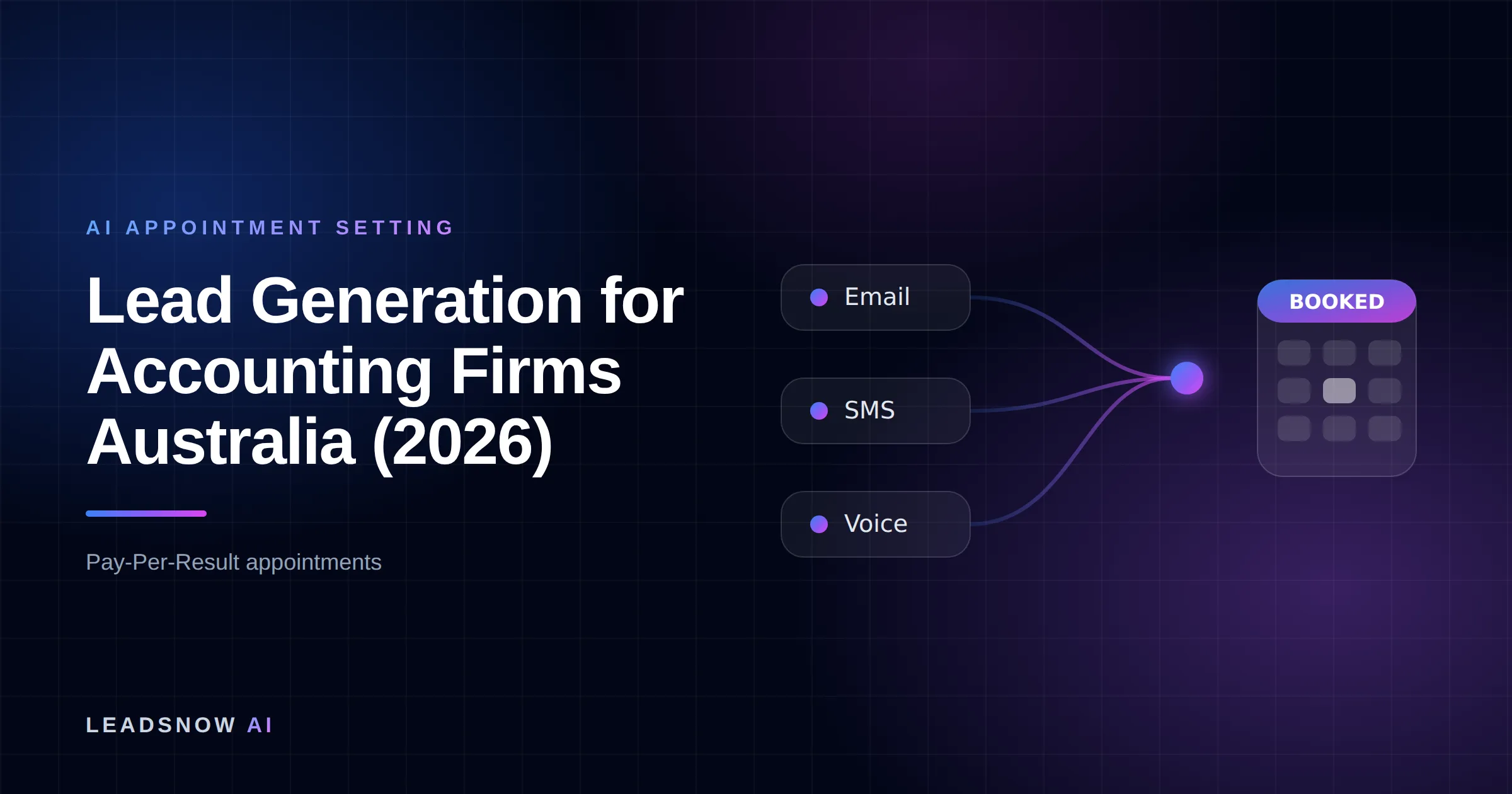
Most Australian accounting firms grow the same way: word of mouth, a referral relationship with a lawyer or broker or two, and clients who arrive because their old accountant retired. It works — until you want it to happen on purpose. One quarter the firm is flat out through lodgement season; the next, the partners are looking at capacity in the advisory team and no reliable way to fill it. That isn’t a marketing failure. It’s the predictable result of a pipeline the firm doesn’t control — referrals arrive on someone else’s schedule, in someone else’s volume, and almost always for compliance work rather than the advisory engagements you actually want to grow.
This page is the hub for accounting firm lead generation in Australia — how partners at compliance and advisory practices build a predictable new-client engine without buying shared lead lists, hiring a business-development person who spends a year “building relationships”, or locking into a retainer that bills whether meetings land or not. For the deeper mechanics, we’ve linked our guide to AI appointment setting in Australia and our work in adjacent verticals like lead generation for financial advisers throughout.
At a glance
Q: How do accounting firms generate leads in Australia in 2026?
Most Australian firms still rely on referrals and walk-in compliance work — high-trust, but unpredictable and skewed toward the lowest-margin services. In 2026 the shift is toward targeted outreach and AI-assisted appointment setting that books qualified new-client meetings — business owners with a defined need, a real timeline and the authority to switch — straight into a partner’s diary. LeadsNow’s pay-per-result model means you don’t buy lead lists or fund a monthly retainer: you pay for qualified booked appointments, and the engagement is judged on closed-deal ROI, not cost-per-lead. The delivery risk sits with the agency, so a firmer cost per appointment reflects tighter qualification, not waste.
How it works
How an AI sales agent books your appointments
Six channels feed in
Outbound email, SMS, voice and social — plus inbound search and AI referrals from our own AI SEO and chat agents.
Your list or CRM
Outbound starts from data you already own — past enquiries, dormant customers, or a targeted prospect list.
Qualified against your rules
Budget, timing and fit are checked before anything reaches your team, using criteria you set.
Booked into your calendar
Only qualified prospects reach the booking step, so your closers spend their time selling.
MAKE MORE SALES.
Pay-Per-Result pricing — We scale sales HARD aligned to your interests, better than anyone else.
Why referral-only pipelines cap an accounting firm’s growth
Referrals are the best clients you’ll ever get. A business owner introduced by their lawyer or an existing client arrives pre-sold on trust — which is exactly what an accounting relationship runs on. Nobody is suggesting you stop nurturing those relationships. They should stay the foundation.
The problem is capacity and control. You can’t dial referrals up when the advisory team has room, and you can’t target the client profile you actually want — the $2m-turnover trades business that needs structure advice, the medical practice outgrowing its bookkeeper, the e-commerce founder who’s never had a management report. Every introduction is downstream of relationships you’ve already built, so the pipeline is permanently one client behind the firm’s ambition.
The usual fallbacks each have a catch. Directory listings and “find an accountant” marketplaces produce price-shoppers comparing you against four other firms on fees. SEO compounds beautifully but takes quarters to produce its first client. Paid ads generate enquiries fast — and then leak, because form-fills that aren’t called back within minutes go cold while everyone billable is mid-deadline. We’ve written up why that window matters in our piece on the 5-minute speed-to-lead rule in Australia; accounting firms, structurally busy and partner-bottlenecked, are among the worst offenders through no fault of their own.
Want this done for you? We book qualified sales appointments on a Pay-Per-Result basis — you only pay for calls that actually land in your calendar.
Compliance walks in the door; advisory has to be sold
There’s a second, quieter cap on growth that’s specific to accounting. Compliance work — BAS, tax returns, annual financials — largely arrives on its own, because it’s mandatory. Advisory work isn’t. Virtual CFO services, structuring, forecasting, exit planning: the clients who most need those engagements rarely wake up searching for them, and referral partners mostly send you compliance-shaped problems.
That means the highest-margin part of a modern firm is the part with the weakest natural lead flow. If the plan for growing advisory revenue is “wait for compliance clients to ask”, the plan is hope. A deliberate outbound engine — one that starts conversations with the right businesses before they’ve picked a firm — is how advisory-led practices actually fill that capacity.
How pay-per-result lead generation works for accounting firms
Pay-per-result inverts the usual risk. Instead of paying upfront for ad spend, a lead list or a retainer that bills regardless of outcome, you pay for a defined outcome: a qualified, exclusive new-client appointment booked into a partner’s diary.
In practice, the machine has three parts:
1. Targeted demand capture
We run offers aimed at the client profile you define — industry, turnover band, service need — so the conversation starts with businesses worth having, not whoever a directory sends past. Enquiries are exclusive to your firm. Nothing is shared, resold or recycled.
2. AI-assisted engagement, instantly and persistently
Our AI agents respond to every enquiry within minutes — including the 7pm Sunday form-fill no firm answers — then follow up persistently over days and weeks. This is the part humans reliably drop. A partner-led firm can’t have someone chase every lukewarm enquiry eleven times; an AI agent doesn’t get bored, doesn’t get busy in March and September, and doesn’t decide a prospect is dead after two attempts. The full mechanics are in our AI appointment setting guide for Australia.
3. Qualification before the diary
Before anything reaches you, prospects are screened against the criteria we agree upfront — the nature and size of the business, the service need, the timeline, and whether the person booking can actually engage a new accountant. You take meetings, not maybes.
Because you pay on booked qualified appointments, the incentives point the right way: we only win when a partner sits down with a business genuinely worth pitching. And because the engagement is judged on closed-deal ROI — new recurring fees against what the appointments cost — the number that matters is the same one you’d use to judge any hire or partner: what did it return?
Book a call and we’ll map what a qualified appointment looks like for your firm.
If we can’t make you money, we don’t deserve yours.
Pay-Per-Result pricing — performance-based alignment.
What counts as a qualified accounting appointment
Loose definitions are where lead generation goes to die, so ours is explicit. A qualified appointment for an accounting firm means:
- A real business or individual in your target profile — the industry, entity type and rough turnover band you’ve told us you want.
- A defined need — switching accountants, outgrowing a bookkeeper, needing advisory, structuring or CFO-level support, not idle curiosity.
- A live timeline — an intention to act this quarter or next, not “maybe after the next financial year”.
- Authority — the owner or decision-maker, not someone gathering quotes for a committee that doesn’t exist yet.
If a booking misses those, it isn’t counted as a result. That discipline is the whole point of pay-per-result: your partners’ time is the firm’s inventory, and an hour in a meeting that was never going to convert is an hour you can’t bill and can’t get back.
Proof from adjacent professional services
Accounting is a professional-services sale: high trust, high lifetime value, considered, and relationship-led. The closest published proof in our portfolio comes from the same regulated, finance-adjacent mould — our work with 121 Brokers, a finance-broking firm.
121 Brokers didn’t need more leads — like most established practices, they were sitting on years of them. We pointed our AI agents at their own database: leads the team had already worked, many literally tagged as junk. From that written-off pool, the AI re-engaged and booked roughly 450 appointments — including a $700k deal from a prospect the AI followed up 18 times before the meeting landed. No human team follows up a junk-tagged lead eighteen times. That persistence, applied to a professional-services database, is the mechanism — and it’s exactly what our database reactivation service does for firms sitting on a decade of unconverted enquiries and lapsed clients.
The wider machine behind it is the one we point at every market: 50,769+ AI-booked sales appointments since 2017, 1M+ leads generated, a body of work documented in 25 filmed client case studies, and a 4.6★ rating from 43 Google reviews. We run the same model for financial advisers and other professional-services firms where the sale, like yours, is won on trust and timing.
Referrals vs SEO vs paid ads vs AI appointment setting
Every channel below can work. The question for a partner-run firm is what each one costs in effort, how long it takes to produce a client, and how predictable it is once running.
| Referrals | SEO / content | Paid ads (DIY) | AI appointment setting (pay-per-result) | |
|---|---|---|---|---|
| Effort from partners | Ongoing relationship upkeep, networking | High and sustained — content, technical, months of it | High — campaigns, landing pages, chasing every enquiry fast | Low — define the ideal client, take the meetings |
| Time to first client | Unknowable — arrives when it arrives | Typically quarters, not weeks | Fast to first enquiry; slower to first good client | Weeks — appointments start once the campaign is live |
| Predictability | Feast or famine | Compounds, but slow to start and hard to steer | Volatile — auction prices, ad fatigue, leaky follow-up | A steady, dial-able flow of qualified meetings |
| What you pay for | Time and reciprocal favours | Content and time, win or lose | Clicks and form-fills, qualified or not | Qualified booked appointments, judged on closed-deal ROI |
| Who it suits | Every firm — as a foundation, not a growth plan | Firms playing a 2–3 year brand game | Firms with in-house marketing capacity and fast follow-up | Partner-led firms that want advisory-capacity filled without hiring marketers |
The through-line: raw enquiries and qualified appointments are different products. Referrals and SEO should absolutely keep running — pay-per-result appointment setting is the controllable layer on top, so a quiet quarter never turns into a scramble.
Frequently asked questions
Is pay-per-result better than a retainer for accounting firm lead generation?
For most firms, yes — a retainer bills every month whether or not a qualified meeting lands, which puts the delivery risk on you. Pay-per-result flips that: you pay when a qualified, exclusive new-client appointment is booked, so the agency’s incentives are aligned with the outcome that matters — new recurring fees, not activity reports. Judge it the way you’d judge any engagement: closed-deal ROI.
What makes an accounting appointment “qualified”?
Four things: a business or individual in your target profile, a defined service need you actually want to sell, a real timeline to act, and the authority to engage a new accountant. If a booking misses those criteria, it isn’t counted as a result — and you don’t pay for it.
Does this work for compliance-led firms, or only advisory practices?
Both, but the leverage differs. Compliance-led firms use it to add clients in a chosen niche instead of taking whatever walks in. Advisory-led firms get the bigger win: advisory engagements rarely arrive by referral, so a deliberate outbound engine is usually the only way to fill that higher-margin capacity on purpose.
Why pay for booked appointments instead of buying leads?
Because most leads never become clients, and paying per lead means paying for that waste. Australian agency ROI’s published benchmarks put the average lead-to-customer conversion rate across all industries at just 2.5%–5%, and note that highly considered purchases — their examples include financial planning — often convert below 2%. Accounting sits squarely in that considered, trust-led category. Paying only for a qualified appointment that’s already been screened and booked strips most of that waste out before it reaches a partner’s diary.
Every firm has the same qualifications — how do we actually stand out?
Not on credentials. CPA Australia alone describes its membership as more than 176,000 professionals across 150 countries and regions — from a prospect’s chair, one qualified accountant looks much like another. What differentiates in practice is who answers first, who follows up, and who turns an enquiry into a structured conversation about the prospect’s business. That’s a systems advantage, not a branding one — which is why speed to lead and persistent follow-up beat another website refresh.
We’re sitting on years of old enquiries and lapsed clients. Is that worth anything?
Usually it’s the most valuable asset the firm isn’t using. That’s precisely what the 121 Brokers engagement proved in an adjacent finance vertical — around 450 appointments booked from leads their own team had already worked and written off. Our database reactivation service applies the same play to accounting firms’ practice-management and CRM databases, and it’s typically the fastest first win because the audience already knows you.
How much does accounting firm lead generation cost in Australia?
We don’t anchor on a per-lead price, because raw leads and qualified appointments are different products. With pay-per-result you pay for qualified booked appointments — and the engagement stands or falls on closed-deal ROI: new recurring compliance and advisory fees against what the appointments cost. Given the multi-year lifetime value of an accounting client, that maths is the conversation worth having, and it’s exactly what we map on a first call.
Book a call
If your firm’s growth plan is “referrals plus hope”, the fix isn’t more networking breakfasts — it’s a controllable channel that books the right new-client conversations while your team stays billable. Let’s map what a qualified appointment looks like for your firm, which services you want to grow, and whether pay-per-result fits.
Book a call with the LeadsNow team. No retainer pitch, no price games — just a straight conversation about your pipeline.
Pay-Per-Result appointments
See if we’re a fit
We book qualified sales appointments for you and you pay on results, not retainers. Our booking page asks a few quick questions so you find out in two minutes whether that model suits your business.
- 50,769+ appointments booked without cold calling.
- Pay-Per-Result pricing — you pay for booked, qualified calls.
- Pick your own time on our live calendar, no phone tag.