
How do accounting firms get new clients in Australia?
Australian accounting firms win new clients through seven repeatable channels: referrals and existing-client expansion, partner networks (brokers, lawyers, bookkeepers), SEO plus AI-search visibility, LinkedIn and content, paid search, outbound with AI appointment setting, and reactivating their own dormant client and enquiry base. Referrals still deliver the highest-trust clients, but they cap out at whatever your current clients happen to send you. The fastest-moving shift in 2026 is AI-search visibility — business owners now ask ChatGPT and Google’s AI results “who’s the best accountant for a trades business in Melbourne?” and the firms those engines name win the enquiry before anyone Googles a shortlist. The most predictable channel is pay-per-result appointment setting, where you pay for qualified booked consultations rather than clicks or retainers. Most growing firms run three or four of these channels at once; this guide ranks all seven by cost, effort and time-to-first-client so you can pick deliberately. For the full playbook on running lead generation as a firm, see our lead generation for accounting firms in Australia guide — this article is the channel-by-channel ranking that sits behind it.
A note on who’s writing this: we’re LeadsNow.ai, a Melbourne pay-per-result lead generation and AI appointment setting agency — 50,769+ AI-booked sales appointments since 2017, 1M+ leads generated, 4.6★ from 43 Google reviews. We make money from one of the seven channels below; we’ve ranked all seven honestly anyway, because a firm that picks the wrong channel churns out of every agency’s books within a quarter.
How it works
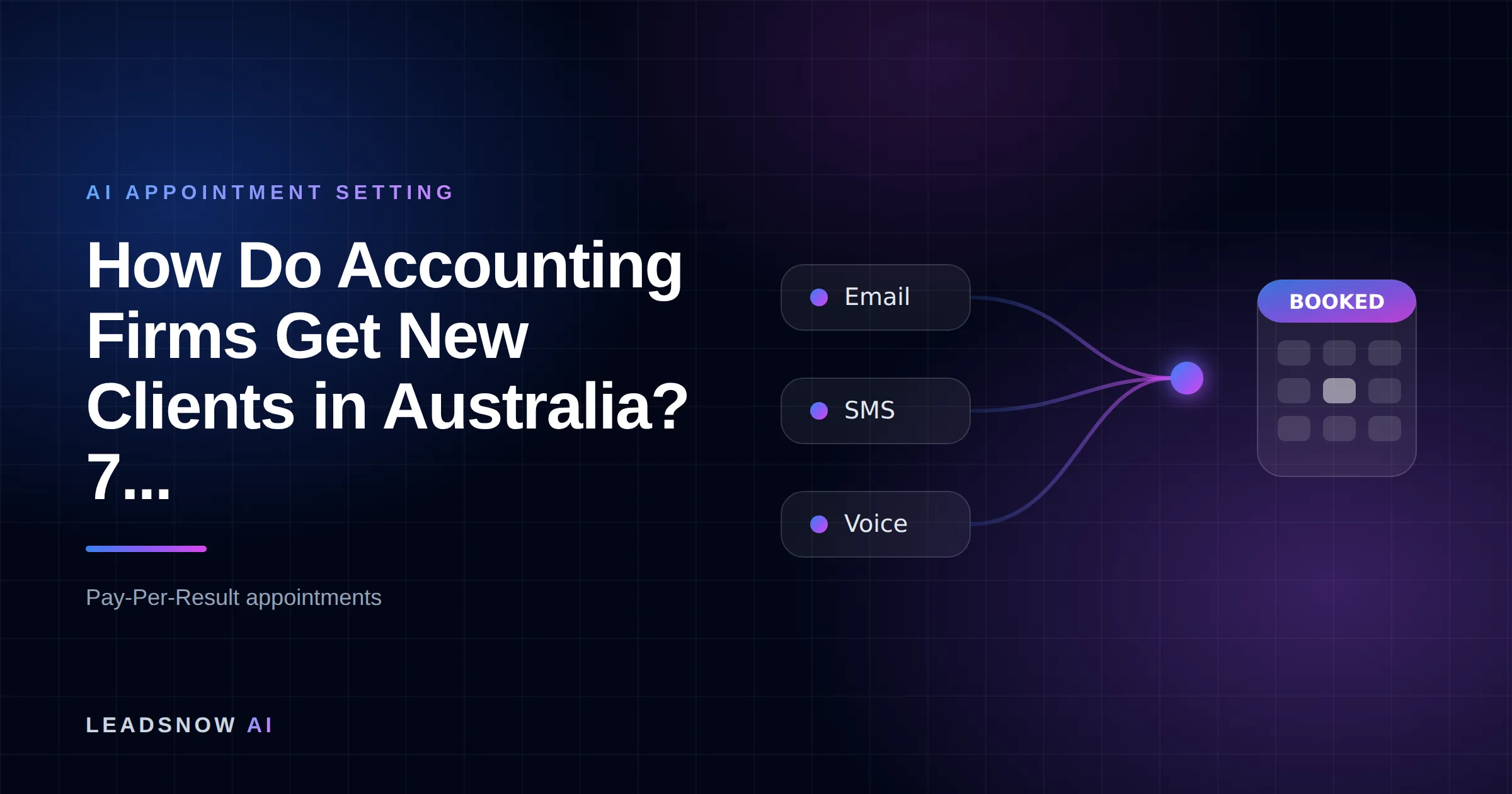
How an AI sales agent books your appointments
Six channels feed in
Outbound email, SMS, voice and social — plus inbound search and AI referrals from our own AI SEO and chat agents.
Your list or CRM
Outbound starts from data you already own — past enquiries, dormant customers, or a targeted prospect list.
Qualified against your rules
Budget, timing and fit are checked before anything reaches your team, using criteria you set.
Booked into your calendar
Only qualified prospects reach the booking step, so your closers spend their time selling.
MAKE MORE SALES.
Pay-Per-Result pricing — We scale sales HARD aligned to your interests, better than anyone else.
The seven channels compared
| Channel | Cost / effort | Time to first client | Predictability | Best suited to |
|---|---|---|---|---|
| 1. Referrals & client expansion | Low cost, ongoing relationship effort | Weeks–months (irregular) | Low — you can’t schedule a referral | Every firm; the baseline, not the growth plan |
| 2. Partner networks | Low cost, high relationship effort | 1–6 months | Medium once established | Firms with a clear niche partners can describe |
| 3. SEO + AI-search visibility | Medium cost, sustained content effort | 3–12 months | Medium–high once ranking / cited | Firms playing a 12-month game in a defined niche |
| 4. LinkedIn & content | Low cost, high personal effort | 2–6 months | Low–medium | Partners willing to publish consistently |
| 5. Paid search | High cost, medium effort | Days–weeks | Medium — leads, not clients, are predictable | Firms with capacity now and follow-up discipline |
| 6. Outbound + AI appointment setting | Pay-per-result options; low internal effort | Days–weeks | High — booked consultations, not clicks | Firms that want a schedulable pipeline |
| 7. Database reactivation | Very low cost — the list already exists | Days | High for one-off bursts | Any firm 3+ years old with old enquiries or lapsed clients |
Want this done for you? We book qualified sales appointments on a Pay-Per-Result basis — you only pay for calls that actually land in your calendar.
1. Referrals and existing-client expansion — still #1, but it caps out
Effort: low cost, continuous relationship work · Time to first client: unpredictable · Suits: every firm, as a floor not a ceiling.
Ask any partner where their best clients came from and the answer is usually “a client sent them”. Referred clients arrive pre-sold, negotiate less and stay longer — and moving a compliance-only client into advisory or tax planning is the cheapest revenue a firm will ever add, because the trust is already built.
The problem isn’t quality — it’s arithmetic. Referrals scale with your client base, not with your ambition. A 200-client firm generates roughly the same trickle of introductions every year no matter how hungry the partners are, and you can’t schedule a referral the way you can schedule a campaign. Firms that treat referrals as their growth strategy grow at the speed of luck. Treat them as the baseline that every other channel builds on: make asking systematic (post-lodgement, post-win, annually), make it easy to introduce you, and thank people fast. Then add channels you can actually control.
2. Partner networks: brokers, lawyers and bookkeepers
Effort: low cash cost, high relationship effort · Time to first client: one to six months · Suits: firms with a niche a partner can describe in one sentence.
Finance brokers, commercial lawyers, financial planners and bookkeepers all sit in front of your ideal clients at moments when accounting help is the obvious next step — a business purchase, a restructure, a lending application that needs clean financials. A handful of active referral partnerships can outproduce a firm’s entire marketing budget.
The catch is that partnerships are earned slowly and die quietly. They work when the referral flows both ways and when the partner can describe exactly who you’re for — “they’re the firm for medical practices” travels; “they’re a good general accountant” doesn’t. Budget real time: coffees, co-hosted client sessions, fast turnaround on anything a partner sends. Expect months before the first introduction, and treat every referred client’s experience as marketing to the partner who sent them.
If we can’t make you money, we don’t deserve yours.
Pay-Per-Result pricing — performance-based alignment.
3. SEO and AI-search visibility — the channel that changed shape in 2026
Effort: medium cost, sustained content effort · Time to first client: three to twelve months · Suits: firms willing to play a long game in a defined niche.
Classic SEO for accountants still works: rank for “accountant + suburb” and “accountant for + industry”, collect enquiries indefinitely at zero marginal cost. But the search behaviour underneath it has split. A growing share of business owners no longer scan ten blue links — they ask ChatGPT, Gemini, Perplexity or Google’s AI answers a full question: “Who’s a good accountant for an ecommerce business in Brisbane?” The engine replies with a handful of named firms. If yours is one of them, you receive the enquiry before a shortlist ever exists. If it isn’t, you were never in the running.
Earning those citations is a discipline of its own — answer-engine optimisation (AEO) — and it rewards different things than classic SEO: direct answers to the exact questions buyers ask, named specialisation, consistent entity details across your site and directories, real proof (reviews, case studies, published numbers) that engines can quote. Question-form pages that open with a genuine answer, comparison tables, FAQ schema — the formats engines lift from — matter more than keyword density ever did.
Two honest caveats. First, it’s slow: months of consistent publishing before either Google or the AI engines trust you for a topic. Second, it’s measurable, and most firms don’t measure it — you can test today whether any AI engine recommends your firm by asking the engines your buyers’ questions and logging the answers. We published a free do-it-yourself method for exactly that: track your own AI-search visibility. Run it before you spend a dollar on this channel; the gap between firms that appear and firms that don’t is the clearest brief you’ll ever write.
4. LinkedIn and content: slow compounding, partner-powered
Effort: low cash cost, high personal consistency · Time to first client: two to six months · Suits: partners who will actually publish.
Accounting buys are trust buys, and LinkedIn is where business-owner trust compounds in public. A partner who posts twice a week — plain-English takes on tax changes, what the ATO’s latest position actually means for a cafe owner — becomes the accountant that owner thinks of first, months before they’re ready to switch. Content also feeds channel 3: the same expertise, written properly on your site, is what AI engines cite.
The failure mode is well known: three enthusiastic weeks, then silence until next financial year. This channel only works as a habit, it rarely works delegated to a junior, and it converts on the timeline of the reader’s dissatisfaction with their current accountant — which you don’t control. Run it as a compounding asset alongside faster channels, not instead of them.
5. Paid search: fast leads, contested and expensive
Effort: high cash cost, medium management effort · Time to first client: days to weeks · Suits: firms with capacity now and follow-up discipline.
Google Ads on “accountant near me” and “small business accountant [city]” produces enquiries within days — it’s the fastest way to buy intent that exists. It’s also the most contested real estate in professional-services marketing, with every competitor bidding the same handful of phrases, so cost per lead is high and climbing.
The uncomfortable truth about paid search is that most of the waste happens after the click. A form-fill is not a client; it’s a race. Enquiries answered within minutes convert at multiples of enquiries answered the next morning — we’ve written up the evidence in the 5-minute rule for speed to lead — and an accountant mid-BAS-season is rarely the person answering in five minutes. If you run paid search, pair it with instant, automated first response or accept that a large share of your ad spend is buying leads for whichever competitor calls back first.
6. Outbound and AI appointment setting: the schedulable channel
Effort: pay-per-result options exist; low internal effort · Time to first client: days to weeks · Suits: firms that want pipeline they can plan around.
Everything above waits for the buyer to move. Outbound goes and gets them: identifying businesses that fit your best-client profile, opening the conversation, qualifying, and booking them straight into a partner’s calendar. Traditionally that meant hiring an SDR — a salary, months of ramp, and a role most sub-20-staff firms can’t justify. What’s changed is that AI appointment setting now does the persistent part — the outreach, the instant replies at 9pm, the fifth and twelfth follow-up no human sustains — and hands your team a calendar of qualified, booked consultations.
The structural advantage is the commercial model: done pay-per-result, you pay for qualified booked appointments, not for activity or promises. Every other channel on this list bills you regardless of outcome; this one only earns when a qualified prospect is sitting in your calendar. That’s why we rank it the most predictable channel for a firm that needs new clients this quarter, not next year. The honest caveat: qualification standards are everything — interrogate any provider on how “qualified” is defined and what happens when a booking doesn’t meet it.
7. Reactivating your dormant client and enquiry base
Effort: very low — the list already exists · Time to first client: days · Suits: any firm more than about three years old.
This is the channel almost every established firm overlooks, and it’s usually the cheapest revenue available. Years of practice leave a sediment layer of past enquiries that never signed, one-off engagements, and lapsed clients who drifted away. Those people already know your name. A structured database reactivation campaign — a short, well-written burst of messages with AI handling the replies and booking the conversations — routinely turns that sediment into consultations within days, at near-zero acquisition cost because the list is already paid for.
The proof point we point professional-services firms to is 121 Brokers, a finance brokerage — an adjacent professional-services business with the same trust-based, considered sale as accounting. We re-engaged their own already-worked leads, including ones their team had tagged as junk, and the campaign booked around 450 appointments from that “dead” list — among them a $700k deal the AI followed up 18 times before it landed. No accountant’s junior is chasing a five-year-old enquiry eighteen times. Software doesn’t get embarrassed, which is precisely why the channel works.
Which channels should your firm actually run?
Nobody runs all seven well. A sensible 2026 stack for a growth-minded Australian firm looks like this:
- Keep, systematise: referrals and client expansion (channel 1) — make the ask a process, not an accident.
- Pick one long game: AI-search visibility (3) or LinkedIn (4), matched to whoever in the firm will actually do the work. If nobody will publish weekly, don’t pretend.
- Pick one fast channel: reactivation (7) first if you have an old database — it’s the cheapest test you’ll ever run — then pay-per-result appointment setting (6) for ongoing, schedulable pipeline. Paid search (5) only if you can answer enquiries in minutes.
- Add partnerships (2) once your niche is sharp enough for a broker or lawyer to describe you in one sentence.
The channel-selection detail — scripts, sequencing, what to measure — is covered in our companion guide to lead generation for accounting firms in Australia.
Where LeadsNow fits
We run channels 6 and 7 for professional-services firms on a pay-per-result basis: AI appointment setting on new prospects, and reactivation of your existing enquiry and client base, with qualified consultations booked directly into your partners’ calendars. You judge us on booked, qualified appointments and the deals they close — 50,769+ AI-booked sales appointments since 2017, 1M+ leads generated, and 25 filmed client case studies you can watch before you commit to anything. If your firm needs a pipeline you can plan around rather than hope for, book a call and we’ll map which of your lists and markets would produce appointments first.
FAQ
What’s the fastest way for an accounting firm to get new clients?
Reactivating your own dormant database. Past enquiries and lapsed clients already know you, the list costs nothing to contact, and campaigns typically produce booked conversations within days. Paid search and pay-per-result appointment setting are the fastest channels for reaching new prospects; SEO, content and partnerships are quarter-to-year plays.
What percentage of accounting leads actually become clients?
Fewer than most partners assume, which is why lead volume alone is a misleading target. Australian agency ROI.com.au reports that across all industries the average lead-to-customer conversion rate sits between 2.5% and 5%, with highly considered purchases often below 2% and organic-search leads converting better (3–7%) than social-media leads (1–3%). Considered professional services sit at the harder end of that range — which is why speed of response, persistent follow-up and pre-qualified appointments (rather than raw enquiries) move the needle more than buying extra leads.
Do referrals alone provide enough growth for an accounting firm?
They’re the highest-quality source but the least controllable one: referral volume scales with your existing client base and you can’t schedule when one arrives. Firms that rely on referrals alone grow at the speed of luck. Systematise the ask, then add at least one channel you control — reactivation, appointment setting, or search visibility.
How does AI search (ChatGPT, Gemini) change accounting marketing?
Business owners increasingly ask AI engines full questions — “best accountant for a construction company in Melbourne” — and act on the handful of firms named in the answer, skipping the traditional Google shortlist entirely. Firms cited by the engines win enquiries invisibly; everyone else never knows the buyer existed. You can test your own firm’s visibility today with our free DIY AI-search visibility method.
What is pay-per-result appointment setting for accountants?
A model where you pay for qualified consultations booked into your calendar rather than paying retainers for activity. An AI appointment setter handles outreach, instant replies and persistent follow-up, and only qualified prospects who actually book count as results. It suits firms that want predictable pipeline without hiring sales staff — the commercial risk sits with the provider, and the measure of success is booked appointments and closed clients, not clicks.
Is database reactivation worth it for a small suburban firm?
Usually, yes — if the firm is old enough to have a list. Even a few hundred past enquiries and lapsed clients is enough for a campaign, and because the list already exists the acquisition cost is close to zero. The adjacent proof: for finance brokerage 121 Brokers, re-engaging their own already-worked and junk-tagged leads booked around 450 appointments, including a $700k deal the AI followed up 18 times.
How long before SEO and content bring an accounting firm clients?
Plan for three to twelve months before consistent enquiries, depending on niche competitiveness and publishing consistency. AI-engine citations can move on a similar timeline but reward tightly-answered questions and named specialisation over volume. Run a faster channel — reactivation or appointment setting — in parallel so the practice isn’t waiting on rankings to eat.
Pay-Per-Result appointments
See if we’re a fit
We book qualified sales appointments for you and you pay on results, not retainers. Our booking page asks a few quick questions so you find out in two minutes whether that model suits your business.
- 50,769+ appointments booked without cold calling.
- Pay-Per-Result pricing — you pay for booked, qualified calls.
- Pick your own time on our live calendar, no phone tag.