
Fix activation first, because a customer who never reaches their first real win will not stick around for a loyalty program. After that, build habit loops that bring people back on their own, layer in lifecycle and win-back messaging for the ones who drift, and only then invest in loyalty perks and segmentation to protect and expand what you have. Track it with a handful of KPIs, not a dashboard of vanity metrics.
TL;DR:
- Activation should be prioritized because shrinking time-to-value significantly boosts long-term retention, especially before investing in loyalty perks.
- Building habit loops and tracking self-return rates are crucial for making customers independently come back, indicating the product earns its own gravity.
- Early reactivation efforts within 90 days of churn are three to seven times more effective, and rapid outreach can prevent deeper customer loss.
- Segmenting retention metrics by cohort, channel, or plan type reveals hidden issues that aggregated numbers can obscure, allowing targeted improvements.
- Outsourcing win-back and appointment-setting to pay-per-result partners like Leadsnow can accelerate growth, especially when internal resources are limited.
Table of Contents
- Customer Retention Strategies Ranked by Impact
- The Retention Metrics and KPIs You Need to Track
- Onboarding and Activation: Cut Time-to-Value and Fix Early Leaks
- Personalization That Turns Casual Users Into Repeat Customers
- Lifecycle and Win-Back Campaigns: Catching Customers Before They Leave
- Loyalty Programs and Community: When They Actually Pay Off
- Segmentation and Cohort Analysis: Don’t Trust the Blended Number
- A Practical 8 to 12 Week Roadmap for Retention Gains
- What Practitioner Data Says About Retention-Focused Selling
- Matching the Playbook to Your Business Model
- Why the “Loyalty Program First” Instinct Is Usually Wrong
- Consider a Pay-Per-Result Partner for the Parts You Can’t Staff
- Sources
- FAQ
How it works
How an AI sales agent books your appointments
Your list or CRM
We start from data you already own — past enquiries, dormant customers, or a targeted prospect list.
The agent makes contact
Email, SMS and voice, with follow-up that persists for weeks instead of stopping after two attempts.
Qualified against your rules
Budget, timing and fit are checked before anything reaches your team, using criteria you set.
Booked into your calendar
Only qualified prospects reach the booking step, so your closers spend their time selling.
MAKE MORE SALES.
Pay-Per-Result pricing — We scale sales HARD aligned to your interests, better than anyone else.
Customer Retention Strategies Ranked by Impact
Most retention advice reads like a grab bag: send a survey, launch a rewards program, hire a customer success person, hope for the best. That order is backwards. A product-growth analysis of ranked retention strategies makes the case that activation and time-to-value produce the largest gains, followed by habit formation, then lifecycle and expansion work. Loyalty programs come later, not because they don’t work, but because they amplify an experience that already has to be good.
Here is the sequence, in the order it actually pays off.
-
Activation and time-to-value. Activation is the moment a customer experiences the outcome they bought your product or service for, not the moment they sign up. A software company might define it as “created and shared a first report.” A gym might define it as “attended three sessions in the first two weeks.” Measure it two ways: activation rate (percentage of new customers who hit that milestone) and time-to-first-value (how many days it takes them to get there). Shrinking that second number is often the single highest-leverage move available, because order matters and many teams try loyalty perks before they’ve fixed onboarding, then wonder why engagement stays flat.
-
Habit loops and in-product engagement. Once someone has reached activation, the job is to make coming back automatic. That means building a trigger (a notification, a reminder, a scheduled check-in), an easy action, and a reward that feels proportional to the effort. The metric to watch is self-return rate: the share of customers who come back without a nudge from you. A rising self-return rate means the product or service has started to earn its own gravity.
-
Lifecycle and win-back flows. Even a well-designed habit loop leaks people. Lifecycle messaging catches customers as they drift, using triggers like a usage drop, a skipped renewal, or a support complaint. The metric here is reactivation rate: the percentage of at-risk or churned customers who come back after an intervention. Recently churned customers respond far better than cold leads. Practitioners tracking win-back timing find that cancellations inside the last 90 days convert three to seven times more often than reaching out to someone who left a year ago, which is why speed matters more than message polish in this stage.
-
Health scores and early-warning signals. A health score blends multiple inputs, usage frequency, support ticket volume, payment friction, and even sentiment from recent interactions, into a single number that flags risk before a customer actually cancels. Predictive analytics guidance recommends using signals like decreased purchase frequency and support spikes to trigger outreach before the relationship deteriorates, not after. One agency practitioner tracking a structured health-scoring system reported surprise client departures dropping from six per year to one or two after putting monthly value reports and scoring in place. That’s not a marginal improvement; that’s the difference between reactive firefighting and actually running the business.
-
Expansion and net revenue retention. Retention isn’t only about keeping customers, it’s about growing the ones you keep. Upsells, cross-sells, and usage-based upgrades all show up in net revenue retention (NRR), a metric that matters most for subscription and B2B service models where a single account can grow well past its original contract value.
-
Segmentation and cohort work. A single blended retention number can hide serious problems. If overall retention looks fine but one acquisition channel or one signup cohort is bleeding customers, averaging across everyone buries that signal. Segmenting by cohort, channel, or plan type is how you actually find where the leak is.
-
Support and response-time improvements. Slow support is a silent churn driver. Customers rarely cancel the moment a ticket goes unanswered, but repeated friction erodes goodwill until a renewal decision goes the wrong way. Setting a hard SLA target, say, first response within a few hours, and holding to it, tends to reduce churn tied to service complaints more reliably than adding new features.
-
Loyalty programs. These sit last for a reason. A loyalty program rewards existing customer behavior; it rarely creates loyalty out of nothing. They work best as a multiplier on top of a product or service that already delivers, not as a patch for one that doesn’t.
Pro Tip: Before building anything new, pull your last 90 days of churned customers and tag each one by the stage where they likely disengaged: never activated, stopped forming a habit, or drifted after a good start. That single exercise usually reveals which of the eight levers above deserves your budget first.
Want this done for you? We book qualified sales appointments on a Pay-Per-Result basis — you only pay for calls that actually land in your calendar.
The Retention Metrics and KPIs You Need to Track
Improving retention isn’t a soft, feel-good initiative. According to a Harvard Business School analysis, lifting customer retention by just 5% can increase profits by 25% to 95%, depending on the business model. That range is wide because the mechanics differ by industry, but the direction is consistent everywhere.
Here are the formulas that matter and how to read them:
| Metric | Formula | What it tells you |
|---|---|---|
| Retention rate | (Customers at end of period − new customers acquired) ÷ Customers at start × 100 | The percentage of your existing base you kept |
| Churn rate | 100 − retention rate | The mirror image; useful for setting reduction targets |
| Repeat purchase rate | Customers with 2+ purchases ÷ total customers | Core health metric for ecommerce and retail |
| LTV (customer lifetime value) | Average purchase value × purchase frequency × customer lifespan | What a customer is worth over the relationship |
| NRR (net revenue retention) | (Starting revenue + expansion − contraction − churn) ÷ Starting revenue × 100 | Whether existing accounts are growing or shrinking |
Cohort retention curves tell a different story than a single monthly number. Plot retention week by week for each signup cohort, and a healthy pattern shows a drop in the first week or two (normal, some people never activate) followed by a plateau. A curve that keeps sliding downward past that early period, rather than flattening, signals a deeper problem. Harvard Business School’s guidance treats a continually declining curve as a sign of missing product-market fit for that cohort, not a marketing problem you can fix with a better email.
Which metric matters most depends on your model. Subscription and SaaS businesses should obsess over NRR because expansion revenue often outweighs new sales. Ecommerce and retail live and die by repeat purchase rate. Service businesses and agencies should watch client tenure alongside LTV, since a single lost account often represents years of revenue.
Onboarding and Activation: Cut Time-to-Value and Fix Early Leaks
Most churn happens earlier than teams expect, often before a customer has even reached the value they signed up for. Fixing that starts with a precise definition of activation, instrumented inside your product analytics so you can see exactly where people stall.
- Define one activation milestone. Not five, one. Pick the single action that best predicts long-term retention (first completed project, first booked class, first successful transaction) and instrument it.
- Build a guided first-run experience. Checklists, first-win templates, and short in-app walkthroughs shrink the gap between signup and that milestone.
- Measure activation by cohort, not in aggregate. A monthly average hides which acquisition source or plan tier is struggling.
- Set a target median time-to-value and chase it down quarter over quarter. Shaving even a few days off that number tends to move retention more than any single campaign.
- Run a 30/60/90-day check. By day 30, confirm activation rate is rising. By day 60, confirm self-return rate is climbing among activated users. By day 90, confirm the retention curve for that cohort is plateauing rather than sliding.
Skipping this step and jumping straight to loyalty perks or win-back campaigns is the most common mistake in retention marketing, because those tactics amplify an experience that hasn’t earned repeat behavior yet.
If we can’t make you money, we don’t deserve yours.
Pay-Per-Result pricing — performance-based alignment.
Personalization That Turns Casual Users Into Repeat Customers
Generic messaging gets generic results. Personalization done well isn’t about inserting a first name into an email, it’s about noticing what a customer actually does and responding to that behavior in the moment.
- Trigger contextual guidance based on behavior: a customer who abandons a task halfway gets a targeted nudge, not a blanket newsletter.
- Segment by behavior, not just demographics: “used the product three times then stopped” is a far more useful segment than “signed up in March.”
- Keep personalization privacy-first: use aggregate or first-party behavioral signals, be transparent about what triggers an outreach, and avoid feeling surveillance-heavy. Trust, once lost over an overly targeted message, is hard to rebuild.
- Focus on feature adoption breadth rather than just login frequency; customers who use three or more core features tend to stick around longer than customers who use one feature constantly.
- Watch natural return rate as your north star metric here: the percentage of customers who come back without a prompt is the clearest sign personalization is actually working rather than just generating clicks.
Lifecycle and Win-Back Campaigns: Catching Customers Before They Leave
Warning signs rarely show up as one dramatic event. A usage drop over two or three weeks, a spike in support tickets, a failed billing attempt, or silence after a normally active account goes quiet, each is a signal worth acting on individually rather than waiting for a clean cancellation notice.
- Map warning signals to specific triggers. A 30% usage drop triggers a check-in email. A failed payment triggers immediate outreach, not a passive retry. A support complaint pattern triggers a proactive call.
- Build multi-step win-back sequences, not single emails. A first touch that acknowledges the gap, a second touch with a specific incentive or resource, and a third touch that offers a human conversation tend to outperform a single generic “we miss you” message.
- Prioritize speed over polish for recent churn. As noted above, customers who canceled within the last 90 days convert back at three to seven times the rate of older leads, so a fast, slightly rough outreach beats a perfectly designed campaign that goes out six weeks late.
- Measure reactivation rate and cost per reacquired customer separately, because a campaign that reactivates 10% of churned users at a high cost per win might still lose money compared to fixing the upstream activation problem instead. Businesses running database reactivation campaigns on dormant leads have seen average conversion rates around 4.4%, with peak campaigns reaching 8.9%, which shows how much value sits in a list most teams have already written off.
- Use behavior-triggered timing over calendar-based blasts. A quarterly “check-in” email sent to everyone regardless of activity performs worse than a message sent the moment a specific behavior signals risk.
Email remains one of the most cost-effective channels for these sequences; teams looking for concrete templates can start with proven email tactics for re-engagement.
Loyalty Programs and Community: When They Actually Pay Off
A loyalty program is not a retention strategy on its own, it’s a multiplier on an experience that already works. Launch one before fixing activation and habit formation, and you’ll mostly reward customers who were staying anyway.
- Discounts drive short-term repeat purchases but train customers to wait for the next markdown rather than building genuine attachment.
- Value perks, early access, exclusive content, priority support, tend to build stronger habitual return than pure price cuts.
- Community-driven rewards, referral credits, member-only groups, recognition programs, create switching costs that discounts can’t replicate.
- Keep the program simple: one or two clear behaviors to reward, not a point system so complicated customers give up tracking it.
- Control marginal cost carefully; a program that erodes margin on every transaction needs a much higher retention lift to justify itself than one built around low-cost perks.
- Track uplift specifically: repeat purchase rate before and after launch, referral uplift as a percentage of new signups, and LTV shift among enrolled versus non-enrolled customers.
Segmentation and Cohort Analysis: Don’t Trust the Blended Number
A single retention percentage across your whole customer base is often close to useless for decision-making. It averages away the exact information you need to fix.
- Slice by acquisition channel first; paid social customers frequently retain differently than referral or organic customers, and blending them hides which channel is actually worth the spend.
- Slice by plan or product tier next, since higher-tier customers often show meaningfully different retention curves than entry-level ones.
- Slice by signup month or cohort to catch seasonal effects and to isolate whether a product change helped or hurt.
- When running experiments, don’t trust small sample sizes; a lift that looks impressive on 40 customers often disappears at scale, so wait for a sample large enough to separate signal from noise before rolling a change out broadly.
- Instrument before you experiment. If you can’t currently track which cohort a customer belongs to, fix that pipeline before running any A/B test on retention tactics.
A Practical 8 to 12 Week Roadmap for Retention Gains
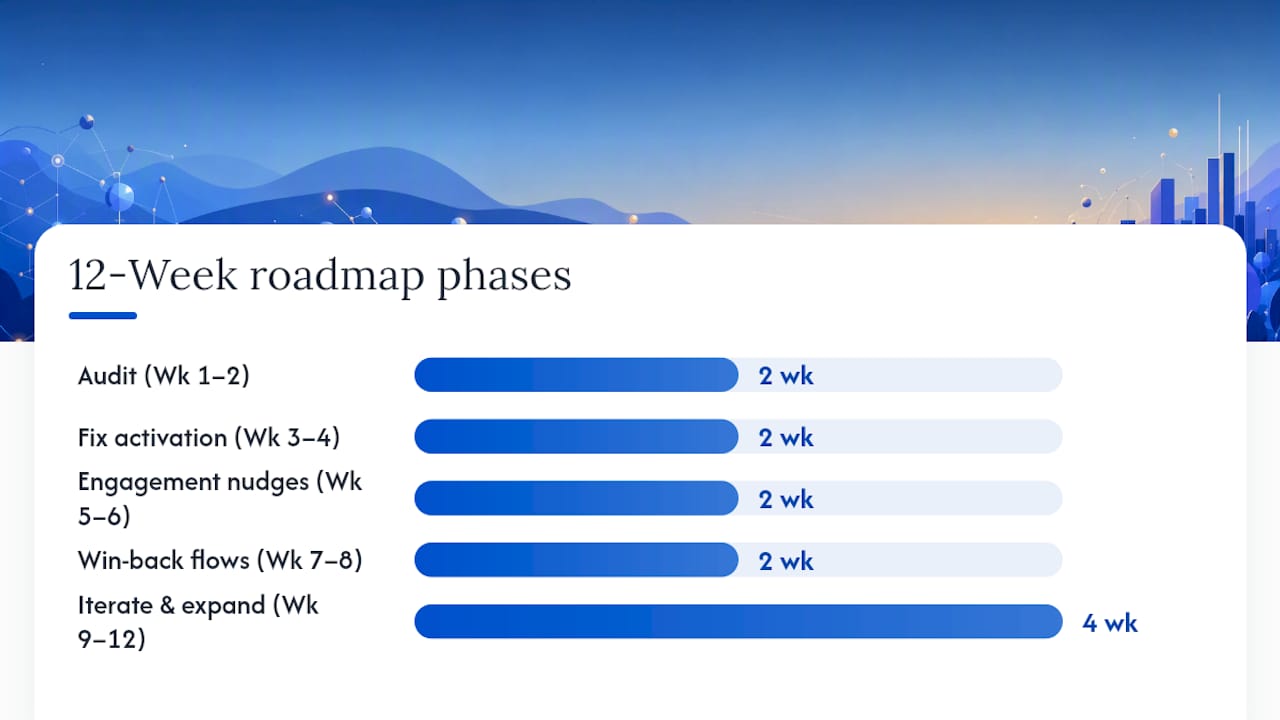
- Weeks 1 to 2: Audit. Pull cohort retention curves, identify where the curve fails to plateau, and tag your last quarter of churned customers by likely disengagement stage.
- Weeks 3 to 4: Fix activation. Instrument your activation milestone, shorten the onboarding path, and set a time-to-value target.
- Weeks 5 to 6: Build engagement nudges. Launch behavior-triggered in-product prompts and start tracking self-return rate weekly.
- Weeks 7 to 8: Launch win-back flows. Build multi-step sequences targeting your two or three highest-value warning signals.
- Weeks 9 to 12: Iterate and expand. Review early results, adjust the weakest step in the funnel, and start testing expansion or loyalty offers on your most engaged segment.
Assign clear ownership: product owns activation instrumentation, marketing owns lifecycle and win-back messaging, support owns the health-score inputs tied to service quality, and analytics owns the cohort reporting that ties it all together. You don’t need an expensive stack to start, a product analytics tool, an email platform capable of behavior triggers, and a shared spreadsheet or CRM view of health scores will get you through the first 12 weeks.
Pro Tip: Set two checkpoints, not one. At week 8, you should see activation rate and time-to-value moving. At week 12, you should see self-return rate and reactivation rate moving. If neither has budged by its checkpoint, the problem is usually instrumentation, not strategy, go back and confirm you’re actually measuring the right milestone.
What Practitioner Data Says About Retention-Focused Selling
Retention work only holds up when the numbers behind it are real, not aspirational. A few data points worth grounding this in:
- Pay-per-result pricing models charge only when a qualified appointment or outcome is delivered, which forces alignment between the seller’s incentive and the client’s actual retention and revenue goals rather than billed hours.
- AI-driven appointment setting has been used to book over 50,000 qualified appointments across client accounts, a scale that only holds up when the underlying follow-up and lead-qualification process is disciplined.
- Database reactivation work on dormant CRM leads has produced average conversion rates near 4.4%, with peak campaigns reaching 8.9%, evidence that a well-run win-back sequence can recover meaningful revenue from a list most teams have already written off.
- Gartner’s 2025 survey found 73% of chief sales officers were prioritizing growth from existing customers, reinforcing that retention and expansion, not just new logos, have become the dominant sales priority.
The mechanism behind a pay-per-result model matters here: when a vendor is paid only for a booked, qualified outcome, its incentive naturally shifts toward quality leads and follow-through, the same disciplines that reduce early churn on the client side.
Matching the Playbook to Your Business Model
The eight-lever sequence above holds across industries, but the emphasis shifts depending on what you sell.
SaaS and subscription businesses should weight activation and NRR the heaviest. A trial user who never reaches their “aha moment” churns regardless of how good your win-back emails are, and expansion revenue from existing accounts usually dwarfs what new logos contribute in a mature product.
Ecommerce and retail live and die by repeat purchase rate. Loyalty programs earn their keep faster here than in SaaS, because the purchase cycle is short enough that perks and points translate into visible behavior change within weeks, not quarters.
Services and agencies need a different lever almost entirely: relationship rituals. Structured onboarding, quarterly business reviews, and consistent value reporting matter more than any in-product nudge, because there’s often no “product” to instrument in the first place. A B2B services retention analysis found that structured rituals like QBRs work specifically where product-led tactics simply don’t apply.
Whatever your model, the sequencing principle stays constant. Fix the front door before you decorate the lobby.
Why the “Loyalty Program First” Instinct Is Usually Wrong
Ask most marketing teams what they’ll do about a churn problem, and the first answer is almost always some version of a rewards program or a discount campaign. It’s an easy pitch to leadership: launch a points system, announce it with a press release, watch engagement metrics tick up for a month. The problem is that this instinct treats retention as a marketing tactic when it’s actually closer to a product and operations problem wearing a marketing costume.
The uncomfortable truth is that loyalty programs mostly reward people who were already going to stay. If your activation rate is weak, if customers hit friction in their first two weeks and never fully experience the value you’re selling, a rewards program just adds a layer of cost on top of a leaky foundation. You end up subsidizing your best customers while the ones who needed help the most quietly disappear before the loyalty email ever reaches them.
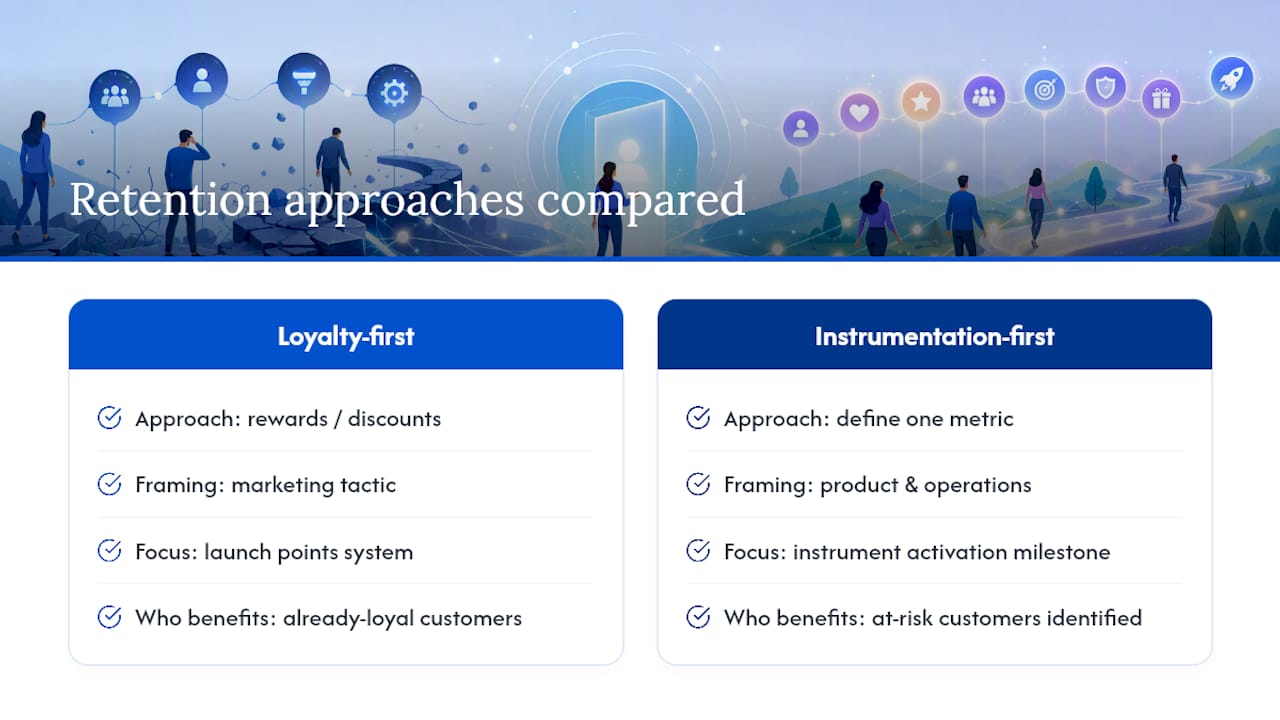
What gets underrated is how much of retention is actually a data and instrumentation problem. Teams talk about “improving engagement” without being able to say, precisely, what their activation milestone is or how long it takes the average customer to reach it. Without that number, every other tactic, personalization, win-back flows, health scores, is guesswork dressed up as strategy. The businesses that actually move their retention rate are usually the ones willing to spend the first few weeks on unglamorous plumbing: defining one metric, instrumenting it, and watching it before touching a single campaign.
There’s also a bias toward treating churn as a single moment rather than a slow leak. A customer rarely wakes up and decides to cancel. They disengage gradually, usage tapers, support tickets pile up, enthusiasm fades, and the cancellation is just the paperwork catching up with a decision that was made weeks earlier. That’s exactly why health scores and early-warning signals matter more than most teams give them credit for. By the time a customer submits a cancellation request, you’ve usually missed the window where a helpful nudge could have changed the outcome.
— Riley
Consider a Pay-Per-Result Partner for the Parts You Can’t Staff
Everything above works, but it takes real hours: instrumenting activation, writing win-back sequences, scoring accounts, running the audit. If your team is stretched thin, outsourcing the appointment-setting and database reactivation pieces to a partner that only gets paid on results is often the faster path to the same outcome, without adding a retainer to your overhead.
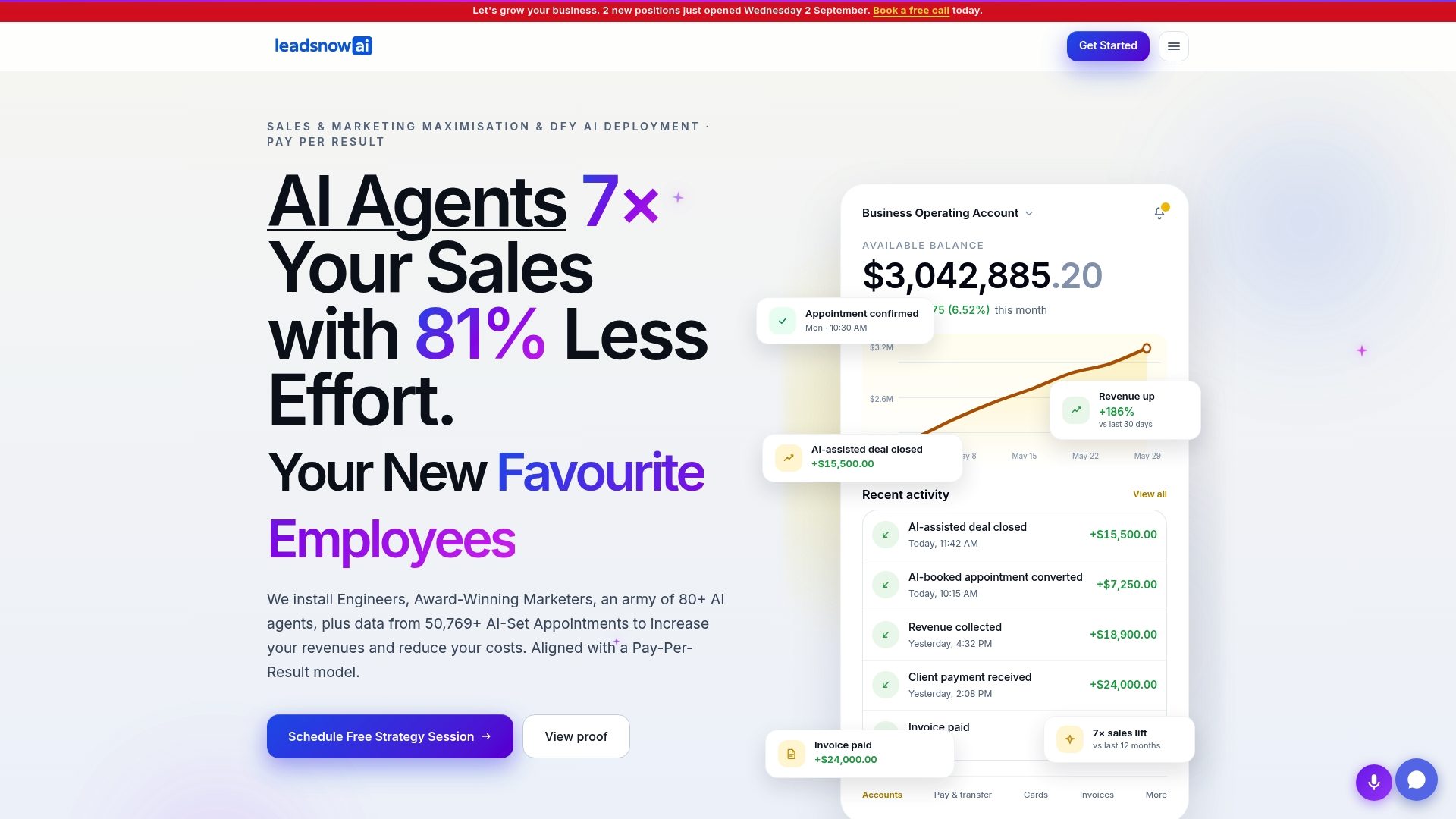
That’s the model Leadsnow runs on: a pay-per-result fee structure where you pay for booked, qualified appointments and reactivated leads, not for hours logged or a monthly retainer regardless of outcome. Their AI sales agents handle outbound follow-up and lead qualification on your existing database, the exact dormant-lead win-back work covered earlier in this guide, while AI-powered lead generation keeps new qualified appointments landing on your calendar. Business owners, coaches, gym operators, and consultants use it specifically because the incentive lines up: Leadsnow only gets paid when a real, qualified appointment shows up booked. If your database has gone quiet or your team can’t keep up with lifecycle follow-up, check the pricing model and see whether a pay-per-result setup fits where your in-house process is stretched thin.
Sources
The claims and formulas in this guide draw on a mix of academic-adjacent business research and practitioner data. For deeper reading:
- How to retain customers | Harvard Business School Online
- Predictive analytics for customer retention | Mu Sigma
- Gartner press release: 73% of CSOs prioritizing growth from existing customers (2025)
- Customer Retention Strategies: 12 Ranked by Impact | Product Growth
FAQ
What is a customer retention strategy?
A customer retention strategy is a coordinated plan to keep existing customers active and engaged rather than relying only on new acquisition. The strongest plans sequence their tactics: fixing onboarding and activation first, then building habit loops, then layering in lifecycle messaging, loyalty programs, and segmentation, following the ranked-impact approach outlined above.
What are the 8 C’s of customer retention?
Definitions of the “8 C’s” vary across sources, and no single standardized list is universally recognized in retention research. Most versions circle common themes like communication, consistency, customer service, and community, but treat any specific 8 C’s list as a mnemonic rather than an established industry standard.
What is the KPI for customer retention?
The core formula is (customers at end of period minus new customers acquired) divided by customers at the start of the period, multiplied by 100. Most teams pair that number with churn rate, repeat purchase rate, LTV, and NRR, since a 5% improvement in retention can lift profits by 25% to 95% depending on the business model.
What are the three pillars of customer retention?
While frameworks vary, most practitioner guidance converges on three foundations: getting customers to their first real value quickly (activation), building habitual engagement that brings them back without prompting, and catching at-risk customers early through health scores and lifecycle outreach before they churn. Loyalty programs and segmentation support these pillars but work best once they’re already solid.
How much does Leadsnow charge for retention-focused lead work?
Leadsnow uses a pay-per-result model, with fees available as a per-result charge or a revenue share, plus a scope-based setup fee for some engagements. Exact rates depend on the scope of work, so current pricing details are available on the Leadsnow pricing page.
Recommended
- Learn how you can increase customer retention in gyms!
- Improving Gym Membership Retention Rates
- How To Re-Engage Old Fitness Client Leads
- 10 email marketing tips for gyms that you need to follow!
Pay-Per-Result appointments
See if we’re a fit
We book qualified sales appointments for you and you pay on results, not retainers. Our booking page asks a few quick questions so you find out in two minutes whether that model suits your business.
- 50,769+ appointments booked without cold calling.
- Pay-Per-Result pricing — you pay for booked, qualified calls.
- Pick your own time on our live calendar, no phone tag.