
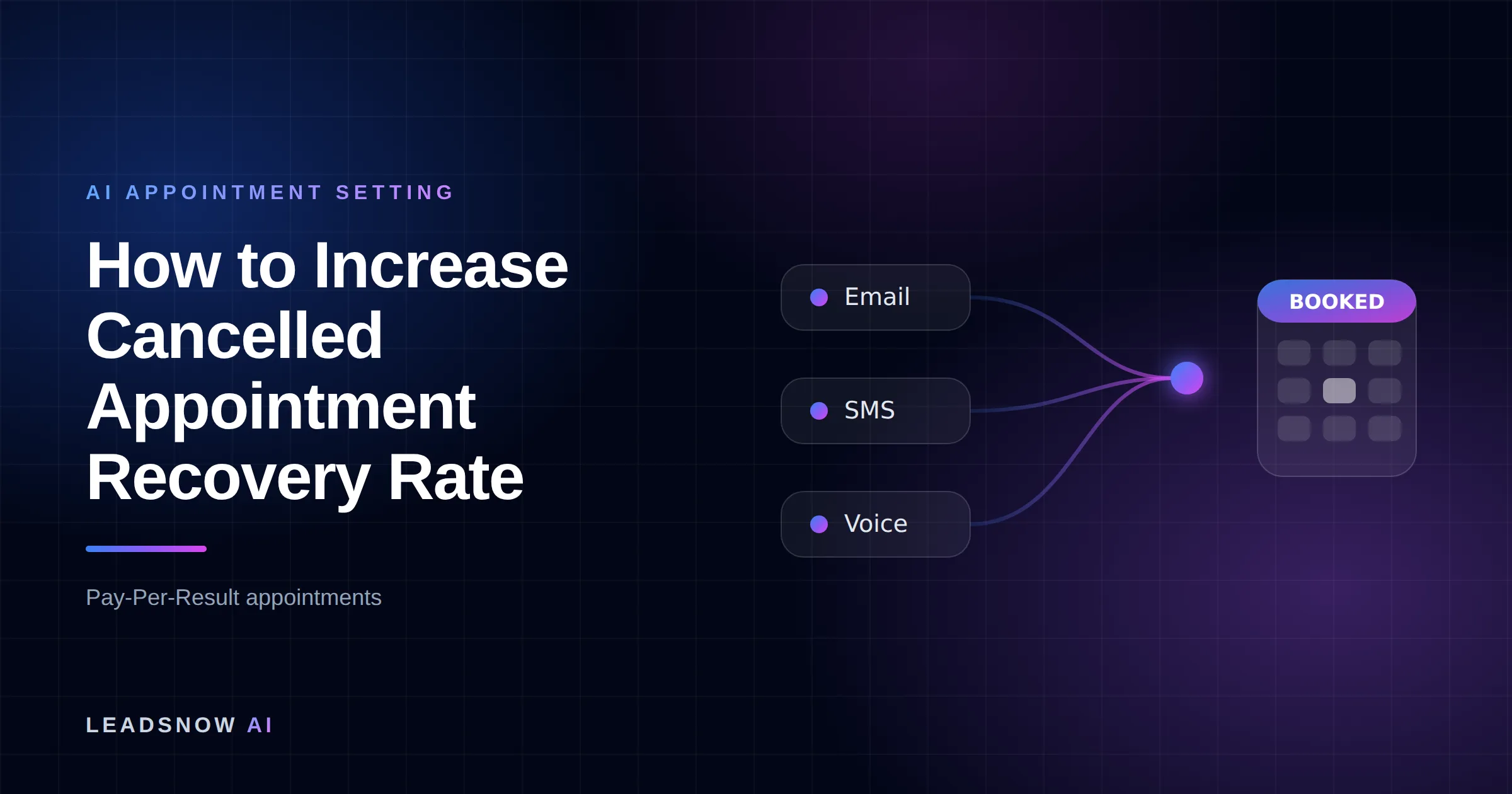
Cancelled appointment recovery rate is the share of appointments cancelled in advance that you rebook and that then go ahead — attended rebookings over total cancellations. The largest lever is replying inside the first hour with two named times. RevenueHero’s 6,428-meeting B2B benchmark publishes a 6.5% no-show rate and no cancellation rate at all.
At a glance:
- Formula: attended rebookings ÷ appointments cancelled in advance, over a fixed window. A rebooking that cancels again counts as zero.
- Denominator boundary: cancellations only. No-shows are a separate metric with a separate fix.
- Biggest lever: response time. A cancellation is a live signal with a half-life measured in hours, not days.
- Second biggest lever: the stated reason. A cancellation tells you why; a no-show tells you nothing.
- The decision rule: the one-hour, two-times rule — answer within the hour, name two specific slots, never ask “when suits you?”
- Worked value: at 28 cancellations a month, each percentage point of recovery rate is worth roughly 3.4 extra attended meetings a year.
What is a cancelled appointment recovery rate, and how is it calculated?
Cancelled appointment recovery rate = attended rebookings ÷ appointments cancelled in advance, measured over a fixed window. If 28 booked calls were cancelled in September and 9 of those prospects sat on a call that actually happened, your September recovery rate is 32.1%.
The mistake almost every team makes is counting the rebooking rather than the attended rebooking. A rebooked call that cancels a second time, or is rebooked and then no-showed, has produced nothing but calendar churn — and it is precisely the population most likely to do that. The only version of this metric worth reporting is the one that counts bums on seats.
Three rules keep it honest. Attribute the outcome to the cancellation month, not the rebooking month. Cap the tail at 60 or 90 days and close the cohort. And count one opportunity once: a prospect who cancels three times is a single denominator entry with a single final outcome, not three chances to score.
How it works
How a cancelled appointment gets recovered
Catch it in an hour
A cancellation is a live signal. Route it to a person or an agent the moment it lands, not to tomorrow’s follow-up list.
Log the stated reason
Capture why they cancelled as a structured field, not a free-text note. Six reasons cover almost every case and they need four different responses.
Offer two named times
Reply with two specific slots inside 72 hours instead of a booking link. Never ask when suits you.
Score attended rebookings
Count only the rebooked calls that actually went ahead, attributed back to the month the cancellation happened.
MAKE MORE SALES.
Pay-Per-Result pricing — We scale sales HARD aligned to your interests, better than anyone else.
Is a cancellation different from a no show?
Yes, and the difference is the entire reason this page exists. A cancellation is an appointment the prospect ended in advance, with notice and usually with a stated reason. A no-show is an appointment the prospect never ended and never attended. One gives you a signal and a window; the other gives you silence and a burnt calendar slot. Recovering a no-show is a different job — it starts with re-establishing contact at all — and belongs on its own page.
The gap shows up in the benchmark data as an absence. RevenueHero’s B2B no-show benchmark (December 2024) analysed 6,428 booked meetings across 15 industries: 4,895 completed (76.1%) and 419 no-shows (6.5%). That leaves 1,114 meetings — 17.3% of the cohort, our arithmetic on their published figures — in neither bucket, which the report attributes in part to meetings still scheduled in the future and does not break out further. Cancellations live somewhere inside that residual. The most-cited B2B meeting benchmark on the internet does not publish a cancellation rate at all, which is a fair indication of how little attention the event gets. Our guide to improving sales appointment show rates uses the same dataset for the no-show side of the picture.
Want this done for you? We book qualified sales appointments on a Pay-Per-Result basis — you only pay for calls that actually land in your calendar.
The one-hour, two-times rule: why the first hour decides the outcome
Here is the rule we run, stated so you can lift it: answer a cancellation within the hour, and name two specific times. Never ask “when suits you?” A prospect who has just cancelled has your business in their head right now; an hour later they are back in their own week and you are a task.
The best-documented evidence for the shape of that decay is about inbound enquiries rather than cancellations, and it should be read that way. In “The Short Life of Online Sales Leads” (Harvard Business Review, March 2011), Oldroyd, McElheran and Elkington analysed 1.25 million sales leads received by 29 B2C and 13 B2B US companies: firms that tried to contact a prospect within an hour of receiving a query were nearly seven times as likely to qualify the lead — which they defined as having a meaningful conversation with a key decision maker — as those that tried an hour later, and more than 60 times as likely as those that waited 24 hours or more. Their separate audit of 2,241 US companies found an average response time of 42 hours, and that 23% never responded at all. That study measured inbound queries in 2011, not cancellations in 2026, so treat it as the shape of the curve rather than as your number. Separately, and as an operator claim rather than a study: in our own client work, fixing response speed alone is typically worth about a 3x lift on the downstream conversion of a lead source. The same logic drives the 5-minute rule for speed to lead.
The second half of the rule — two named times — has independent research behind it from an unrelated field. In a field experiment published in the Proceedings of the National Academy of Sciences (Milkman, Beshears, Choi, Laibson and Madrian, 2011), employees were mailed reminders about free on-site flu clinics. The control group vaccinated at 33.1%. Those prompted to write down just a date vaccinated 1.5 percentage points higher, not statistically significant. Those prompted to write down a date and a time vaccinated 4.2 percentage points higher, which the authors call both significant and of meaningful magnitude. We are borrowing the mechanism, not the number: a vague intention converts worse than a specific one, and specificity means a time, not just a day. A booking link asks the prospect to generate that specificity themselves at the moment they are least willing to. Two named slots hand it to them.
The cancellation-reason taxonomy: what people say, and what it means
This is what a cancellation gives you that a no-show cannot: a stated reason. Six reasons cover almost every cancelled sales appointment, and they need four different responses. Treating them as one audience is why most recovery sequences send everybody the same “sorry we missed you, here’s my calendar link” email and recover the easy third.
| Stated reason | What it usually means | The response that rebooks | What kills it |
|---|---|---|---|
| “Something’s come up” | A genuine diary collision. Intent is intact; the highest-recovery reason of the six. | Reply within the hour naming two specific slots inside the next 72 hours. | Sending a booking link and waiting. You have handed the work back to someone who just said they are busy. |
| “Can we push it a few weeks?” | A deferral, not a cancellation. They are protecting the relationship and the timing is real. | Accept the delay and book the actual date now, in the calendar, at the far end. | Agreeing to “circle back in a few weeks” with no calendar entry. That record is already lost. |
| “I need my business partner or CFO on the call” | Good news in a cancellation costume: the buying group just got bigger, which usually means the deal got more real. | Rebook explicitly as a two-person meeting and send a one-page brief the absent person can read cold. | Rebooking the same 1:1. You will hit the identical block a second time. |
| “Budget isn’t there right now” | An objection surfacing early. Not a scheduling problem, so rebooking the same call does not solve it. | Offer a shorter, differently scoped call, or route to long-term follow-up with a dated trigger — their budget cycle, not your cadence. | Persistence. Four reminders convert this record into a hard no. |
| “We’ve gone another direction” | A loss disguised as a cancellation. Lowest-recovery reason of the six and the most valuable one to log. | One question — what did they have that we didn’t? — then a dated trigger at their likely review point. | Trying to rebook at all. The only thing worth recovering here is the objection. |
| No reason given | Ambiguous, and often a channel failure rather than an intent failure: they cancelled in whichever channel was easiest to cancel in. | Switch channel immediately. If they cancelled by calendar or email, respond by phone or SMS, then treat as reason one. | Replying in the channel they used to get away from you. |
The single change with the best ratio of effort to effect is making the stated reason a structured field rather than a free-text note. Until the reason is a value your CRM can route on, every cancellation gets the same message, and the same message can only ever be written for reason one.
If we can’t make you money, we don’t deserve yours.
Pay-Per-Result pricing — performance-based alignment.
The levers, ranked by effect size
| # | Lever | Reasons it addresses | Build cost | What it changes |
|---|---|---|---|---|
| 1 | Respond inside the first hour, every time | All 6 | 2–4 hours to wire a calendar or CRM webhook to an alert or an agent | Median response time from hours or days to minutes |
| 2 | Name two specific times instead of sending a link | 1, 2, 3, 6 | 30 minutes of copywriting | Turns a reply into a decision rather than a task |
| 3 | Capture the stated reason as a structured field | All 6 | 1 hour of CRM configuration plus a scripted question | Makes routing possible at all — without it, one message for six reasons |
| 4 | Switch channel from the one they cancelled in | 1, 6 | 0 hours — a written rule | Recovers the silent cancellations, the largest under-worked group |
| 5 | Rebook inside 72 hours, not next fortnight | 1, 2, 6 | 0 hours — a calendar policy plus some near-term slots held open | Cuts the second cancellation, where recovery programs leak |
| 6 | Route reasons 4 and 5 out of recovery entirely | 4, 5 | 1 hour to build the two exit paths | Stops burning follow-up capacity on records that will not rebook |
Change lever 1 first, and change it before you touch the copy. A perfect message sent on Thursday to a Tuesday cancellation is competing against everything the prospect did on Wednesday.
What is a percentage point of recovery rate worth?
Do this arithmetic with your own numbers before you build anything. The inputs below are illustrative — substitute yours.
- 200 appointments booked per month
- 14% cancelled in advance = 28 cancellations per month, 336 per year
- 1 percentage point of recovery rate = 336 × 0.01 = 3.36 extra attended meetings per year
- At a 25% close rate = 0.84 extra closed deals per year, per percentage point
- At an $8,000 average deal value = $6,720 a year, per percentage point of recovery rate
- Moving from 10% to 30% recovery — 20 points — is worth roughly $134,400 a year on these inputs
This is arithmetic, not a forecast: it tells you what a point of recovery rate is worth in your business, not what your recovery rate will become. It is also why cancellation recovery is usually underfunded — 28 events a month feels like noise, and 336 events a year does not.
How do you stop the rebooked call cancelling again?
Second cancellations are where recovery programs quietly fail, and they are largely predictable from the taxonomy: reasons 4 and 5 re-cancel because the underlying problem was never a diary problem. Three rules hold it together. Rebook near, not far — a slot ten days out has ten days of new priorities in front of it, so hold near-term capacity for recovered appointments. Make the rebooked call smaller — a cancelled 45-minute discovery call rebooks better as a 15-minute call with a named agenda. And treat the second cancellation as routing, not persistence: two cancellations on one opportunity says the timing or the buying group is wrong, so move the record to a trigger-based long-term track. Watch show rate alongside this metric — a rising recovery rate with a falling show rate means you are rebooking people who were telling you something.
Cancellation recovery is one stage in a longer sequence, and it inherits whatever the stages before it did badly: appointments booked from weak qualification cancel more, and appointments booked a fortnight out cancel more again. Our map of the sales pipeline stage by stage sets out where this one sits and what each of the others costs you.
Should you run cancellation recovery in-house or hand it over?
The method above is complete and genuinely usable. Someone with your CRM login, four hours and a willingness to answer the phone can implement every lever in the table. What decides whether that survives contact with a real month is volume and timing, so here is the honest crossover.
| Cancellations per month | Share arriving outside business hours | What actually works | Honest cost to run it |
|---|---|---|---|
| Under 15 | Any | One named person, a phone and a diary. Do not automate this. | 1–2 hours a week. A system would cost more than it returns. |
| 15–60 | Under a third | Templated first touch, human call-back within the hour during business hours | One 4-hour build, then 4–6 hours a week — and it degrades in the first busy week |
| 15–60 | Over a third | Automated first touch on every cancellation; a human closes the rebooking | The build, plus an evening and weekend roster you will probably not staff |
| Over 60 | Any | Automated first hour on every cancellation, reason captured at contact, humans on the exceptions | Not achievable on a human roster — the one-hour rule is what breaks first |
The lever that fails first when a person owns it is lever 1, because the first hour after a cancellation is frequently 9pm on a Sunday or the middle of a day your one setter is already on the phone. Everything else on this page is a policy decision; response time is a staffing one. We have booked more than 50,769 AI-assisted sales appointments since 2017 and generated over a million leads, and this recovery work sits inside our AI appointment setting service on a pay-per-result basis — you pay on booked qualified appointments rather than on a retainer. If you are weighing the build-versus-buy question more broadly, who should run your AI appointment setter and our overview of appointment setting outsourcing set out both sides.
Two things about our own numbers, so nobody quotes them wrongly. They are operator claims from our client work — there is no published sample size or window behind them, and they are not a guarantee. And they do not multiply. We typically see roughly a 3x lift from fixing speed to lead alone and roughly 2x from doubling contact rate, but 3 × 2 is not the headline ~300% we quote for a client moving from 2020 operations to 2026 AI-driven ones, because the levers overlap: fixing response speed is part of how contact rate improves in the first place. Anyone multiplying lever claims together is selling you a number that does not exist.
Frequently asked questions
What is a good cancelled appointment recovery rate?
There is no credible published benchmark, and you should be suspicious of anyone who quotes one. The most-cited B2B meeting dataset — RevenueHero’s December 2024 no-show benchmark of 6,428 meetings across 15 industries — reports 76.1% completed and a 6.5% no-show rate, and never separates cancellations out of the remainder at all. Set your own baseline over one month, then improve against it.
A prospect cancelled the sales call — should I chase now or give them space?
Now, and specifically within the hour. Giving them space is the intuition that costs the most, because it treats a cancellation as a rejection when five of the six stated reasons are not one. The relevant evidence on response windows comes from inbound leads rather than cancellations: Harvard Business Review’s 2011 analysis of 1.25 million leads found firms contacting within an hour were nearly seven times as likely to have a meaningful conversation with a decision maker as those contacting an hour later. Respond fast, and keep the message short, warm and containing two times.
How do I rebook a cancelled appointment without seeming desperate?
Ask for a decision, not for their availability. Tuesday 10am or Thursday 2pm, which is easier, reads as competent; let me know when suits reads as needy and converts worse. The specificity matters mechanically: in a 2011 PNAS field experiment, people prompted to write down a date and a time acted 4.2 percentage points more often than the control group, while a date alone produced a non-significant 1.5 points. Desperation is volume, not speed — one fast, specific message beats four reminders over a fortnight.
How many times should I try to rebook a cancelled appointment?
Once properly, and then stop. One fast, specific attempt in a channel they have not just cancelled in; if that produces no reply, one short follow-up 48 hours later; then the record leaves the recovery track for long-term follow-up with a dated trigger. Two cancellations on the same opportunity is a routing signal, not an invitation to persist.
Is cancellation recovery the same as no-show recovery?
No. A cancellation comes with notice and usually a stated reason, which is what makes reason-based routing possible; a no-show gives you neither and starts with the problem of re-establishing contact at all. They share a rebooking mechanic and almost nothing else, and rolling them into one lost-appointments number hides which of the two you are actually bad at.
Pay-Per-Result appointments
See if we’re a fit
We book qualified sales appointments for you and you pay on results, not retainers. Our booking page asks a few quick questions so you find out in two minutes whether that model suits your business.
- 50,769+ appointments booked without cold calling.
- Pay-Per-Result pricing — you pay for booked, qualified calls.
- Pick your own time on our live calendar, no phone tag.