
Lead follow-up automation replaces manual, delayed outreach with instant, behavior-triggered sequences that contact leads the moment they show intent. The immediate payoff is speed: leads reached within minutes convert at far higher rates than those left waiting for a callback the next day. Done right, it routes hot leads to reps and lets everyone else move through a scored nurture path automatically. The rest of this guide covers how to build it, measure it, and avoid the mistakes that turn automation into spam.
TL;DR:
- Automated follow-up sequences reduce response times to minutes, significantly increasing the chances of converting leads before they lose interest.
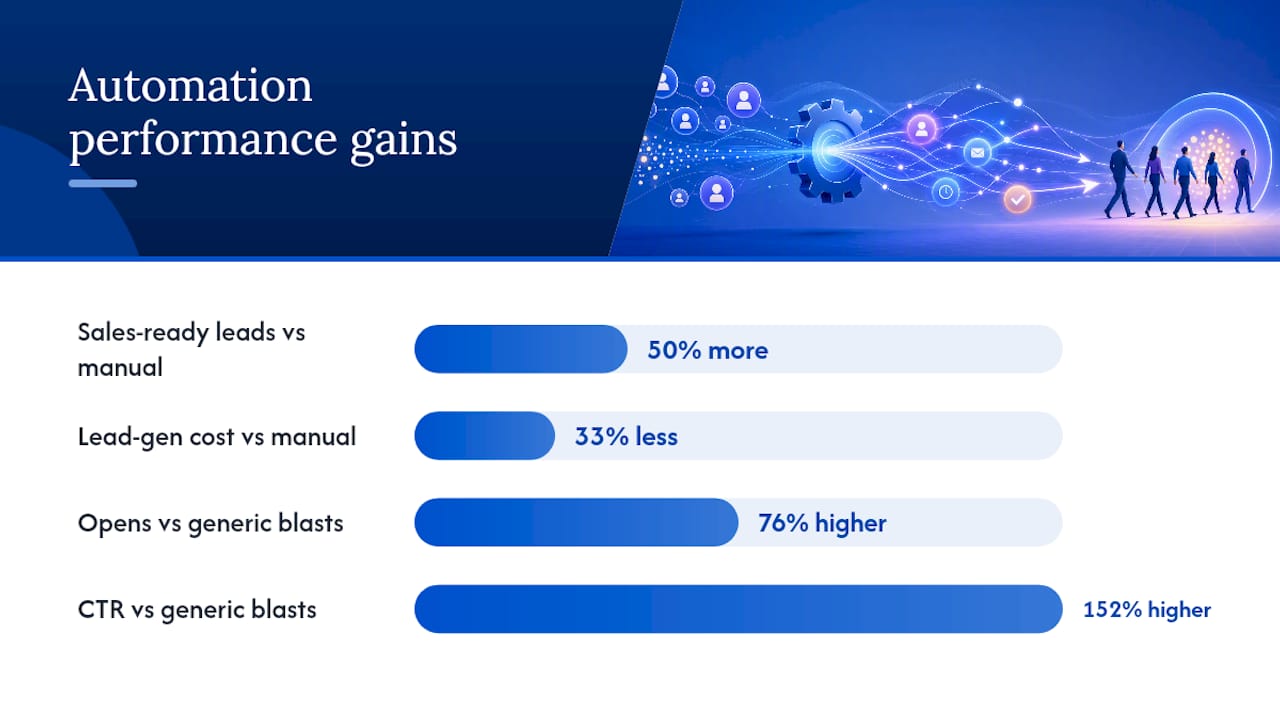
- Triggered, personalized messaging increases reply rates by up to 76 percent and click-through rates by 152 percent compared to generic emails.
- Building a reliable system requires integrating five layers, including a CRM, lead enrichment, behavioral scoring, multichannel engagement, and governance tools.
- Proper setup involves capturing detailed lead data at entry, running tailored sequences, and defining clear handoff and SLA rules for timely sales reps’ response.
- Over-automation and data errors can hinder results; regular audits, guardrails, and human oversight are essential for maintaining effectiveness.
Table of Contents
- Why Automated Lead Nurturing Pays Off
- What Makes Up a Lead Follow-Up Automation System?
- How Do You Set Up an Automated Follow-Up Sequence?
- Which Tools Do You Actually Need to Run This?
- How Do You Measure If Automation Is Working?
- Where Automation Goes Wrong
- Does Pay-Per-Result AI Follow-Up Actually Work?
- What Sales Leaders Get Wrong About Automation
- A Direct Way to Get These Results Without Building It Yourself
- Sources
How it works
How an AI sales agent books your appointments
Your list or CRM
We start from data you already own — past enquiries, dormant customers, or a targeted prospect list.
The agent makes contact
Email, SMS and voice, with follow-up that persists for weeks instead of stopping after two attempts.
Qualified against your rules
Budget, timing and fit are checked before anything reaches your team, using criteria you set.
Booked into your calendar
Only qualified prospects reach the booking step, so your closers spend their time selling.
MAKE MORE SALES.
Pay-Per-Result pricing — We scale sales HARD aligned to your interests, better than anyone else.
Why Automated Lead Nurturing Pays Off
The math on speed alone justifies the investment. Teams running automated nurture sequences generate 50% more sales-ready leads at 33% lower cost than manual outreach, and triggered emails see open rates 76% higher and click-through rates 152% higher than generic blasts.
Beyond the numbers, automation fixes a consistency problem. Reps forget to follow up; sequences don’t. Marketing messaging drifts between reps; a templated sequence doesn’t.
What’s changed recently is personalization at scale. AI-generated video touches, dynamic subject lines, and behavior-based content swaps mean a lead gets a message that feels custom without a human writing it fresh each time.
- Faster first response, often within minutes instead of hours
- Higher reply and booking rates from triggered, relevant messaging
- Consistent follow-up regardless of rep workload
- Personalization at scale through AI-driven content and video
Fast fact: Automated nurture sequences cut lead-gen costs by 33% while producing half again as many sales-ready leads, according to Sendspark’s research.
Want this done for you? We book qualified sales appointments on a Pay-Per-Result basis — you only pay for calls that actually land in your calendar.
What Makes Up a Lead Follow-Up Automation System?
A working system is really five layers stacked on top of each other, not one tool doing everything.
- CRM as the single source of truth. Every touch, score change, and status update writes back to one record. Workflow automation and webhooks push updates in real time instead of batch syncs that leave reps working stale data.
- Capture, enrichment, and deduplication. New leads from forms, ads, chat, and referrals need enrichment (company size, role, intent signals) and a dedupe pass before they enter any sequence. A lead entered twice gets double emails, which reads as sloppy fast.
- Behavioral scoring and routing. Points accumulate from actions: pricing-page visits, email clicks, demo requests. Cross a threshold and the lead routes to a rep instead of staying in an automated track. This is where AI lead nurturing earns its keep, since scoring models can weigh dozens of signals a human would never track by hand.
- Multichannel orchestration. Email carries the volume, but SMS, chatbots, LinkedIn touches, and short video messages catch leads who ignore email entirely.
- Dashboards, SLAs, and governance. Response-time targets, data ownership rules, and visible reporting keep the system from turning into a black box.
Each layer depends on the one below it. Skip enrichment and your scoring model runs on garbage. Skip SLAs and your “instant” routing sits in a queue nobody watches.
How Do You Set Up an Automated Follow-Up Sequence?
Building sequences in the right order prevents the two most common failures: leads falling through cracks and leads getting bombarded.
- Qualify and enrich on entry. Capture source, intent signal, and basic firmographic data the moment a lead submits a form or books a call. Zapier’s lead follow-up automations sync this across forms, social channels, and your CRM so nothing sits unlogged.
- Run a welcome sequence. Send message one within five minutes of capture, ideally a short personalized video rather than plain text. Follow with two to three educational touches over the next 48 hours, spaced enough to avoid feeling like a bombardment.
- Branch into nurture-to-convert. A lead who visits your pricing page twice gets a different track than one who downloaded a guide and went quiet. Triggers should include pricing views, trial activity, and repeat site visits, each pulling the lead toward a booking link.
- Deploy re-engagement for stalled leads. After 10 to 14 days of silence, shift to a re-engagement cadence: one direct check-in message, one value-add resource, then a final “should I close this out” message before moving the lead to long-term nurture.
- Set handoff rules. Define the score threshold that triggers rep assignment, what context the rep sees (source, touches, score history), and the SLA for first rep contact, ideally under 15 minutes for hot leads.
Pro Tip: Build your re-engagement track around a short, personalized video rather than another text email. Recovery sequences using video within hours of a missed demo materially outperform text-only follow-ups on reschedule rates.
If we can’t make you money, we don’t deserve yours.
Pay-Per-Result pricing — performance-based alignment.
Which Tools Do You Actually Need to Run This?
Most teams overbuild their stack, then wonder why nothing talks to anything else. A simpler, four-tool setup that integrates cleanly beats a sprawl of point solutions almost every time.
- CRM plus workflow automation: the backbone that owns lead records and triggers actions.
- Email/SMS engagement platform: handles sequence delivery, timing, and reply detection.
- Personalization layer: video messaging or AI chat for the touches that need a human feel.
- Analytics and attribution: tracks which channel and message actually drove the conversion.
Before scaling any of this, run through an integration checkpoint: confirm field mapping between systems, test webhooks fire correctly, verify dedupe logic catches repeat entries, and check enrichment data populates before scoring runs. Then check deliverability. Warm up new sending domains gradually, monitor bounce and spam-complaint rates weekly, and never launch a sequence to your full list on day one.
Run a go/no-go test with a small batch of live leads first. If routing, scoring, and handoff all fire correctly on 20 to 30 real leads, scale up. If anything breaks, you want a rollback step ready, not a scramble.
How Do You Measure If Automation Is Working?
Track outcomes, not just activity. Open rates feel good but don’t pay the bills.
- Response time: minutes from lead capture to first outreach.
- Time-to-MQL: how long it takes a lead to cross your qualification threshold.
- MQL-to-SQL conversion: the percentage of qualified leads that become sales-ready.
- Booked meetings per lead: the number that ties automation directly to pipeline.
- Secondary signals: open rate, click rate, reply rate, deliverability, and which channel actually drove the reply.
Run A/B tests on one variable at a time: send timing, subject line, or channel mix. Structure a pre/post comparison by holding a control group on your old process for two to four weeks while the new sequence runs on a matched segment, so you can attribute the lift to the automation rather than seasonal demand.
Where Automation Goes Wrong
Over-automation is the most common failure. When every message is templated and no human ever checks in, replies get ignored and complex objections get a canned response instead of a real answer. Build in a rule: any reply containing a question outside your script routes to a human within the hour.
- Dirty data breaks scoring before it breaks anything else. Dedupe and enrich before leads enter sequences.
- Protect deliverability with spacing rules and immediate reply detection that pulls a lead out of a sequence the second they respond.
- Set explicit AI guardrails. Let AI handle predictable, reversible actions like scheduling and reminders; keep pricing negotiations and complex objections with a human.
Pro Tip: Audit your automated sequences quarterly for reply rates by message. A step that consistently gets replies flagged as “stop” or “unsubscribe” needs rewriting or removal, not more volume.
As adoption of AI agents in sales workflows accelerates, fewer than 40% of sales organizations currently report that AI agents have measurably improved productivity, a gap that traces back to missing guardrails and unmeasured rollouts rather than technology itself.
Does Pay-Per-Result AI Follow-Up Actually Work?
A lead comes in, an AI agent qualifies intent and books a slot on the calendar, a human rep takes the call, and the client only pays once that appointment is confirmed. No qualified booking, no invoice.
That structure maps directly to the scoring and handoff rules covered above: AI handles qualification and scheduling, a person handles the conversation that actually closes.
What Sales Leaders Get Wrong About Automation
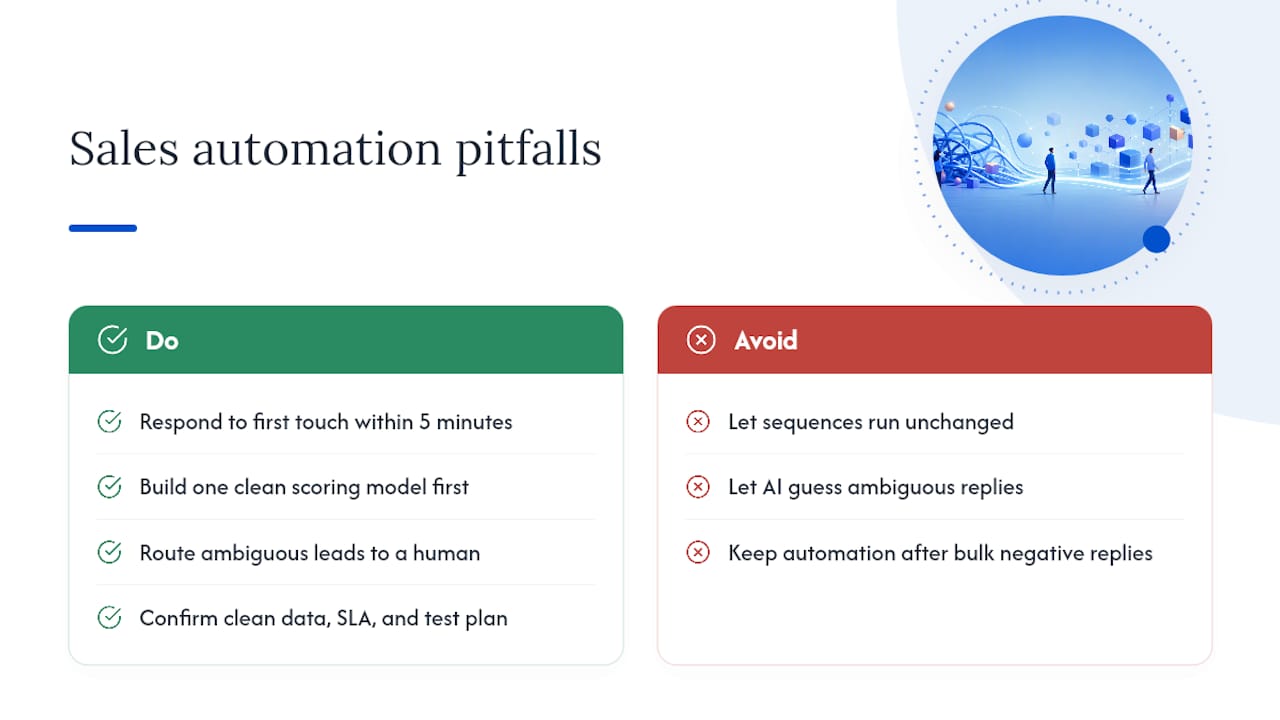
The mistake most leadership teams make isn’t under-investing in automation. It’s assuming that once a sequence is built, it runs itself forever. Sequences decay as your audience, offer, and channels shift, and nobody notices until reply rates quietly drop.
Three things to prioritize on launch day: get your first-touch response under five minutes, build one clean scoring model before you build five sequences, and route anything ambiguous to a human rather than letting AI guess. Pause automation the moment reply sentiment turns negative in bulk. Before approving any rollout, leadership should confirm three things: clean source data, a written SLA for rep response time, and a testing plan that runs before full-list deployment.
— Riley
A Direct Way to Get These Results Without Building It Yourself
Everything above assumes you have the time and staff to build scoring models, sequence templates, and dashboards in house. If you’d rather skip that build and pay only for results, Leadsnow runs the entire follow-up engine for you and charges nothing until a qualified appointment lands on your calendar.
This fits best for high-ticket coaches, gym operators, consultants, and startups who need booked meetings, not another dashboard to babysit. AI agents handle qualification, scoring, and follow-up across channels, then hand a rep a warm, ready-to-close conversation.
If you want to see what that looks like for your business specifically, book a strategy call with Leadsnow and get a plan built around your funnel before you commit to anything.
Sources
- Automated Lead Nurturing: How It Works and How to Overcome Common Challenges | Sendspark
- Lead Follow-Up — Zapier
- Automated lead nurturing: How it works and how to overcome common challenges | Salesforce
- Gartner press release on AI agents in sales
Recommended
Pay-Per-Result appointments
See if we’re a fit
We book qualified sales appointments for you and you pay on results, not retainers. Our booking page asks a few quick questions so you find out in two minutes whether that model suits your business.
- 50,769+ appointments booked without cold calling.
- Pay-Per-Result pricing — you pay for booked, qualified calls.
- Pick your own time on our live calendar, no phone tag.