
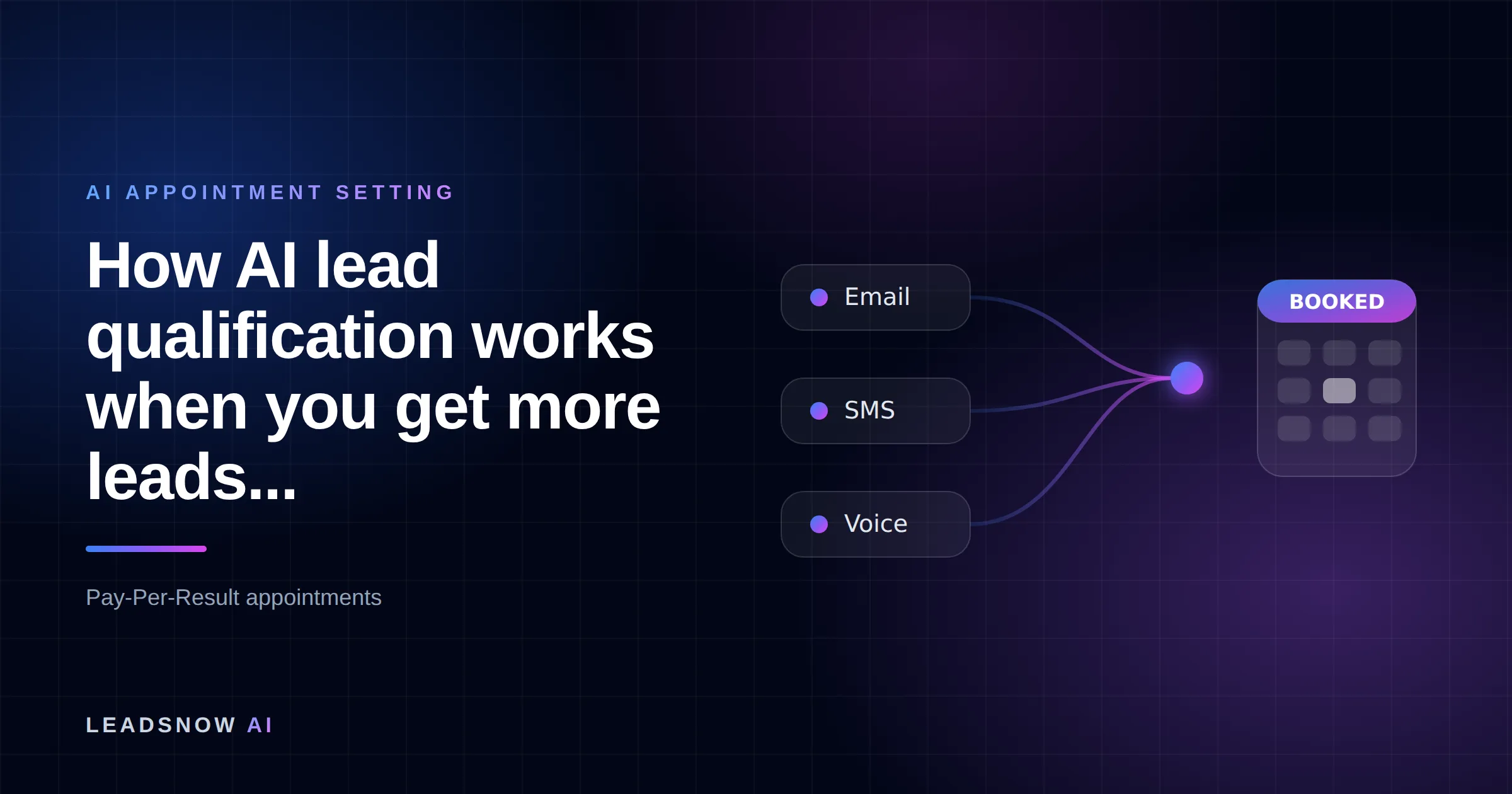
AI lead qualification is an automated first conversation — SMS, email or voice — that reaches every inbound lead within minutes, scores the answers against a written gate, and hands only the passes to a human. It exists because capacity is the ceiling, not skill: in Harvard Business Review’s audit of 2,241 US companies, 23% never responded to a web-generated test lead at all.
What AI lead qualification does when I have more leads than I can call
It does three jobs and stops: first contact on every record inside a fixed window, a short fixed set of questions recorded as data, and routing on the result — passes to a rep or into a calendar, declines to a logged list with a reason. It does not negotiate, discount, diagnose a complex requirement or replace a discovery call.
- The capacity test: monthly inbound ÷ (reps × 4.1 quality conversations a day × working days). Above 1.0, some leads will never get a first attempt.
- The human ceiling: 4.1 quality conversations per SDR per day, from a median 112 total daily activities (The Bridge Group, 351 B2B companies, 2025).
- Day one: export your last 300 inbound leads and count the ones that never got a first attempt.
- The SLA worth writing: automated first touch inside 60 seconds, a human on a passed lead inside 15 minutes. Sixty seconds is the operational target you run to; the threshold written into a corporate agreement is usually looser — we contract to under five minutes, inbound, in business hours, which is the figure on our corporate appointment setting page.
Which acronym you structure the questions around — BANT, MEDDIC, CHAMP — is a separate decision, covered in our lead qualification framework comparison. This page is the other problem: volume arriving faster than your team can hold conversations.
How it works
How to stand up AI lead qualification on inbound you cannot call
Count the unworked leads
Export your last 300 inbound leads with created and first-attempt timestamps. Count the rows that never got a first attempt.
Divide by your ceiling
Real capacity is reps x 4.1 quality conversations a day x working days (The Bridge Group’s 2025 SDR benchmark). Above a ratio of 1.0, leads are dying unworked.
Write the gate
Turn your qualification sentence into four to six threshold checks, each with a pass value and a decline reason code.
Route inside the hour
Automated first touch at 60 seconds, a human on every pass within 15 minutes. Declines go to a logged list for the monthly audit.
MAKE MORE SALES.
Pay-Per-Result pricing — We scale sales HARD aligned to your interests, better than anyone else.
Work out your conversation ceiling before you buy anything
The number most teams use for capacity is wrong. It is not reps × leads or reps × dials; it is reps × the number of real conversations a person can hold in a day, and that number is small and well measured. The Bridge Group’s 2025 SDR Models, Motions & Metrics report (10th edition, 351 B2B companies) puts SDRs at 4.1 quality conversations a day, from a median 112 daily activities — 44 phone, 41 email, 19 LinkedIn, 8 text/other. It is measured on dedicated sales development reps, so it fits a team doing first contact for a living and flatters a closer who is also running live deals.
Worked through, with numbers you can swap:
- 1,200 inbound leads a month, 4 reps on inbound, 21 working days.
- Ceiling = 4 × 4.1 × 21 = 344 quality conversations a month.
- Ratio = 1,200 ÷ 344 = 3.5.
- Even if every conversation went to a brand-new lead, 856 — 71% — are never spoken to. Reps also service live pipeline, so first-touch conversations land nearer 200 and the unworked share is closer to 83%.
The conversation ceiling is the honest version of your pipeline maths: a lead you never speak to cannot convert, whatever your scoring model says about it. Calculate it before the vendor call, not after.
| Ceiling ratio | What is actually wrong | What to automate first |
|---|---|---|
| Below 0.6 | Spare capacity. Any leakage is speed or persistence, not volume. | Nothing. Fix response time and attempt counts in-house. |
| 0.6 – 1.0 | At capacity. Peaks spill; quiet weeks hide it. | Reminders, rescheduling and routing only. Keep humans on first contact. |
| 1.0 – 2.0 | Over capacity. A measurable share of leads dies unworked. | Automate first contact and qualification. Humans take passes only. |
| Above 2.0 | Structurally over. Hiring cannot close the gap at a 3.0-month ramp. | Automate qualification, or cut spend on the lowest-converting source. |
Read the fourth row against Bridge Group’s other figures — average ramp 3.0 months, average SDR tenure 1.9 years. A team at ratio 3.5 cannot hire its way out: the fix lands a quarter late and is rebought every two years.
Want this done for you? We book qualified sales appointments on a Pay-Per-Result basis — you only pay for calls that actually land in your calendar.
What “qualified” should mean before you let software decide it
A gate is only as good as the sentence behind it, and most teams have never written that sentence down. Ours runs in production on our booking page, so we can describe it exactly. It is a conditional ladder: the first four rungs are asked of everybody in a fixed order, and two further rungs are asked only when the earlier answers are marginal. Nothing ends it early — we removed the three answers that used to, because the answers of the people you turn away are the only evidence you have that your thresholds are right.
| Rung | What it tests | Passes | Below the threshold |
|---|---|---|---|
| 1. Lead volume | Leads per month: 0–10 / 10–100 / 100–1,000+ | 10–100 or more | 0–10 passes only if a later rung compensates it |
| 2. Commercial model | Will they engage on a performance basis at all | Yes — and the quiz continues either way | A no routes to one fixed-fee alternative later in the flow; a no to both is the only refusal we do not try to rescue |
| 3. Acquisition budget | Existing monthly spend band | Top band clears every remaining condition on its own | Lowest band blocks that attempt; lowest band and lowest volume as the first answers arms a lockout |
| 4. Customer lifetime value | Average revenue from a customer over their lifetime | Above our floor | Not fatal on its own: it needs the top budget band, or higher volume on the middle band, or rung 5 |
| 5. Backup pair (asked only if the rungs above would decline) | What they could realistically invest this month, and current monthly revenue | Both above their bars | Either one below its bar declines |
| 6. Repeat attempts | Failed attempts since the last pass | 0 or 1 | 2 locks the visitor out — with exactly one clean retake granted, then it is final |
Three design choices matter more than the thresholds. A decline carries a reason code, not just a no — and ours separates the attempt from the person: a low budget blocks the attempt it appears in, while the worst pair of opening answers, or a failed attempt with a lifetime value under the floor, locks the visitor instead. Every answer is posted server-side against the same attempt id as the email that books the call, so whoever takes the call already holds the qualification data. And the rescue rungs exist because we measured the cost of not having them: the budget question was declining people who had already agreed to the commercial model and simply were not running ads that month.
The honest limitation: our block state lives in the browser, so anyone in a private window can start again. We accepted that — a gate built to be unbeatable costs more than the unqualified calls it saves.
The seven steps, and the one to do on day one
- Day one, and it takes about an hour: export your last 300 inbound leads with created timestamp, first-attempt timestamp, source and outcome. Count the rows with no first attempt and the median gap on the rest. That count is your business case, and nothing else this month will be as persuasive internally.
- Write the qualification sentence — who you spoke to, what they confirmed, what was booked. If you cannot write it in one sentence, the gate will not be consistent.
- Turn the sentence into 4–6 checks with thresholds, each with a pass value and a decline reason code, ordered so the cheapest disqualifier is asked first.
- Suppress before you contact. De-duplicate on phone and email, drop staff and existing customers, and run your do-not-contact list before the agent sends anything.
- Deploy on one source only and run humans on everything else for 30 days. One source gives you a clean comparison; all of them at once gives you an argument.
- Wire the routing and the SLA (next section), including what happens when nobody claims the handoff.
- Audit the decline log monthly. Pull ten declines and ten passes at least 30 days old and check them against what happened. A gate nobody back-tests drifts tighter every quarter, invisibly, because rejected leads never appear in a pipeline report.
You are finished when every inbound lead gets an automated first touch inside 60 seconds, every decision carries a logged reason, and you can produce last month’s decline log on request. Measurement — which denominator to publish, how to back-test the gate — is set out in increasing sales qualification rate.
If we can’t make you money, we don’t deserve yours.
Pay-Per-Result pricing — performance-based alignment.
Routing and SLA: where a passed lead goes in the next 15 minutes
Qualification without routing just moves the queue. The SLA has an external anchor, and an old one: in Harvard Business Review’s 2011 study of 1.25 million leads across 29 B2C and 13 B2B US companies, firms contacting within an hour were nearly seven times as likely to qualify a lead — which the authors defined as having a meaningful conversation with a key decision maker — as those trying an hour later. It is fifteen years old and was run when a first attempt meant a phone call, so read it as evidence that the hour matters, not as a current benchmark. One hour is the outside edge; everything below is margin.
| Event | Clock | Owner | Fallback when it is missed |
|---|---|---|---|
| Lead created | 60 seconds | Agent | Alert the queue owner at 5 minutes |
| Gate returns a pass | Immediate | Router | Round-robin reassign after 10 minutes |
| Human first attempt on a pass | 15 minutes | Rep | Reassign, then let the agent book the meeting instead |
| Gate returns a decline | Same day | Agent | Nurture list with the reason code; re-offer at 90 days |
| Edge case or ambiguous answer | 1 hour | Manager queue | Manual review, logged as a tuning case |
The fallback column is the one teams skip and the one that decides whether the system survives a busy Tuesday. Every rule needs an owner by name: if a qualified lead can sit unclaimed with nobody accountable, you have rebuilt the original problem in software. Scoring and speed are distinct levers, unpicked in speed to lead versus lead scoring.
What breaks at volume — including the gate we put in the wrong place
We got the placement wrong ourselves. We embedded our qualifying quiz inline on 86 content pages. Measured 19 August to 3 September 2026, bots and test rows excluded, the inline copies produced 145 impressions, 1 start, 0 contacts, 0 bookings; the same quiz on our booking pages, same window, produced 126 impressions, 46 starts, 22 contacts and 8 bookings. We removed the inline version.
A qualification gate placed before intent has formed does not filter demand — it collects nothing and quietly poisons your funnel numbers. Those inline copies also inflated our denominator badly enough that an unrelated change looked like a regression when it was flat.
The other four, in the order they appear:
- Duplicates. One human, three forms, three agent conversations. Dedupe on normalised phone and email before the gate.
- Silent over-qualification. The gate tightens, the decline pile grows, nobody notices. This is what the ten-and-ten audit is for.
- Record decay. At volume the dead-number rate decides your contact rate more than your script does — see CRM data hygiene.
- Consent drift. Suppression lists must run at send time, not at import time. A list washed last month is not washed.
What it costs to run this yourself
The method above is complete and a competent ops person can run it. The cost sits in three places. Hours: about a week to wire the gate, then a half-day a month for the decline audit and script tuning, indefinitely — tuning is dropped first and matters most. Tooling: a conversational layer across SMS, email and voice, dedupe and suppression, and calendar write-access, all of which must survive your CRM’s next schema change. Skill: someone who can read a decline log and tell a bad threshold from a bad script.
In our own client work the levers are large and they overlap: contacting faster is worth roughly 3x on its own, doubling contact rate roughly 2x, doubling set rate roughly 2x. Those do not multiply — 3x × 2x × 2x is 12x, and 12x is not what happens, because each lever is counting the same leads. Treat them as one combined improvement, not a stack. The pattern is not exotic — LeadsNow has run it to 50,769+ AI-booked sales appointments since 2017 across more than a million leads — and the half-day a month above is the part that decides whether it keeps working. If your ratio is under 1.0 the arithmetic says keep it in-house: you have the capacity, and what you are short of is speed, not hands. Above 2.0 it is a staffing decision whichever way you go; our enterprise lead generation services and AI appointment setting pages set out what handing it over involves.
Questions people actually ask about AI lead qualification
How many leads do I need before AI lead qualification is worth it?
Use the ceiling ratio rather than a headcount rule. Divide monthly inbound by (reps × 4.1 × working days), using the 4.1 quality conversations per SDR per day reported in The Bridge Group’s 2025 SDR Models, Motions & Metrics report of 351 B2B companies. Below 0.6 the answer is no — fix speed and persistence first. Above 1.0 a measurable share of your leads is already dying unworked.
Will an AI qualifier reject leads that would have closed?
Yes, some, which is why every decline needs a reason code and a monthly sample. Pull ten declined and ten passed leads at least 30 days old and check them against what happened. A gate that has never rejected anything worth having is too loose; a gate nobody audits drifts tighter every quarter at no visible cost.
Is this the same thing as lead scoring?
No. Scoring ranks records you already hold so you know who to call first; qualification is a conversation that produces facts that were not in the record. Scoring changes the order of the queue. Qualification changes the length of it.
How fast does the first contact actually need to be?
Inside an hour is the evidence-backed boundary: Harvard Business Review’s 2011 analysis reports two datasets. In a study of 1.25 million leads across 29 B2C and 13 B2B US companies, firms contacting within an hour were nearly seven times as likely to qualify a lead as those contacting an hour later, and more than 60 times as likely as those who waited 24 hours or longer. In a separate audit of 2,241 US companies, 23% never responded at all. Set the automated touch at 60 seconds so the hour is never at risk.
Do appointments booked by an AI agent actually get attended?
Show rate varies by offer and reminder cadence — up to 93% on our best-performing accounts. The reminder sequence and how specific the qualification was matter more than whether a human or an agent booked it.
Pay-Per-Result appointments
See if we’re a fit
We book qualified sales appointments for you and you pay on results, not retainers. Our booking page asks a few quick questions so you find out in two minutes whether that model suits your business.
- 50,769+ appointments booked without cold calling.
- Pay-Per-Result pricing — you pay for booked, qualified calls.
- Pick your own time on our live calendar, no phone tag.