
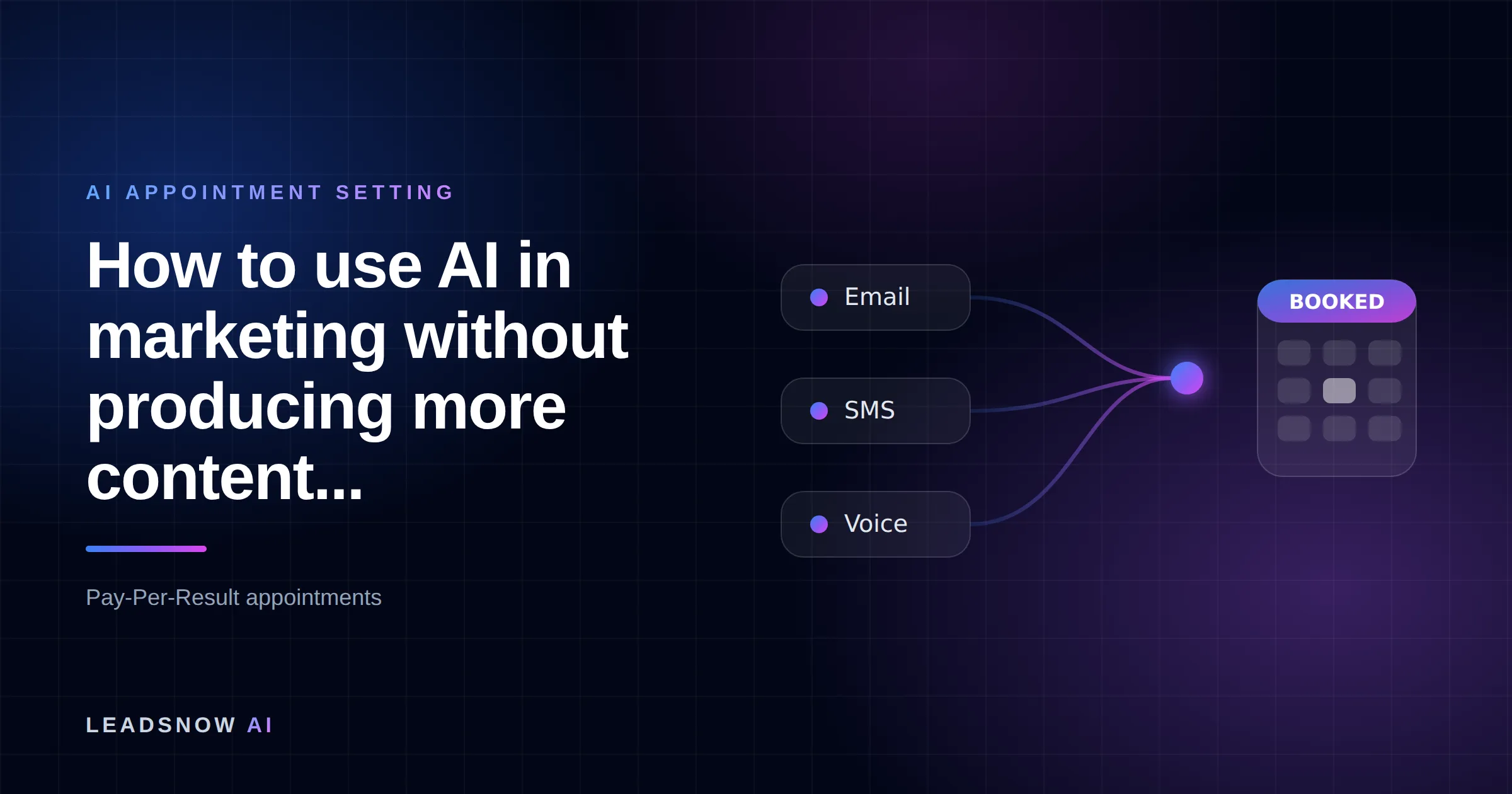
Use AI first on the jobs where a customer is already waiting — the first response to an enquiry, the follow-up nobody gets to, qualification before the calendar, and the reminder before the meeting. Content generation comes last. The odds of qualifying a web lead drop about 21 times between a five-minute and a thirty-minute callback (Lead Response Management, phone data).
At a glance
- The order: respond → follow up → qualify → remind → and only then produce.
- The metric: booked qualified conversations per 100 enquiries, which is contact rate × set rate. Name it before you switch anything on.
- The rule: the Waiting-Customer Rule — hand AI a job where a human is currently making someone wait, before a job where AI makes something new.
- What has done nothing for us: scaled content with no distribution plan, and on-page engagement widgets (our own test: 145 impressions, 1 start, 0 bookings).
- Floor to bother: roughly 40 inbound enquiries a month. Below that, one person with a phone beats every system described here.
How to use AI in marketing: the six jobs, ranked by what they move
Rank the jobs by the funnel stage they touch, not by how impressive the demo is. Jobs 1 to 4 move a stage you can count this month; 5 and 6 do not.
| Order | The job you hand over | Stage it moves | Effect, and whose number it is |
|---|---|---|---|
| 1 | First response to an inbound enquiry, in seconds, at any hour | Contact rate | Odds of qualifying a web lead drop about 21× between a 5-minute and a 30-minute callback (Lead Response Management study, 15,000+ web leads and 100,000+ call attempts — an old study, phone contact only). In our own client work, speed to lead alone is worth about 3×. |
| 2 | Persistent multi-touch follow-up across the whole list, for months | Contact rate | In our own client work, doubling contact rate is worth about 2×. It is also the job humans abandon first. |
| 3 | Qualification and routing before anything reaches a calendar | Set rate | In our own client work, doubling set rate is worth about 2× — it protects closers’ hours rather than filling them. |
| 4 | Reminder and confirmation cadence between booking and meeting | Show rate | Show rate varies by offer and reminder cadence — up to 93% on our best-performing accounts, and it costs almost nothing once jobs 1 to 3 exist. |
| 5 | Scaled content and page generation | Nothing you can count this quarter | Google’s own spam policy treats generating many pages without adding value as scaled content abuse. Volume is not the constraint; distribution is. |
| 6 | On-page engagement widgets (inline quizzes, chat bubbles on articles) | Nothing, in our data | Our own test, 2026-08-19 to 2026-09-03: 145 impressions, 1 start, 0 contacts, 0 bookings on content pages, against 126 / 46 / 22 / 8 on booking pages in the same window. |
How it works
Sequencing AI marketing work in the first 30 days
Count the waiting
Pull last month’s enquiry volume, contact rate and median time from form submission to first human contact. That last number is usually the business case.
Define qualified
Write qualified down as four testable fields, agreed with the sales manager. Nothing downstream works until this exists.
Hand over first response
Deploy instant first response on one form and one phone line only. Leave every other channel alone so the comparison stays clean.
Extend in order
Report contact rate and booked conversations per 100 enquiries against the prior month, then add follow-up, qualification and reminders. Content generation comes last.
MAKE MORE SALES.
Pay-Per-Result pricing — We scale sales HARD aligned to your interests, better than anyone else.
The Waiting-Customer Rule: hand over the jobs where someone is already waiting
Most AI marketing programmes start at job 5 because it is the easiest to buy and the easiest to show a board. The Waiting-Customer Rule inverts that: give AI a job where a human is currently making someone wait, before you give it a job where AI makes something new. A lead that filled in your form at 9:40pm is waiting. A blog post that does not exist is not.
Waiting is already costing you conversions you have paid for: you bought that enquiry with media spend, and a 30-minute delay writes most of it off before anyone has spoken. That is the mechanism behind increasing your speed-to-lead conversion rate, and behind automated lead follow-up for the records nobody reached on attempt one. Across those two jobs and the qualification layer on top of them, LeadsNow has delivered 50,769+ AI-booked sales appointments since 2017.
Want this done for you? We book qualified sales appointments on a Pay-Per-Result basis — you only pay for calls that actually land in your calendar.
What each job needs before you turn it on
Every job fails in a specific, predictable way. The precondition column is what prevents it; the volume column is the point below which automating it is not worth the build.
| Job | Don’t bother below | Precondition | Human checkpoint | How it goes wrong |
|---|---|---|---|---|
| Instant first response | ~40 enquiries/month | Form and phone feed one system within 60 seconds; one named owner of that inbox | Weekly read of 10 transcripts | The agent contacts someone a rep has already spoken to. Dedupe on phone and email, not email alone. |
| Long-tail follow-up | ~200 uncontacted records | A consent field and source per record; consent rules (Spam Act in Australia, TCPA in the US) apply to the machine exactly as to a rep | Opt-out audit monthly | Cadence is written for your convenience, not the buyer’s: five touches in two days, then silence. |
| Qualification before booking | ~100 leads/month | “Qualified” written down as four testable fields, agreed by sales, not marketing | Sales reviews rejected leads weekly | The definition lives in a slide, so the agent books anyone and the sales team stops trusting the calendar. |
| Reminder cadence | ~20 meetings/month | Booking system emits a real event the agent can hook | Monthly no-show review | Reminders fire at the wrong local time for a multi-state list. |
| Content generation | Never, without a distribution plan | A named channel and a person who owns the publish decision | Human edit before publish, always | Volume goes up, nothing downstream moves, and the team concludes AI does not work. |
If you cannot fill the precondition column for a job, you are not ready to automate it — you are ready to fix the data underneath it, usually a fortnight of unglamorous CRM work.
Which AI marketing use-cases measurably do nothing
Not a claim that they never work for anyone — this is the list where we hold numbers or a published policy, and the numbers are zero.
- On-page engagement widgets. We embedded a booking quiz inline on 86 content pages and measured it against the same quiz on our booking pages, 2026-08-19 to 2026-09-03, humans only, bots and test rows excluded. Content pages: 145 impressions, 1 start, 0 contacts, 0 bookings. Booking pages: 126 impressions, 46 starts, 22 contacts, 8 booked. We removed the widget.
- Content volume as a strategy. Generating pages faster does not create demand, and Google’s search spam policies explicitly name “using generative AI tools or other similar tools to generate many pages without adding value for users” as scaled content abuse. The constraint on content has never been production cost.
- Personalisation with no data behind it. Industry tokens on a list where the industry field is 40% empty produce personalised nonsense at scale. Fix the field, or send the plain version.
The honest read of our own failure: we did not measure a bad quiz, we measured a good quiz in the wrong place. Content pages sell the click; booking pages close.
If we can’t make you money, we don’t deserve yours.
Pay-Per-Result pricing — performance-based alignment.
What the top three levers are worth on 400 enquiries a month
Substitute your own numbers. A business taking 400 enquiries a month, contacting 30%, booking 20% of those contacted, holding 70% of bookings, closing 25% of held meetings at a $5,000 average deal:
- Today: 400 → 120 contacted → 24 booked → 17 held → 4.2 sales → about $21,000 a month.
- After jobs 1 and 2 take contact rate from 30% to 60%: 400 → 240 contacted → 48 booked → 34 held → 8.4 sales → about $42,000 a month.
- Add job 4 lifting show rate from 70% to 85%: 41 held → 10.2 sales → about $51,000 a month.
That is roughly 2.4×, not 12×. The multipliers we quote — about 3× for speed to lead, about 2× for doubling contact rate, about 2× for doubling set rate — do not multiply together, because they overlap: responding in seconds is one of the reasons contact rate doubles, so you count the stage once, not the lever three times. Anyone selling 12× has multiplied three measurements of one event. Our averages and their definitions — including that our median client outcome is closer to 4× than the 7× average — are on the LeadsNow methodology page.
“We have been told to do something with AI” — the first 30 days, in order
For a marketing manager with a mandate and no brief, the sequence that survives a budget review:
- Days 1–5: count the waiting — enquiries received last month, how many were contacted at all, and the median time from form submission to first human contact. That last number is usually the business case.
- Days 6–10: write the four-field definition of a qualified lead with the sales manager in the room. Nothing else works until this exists.
- Days 11–20: deploy job 1 on one channel only — one form, one phone line — and leave everything else alone so the comparison stays clean.
- Days 21–30: report contact rate and booked conversations per 100 enquiries for that one channel against the prior month, then extend to jobs 2 and 3.
Resist running five pilots at once: five simultaneous changes give you one unattributable number and no second round of funding.
Do it yourself, or hand it over: where the crossover sits
Jobs 1 to 4 are genuinely buildable in-house. The cost is not the licence, it is the maintenance: a response agent is a live operational system, not a campaign.
| Situation | Do it in-house | Hand it over |
|---|---|---|
| Under ~40 enquiries/month | Yes — a person and a phone, no system | No |
| 40–150 enquiries/month, someone owns ops | Yes — budget 30–60 hours to build, then 3–5 hours a week of transcript review, prompt fixes and CRM hygiene, indefinitely | Only if nobody owns that weekly time |
| 150+ enquiries/month, or multi-state hours, or a compliance review on every script | Only with a dedicated owner, not a side-of-desk one | Yes — this is where side-of-desk ownership breaks |
If you hand it over, the commercial model matters more than the vendor: ours is pay-per-result — 5–20% of the sales generated, or a fee per booked qualified appointment, rather than a retainer or per-seat licence. Jobs 1 to 4 as a service are described on our AI appointment setting and AI marketing services pages. We do not do brand strategy, creative direction or content marketing — jobs 5 and 6 are not our lane, and a vendor claiming all six should be asked which one they can show a number for.
Frequently asked questions
What is the first AI marketing use case that pays for itself?
Instant first response to inbound enquiries. It needs no new audience, no new creative and no new media spend — it converts leads you have already paid for. The Lead Response Management study, run on three years of data across six companies, 15,000+ web leads and 100,000+ call attempts, found the odds of qualifying a lead drop about 21 times between a 5-minute and a 30-minute callback. It is an old study and it measured phone contact only, but nothing since has reversed the direction.
How do I use AI in marketing if I have no budget for a new platform?
Start with measurement and definitions, which cost hours rather than licences: median time to first contact, contact rate, and a written four-field definition of a qualified lead. Most teams find a fixable routing problem before they spend anything, and every one of those three artefacts is required by whatever you buy later.
Should I use AI to write my marketing content?
For drafting, editing and reformatting work a human then owns, yes. For publishing volume, no: Google’s spam policies define scaled content abuse as generating many pages primarily to manipulate rankings rather than help users, and that judgement does not depend on whether a human or a model typed it. Publishing capacity has not been the bottleneck for a decade; distribution and demand are.
Does AI in marketing replace my marketing team?
It replaces the queue, not the team. The jobs it does well are the high-volume, low-judgement ones your team already does badly because there are too many of them — first response at 9:40pm, attempt seven of nine, reminder sequences. Positioning, offer design and segment choice stay human, and the systems get worse without them.
How long before an AI marketing job shows up in revenue?
Jobs 1 and 2 show up in contact rate within days, because contact rate is measured the moment a call connects; revenue follows at the speed of your sales cycle. Job 4 shows in show rate within a month. Job 5 does not report on a quarterly cycle at all, which is the real reason it should not be first.
Pay-Per-Result appointments
See if we’re a fit
We book qualified sales appointments for you and you pay on results, not retainers. Our booking page asks a few quick questions so you find out in two minutes whether that model suits your business.
- 50,769+ appointments booked without cold calling.
- Pay-Per-Result pricing — you pay for booked, qualified calls.
- Pick your own time on our live calendar, no phone tag.